
September 29, 2026
Commercial and Residential Cleaning in 2026
Compare commercial and residential cleaning markets in 2026. Explore pricing, staffing, compliance, and how AI estimators streamline operations.

Saturday, August 15, 2026
Discover how to calculate and reduce house cleaning customer churn with proven retention strategies for 2026.

A house cleaning business calculates customer churn by dividing lost recurring customers by the customers active at the start of the period, then multiplying by 100. A monthly loss of 5 customers from a starting base of 50 produces a 10% monthly churn rate.
That number can look manageable until you account for compounding. Residential cleaning businesses commonly report 20% to 35% annual churn, and many cancellations happen during the first 90 days, when expectations, scope, communication, and service quality haven't been aligned. Cleaning-business churn commentary highlights why the first few visits deserve more attention than most owners give them.
House cleaning customer churn isn't just a cancellation problem. It affects route density, replacement-sales pressure, staffing decisions, and the reliability of recurring revenue. An owner who measures churn monthly can identify whether clients are leaving because of service dissatisfaction, unclear estimates, price changes, life events, or a simple failure to rebook.
The formula is straightforward:
[
\text{Churn Rate}=\left(\frac{\text{Lost Customers}}{\text{Customers at Start of Period}}\right)\times 100
]
Suppose your business begins the month with 50 active recurring cleaning clients. During that month, 5 of those clients cancel their recurring plans.
[
(5 \div 50)\times 100=10%
]
Your monthly churn rate is 10%.
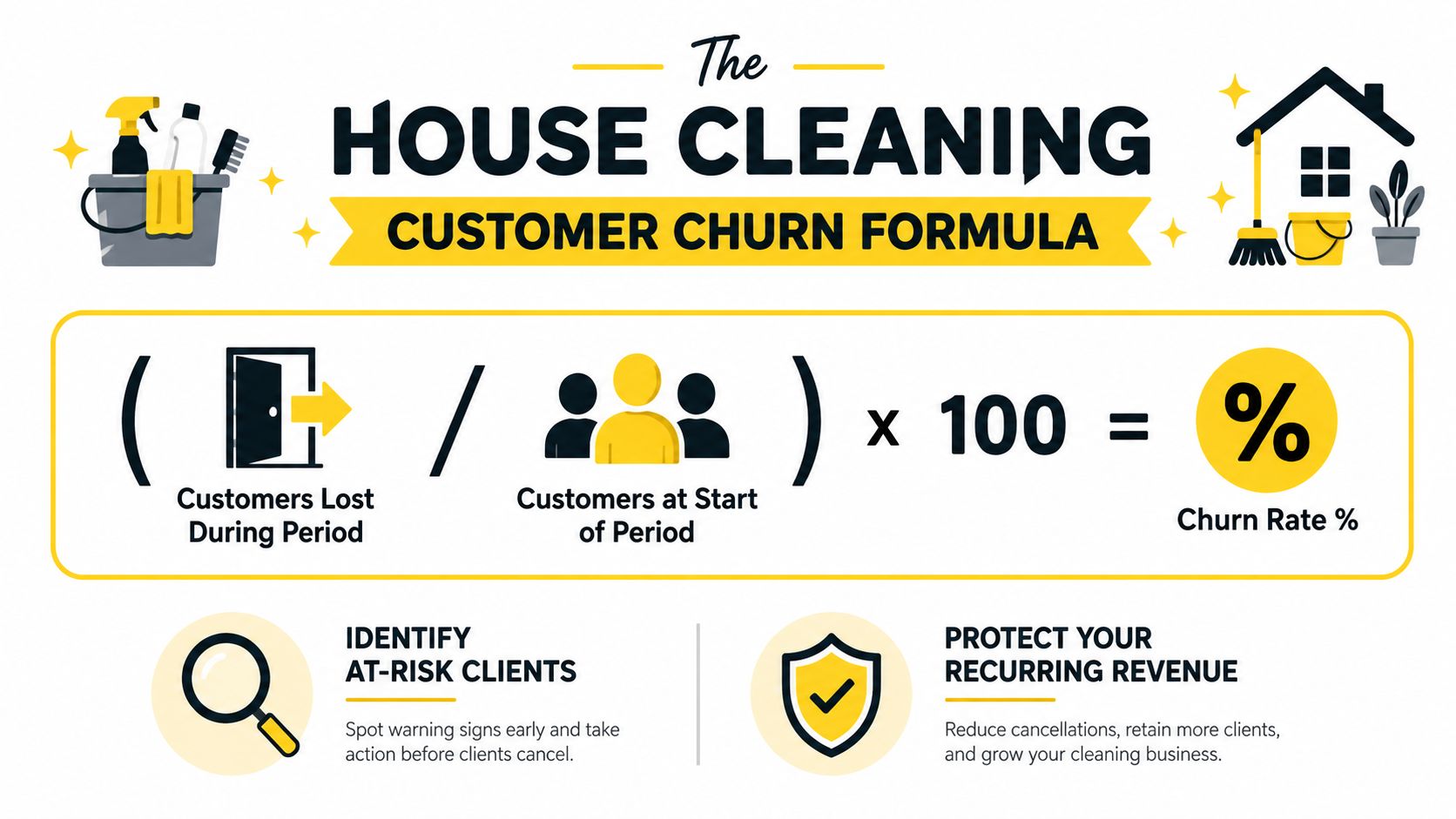
The denominator must contain only customers who were active on the first day of the measurement period. Don't add clients who booked after the month began. Those new accounts weren't exposed to the full period's cancellation risk, so including them makes churn look lower than it really was. Yotpo's churn-rate guidance also clarifies that customers acquired during the period should be excluded from both the numerator and denominator.
The lost-customer count should include recurring clients who canceled, failed to renew, or stopped doing business during that same period. One-time cleaning customers don't belong in a recurring churn calculation because they never entered a recurring relationship.
Practical rule: Calculate churn from the customers you had, not from the larger customer count you hope to have by month-end.
Run the calculation separately for weekly, bi-weekly, and monthly customers if your schedules behave differently. A blended figure is useful for a high-level review, but cohorts often reveal the core issue. For example, a new-client cohort may be leaving quickly while established customers remain stable.
A reliable churn process takes only a few minutes when your customer records are consistent. The important part isn't complex software. It's applying the same definitions every month.
Pick a calendar month or quarter and keep that timeframe consistent. Monthly measurement is standard for recurring-service businesses because it gives owners an early view of retention rather than forcing them to wait for an annual report. MetricGate's churn-rate documentation supports using a clearly defined period and comparing results consistently over time.
On the first day of the month, record every active recurring client. Include weekly, bi-weekly, and monthly clients whose service relationship is still open. Don't include prospects, one-time cleans, paused accounts you have formally excluded, or customers who canceled before the period began.
By the last day of the month, identify which clients from that starting list canceled or stopped booking entirely. A new client who signed up during the month doesn't belong in this count, even if they canceled quickly, because they weren't part of the opening population.
For bi-weekly service, formal cancellation isn't the only signal. If a client hasn't booked or communicated for 60 to 90 days past their normal cleaning date, count that account as lost under your defined inactivity rule. Subscription-style churn guidance explains the broader principle of treating customers as lapsed after a defined period without activity.
Divide the lost clients by the starting clients, then multiply by 100. If you started with 50 recurring clients and 5 canceled, the result is 10% monthly churn.
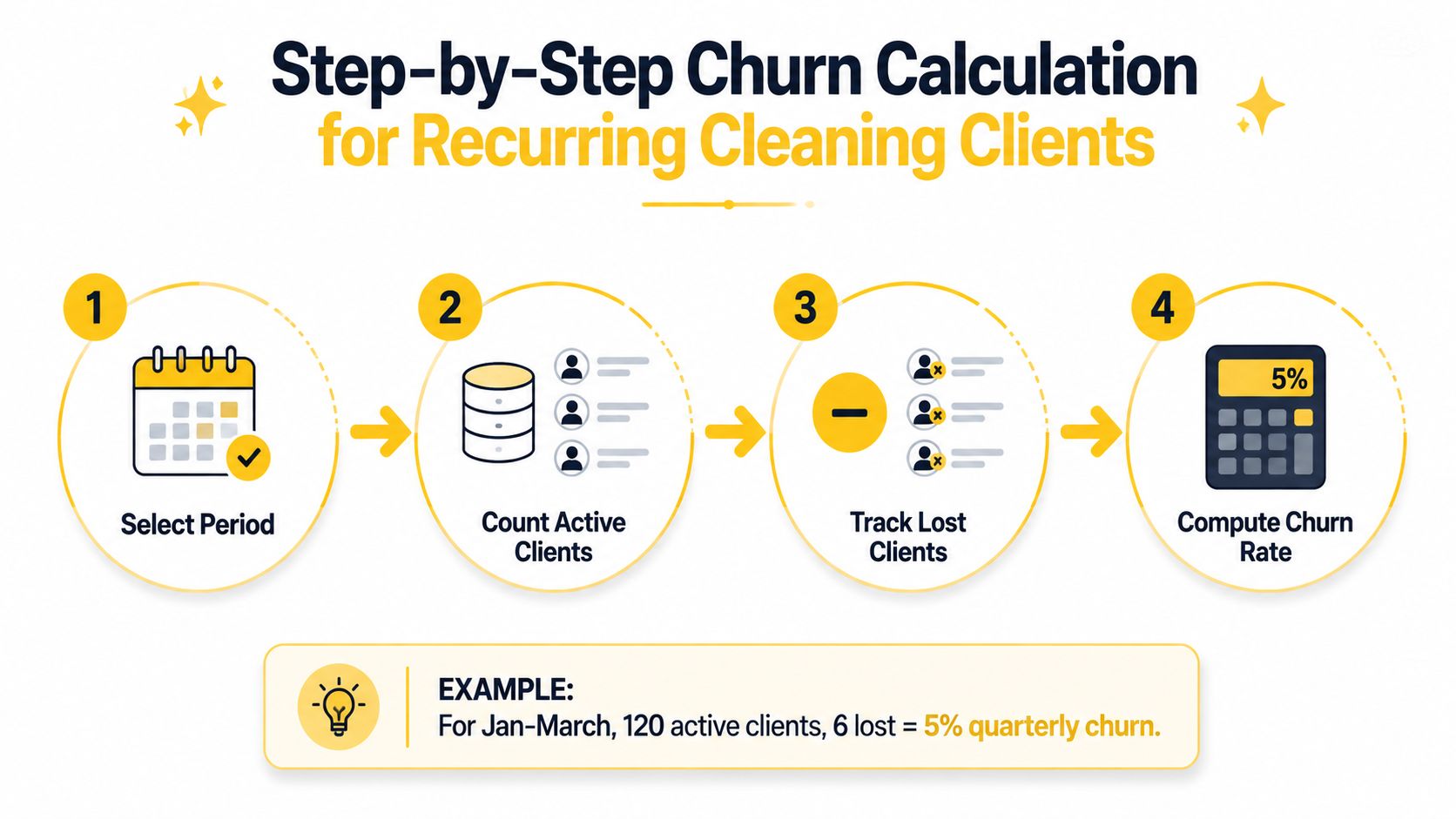
Record the result alongside the customer IDs, cancellation reasons, service cadence, signup date, assigned team, and last completed clean. The percentage tells you what happened. The supporting fields tell you what to fix.
Benchmarks help you decide whether a result deserves attention, but they aren't a substitute for clean internal data. Different operators define inactivity differently, and monthly and annual figures aren't interchangeable.
A 2026 cleaning-industry benchmark places healthy annual churn at about 5%, describes below 3% as excellent, and flags above 7% as critical. At a 7% annual churn rate, a company with 1,000 recurring clients would lose 63 accounts in a year. The benchmark source explains the retention implications for cleaning businesses, particularly the importance of onboarding, consistent quality, and reliable communication.
| Annual Churn Rate | 100 Clients Lost/Year | 500 Clients Lost/Year | 1000 Clients Lost/Year |
|---|---|---|---|
| 3% | 3 | 15 | 30 |
| 5% | 5 | 25 | 50 |
| 7% | 7 | 35 | 70 |
The table shows the arithmetic at the stated rates. The benchmark's specific example of 63 lost accounts at 7% with 1,000 recurring clients reflects the source's operating illustration, while a simple percentage table produces 70. That difference is a useful reminder to document whether you're using a rounded planning rate, an observed customer count, or a cohort-adjusted calculation.
Independent residential cleaning summaries commonly place monthly recurring churn around 2% to 4%. The same body of industry commentary describes annual recurring churn around 20% to 35%, with early departures concentrated in the first 90 days. Cleaning-business benchmark summaries show why owners should state the period and definition whenever they compare figures.
A business near 5% annual churn in one benchmark is preserving about 95% of its recurring base year over year. A business above 7% faces a much more urgent replacement burden, especially if new bookings merely replace canceled accounts instead of expanding the base.
Monthly churn is useful because it gives you an early warning. It can also mislead you when you read it as a series of isolated monthly events.
At 3% monthly churn, the loss compounds to about 30% annual churn. At 4% monthly churn, it compounds to nearly 39% annually. Cleaning-industry benchmark commentary uses this compounding math to show why apparently small monthly losses can create substantial annual revenue leakage.
A client who leaves in January doesn't return to the customer base for the February calculation. Each month's remaining base becomes the next month's starting point. That makes the difference between stable retention and repeated small losses much larger than a simple addition suggests.
One source reports recurring customer churn around 4.89% per month in December 2025, while other cleaning-business summaries cite annual churn bands of roughly 20% to 30%. MaidCentral's cleaning-industry statistics presents the monthly view, while the annual summaries use a different time horizon and may apply different definitions of inactive customers.
Those figures shouldn't be compared without checking the cohort, service cadence, and inactivity rule. A monthly rate can reflect a particular segment or season, while an annual band may aggregate customers across the full year.
Use monthly churn for intervention and annual churn for strategic planning. If the monthly figure rises, inspect cancellations before the pattern becomes embedded in your annual results.
The first few visits are where many cleaning relationships either become routine or begin to unravel. Residential recurring cleaning commentary places many departures in the first 90 days, especially when onboarding is weak or the client never receives a clear explanation of expected value. Industry guidance on cleaning-company onboarding and churn connects early cancellations with expectation problems rather than treating them as unavoidable price sensitivity.
Clients need to know what the initial clean includes, what it excludes, how long a first visit may differ from maintenance visits, how access works, and where to report concerns. If your estimate implies one scope and the crew delivers another, the cancellation may look like a price objection even though the failure happened before the first appointment.
Use a simple sequence:
The estimate is part of retention, not merely a sales document. Estimatty can standardize the information collected before booking, but the owner still needs to make the service boundaries clear and ensure the field team follows them.
Appointment reminders also protect the early relationship by reducing missed visits and uncertainty. A practical appointment reminder email template can help you keep the first communication touchpoints consistent without making every employee write messages from scratch.
Retention improves when you remove the reasons clients have to reconsider the relationship. Discounts alone rarely solve unclear scope, missed communication, inconsistent arrival patterns, or a quality issue that nobody acknowledges.
Send a written confirmation before the first visit and after any material change. List rooms, surfaces, add-ons, exclusions, access instructions, and the recurring cadence. When a client asks for extra work, document whether it belongs in the existing estimate or requires a revised estimate.
Don't wait until a client remembers to contact you. Confirm the next appointment before the current visit is complete, send a reminder at the agreed cadence, and flag accounts that haven't responded. A pause isn't necessarily dissatisfaction, but silence needs an owner and a follow-up date.
A low satisfaction response should create a task, not disappear into a spreadsheet. Assign the issue, contact the client, inspect the relevant service notes, and record whether the resolution restored the account. Formal feedback is valuable only when someone acts on it.
For a broader retention framework covering follow-up, communication, and intervention practices, these actionable churn reduction tips offer useful ideas that can be adapted to residential cleaning.
Track cancellation reasons using practical categories:
Owners often waste time sending discounts to customers who wanted a reliable response or a corrected cleaning issue. Better customer engagement practices help connect each client touchpoint to a clear operational action.
A useful feedback system is short, timed, and connected to the work. Long surveys sent too often create fatigue and produce less useful information than a focused question delivered soon after service.
Cleaning-industry satisfaction guidance recommends structured surveys using 1–5 or 1–4 scales, keeping them under 10 questions, and checking in with new clients after a few weeks. CleanLink's survey guidance also recommends limiting formal surveys for ongoing clients to two or three times per year.
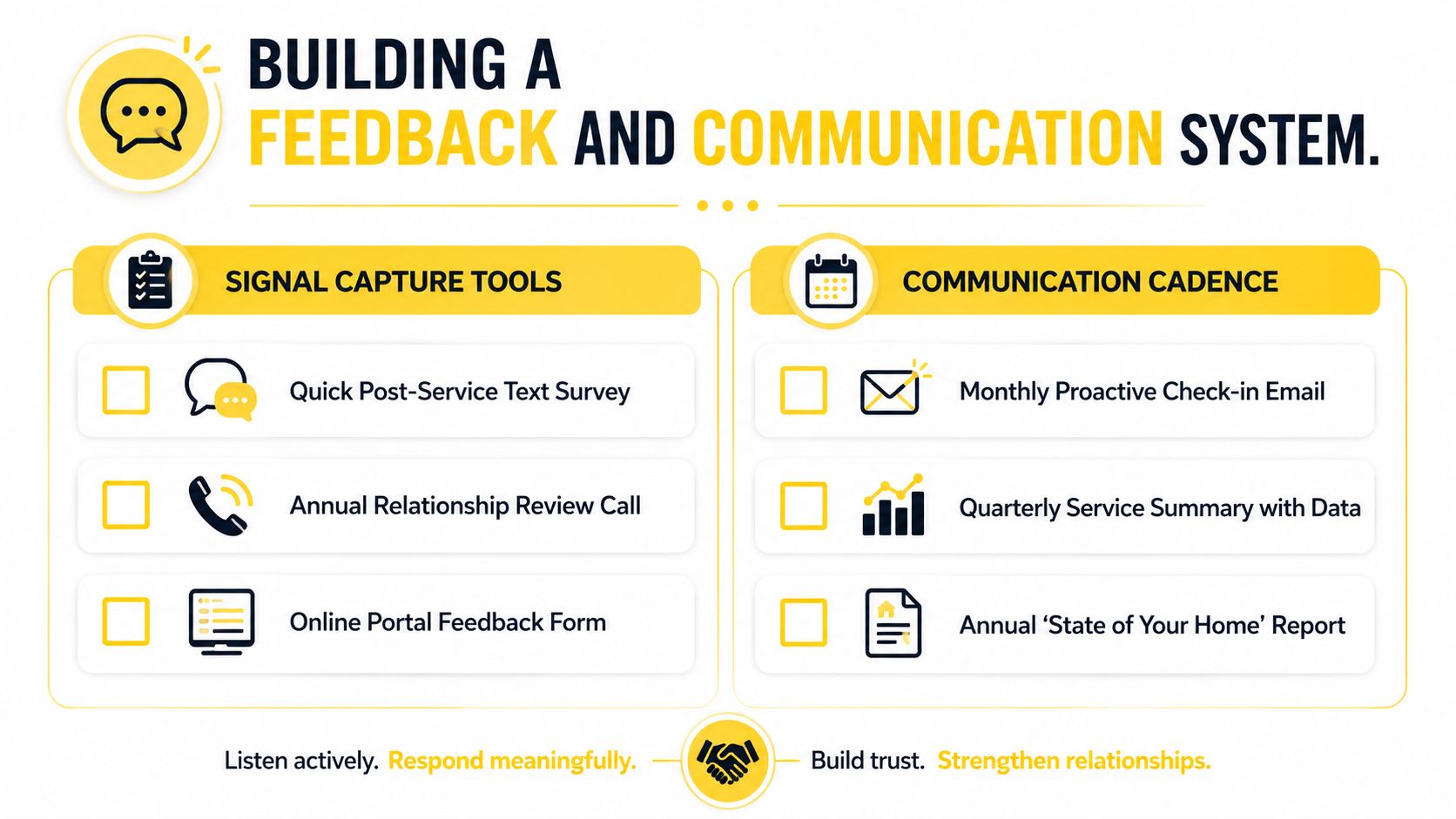
After the first clean, ask whether the result matched expectations. After a complaint, ask whether the resolution addressed it. For established clients, use periodic relationship reviews rather than asking the same broad satisfaction question after every visit.
Track more than survey scores. A client who stops replying, reschedules repeatedly, delays payment, or asks about cancellation may be showing risk before they state it directly. Pair those signals with the service history and the assigned cleaner's notes.
Every negative or deteriorating response needs a named owner, deadline, and resolution code. A quality-assurance process that records the issue, correction, and follow-up keeps feedback connected to service delivery. Cleaning quality-assurance guidance provides a useful model for linking client feedback with repeatable inspection and follow-up practices.
Churn belongs in the same monthly review as active recurring clients, completed visits, new bookings, and revenue. If cancellations stay in a notes app or inside individual text threads, the owner can't distinguish a temporary spike from a recurring operating defect.
The most useful review doesn't ask only, “How many clients left?” It asks which cohort left, how long they had been customers, which team served them, what reason they gave, and whether the business had a chance to intervene earlier.
Review the opening customer count, lost customers, calculated rate, and cancellation reasons every month. Compare the result with your own historical pattern and the relevant benchmark, but don't change definitions from one period to the next to make performance look better.
A churn KPI becomes valuable when it changes decisions. Rising early-tenure losses may justify better onboarding. Team-specific complaints may point to quality control or training. Silent lapses may require stronger rebooking and reminder workflows.
Owner's perspective: Cancellations aren't random once you record the conditions surrounding them.
Written procedures make these responses repeatable across teams. A policies and procedures manual can document scope confirmation, complaint handling, inspection standards, follow-up ownership, and escalation rules. If staffing growth is creating inconsistent service, owners can also review hiring resources from pipehirehrm.com as part of a broader operations plan.
Use this checklist at the same point every month:
Use data collection software if manual records are causing missing dates, duplicate accounts, or inconsistent cancellation labels. The tool matters less than preserving the same starting-base rule every period.
Not automatically. Define a pause status with a follow-up date. Count the client as lost only when they cancel, fail to resume under your documented inactivity rule, or otherwise stop doing business.
No. House cleaning customer churn should measure recurring relationships. Track one-time clients separately as a conversion or repeat-booking metric.
Compare similar periods when possible and annotate unusual scheduling conditions. Don't change the churn definition because demand or household routines changed.
A spreadsheet can work if it stores the opening status, service cadence, last completed clean, cancellation date, reason, and follow-up action. Owners who want more guidance on estimates and booking workflows can explore the Estimatty blog.
Estimatty helps cleaning businesses collect consistent service details, deliver estimates by SMS or email, and support follow-up workflows that reduce missed opportunities and expectation gaps. Visit Estimatty to see how a 24/7 web and voice estimator can support better booking consistency and a stronger retention process.