
September 29, 2026
Commercial and Residential Cleaning in 2026
Compare commercial and residential cleaning markets in 2026. Explore pricing, staffing, compliance, and how AI estimators streamline operations.

Wednesday, August 12, 2026
Discover how field service mobile software transforms cleaning operations. Learn key features, ROI metrics, and how Estimatty complements your mobile tools.
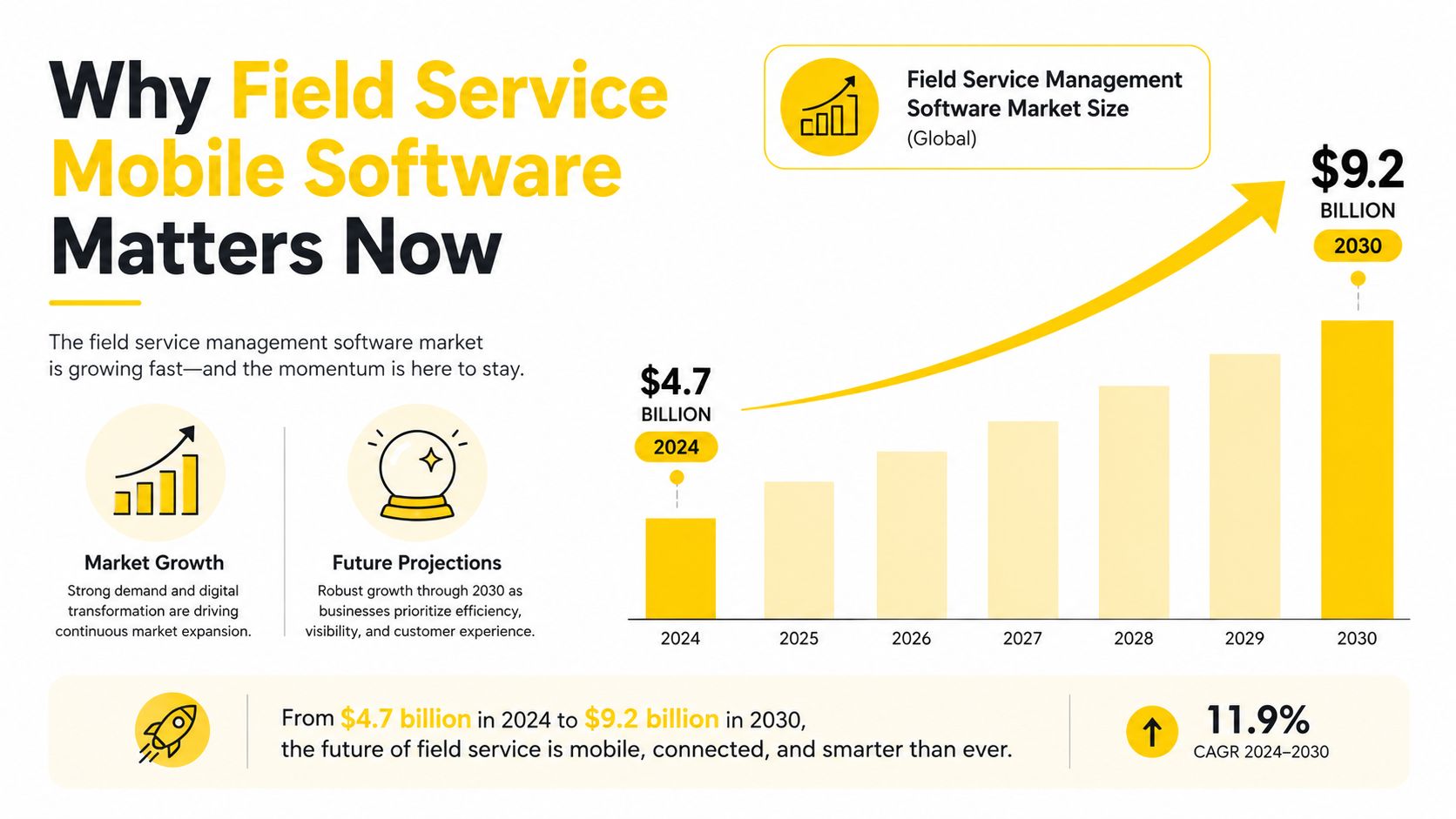
The field service management software market is no longer a side category. Verdantix values it at $4.7 billion in 2024 and expects it to reach $9.2 billion by 2030, which is a serious signal that service businesses are moving off paper, out of spreadsheets, and into mobile workflows that hold up in the field. For cleaning businesses, that shift matters because the gap between “we got the job” and “we completed the job cleanly, documented it, and billed it fast” has become a technology problem as much as an operations problem. Estimatty's service business software guide fits into that same broader shift toward connected service operations.
Cleaning owners feel the pressure in everyday ways. Customers want fast updates, clear arrival windows, job photos, and answers without phone tag. Crews need the address, scope, and special instructions on their phones before they drive out, not after they've already knocked on the door.
Paper forms and manual scheduling still work until the day they don't. A missed note, a late reschedule, or a forgotten add-on service can turn a profitable visit into a margin leak. That's why field service mobile software has become a practical necessity, not a nice-to-have.
The market growth tells you something important, but the day-to-day pressure tells you even more. Verdantix puts the FSM software market at $4.7 billion in 2024 with a path to $9.2 billion by 2030, and other trackers sit in a similar band, including Grand View Research at $6.1 billion in 2025 rising to $13.8 billion by 2033 and Fortune Business Insights at $5.37 billion in 2025 reaching $13.79 billion by 2034. That consistency points to broad adoption across service industries, not a temporary software fad.
For cleaning businesses, the change is simple. Customers no longer accept fragmented communication, and crews can't afford to wait for the office to relaunch a schedule by text, email, or voicemail. They expect the kind of service flow where the office sees what the field sees, and the field sees what the office promised.
A cleaner with a clipboard can still complete jobs. The problem is everything around the job, including updates, proof of work, recurring visits, and billing handoffs. When those steps stay manual, the business spends more time coordinating than cleaning.
That's where mobile service tools pull ahead. They give the office and the crew a shared operational record, which means fewer misunderstandings about recurring clients, scope changes, and special instructions. The more complex the route, the more painful the old way becomes.
Practical rule: if your team has to call the office for every detail, the software isn't supporting the work, it's delaying it.
The cleaning industry feels this especially in commercial work, where multiple crews, locked buildings, and recurring schedules leave very little room for confusion. A mobile system doesn't just reduce admin load. It helps keep the service promise intact when the day gets busy.
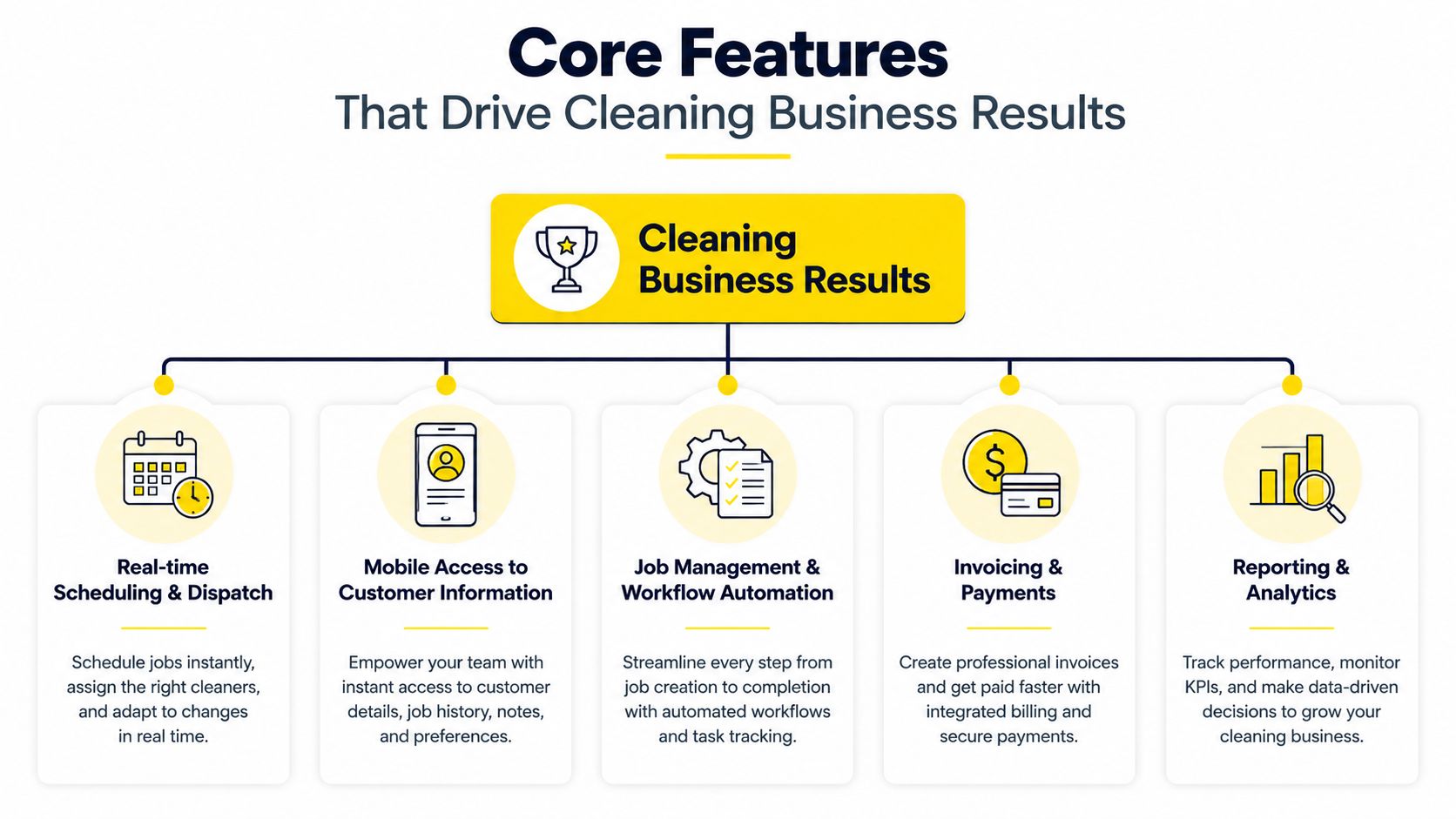
The feature list looks crowded until you separate what matters from what only looks good in a demo. Gartner's FSM definition points to real-time visibility, workforce management, customer information access, time tracking, and offline mode as standard mobile capabilities, plus two-way communication among dispatchers, customers, and technicians, with access to GPS location, work scope, warranty coverage, equipment history, and parts availability. For cleaning businesses, that translates into a smaller set of features that carry most of the weight.
Dispatch and scheduling need to be live, not static. If a recurring residential client moves a visit or a commercial site adds a post-construction pass, the office should be able to update the job once and push it out to the crew without a chain of texts.
Customer history matters just as much. A technician who can see the last service notes, special products, or recurring complaints walks in prepared. That's a real customer experience advantage, not just a convenience.
Job completion workflows, time tracking, and photo documentation close the loop. Cleaning businesses rely on visible proof, especially for turnovers, deep cleans, and quality disputes. If the app makes it easy to capture before-and-after photos, notes, and signoff, the office spends less time defending completed work.
A good mobile workflow should make the right thing the easy thing. If crews have to fight the app to upload evidence or close a job, they'll skip steps.
Invoicing and payments are not glamorous, but they decide how fast you get paid. Reporting also matters because owners need to spot repeated issues, slow jobs, and underpriced service lines. One platform may look slick on the surface, but if it can't support clean handoffs from field completion to billing, it's only solving part of the problem.
For cleaning teams comparing vendors, scheduling software for cleaning businesses is worth reviewing alongside mobile functionality because the schedule is where most operational failures start.
Offline mode is often marketed as a simple feature, but in the field, it becomes a true test of its capabilities. Microsoft documents offline-capable field service mobile workflows that enable workers to continue viewing work orders, updating task status, capturing notes, photos, and signatures, then synchronize once connectivity returns. Salesforce and ServiceNow document similar behavior. The key question isn't whether offline exists, it's whether it survives actual low-signal work.
Cleaning crews don't only work in offices with good Wi-Fi. They work in basements, stairwells, rural routes, back rooms, and industrial sites where signal drops without warning. If the app falls apart there, the office loses visibility and the crew loses momentum.
The first test is data scope. Which records are cached on the device, and which ones disappear when the connection drops? If the crew can't access the customer profile, job notes, and checklist while offline, the app isn't ready for field work.
The second test is sync behavior. When a technician updates a job offline and then reconnects later, does the platform preserve the record cleanly, or does it create confusion? That matters most for photos, signatures, inventory updates, and notes, because those are the details that often break first.
The third test is recovery. If two people touch the same job while one device is offline, what happens when the devices reconnect? A platform that handles conflicts poorly can create more cleanup work than it saves.
My rule after testing multiple systems: I'd rather use a simpler app with reliable sync than a feature-heavy one that loses evidence or corrupts job notes after a dead-zone shift.
Offline-first reliability is the standard here. A mobile app that only works when the connection is strong is not built for the places where cleaning crews earn their keep.
Field service mobile software handles the work after the sale, but the customer journey starts earlier. Cleaning businesses lose money when estimating, booking, scheduling, and dispatch sit in separate systems that don't hand off cleanly. That's why a mobile field stack works best when it connects to pre-sale tools like Exayard AI estimating software, which is built to capture leads and estimates before the job ever reaches the schedule.
In a cleaning operation, that handoff matters. A prospect sends a request, gets an estimate, books, and then the field team needs the same details in the mobile app without retyping them. If the estimate already includes square footage, surfaces, urgency, and service notes, dispatch can schedule with far less friction.
Estimatty's workflow is a useful example because it sends instant estimates by SMS and email, captures the core details through the Matty agent, and creates a structured intake path that can feed the rest of the operation. The point isn't the branding. The point is that the office doesn't have to rebuild the job after the customer already requested service.
That same logic applies once the job is won. AI estimates software for cleaning businesses is most useful when it doesn't stop at pricing. It should create a clean transition into scheduling, dispatch, and field execution.
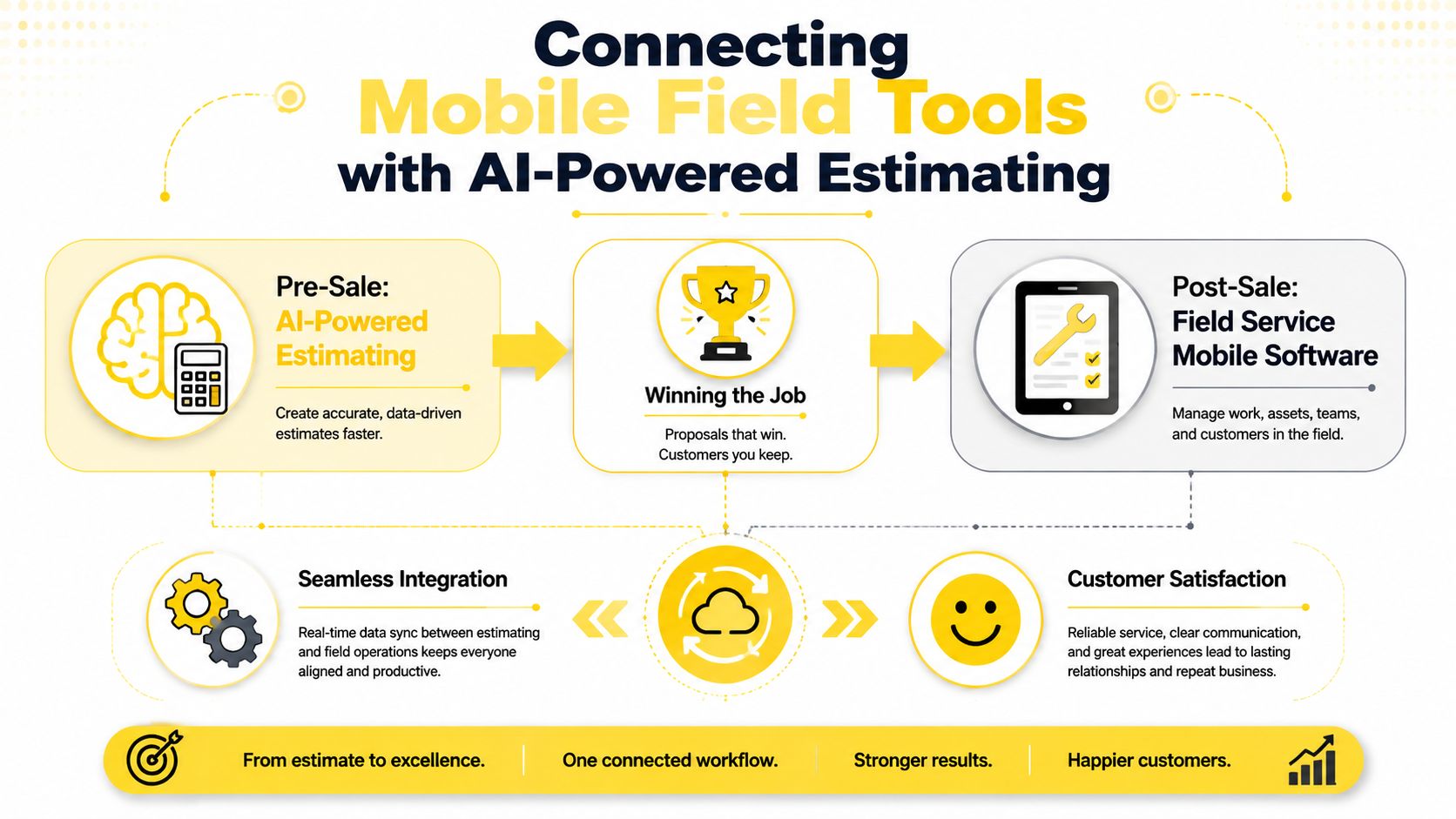
When that connection works, the office sees the estimate, the job, and the crew assignment as one chain instead of three disconnected tasks. Customers feel it too, because they're not repeating the same details every time they interact with the business.
The productivity case for mobile tools is hard to ignore. One field-service roundup reports that 93% of service organizations saw increased productivity after implementing mobile solutions, and technicians using mobile apps completed an average of 2.3 additional jobs per day than those using paper-based systems. Mobile-first field service operations have also been associated with 25% higher technician productivity and 20% faster service resolution in a Field Service News-citing analysis.
Those numbers matter in cleaning because small efficiency gains stack quickly across recurring routes. If a crew finishes jobs faster, you can fit more work into the same day without adding truck rolls or extending office hours. If the office spends less time chasing paperwork, billing moves faster and the schedule gets cleaner the next morning.
A cleaning business should read those figures as indicators of throughput, not just software performance. More jobs per day means less idle time between stops. Faster resolution means fewer callbacks, which keeps crews from getting pulled back to fix avoidable mistakes.
SightCall reports a median first-time fix rate of 71.9% across industries, and implementation data also shows a 31% increase in first-time fix rate, a 32% increase in mobile worker productivity, and a 26% reduction in truck rolls where field service automation is in place. Those are strong signs that the combination of better information, better timing, and better job records reduces waste across the board.
Owners don't need perfect precision to make the call. If crews are losing time to paper, duplicate entry, or missing job details, mobile software usually pays for itself in rescued labor.
For practical finance tracking, time and attendance software for cleaning teams can complement the field app by making labor visibility tighter at the crew level.
A solo cleaner doesn't need the same rollout plan as a franchise, and pretending otherwise causes adoption problems. The right setup depends on how many jobs move through the business, how much recurring work exists, and whether the office is one person or several.
A solo residential cleaner usually feels the biggest pain around scheduling consistency and no-shows. Mobile software helps most when it gives that owner a live calendar, customer notes, and a simple way to confirm appointments without bouncing between texts and paper. The rollout should be light, with only the core job data turned on at first.
A small team moving from three cleaners to eight usually hits a different wall. At that stage, the issue is coordination. One dispatcher can't keep the whole operation in their head anymore, so the software needs to standardize job instructions, capture completion notes, and keep everyone aligned when one crew gets delayed.
Multi-location brands have the hardest integration job because every market has its own habits. The platform has to keep service quality aligned while allowing local dispatching and customer communication to stay responsive.
A useful reference point for back-office coordination is job management software for cleaning businesses, especially when the business needs one source of truth across estimating, scheduling, and completion.
A demo can make almost any platform look capable. The true test is whether it fits your cleaning operation without forcing you to rebuild the business around the software. Start by separating must-haves from nice-to-haves.
Pricing deserves a close look too. The cheapest platform can become the most expensive one if it causes billing delays, missed jobs, or weak adoption in the field. I'd also watch for generic features that sound impressive but don't solve cleaning-specific work, especially if the vendor can't explain how recurring clients, add-on services, and photo-heavy proof-of-work flow through the app.
If the platform doesn't make your crew faster, your office calmer, and your invoices cleaner, it's the wrong fit.
The right field service mobile software should support the way cleaning businesses really operate. If your current system still depends on paper forms, scattered texts, and memory, it's time to tighten the loop from estimate to dispatch to completion.
If you want a cleaner handoff from lead capture to scheduling to job execution, Estimatty is built to deliver instant estimates, capture job details, and keep your team aligned before the crew ever leaves the shop. Visit Estimatty to see how it fits into a mobile-first cleaning workflow.