October 23, 2026
How to Start Commercial Cleaning in 2026
Learn how to start commercial cleaning in 2026 with proven steps for pricing, staffing, licensing, and automation that win recurring contracts.

Friday, September 4, 2026
Compare 10 Connecteam alternative tools for cleaning businesses by features, pricing, use cases, pros, cons, migration needs, and Estimatty fit.

The wrong way to pick a Connecteam alternative is to ask which app has the longest feature list. Cleaning businesses don't lose time because they lack another all-in-one platform, they lose time because one bottleneck keeps breaking the workflow. A solo cleaner may need low-friction scheduling, a growing residential operator may need booking-to-payment flow, and a commercial janitorial company may need location-based timekeeping and inspections.
That's why the best replacement depends on the constraint you're trying to remove. Homebase and Sling fit lean crews that need fast scheduling and attendance control, When I Work fits managers who want approachable multi-location scheduling, Deputy fits compliance-heavy operations, QuickBooks Time fits teams already living in QuickBooks, Jobber and Housecall Pro fit broader field service, ZenMaid fits maid-service workflows, Launch27 fits online booking, and Swept fits commercial janitorial control. Pricing should be verified on each vendor's current plans before you publish or sign, because package names and bundles can change.
Keep one distinction clear. Workforce management software runs schedules, clock-ins, messages, payroll handoffs, and inspections. Estimatty handles 24/7 estimates, prospect conversations, SMS and email delivery, notifications, and no-code setup, so it complements operations software when your bigger leak is missed leads and slow response time. If your cleaning company needs to fix both sides of the funnel, start by fixing hidden workflow constraints, then decide whether you need a scheduler, a field-service system, or an estimate engine.
Homebase is the cleanest starting point for small cleaning crews that need scheduling, time tracking, and team communication without a long implementation. Its position in the market makes sense, because per-location pricing can work well for a small operation, while the built-in payroll option helps reduce double entry between approved time and pay runs. The trade-off is simple, once you add more locations, the bill can climb faster than a per-user tool.
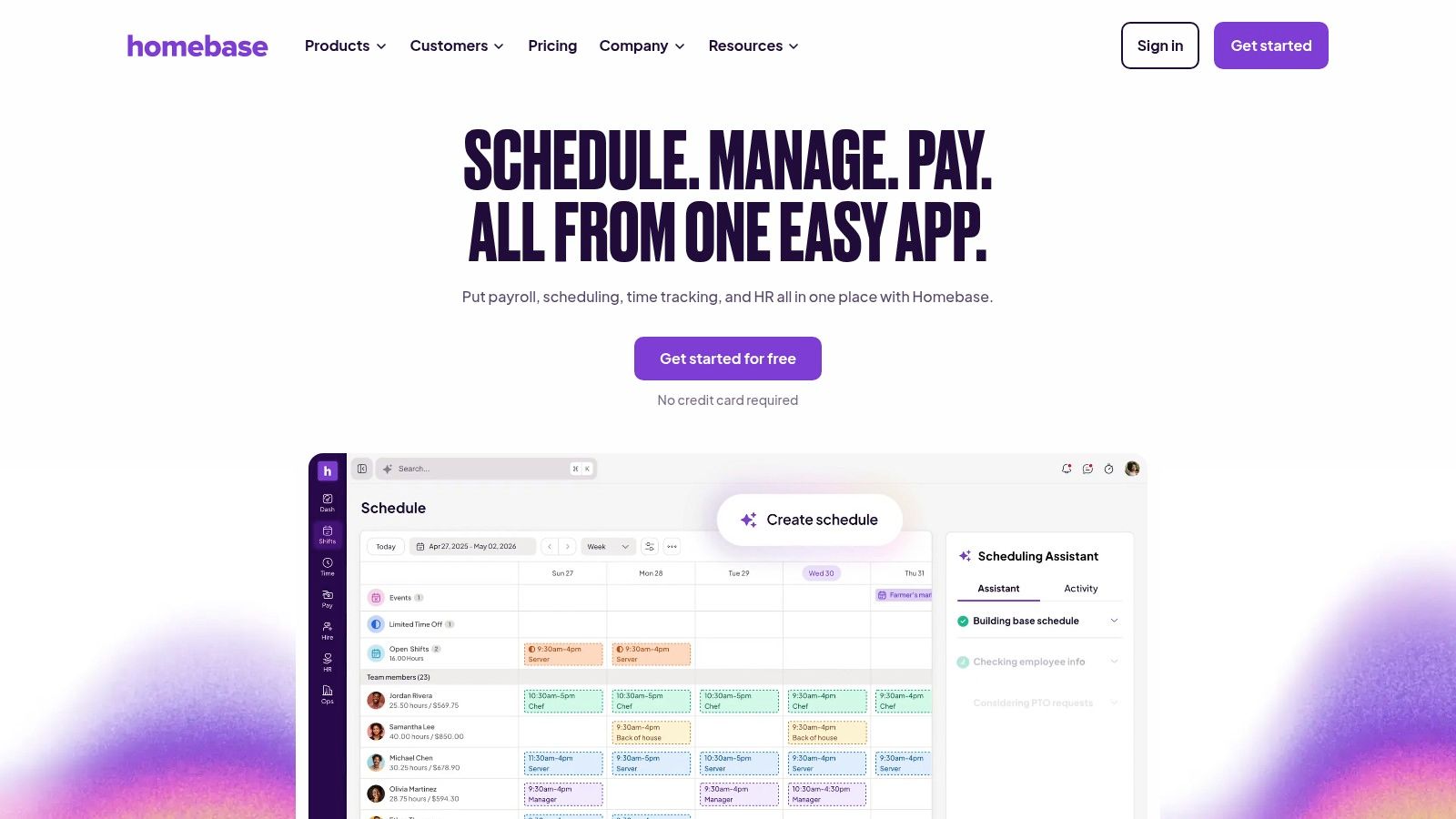
Homebase gives you drag-and-drop scheduling, sales and labor forecasting, mobile time clocking with GPS and photo capture, and team messaging inside the same app. That combination works for a cleaning owner who needs to publish schedules quickly, approve time fast, and keep shift notes in one place. The optional payroll add-on with full tax filings is useful if you want one system to carry hours all the way into pay.
Practical rule: pick Homebase when you want scheduling and payroll adjacency, not deep operations complexity.
It's also easy for non-technical owners to roll out, which matters more than flashy features in a cleaning business. If your crew is small, mobile, and mostly hourly, the learning curve stays low and the system feels familiar within days.
The main downside is per-location pricing for multi-site teams. If you run several houses, routes, or satellite crews, you'll want to confirm whether the pricing matches your staffing pattern before you migrate. Advanced analytics and controls also sit higher in the stack, so owners who want more detail will need to budget accordingly.
For a small business that wants a simple time clock reference, the internal comparison at Estimatty's best time clock guide is a useful companion before making the jump.
When I Work makes sense when you want a cleaner interface than a heavier workforce suite and you're managing multiple locations. It is built around scheduling, time and attendance, and messaging, so it fits a cleaning company that needs dependable shift coordination without a giant admin burden. For owners who hate cluttered dashboards, that matters.
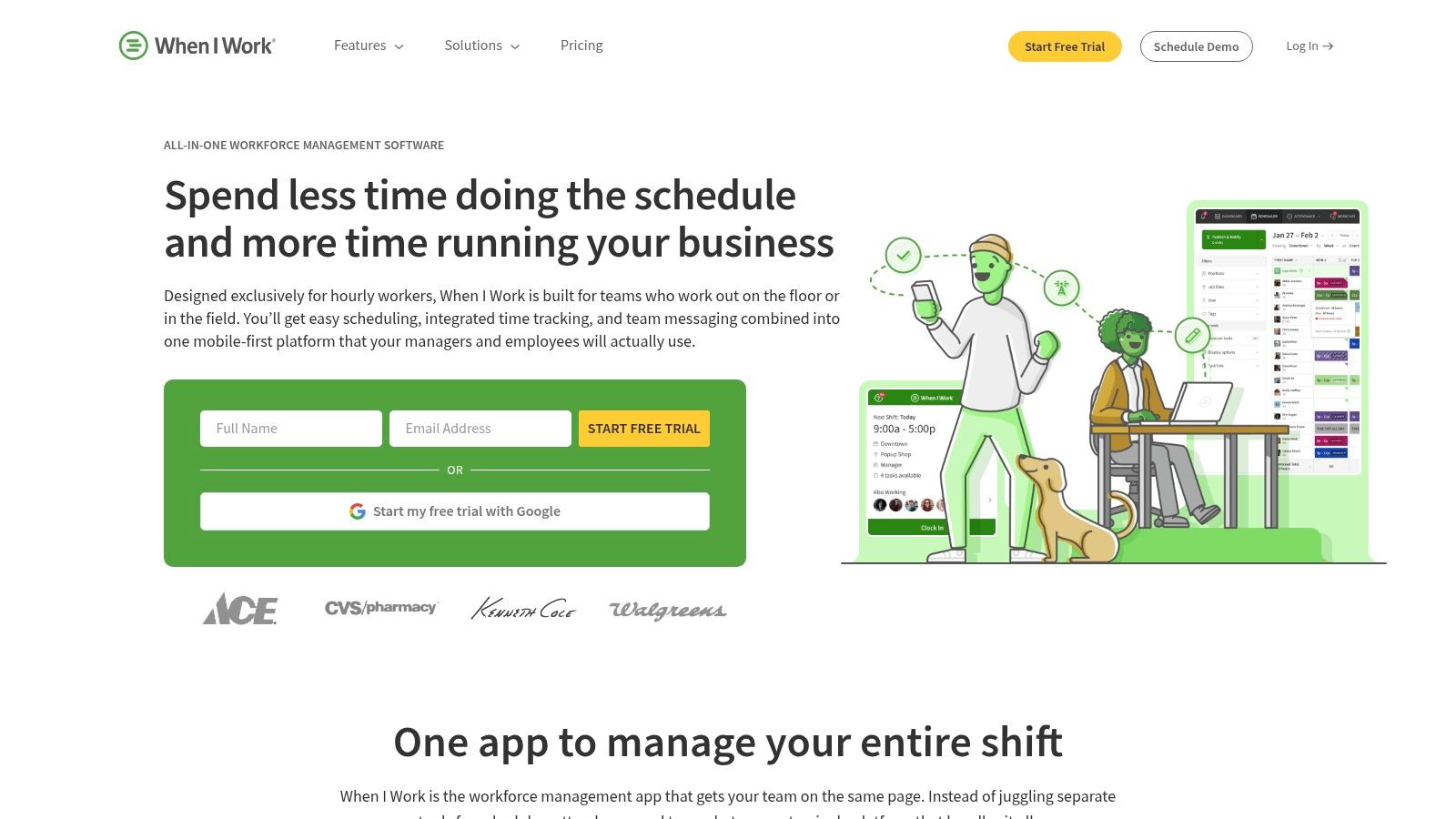
The platform centers on employee scheduling, forecasting, templates, and a mobile time clock with GPS, geofence, and PTO or availability requests. Messaging lives inside the scheduler, so dispatchers and cleaners don't need to bounce between tools to answer shift questions. Higher tiers add SSO, API, and webhooks, which helps once you start connecting it to other systems.
That structure is especially useful for cleaning businesses that grow from one crew to several routes or buildings. Managers can learn it fast, employees can check shifts without training drama, and the workflow stays understandable.
When I Work's per-user pricing can be a clean fit for moderate team sizes, especially when your staff count is stable. But if you add a lot of part-time cleaners, seasonal help, or supervisors, you should test the total cost before committing. The tool is approachable, not overbuilt, and that's exactly why many small and mid-sized operators prefer it.
Direct call: choose When I Work if you want multi-location scheduling that your team will actually open and use.
If you're comparing it against a booking-focused system, the scheduling layer is strong, but it doesn't replace Estimatty's estimate capture, SMS/email delivery, and lead conversion flow. The scheduling path and the estimate path solve different problems.
Deputy is the right move when compliance starts to matter more than convenience. Cleaning businesses with larger headcounts, mixed shift types, or multi-site operations need break management, leave tracking, and payroll integrations that don't fall apart under pressure. Deputy is built for that kind of discipline.
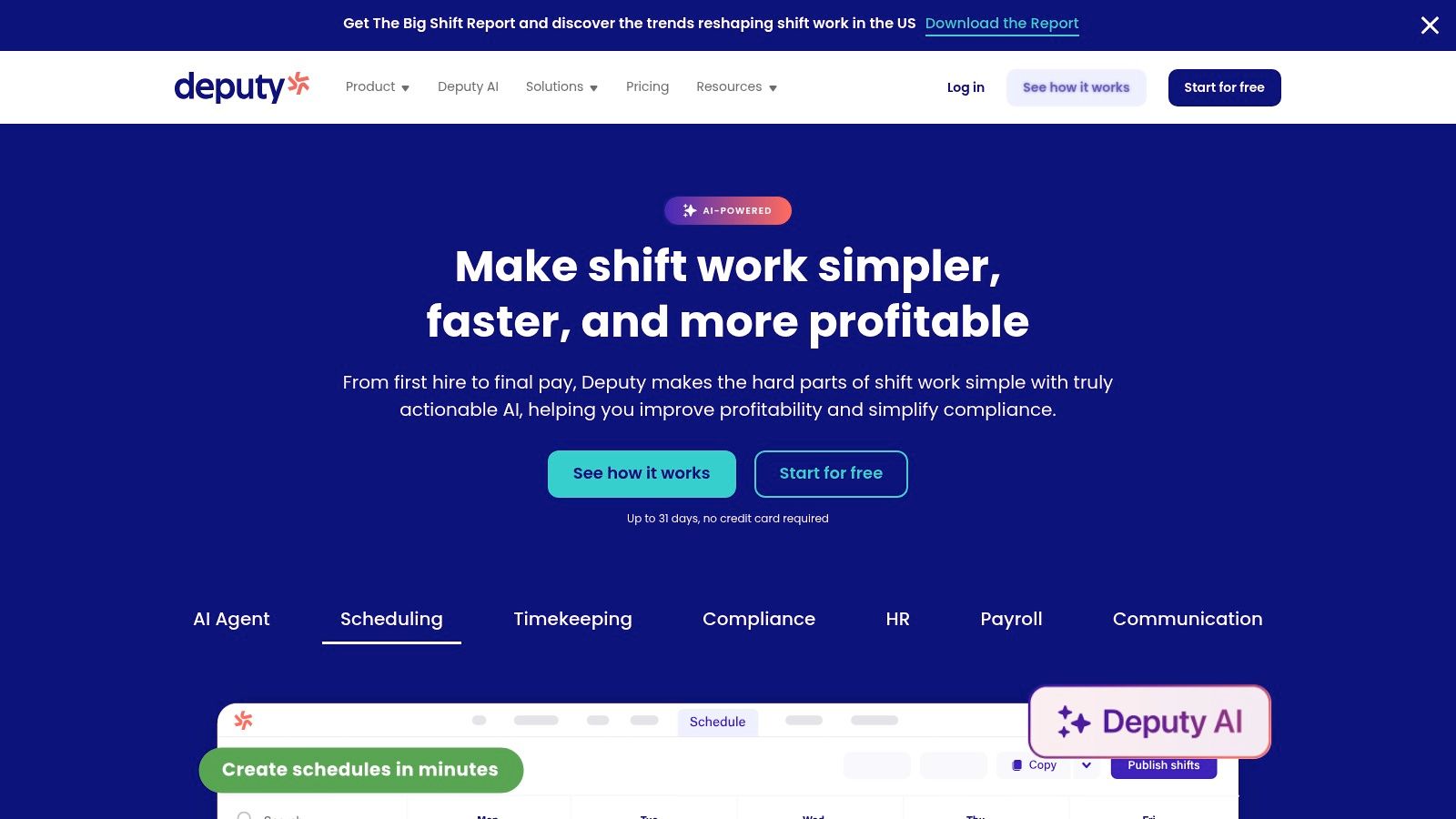
Deputy's scheduling engine handles shifts, swaps, and offers, while its time clock works across mobile, tablet, web, and watch. Break-compliance prompts and flags are the headline reason to consider it, especially if your cleaning operation spans locations with different labor expectations. Integrations with ADP, Gusto, QuickBooks, and Xero give payroll teams a cleaner handoff.
That makes it a serious option for owners who don't want timekeeping errors to become payroll disputes. It also scales from a small operation to a multi-site enterprise without forcing the manager back to spreadsheets.
Deputy is stronger and more structured than a basic scheduler, but that also means the price can stack up as headcount grows. Deeper reporting customizations may require exports or add-ons, so owners who want highly custom analytics should plan for that early. It's a compliance tool first, not a lead-response tool.
For teams standardizing time and attendance, the time and attendance software guide is the best internal reference to compare the category before you commit.
Sling is the low-friction pick for owners who want a lean scheduling and time tracking system with a sensible free entry point. If your cleaning company is still small, or you run several crews but don't want a bulky admin stack, Sling is easy to roll out and easy to keep. It stays focused on basics, which is exactly why some operators like it.
The free scheduling tier covers up to 30 users, and the premium layers add mobile time tracking, labor and overtime cost tracking, announcements, a kiosk time clock, PTO, and payroll reports. The pricing model is clear, and the annual billing policy that charges only for active users helps reduce waste. For a cleaning business with fluctuating seasonal labor, that's a meaningful advantage.
A simple schedule beats a complicated system nobody opens.
Sling works well for independent owners, small teams, and multi-crew businesses that need a shared operating rhythm. It isn't trying to be a full workforce suite, and that restraint keeps adoption easier.
The limitation is depth. You won't get the same HR, compliance, or reporting weight that larger workforce-management platforms provide. If you need only scheduling and attendance, that's fine. If you need payroll-grade controls or richer operational data, you'll outgrow it.
For a cleaning business that wants a simple first step, Sling is a practical connecteam alternative. It fixes coordination, not quoting, and it doesn't compete with Estimatty's role in turning inquiries into estimates.
QuickBooks Time is the strongest choice when your cleaning business already runs on QuickBooks and you want time tracking to flow straight into accounting and payroll. That matters because job costing gets messy fast when crews, job codes, and pay runs live in separate systems. If your bookkeeper already trusts QuickBooks, this tool reduces friction.
The platform gives you GPS-enabled mobile time tracking, geofencing, scheduling, approvals, timesheet exports, and job or project tracking. That combination is built for teams that need to know what labor went to which job, not just who worked that day. For cleaning operators, that can make house accounts, recurring service routes, and commercial sites easier to analyze.
The main advantage is the integration path with QuickBooks accounting and payroll. That makes it familiar to CPAs, bookkeepers, and owners who want one financial source of truth.
QuickBooks Time is narrower than a field-service CRM. It handles time and jobs well, but it doesn't give you the broader dispatch, customer communication, or booking flow that a residential service business may need. Packaging can also shift depending on payroll and time bundles, so you should verify the full cost before you switch.
For cleaning companies that live inside QuickBooks, it's a strong answer to the tracking problem. For estimate capture, after-hours lead handling, and add-on pricing logic, Estimatty still fills the front-end gap better.
Jobber is the cleaner choice for residential and light commercial cleaning companies that want one system from booking to payment. It's not just a scheduler, it's a field-service workflow built around customer communication, dispatch, invoicing, and payments. That matters when your biggest problem is app sprawl.
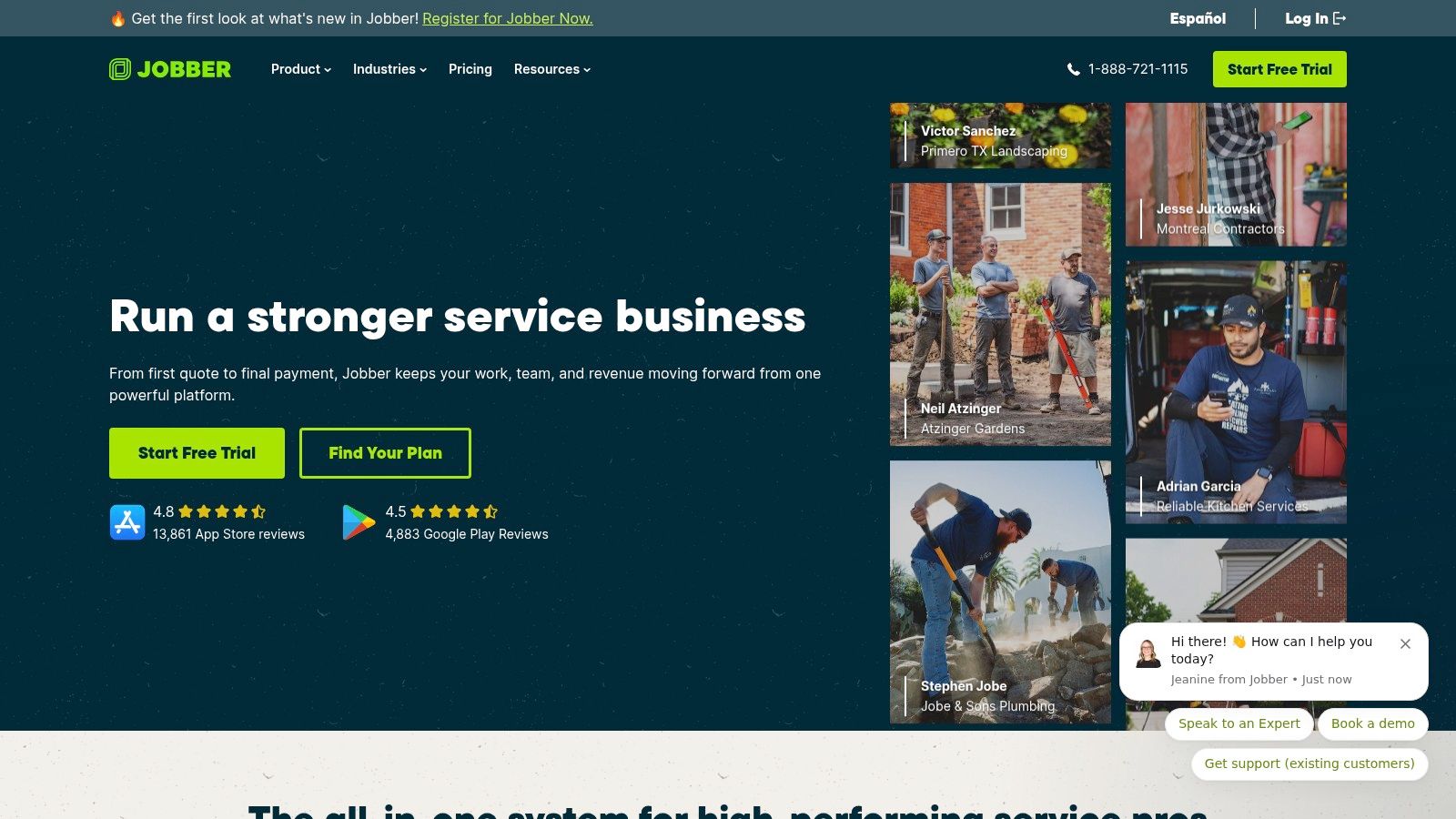
Jobber handles quotes and estimates with templates and automatic follow-ups, scheduling with route optimization, invoicing, card and ACH payments, and reminders that keep accounts receivable from dragging. The app is also available in Spanish for field team members, which helps on crews where language accessibility matters. That combination is hard to beat for home-service operators.
The key advantage is flow. A customer inquiry can become a job, a crew assignment, an invoice, and a payment reminder without a pile of separate tools. That saves the owner and the office manager real time.
Jobber is heavier than a pure time clock. If all you need is attendance and shift control, it's more system than you want. The plan structure also uses user limits, and add-ons can raise the total cost quickly as you scale. The trade-off is worth it only if you want more than scheduling.
For operators who want a structured dispatch and quote process, the internal comparison at job management software for cleaning teams pairs well with this decision.
Housecall Pro fits cleaning businesses that want online booking built into the site and connected to Google. It leans into consumer acquisition, scheduling, dispatch, invoicing, payments, and review collection, which makes it a strong choice for residential operators who care about lead flow as much as field execution. That's a bigger play than workforce management alone.
The platform offers online booking for your website and Google, scheduling and dispatch in the mobile app, invoicing, payments, and review collection. Add-ons for pipeline, proposals, GPS and telematics, and payroll let you build more as the business grows. For cleaning companies trying to turn web traffic into scheduled work, that is a major advantage.
Its strongest value is speed from inquiry to appointment. The setup content and help center also reduce the time it takes to get a team live.
Housecall Pro can become expensive once you layer in add-ons, and some analytics or marketing integrations need workarounds. It's broader than a time clock tool and more consumer-facing than a janitorial control system. That's good if you need growth and booking conversion. It's less useful if your only pain point is shift management.
If you're comparing cleaning software options, the Housecall Pro vs. Jobber vs. ZenMaid guide helps separate booking, dispatch, and maid-service priorities.
ZenMaid is the most obvious connecteam alternative for maid services because it was built for maid-service workflows, not adapted from another category. That specialization shows up in scheduling, cleaner communication, checklists, and payments. If your business is residential cleaning first, you'll feel the difference quickly.
ZenMaid's cleaning-centric scheduling includes dispatch and map views, digital checklists, and automated texts and emails. Cleaner GPS tracking is available on Pro+, and integrations with QuickBooks, Stripe, and Square keep the back end practical. The result is a tool that feels crafted for maid service operations rather than generic field work.
That specificity matters because cleaning owners often don't want to configure every workflow from scratch. They want a system that already speaks the language of recurring visits, cleaner coordination, and client updates.
The starter tier limits appointments per month and may not include GPS, so owners should check whether the lowest plan fits their volume. It also has fewer enterprise-grade integrations and analytics than larger suites. But for a cleaning company that wants a focused, affordable, and easier-to-adopt system, that's an acceptable compromise.
ZenMaid is a strong operational fit, not a lead-conversion engine. If you need faster after-hours estimates, use Estimatty beside it rather than replacing it.
Launch27 is the right tool when online booking is the main bottleneck. It's built for cleaning startups and growing brands that want branded booking forms, customer portals, cleaner portals, and automation around the booking journey. If your website is supposed to sell cleaning appointments, this platform is built for that job.
The platform supports branded booking forms that work well for websites, plus cleaner, customer, and office staff portals. It also includes a scheduling and payroll manager with Google Calendar integration and connections to Zapier, QuickBooks, Twilio, and analytics tools. Multi-location and multilingual support on the top tier make it easier to grow without rebuilding the workflow.
The biggest reason to choose Launch27 is that it reduces booking friction. If prospects can book online cleanly, the office spends less time on manual back-and-forth.
Launch27 has fewer route-optimization and dispatch tools than a full field-service suite. Its marketing automation is also narrower than a dedicated CRM. That's fine if your priority is conversion and operational simplicity, not deep fleet management.
For owners who want a cleaner, more direct appointment funnel, Launch27 is a sharp choice. For estimate handling outside business hours, Estimatty still adds value because it captures and standardizes the conversation before it turns into a booking.
Swept is the clear pick for commercial janitorial control. It is built for night crews, recurring contracts, building coverage, and the kind of field accountability that cleaning operators need when sites run after hours. If your bottleneck is keeping standards tight across multiple properties, Swept stays on that problem.
Swept gives you GPS and geofenced time tracking, scheduling and work orders, quality inspections with photos and notes, cleaner checklists with translation support in 100+ languages, profitability reporting, supply requests, and a client portal on higher tiers. That setup fits operations managers who need proof of work, and it helps multi-location owners keep one process across different sites.
The multilingual support matters in real crews. It cuts down on missed instructions between office staff and cleaners, which is exactly where commercial accounts slip.
Swept does not try to win homeowner leads, and it does not replace a full field-service CRM. That makes it a strong fit for commercial janitorial teams that want control, not a sales engine.
Solo cleaners will usually find it too specialized. Maid-service operators and residential field-service teams should look elsewhere. For cleaning operators managing hiring and employee onboarding at scale, Pipehire HRM's cleaning employee hiring blog is worth a look alongside Swept, and teams that need employee texting with Call Loop can coordinate shift changes without phone tag.
| Tool | Key features | UX & ease of use | Value proposition | Best for | Pricing note |
|---|---|---|---|---|---|
| Homebase | Drag-and-drop scheduling, GPS/photo time clock, team messaging, payroll add-on | Intuitive; fast schedule publishing; good live support | Saves scheduling time, ties time tracking to payroll | Small cleaning crews to multi-location teams | Free tier (1 location, ≤10 employees); per-location pricing can rise |
| When I Work | Employee scheduling, GPS/geofence time clock, messaging, API/SSO on higher tiers | Modern, easy to learn UI | Per-user pricing with solid multi-location controls | Shift-based cleaning teams who prefer per-seat billing | Competitive per-user pricing; API/SSO on upper plans |
| Deputy | Robust shift scheduling, multi-device time clocks, break compliance, payroll integrations | Reliable mobile apps; broad integrations | Strong compliance and enterprise scalability | Multi-site firms needing break/overtime controls | Tiered plans; cost increases with headcount/features |
| Sling | Free scheduling (up to 30 users), mobile time tracking, announcements, kiosk clock | Lean, simple UX; quick rollout | Very low-cost entry; transparent billing for active users | Independent or budget-conscious multi-crew cleaners | Free tier up to 30 users; Premium for labor/overtime features |
| QuickBooks Time | GPS time tracking, scheduling, job/project costing, QuickBooks integration | Familiar for bookkeepers; solid mobile apps | Seamless time-to-payroll and job costing with QuickBooks | Cleaning businesses using QuickBooks accounting | Pricing varies; often bundled with QuickBooks Payroll |
| Jobber | Quotes/estimates, routing/dispatch, invoicing/payments, integrations | Purpose-built workflow from quote to payment | Reduces app sprawl; speeds invoicing and payments | Residential & light commercial cleaning operations | Per-user limits by plan; add-ons raise total cost |
| Housecall Pro | Online booking (site & Google), scheduling/dispatch, invoicing, review tools | Strong mobile UX; fast booking-to-payment flow | Built-in marketing & Google booking integration | Consumer-facing home services wanting embedded booking | Core features included; advanced add-ons increase cost |
| ZenMaid | Cleaning-centric scheduling, digital checklists, automated texts, GPS (Pro+) | Tailored to maid services; quick adoption | Industry-specific workflows with simple setup | Maid services and house-cleaning businesses | Affordable flat tiers; Starter has appointment limits |
| Launch27 | Branded booking forms, customer/cleaner portals, scheduling, Zapier/QuickBooks | Optimized for online conversion and booking | Unlimited users/bookings on tiers; strong online booking focus | Startups/growth brands focused on web conversion | Growth-friendly plans; higher tiers add multi-location/multilingual |
| Swept | GPS time tracking/geofencing, inspections with photos, multilingual checklists, client portal | Janitorial-focused UX; strong multilingual support | Suits multi-site janitorial contracts with quality checks | Commercial janitorial teams managing many client sites | Location-based pricing as client sites are added |
The right connecteam alternative depends on the bottleneck you need to remove, not the number of features in the brochure. For lean teams, Sling or Homebase is the practical pick because they keep scheduling and attendance simple. For approachable multi-location scheduling, When I Work is the cleanest move. For compliance-heavy operations, Deputy is the safer choice. If your books already run through QuickBooks, QuickBooks Time gives you the most direct job-costing path. For broader residential field service, pick Jobber or Housecall Pro. For maid-service specialization, ZenMaid is the strongest fit. For online booking, Launch27 is built around conversion. For commercial janitorial control, Swept is the best match.
Estimatty belongs in a different decision bucket. It's the better choice when the problem is turning website and phone inquiries into fast, consistent estimates, especially after hours, on weekends, and during holiday gaps. Its value comes from standardized pricing, add-ons, SMS and email delivery, real-time notifications, CRM or Zapier connections, and human handoff when a live person needs to step in. That makes it a front-end sales system, not a workforce-management replacement, and that distinction matters if your cleaning business wants to stop leaking leads before the first job is even scheduled. For more cleaning-business workflow guidance, keep Estimatty's blog close while you evaluate the operational stack.
Use this migration checklist before you switch any tool, export customers, jobs, employees, locations, pricing rules, availability, payroll settings, and message templates. Map fields carefully, confirm integrations, pilot one crew or one location, and test GPS, notifications, estimates, approvals, and payment or payroll handoffs before full rollout. Train managers and cleaners, set a rollback date, then review adoption and lead-conversion outcomes after launch so you know whether the new system fixed the constraint you hired it to solve.
Estimatty gives cleaning businesses a faster way to capture leads, standardize estimates, and respond the moment a prospect calls or visits your site. If you want your quoting process to work day, night, and on holidays without adding headcount, visit Estimatty and see how the system fits alongside your scheduling or field-service stack.