
September 21, 2026
Inside and Out Cleaning: A Practical Pricing Guide
Learn what inside and out cleaning really includes, how pricing works, and which add-ons actually pay off for residential and commercial estimates.

Monday, September 14, 2026
Discover what drives apartment cleaning services cost in 2026, with real price ranges by unit size, frequency, and add-ons, plus tips to price jobs for profit.

A standard apartment cleaning visit commonly costs $75 to $175, but that number can swing dramatically with apartment size, service frequency, condition, and location. The price isn't determined by bedrooms alone. It's determined by how many labor minutes the crew must sell, how much friction they face getting inside, and how much uncertainty the estimator builds into the job.
I've priced enough apartment jobs to know where owners lose money. They don't usually lose it on obvious requests such as an oven cleaning. They lose it when a “standard” apartment has heavy pet hair, three flights of stairs, a locked freight elevator, no nearby parking, and months of buildup that wasn't captured during intake.
The honest way to understand apartment cleaning services cost is to look behind the headline rate. Labor minutes, soil load, access, frequency, and service scope explain why two units with the same bedroom count can produce entirely different estimates.
Professional apartment cleaning services in the U.S. commonly fall between $75 and $175 for a standard visit, with the final price varying by unit size and cleaning scope, according to HomeAdvisor's apartment cleaning cost guidance. Treat that range as a market reference, not a pricing rule.
A tidy studio with clear access may sit near the lower end. A larger apartment with more bathrooms, buildup, or difficult entry can move well above it. The crew might charge the same underlying labor rate, but the estimate changes because the job consumes a different amount of paid time.
Unit size and layout establish the initial labor requirement. Square footage matters, but room count matters too. A compact apartment with multiple bathrooms can take longer than a more open unit with similar floor area because fixtures and transitions create more work.
Soil load is the second major variable. A recently maintained apartment needs maintenance cleaning. A unit with grease, pet hair, clutter, smoke residue, or neglected bathrooms needs a different labor allowance. A flat rate that ignores condition is how callbacks begin.
Access logistics consume productive time. Stairs, elevators, parking distance, freight reservations, doorman procedures, key handoffs, and long walks from the vehicle all belong in the estimate.
Frequency changes the amount of buildup between visits. Weekly and biweekly service usually requires less recovery work than a first-time or infrequent clean, so recurring clients shouldn't be priced like reset jobs.
Owner's rule: Price the labor minutes you expect to spend, then protect the estimate with a condition and access buffer.
Owners building a repeatable intake process can use this cleaning service cost framework alongside the SkipCalls guide for cleaning companies to tighten lead handling and reduce missed details. The best estimator captures these variables before a cleaner reaches the building.
A defensible apartment estimate starts with four inputs. Capture them in the same order every time, and a customer who challenges the price can see exactly what changed.
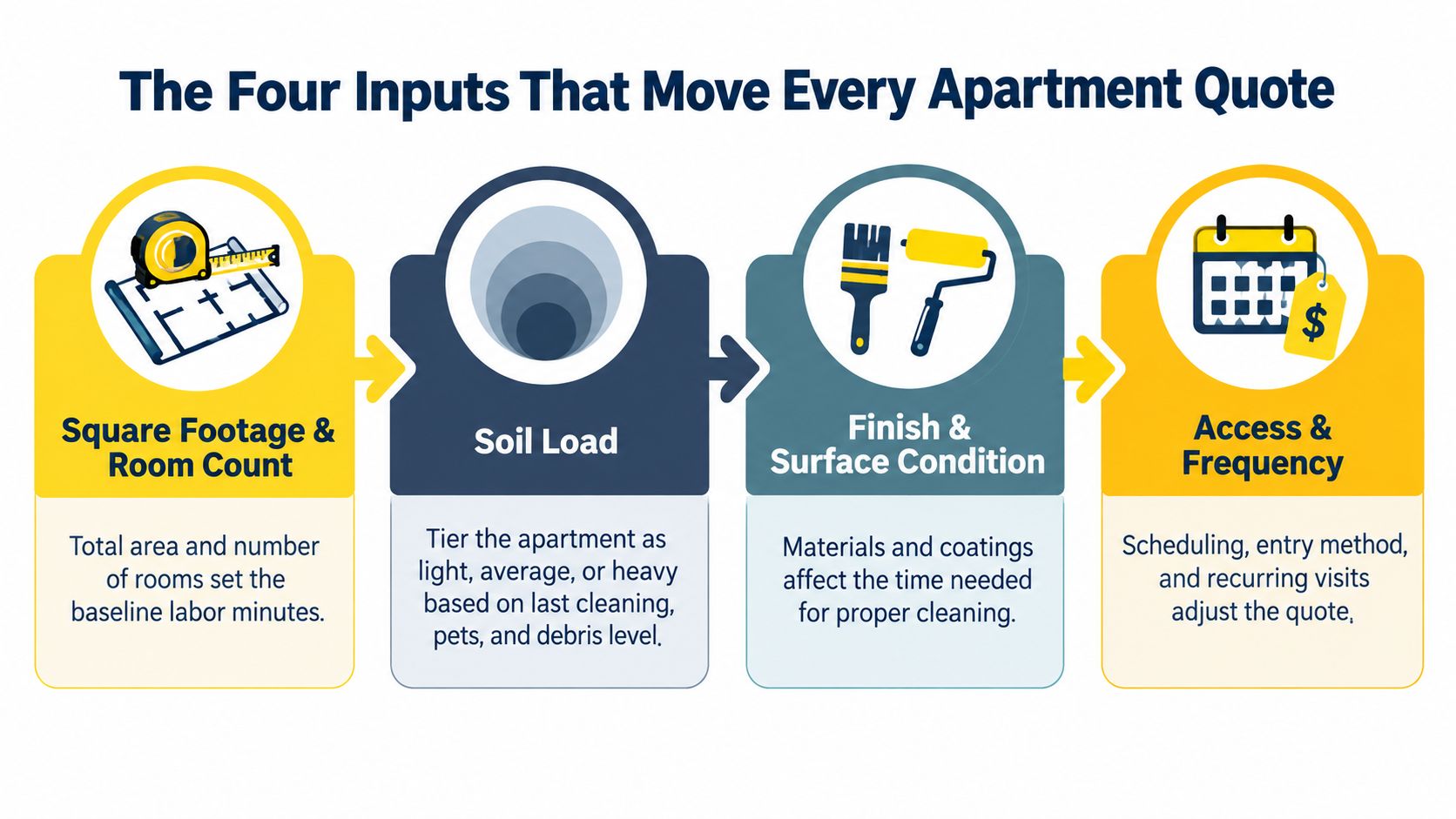
Use the measured floor area as the baseline, then verify bedrooms, bathrooms, kitchens, living areas, and special spaces. Square footage tells you how much surface exists. Room count tells you how fragmented the work is.
Don't let a customer describe a two-bedroom apartment as “small” and treat that as usable pricing data. Ask for the actual size, bathroom count, layout, and whether rooms are furnished.
Tier the condition as light, average, or heavy. Ask when the last professional cleaning occurred, whether pets live there, whether anyone smokes, how often cooking happens, and whether clutter limits access to surfaces.
A heavy-soil tier needs a documented buffer. The provided pricing guidance notes that a dirty or cluttered apartment can move estimated cost by ±20% to 300% relative to a standard job because the labor burden changes so sharply (Cleaning Services Authority).
Record stairs, elevator availability, freight bookings, loading rules, parking distance, entry codes, lockboxes, and key handoffs. A unit on an upper floor isn't automatically expensive, but a walk-up with equipment hauling and restricted parking can consume time before cleaning starts.
Separate one-time, weekly, biweekly, monthly, and infrequent service. Frequency affects buildup, preparation, and expected labor minutes. This apartment cleaning pricing coverage distinguishes standard, deep, one-time, and recurring service rather than treating every visit as identical.
For a deeper estimating workflow, see how to estimate cleaning jobs. These four inputs create the audit trail behind the estimate, which is far stronger than saying, “That's just our rate.”
Move-out cleaning costs more because empty units expose cabinets, closets, appliance interiors, baseboards, tracks, and neglected edges. Recent cost data lists move-out ranges of $90 to $130 for studios, $100 to $190 for one-bedroom units, $140 to $210 for two-bedroom units, and $180 to $300 for three-bedroom, two-bath apartments (Rapid Eye Inspections).
The table below combines the available market ranges into practical planning bands. The “median” is a planning midpoint, not a guaranteed market average.
| Unit Size | Standard Clean Low–High | Standard Median | Deep Clean Low–High | Deep Median | Move-Out Clean Low–High | Move-Out Median |
|---|---|---|---|---|---|---|
| Studio | $75–$110 | $92.50 | $100–$165 | $132.50 | $90–$130 | $110 |
| 1 bedroom | $75–$175 | $125 | $125–$250 | $187.50 | $100–$190 | $145 |
| 2 bedrooms | $100–$175 | $137.50 | $125–$250 | $187.50 | $140–$210 | $175 |
| 3 bedrooms | $125–$175 | $150 | $150–$250 | $200 | $180–$300 | $240 |
The standard and deep-clean bands reflect HomeGuide's apartment cleaning pricing ranges, while the broader standard and one-time reference points are also consistent with Thumbtack's apartment cleaning pricing guide. A separate HomeAdvisor move-out cost guide reports a $360 average for professional move-out cleaning, with most jobs between $120 and $420, showing why empty-home condition and scope can push a job beyond apartment-only planning bands.
The range reflects labor minutes, not the label on the service. A deep clean takes longer because it adds detail work. A move-out clean can take longer still because the unit is being reset for another occupant, not merely maintained.
Don't use these figures as permission to underprice. An estimate outside the bands may be justified by location, access, severe soil, specialty add-ons, or a larger-than-assumed layout. If the scope is standard and the number is far below the range, expect either rushed work or a later renegotiation.
For owners who need a more structured reference, this home cleaning price list is useful as a starting point, but your local labor and access conditions must control the final estimate.
Labor is the cost center that explains most apartment pricing. The available pricing guidance states that labor typically represents 50% to 70% of total cleaning-service cost, so payroll, cleaner count, travel, and on-site minutes can move an estimate more than visible supply costs (Cleaning Services Authority).
One 2026 pricing guide places house-cleaning rates at $35 to $75 per hour per cleaner, with a midpoint around $50 per hour. Another cost guide lists average U.S. cleaning-task pricing at $33 per hour (FieldTics). Those are market references, not profit. Your estimate must also recover payroll burden, insurance, travel, supplies, scheduling, rework risk, and margin.
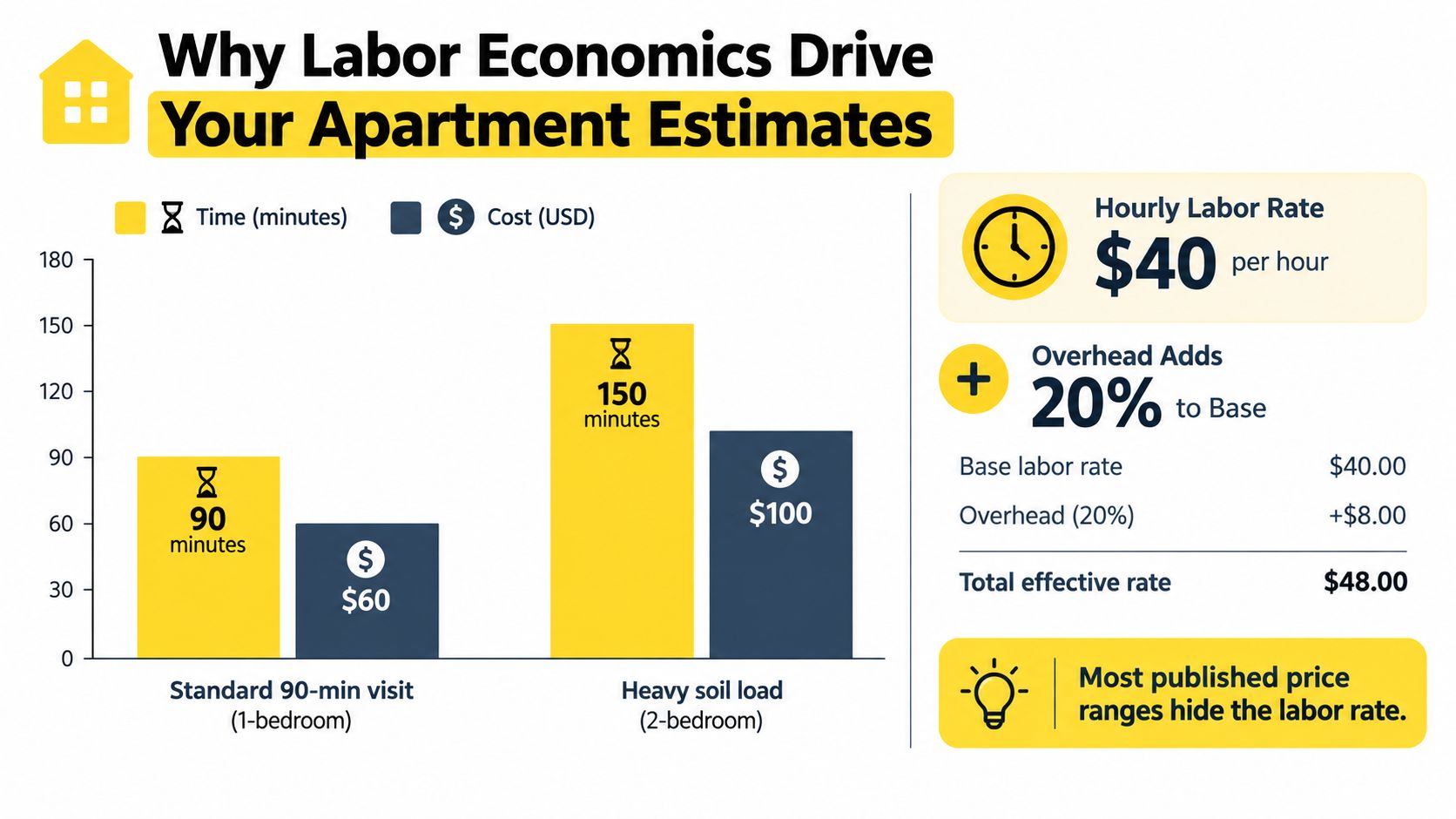
A 90-minute appointment doesn't consume only 90 minutes of company capacity. The cleaner may spend additional paid time driving, loading equipment, entering the building, waiting for an elevator, and completing closeout notes. A two-person crew may reduce on-site duration but still creates two wage lines.
Regional labor also matters. Major-market household-help rates commonly cluster in the low-to-mid $20s per hour, with Seattle, Los Angeles, New York, and Chicago generally pricing above smaller Sun Belt markets (Cleaning Services Authority). That regional spread belongs in your estimator as a market-specific multiplier, not as an afterthought.
Practical math: Convert expected labor minutes into payroll cost first. Add overhead and margin after you know what the job consumes.
Review how to calculate labor cost per hour before setting a flat apartment rate. A flat price works only when the estimator converts unit details into a realistic time allowance.
Recurring service is where cleaning businesses either build dependable revenue or lose margin. A weekly apartment usually has less buildup than a first-time visit, so the cleaner can allocate fewer labor minutes to recovery work. Monthly service and one-time jobs deserve more caution because the apartment has more time to accumulate grease, dust, pet hair, and bathroom residue.
The verified pricing guidance places recurring monthly visits around $90 to $150, while standard apartment cleaning commonly falls between $75 and $175 and deep or one-time work is often around $125 to $250 (Thumbtack). The exact adjustment should come from expected labor minutes, not from an automatic discount.
| Cadence | Pricing Adjustment | Example 2-Bedroom Price |
|---|---|---|
| Weekly | Lower than a first-time standard visit when condition stays light | Set from recurring labor minutes |
| Biweekly | Moderate reduction when buildup remains controlled | Set from the inspection tier |
| Monthly | Closer to the full standard rate | Use the standard labor floor |
| One-time standard | Full standard estimate | Based on current condition |
| Deep clean | Premium for detail work and buildup | Reclassify if maintenance scope won't hold |
| Move-out clean | Higher scope for vacant-unit reset | Price cabinets, appliances, closets, and access separately |
A common mistake is discounting frequency before confirming the initial condition. If the first visit needs a deep clean, sell that service transparently, then establish the recurring rate after the apartment reaches maintenance condition.
The Thumbtack pricing guidance also notes that recurring monthly pricing can be lower because the labor and time burden is reduced. That reduction disappears when clients skip visits, add clutter, or expect deep-clean detail at a maintenance rate.
Bedroom count is a weak estimate when access is difficult. Two one-bedroom apartments can have the same floor plan and completely different service economics if one has convenient parking and the other requires a long walk, security check, elevator wait, and equipment haul.
Location differences are substantial. One recent guide lists a standard one-bedroom apartment in New York City at approximately $118 to $237, while Bay Area move-out cleaning can run roughly $240 to $900 for most apartments and homes (LatestCost). Those figures show why national averages don't answer a local logistics question.
Ask these questions during intake:
These details create paid time that customers don't always see. They also create failure points. A missing key, unavailable elevator, or blocked loading zone can turn a profitable route stop into a loss.
Quote it explicitly: If access adds labor, travel, waiting, or coordination, put that input in the estimate instead of hoping the crew absorbs it.
Regional wage differences compound these logistics. A dense high-cost market can require a higher labor multiplier even when the apartment itself looks ordinary. Owners who price only by bedrooms are transferring building friction straight into their margin.
A repeatable estimator should make two trained people reach nearly the same result from the same apartment details. The system doesn't need to be complicated, but it must force the right questions before anyone promises a price.
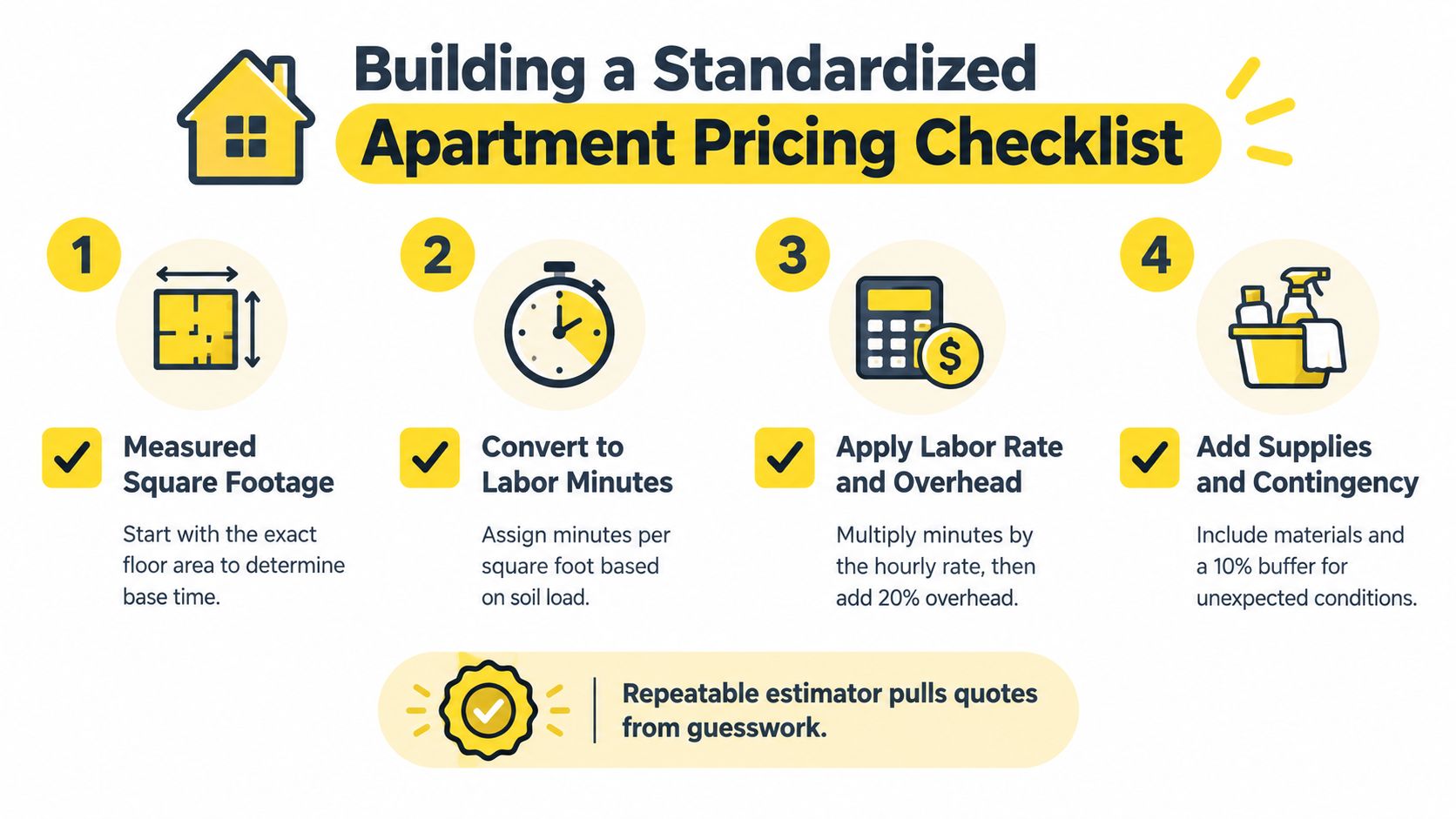
Record measured square footage, bedrooms, bathrooms, floor level, layout, and whether the apartment is furnished or vacant. Don't accept “average size” when the customer can provide a listing, floor plan, or property record.
Assign a base time for standard, deep, and move-out service. Then adjust for room complexity, fixtures, appliance interiors, cabinets, windows, laundry areas, and any requested add-ons.
The estimator should show the reason for each adjustment. “Two bathrooms” is useful. “Two bathrooms plus heavy soap buildup and interior glass” is much better.
Use market-specific labor economics instead of a national guess. Labor commonly accounts for 50% to 70% of cleaning-service cost, so an incorrect wage assumption can distort the entire estimate (Cleaning Services Authority).
Add payroll burden, insurance, travel, supplies, and required margin. A cleaner's hourly wage is not the same as the company's billable hourly cost.
Use condition tiers such as light touch-up, lived-in maintenance, and post-tenant reset. Add access charges for stairs, long parking walks, freight bookings, key handling, and difficult entry. Include specialty line items for ovens, refrigerators, windows, laundry, and heavy pet hair.
A written checklist also improves operational decisions. Owners reviewing sustainable supply choices can use Fillaree's eco-cleaning program guide when evaluating products and waste practices without hiding those costs inside an unexplained flat rate.
Callbacks usually begin before the crew arrives. The customer described one job, the estimator assumed another, and the cleaner discovered the difference at the door. A standardized intake process closes that gap by making square footage, soil condition, access, frequency, and add-ons visible before scheduling.
Documentation finishes the job. Save photos of trouble spots, record the customer's requested scope, and send a confirmation message before service. The confirmation should identify what is included, what isn't included, access instructions, estimated duration, and any condition-based adjustment.
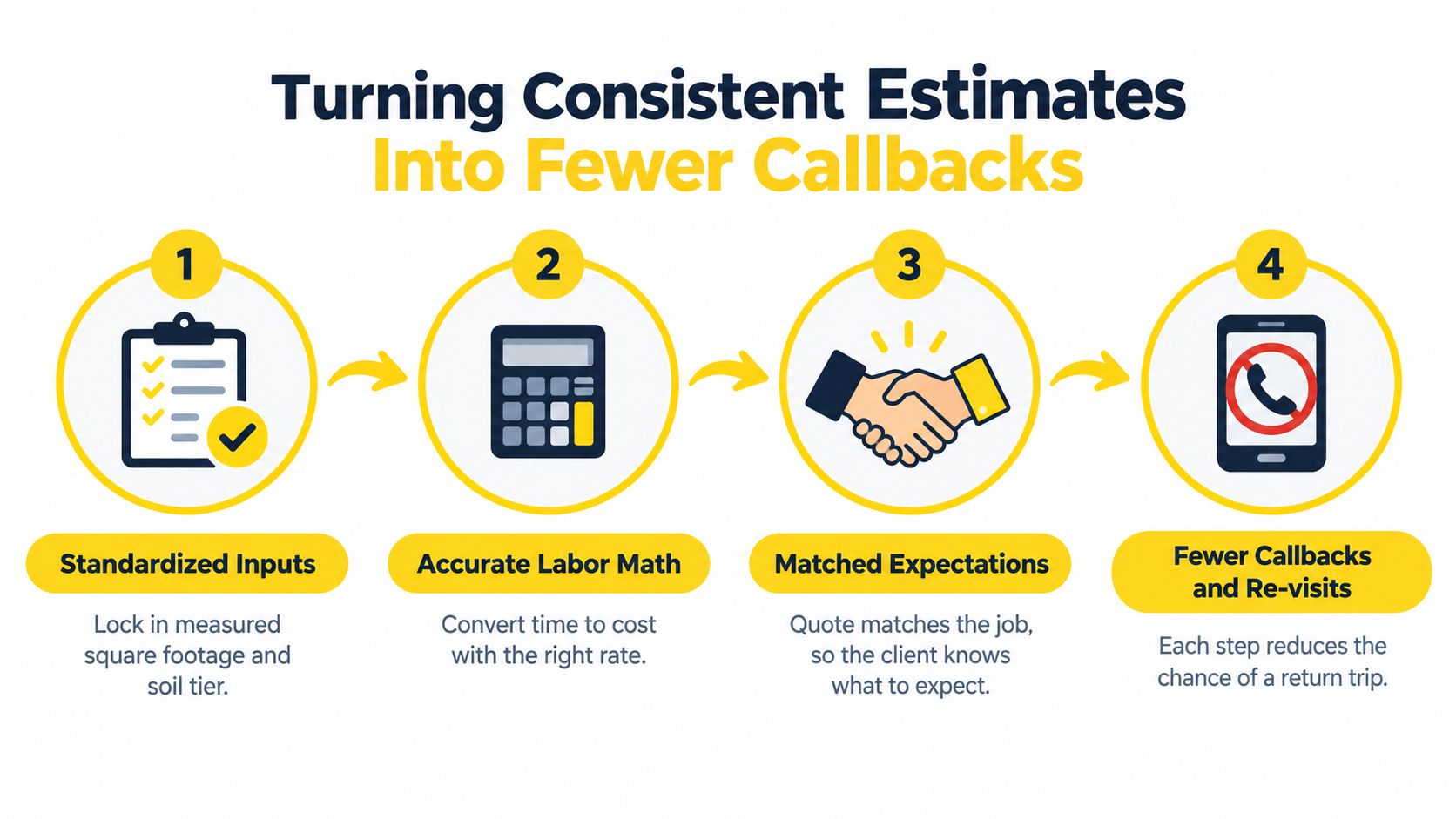
Every estimator should use the same intake fields. Every crew should receive the same job notes. That consistency matters when one-bedroom apartments differ by building access, furnishing, soil load, and service cadence.
Review unusual estimates regularly. If one estimator prices a unit much lower than another estimator handling the same facts, the business has a process problem, not a customer problem.
A software estimator can require the same questions, apply the same labor rules, and flag missing information before an estimate is sent. AI-assisted tools can also collect square footage, surfaces, urgency, condition, and add-ons through a website or phone interaction.
Estimatty is one option built for cleaning businesses. It captures service details and sends instant estimates by SMS and email, while notifying the team when a prospect is ready for follow-up. It can replace inconsistent forms and after-hours voicemail with a structured intake process, but owners still need to configure local pricing, labor assumptions, and scope rules correctly.
Use cleaning quality assurance to connect the estimate to the inspection and follow-up process. The point isn't merely to send a faster number. It's to send a number that the crew can deliver without renegotiation.
Final pricing rule: Measure the apartment, classify the soil, price the access, separate the service tier, and convert every assumption into labor minutes.
Estimatty helps cleaning businesses collect apartment details, apply consistent pricing rules, and send personalized estimates through web and voice interactions around the clock. Visit Estimatty to see how you can replace gut-feel pricing with a structured estimate process that protects margin and reduces callbacks.