October 20, 2026
How to Follow Up on a Quote and Close More Cleaning Sales
Learn how to follow up on a quote with timing, templates, and tactics that turn estimates into booked cleaning jobs. Practical advice for cleaning businesses.

Thursday, July 16, 2026
Master the window cleaning price per square foot model. Our guide helps cleaning business owners set profitable, consistent rates and automate estimates.
.png)
Commercial window cleaning usually lands between $0.50 and $2.50 per square foot. For most owners, the challenge isn't knowing the range. It's knowing when to charge near the bottom, when to move up, and how to turn that into a repeatable estimating system.
A lot of cleaning businesses are stuck in the same cycle right now. A prospect calls about a storefront, office building, or mixed-use property. You do a fast walkthrough, throw out a number that seems reasonable, and hope the job makes money. Then the labor runs long, access is worse than expected, and the estimate that looked fine on paper turns into a margin leak.
That's why serious commercial operators stop pricing by instinct and start pricing by system. The window cleaning price per square foot model gives you a standard language for commercial work, a way to stay consistent across jobs, and a clearer path to growth without second-guessing every estimate.
One of the fastest ways to stall a cleaning business is inconsistent estimating.
The pattern is familiar. On Monday, you price a small retail job aggressively because you want to win it. On Wednesday, you price a similar building much higher because the customer sounds difficult or the site looks busier. By Friday, you've got three jobs on the calendar with three different pricing logics behind them. Your team can't predict labor, you can't predict profit, and the business feels harder than it should.
Owners usually think the problem is competition. It usually isn't.
The bigger problem is that the business has no standard for commercial glass. Residential work can often survive on a per-window mindset because the scale is smaller and the work is easier to visualize. Commercial work breaks that habit fast. Storefront glass, office facades, and multi-story buildings need a framework that scales.
Practical rule: If two estimators can walk the same site and come back with very different prices, the business doesn't have a pricing strategy. It has opinions.
That's where square-foot estimating changes the game. Instead of pricing based on mood, memory, or whatever your last job looked like, you start with measurable surface area and then adjust for the variables that change production.
A good system does three things:
This is what separates a hustling operator from a company that can expand. The owner who still estimates from the truck by rough guess eventually becomes the bottleneck. The owner who standardizes estimating builds something that can be taught, delegated, and improved.
Commercial clients notice the difference too. They don't just want a low number. They want a vendor who sounds organized, prices with confidence, and can explain what's included without fumbling through a mental calculation.
Commercial window cleaning runs on a simple core principle. Measure the glass or facade area, apply a service-level rate, then add complexity where the job demands it.
According to HomeGuide's commercial window cleaning pricing breakdown, the standard commercial pricing metric is $0.50 to $2.50 per square foot, with standard services generally at $0.50 to $1.00 per square foot and premium services at $1.00 to $2.50 per square foot.
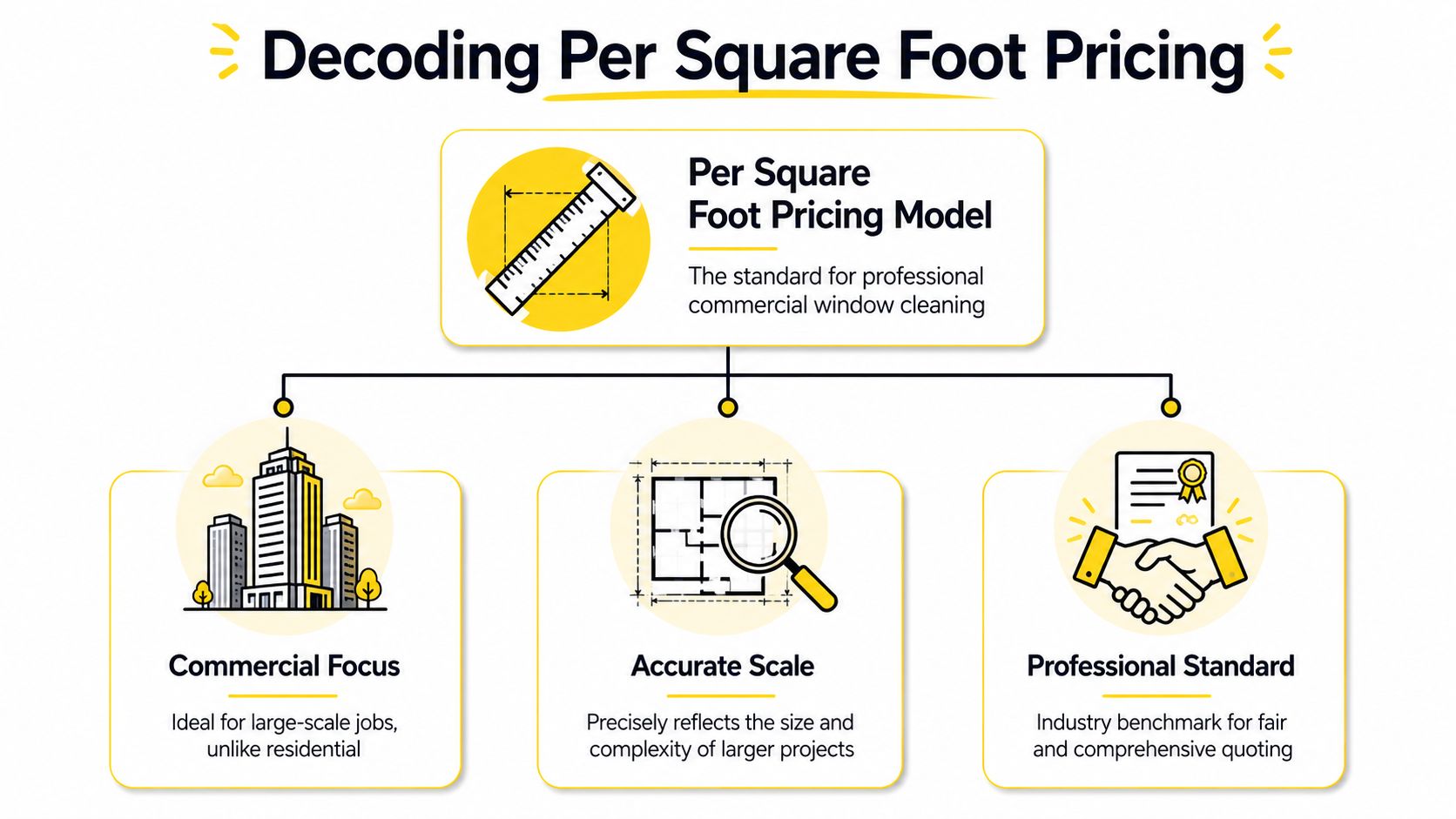
The lower part of the range fits straightforward jobs. Think accessible storefronts, ground-level glass, and routine interior and exterior washing where the crew doesn't need special equipment or unusual setup time.
That type of work is easier to standardize because production stays steady. The crew arrives, cleans, details the obvious edges, and moves on. There's less uncertainty, which means you can estimate more aggressively without inviting a surprise loss.
The top half of the range is where many owners undercharge.
Premium pricing isn't just about using better solution or promising better shine. It belongs on jobs with more labor density per square foot. Hard-to-reach glass, detailed sills, screen cleaning, specialty glass care, and properties that need a more polished finish all belong higher in the range. Once the site demands more setup, slower movement, or extra detailing, your base rate needs to reflect that.
A lot of owners know this in theory but still blend everything into one vague number. That's what creates confusion for the customer and inconsistency for the company.
A cleaner way to sell and estimate is to define your service bands before the lead comes in.
If you want a broader estimating framework for packaged services, this commercial cleaning pricing calculator guide from Estimatty is a useful reference point for building standardized estimates.
Clean estimating starts when your price range matches your service design. If every job gets a custom logic, scaling gets messy fast.
Two buildings can have similar square footage and still deserve very different estimates.
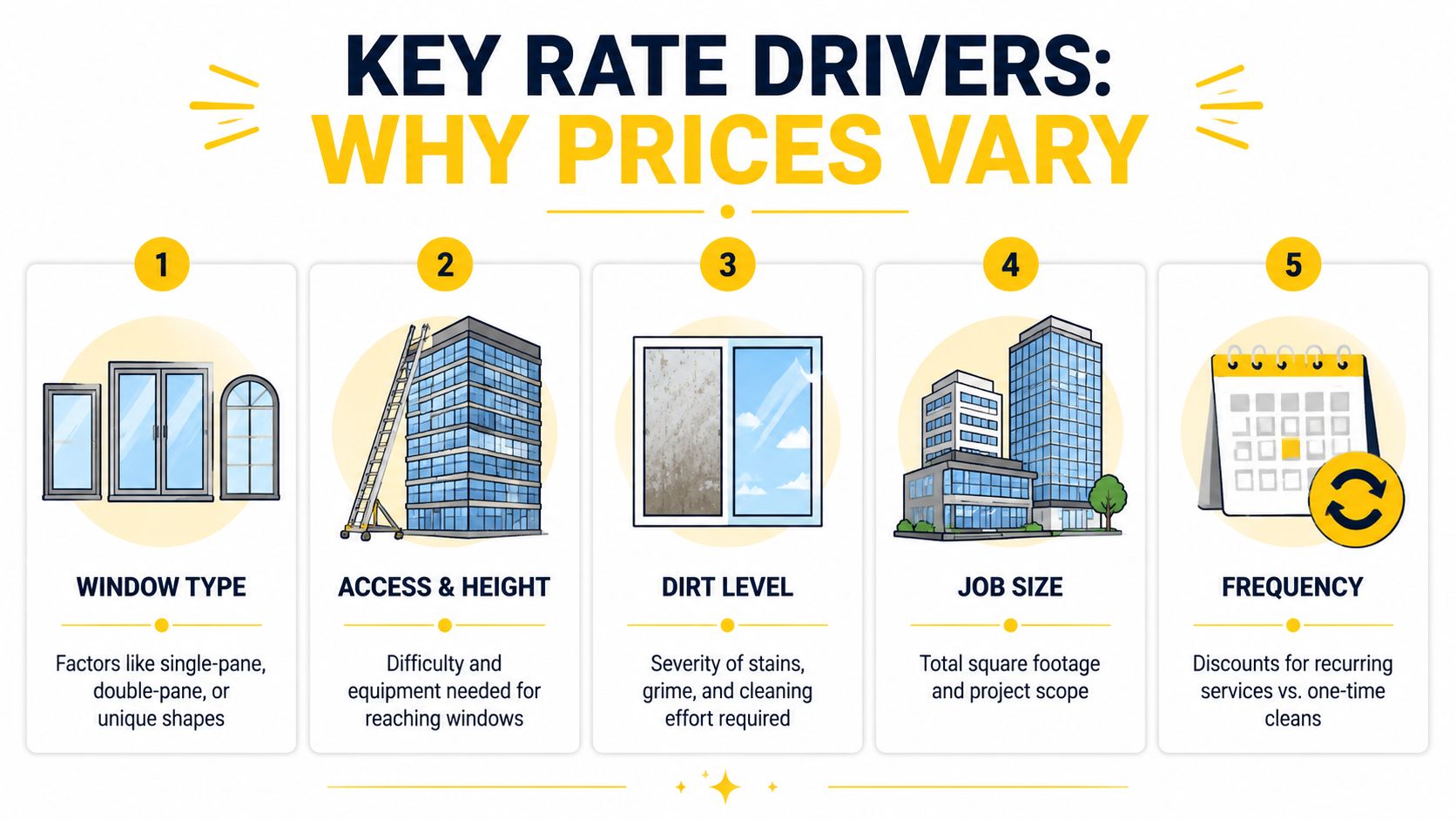
That's because square footage gives you a baseline, not the final number. The final number comes from production obstacles. Height, access, soil level, setup time, and glass condition all change the labor required to clean each square foot profitably.
The cleanest example is building height.
According to Professional Window Cleaning's pricing calculator guide, difficult access or heavy buildup commonly adds a 20% to 50% price increase, and windows above the second floor can move from a standard $8 to $16 per window up to $10 to $40 per window because of added safety equipment and specialized labor.
That tells you something important even if you estimate commercial work by square foot. Once the property moves above simple ladder access, your labor pace slows and your risk rises. If you keep using a ground-level rate on high-level glass, you're absorbing extra difficulty without getting paid for it.
Owners often focus on height and forget access.
A one-story property can still be difficult if the glass is broken up by landscaping, signage, awnings, tight walkways, locked sections, or interior obstacles. The square footage may look generous on paper, but the crew doesn't clean paper. They clean around obstructions, reposition tools, coordinate entry, and lose rhythm.
Use a short access checklist during site review:
A clean estimating process gets stronger when you connect field conditions to labor cost, not just visual impressions. If your team still struggles to translate site complexity into labor pricing, this labor cost per hour guide from Estimatty helps build the backend math.
A quick field example helps here:
Dirty glass isn't all the same.
Routine dust and fingerprints fit your normal production assumptions. Post-construction residue, adhesive, mineral buildup, and neglected frames don't. Those jobs require slower passes, more detailing, and in some cases special handling to avoid damage.
If the glass needs restoration effort instead of maintenance cleaning, it shouldn't be priced like maintenance cleaning.
Too many businesses get trapped. They sell a standard clean, then perform a recovery project. That gap eats profit fast.
Not every pricing model is wrong. But not every pricing model fits commercial window work either.
Residential jobs often behave one way. Commercial jobs behave another. If you apply the same estimating method to both, you end up either too cheap for difficult sites or too expensive for simple ones.
According to Housecall Pro's window cleaning pricing guide, residential window cleaning predominantly uses per-window pricing of $8 to $16 or per-pane pricing of $4 to $8, while commercial estimators rely on square footage because it's the only viable way to standardize estimates across diverse building sizes.
A house usually gives you a manageable count, familiar layouts, and less variation in production per unit. Counting windows works because the scope stays visible.
Commercial buildings don't cooperate that way. You might have wide storefront panels, narrow vertical sections, glass entrances, upper office strips, and a facade that mixes easy access with awkward corners. Counting “windows” doesn't capture the labor density well enough.
| Pricing Model | Best For | Pros | Cons |
|---|---|---|---|
| Per square foot | Commercial properties, storefronts, offices, mixed-size glass projects | Scales well, standardizes estimating, easier to train staff on | Needs clear adjustment rules for access and complexity |
| Per window | Residential homes and small simple jobs | Easy to explain, quick to count on predictable layouts | Breaks down on large commercial facades and mixed glass sizes |
| Hourly | Unusual cleanup, uncertain site conditions, one-off problem jobs | Protects against unknown labor conditions | Harder for customers to compare and budget, less scalable for standardized sales |
| Flat-rate | Repeat properties with stable conditions | Fast to present and easy for recurring clients to accept | Dangerous if site conditions change and your assumptions are wrong |
For a broader look at how cleaning businesses structure pricing across service types, this guide on pricing cleaning jobs from Estimatty is worth reviewing.
Most profitable operators don't use one model for everything. They use the right model for the property type.
For commercial glass, square foot pricing gives you the strongest base because it converts building scale into a system. For specialty cleanup or uncertain conditions, hourly pricing can act as a protective tool. For residential, unit-based pricing still makes more sense because accessibility and pane style vary too much for a clean square-foot formula.
That's the practical takeaway. Don't force one estimating method onto every job just because it's familiar.
A strong estimate needs simple math and disciplined rules.
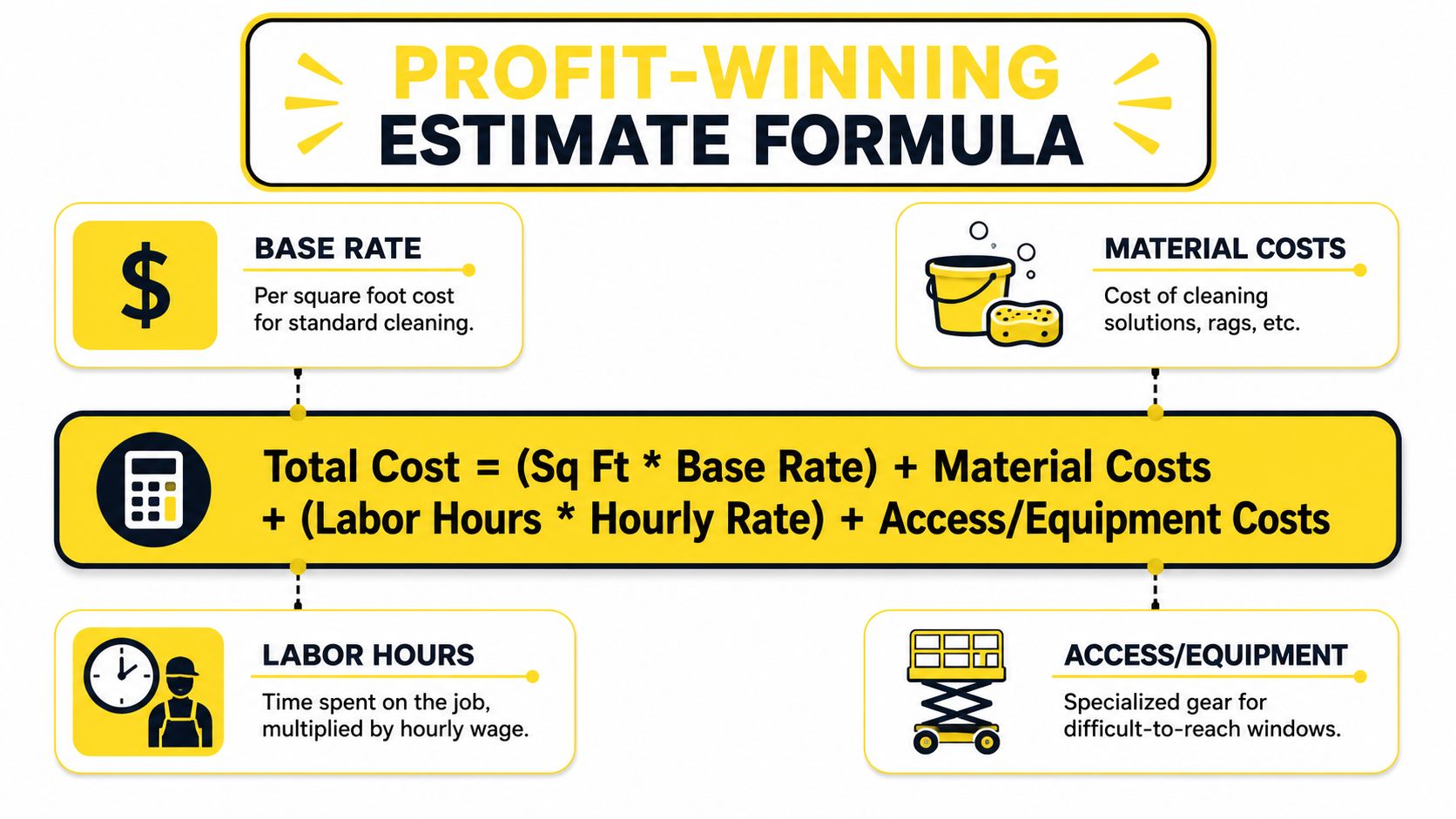
The formula doesn't have to be fancy. It has to be repeatable. Start with measured area, choose a base rate that matches the service level, then layer in labor and access costs when the site demands them.
Use this structure internally:
Estimate total = square footage × base service rate + access or equipment cost + labor adjustments + material adjustments
That keeps your estimating logic clean. It also helps you separate the part of the price tied to scale from the part tied to difficulty.
According to MyQuoteIQ's commercial pricing reference, commercial pricing can range from a baseline of $0.50 per square foot for accessible storefronts up to $2.50 per square foot for high-rise facades that require scaffolding and specialized labor, and hourly rates for complex jobs can reach $170 per hour versus the more standard $40 to $60 per hour.
Take a 1,500 square foot ground-level storefront with clean access and routine maintenance needs.
This is the type of property where many operators start near the lower commercial range because production is stable and equipment needs are light. If the site is accessible, the work scope is standard, and the crew can move continuously, your estimate can stay close to your baseline model. The key is discipline. Don't add arbitrary padding. Don't discount it just because the customer asks quickly. Let your system drive the price.
Now look at a 10,000 square foot office building with 3 stories and some difficult-to-reach sections.
This isn't just a bigger version of the storefront. The job changes category because labor slows, setup expands, and safety planning becomes part of the work. That's when your estimate should move up the commercial range and include explicit line items or internal modifiers for equipment and labor intensity.
The estimate that wins profitable jobs isn't always the lowest one. It's the one that matches the real production cost before the crew ever leaves the shop.
Material control matters here too. If you're trying to tighten margin discipline on solutions and consumables, Fillaree's eco-conscious buying tips offer a practical way to think about unit cost instead of buying by habit.
If you want to turn this kind of estimating logic into something your office can use faster, this cleaning estimate calculator guide from Estimatty is a useful model for systemizing the workflow.
Most owners focus so hard on the base estimate that they leave easy margin behind.
The base service gets you in the door. Profit often comes from the add-ons that fit naturally around the job. Screen cleaning, track detailing, sill work, and hard water stain removal can move a standard visit into a stronger ticket without creating a difficult sales conversation. They make sense because the customer already understands the value of cleaner glass. You're not introducing a random service. You're completing the result they want.
Don't tack them on as an afterthought. Present them as options during the estimate process.
A simple approach works well:
That structure protects your average job value without pressuring the customer. It also gives your team a cleaner script because they're recommending relevant upgrades, not improvising a sales pitch.
A profitable base rate in one market can be weak in another.
Labor availability, travel patterns, competition, building type, and customer expectations vary by city and service area. If your prices feel tight even when production goes well, the issue may not be your efficiency. It may be that your base rate is too low for your region. Review local competitors, compare the types of properties they serve, and check whether your pricing reflects the labor burden of your market.
If hiring is the primary pressure point behind your pricing, staffing systems matter too. For recruiting and team-building ideas designed for cleaning companies, pipehirehrm.com and the articles on get.pipehirehrm.com/blog are worth keeping on your radar.
A pricing strategy only becomes valuable when the business can use it consistently.
That's where many owners get stuck. They've learned how to think through rate bands, access problems, and service tiers, but the whole system still lives in their head. That means every estimate depends on the owner being available, focused, and willing to manually work through the same questions again.
Once your pricing rules are documented, your operation gets lighter.
Your team can estimate using the same logic. Leads get a more consistent experience. You stop rewriting pricing from scratch for every inquiry. This is also where the difference between residential and commercial estimating becomes operationally important. As noted in NJM Roof Cleaners' residential pricing examples, a 1,500 sq ft home with 15 windows averages $150 to $250, while a 4,200 sq ft home with 42 windows averages $500 to $600, which reinforces that residential pricing often follows window count more than raw house size. That's exactly why business owners need structured rules instead of one-size-fits-all thinking.

When your website, intake process, and internal pricing logic all match, scale gets more realistic.
Instead of chasing every lead manually, you can push standardized estimating into a system that runs day and night. That's the bigger shift. Better pricing isn't just about protecting margin. It's about removing owner dependence from the sales process. For owners exploring automation in the cleaning industry, this look at AI estimates software for cleaning businesses gives useful context. For growth ideas beyond pricing, estimatty.com/blog and get.pipehirehrm.com/blog are both solid reads, especially if you're tightening sales systems while also planning to hire.
If you want a faster way to deliver consistent estimates without relying on memory, spreadsheets, or after-hours callbacks, Estimatty is built for cleaning businesses that need standardized pricing on autopilot. It helps turn your rate structure into a 24/7 estimating system so leads can get accurate estimates quickly and your team can focus on operations, follow-up, and growth.