September 29, 2026
Commercial and Residential Cleaning in 2026
Compare commercial and residential cleaning markets in 2026. Explore pricing, staffing, compliance, and how AI estimators streamline operations.

Thursday, August 13, 2026
Launch profitable post construction cleaning services with our 2026 guide. Learn pricing models, workflows, equipment, and how to win more contracts.
You're standing on a site that looks finished until you notice the truth. Fine dust is sitting in the tracks, adhesive residue is still on the glass, and the GC wants handover tomorrow. That's exactly where post construction cleaning services stop being “extra cleanup” and start being a margin business. The win goes to the operator who scopes the work clearly, writes the handoff cleanly, and prices the job like a real commercial project.
That means the first problem is not labor, it is quote discipline and scope clarity. If the scope is loose, the job turns into free touch-ups, missed punch items, and arguments at the end of the project. Smart operators treat the estimate, the walk-through notes, and the contract handoff as the part that protects profit, because that is where jobs get won or lost.
A crew can clean houses all day and still get buried on a commercial cleanup. The buyer is not looking for a tidy space, they are buying a handover-ready asset. General contractors, property managers, and commercial owners care about inspection clearance, responsibility boundaries, and whether the site is ready for trades, photos, or occupancy.
The pricing pressure is different too. Industry reporting puts commercial projects at 52% of total revenue in 2022, which tells you where the serious money sits in this market market context. That matters because post-construction work is won on scope control, not on who can send the most bodies into a room. If your estimate is loose, every uncovered sticker scrape, drywall pass, or glass touch-up turns into unpaid labor.
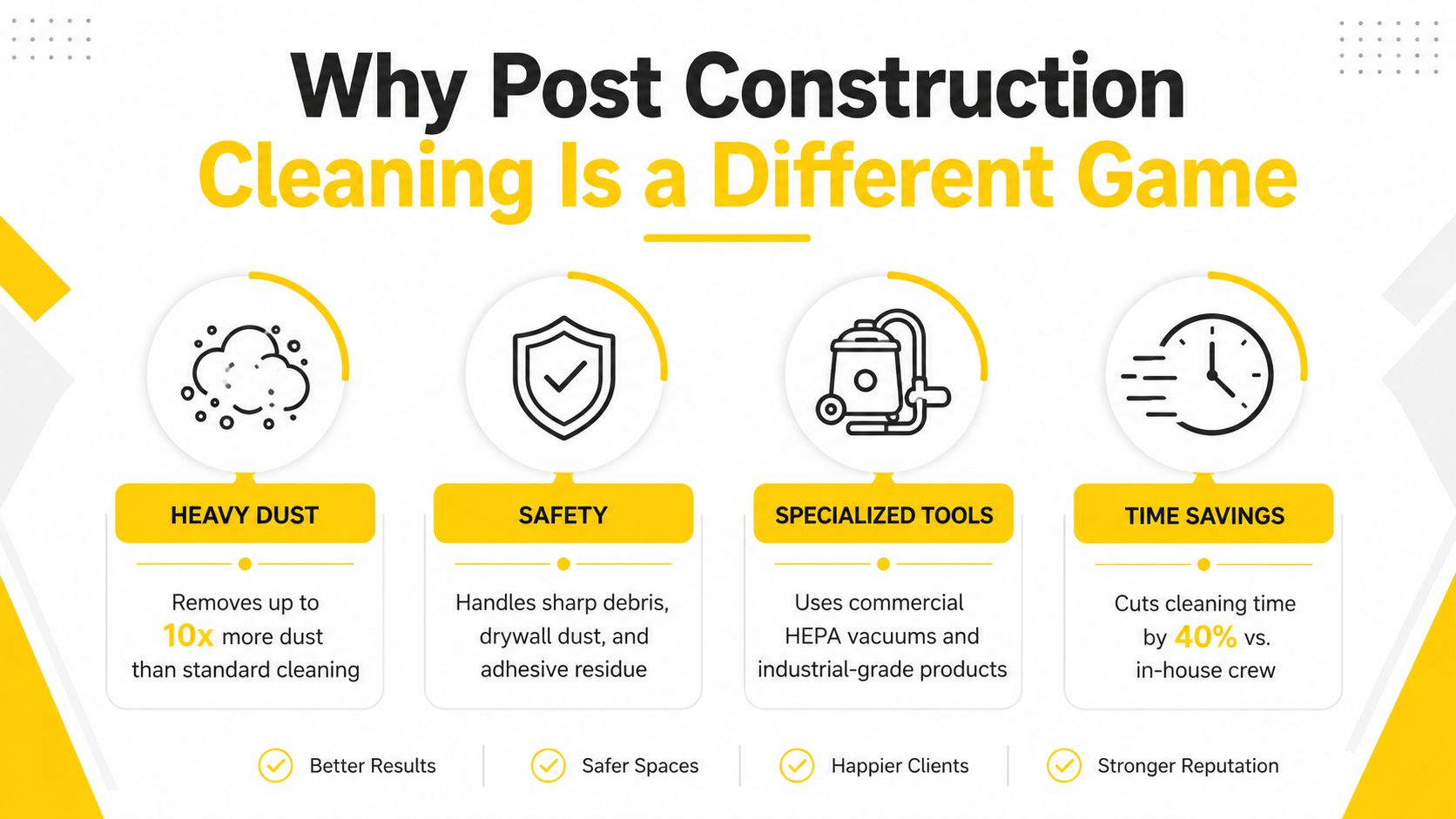
Homeowners complain about crumbs. Commercial clients complain about delays, punch-list slippage, and surfaces that fail inspection because the cleaning scope was never nailed down. Your estimate has to speak the language of turnover, not domestic tidiness. If the scope is vague, the project becomes a pile of free extras, and that is how margin disappears.
Practical rule: if the client cannot tell you which trades are finished, which finishes need protection, and what is included at turnover, the scope is not clean enough to price.
That is also why liability sits near the top of the checklist before you chase bigger jobs. A team working around unfinished surfaces, debris, ladders, and active trades needs coverage and a real safety plan, not wishful thinking. A direct read on liability insurance for a cleaning company belongs in your setup before you take on larger commercial work.
A post-construction job falls apart fast when a crew treats it like one big wipe-down. It is not one pass, and it is not one labor blob. The work has three phases, rough clean, detail or final clean, and touch-up or punch clean right before handover. That order protects margin because you stop polishing surfaces too early and then paying again to remove dust from late trades.
The rough clean comes first. Crews pull out debris, haul trash, strip stickers, and clear the heavy mess so the site can be worked in by the next trade. The goal is access and visibility, not a showroom finish.
The detail clean is where the job starts looking ready for turnover. Use a ceiling-to-floor sequence, start with overhead fixtures and ducts, move to walls and cabinetry, then finish with floors so you do not drag dust back onto cleaned surfaces workflow guidance. That order is the difference between efficient labor and doing the same work twice.
The touch-up clean happens right before handover. Airborne construction particles keep settling after the first pass, so the final visit belongs close to occupancy or inspection, not at the start of the week settling-dust timing. This pass is for fingerprints, trim dust, vent buildup, and the last junk the finishing trades leave behind.
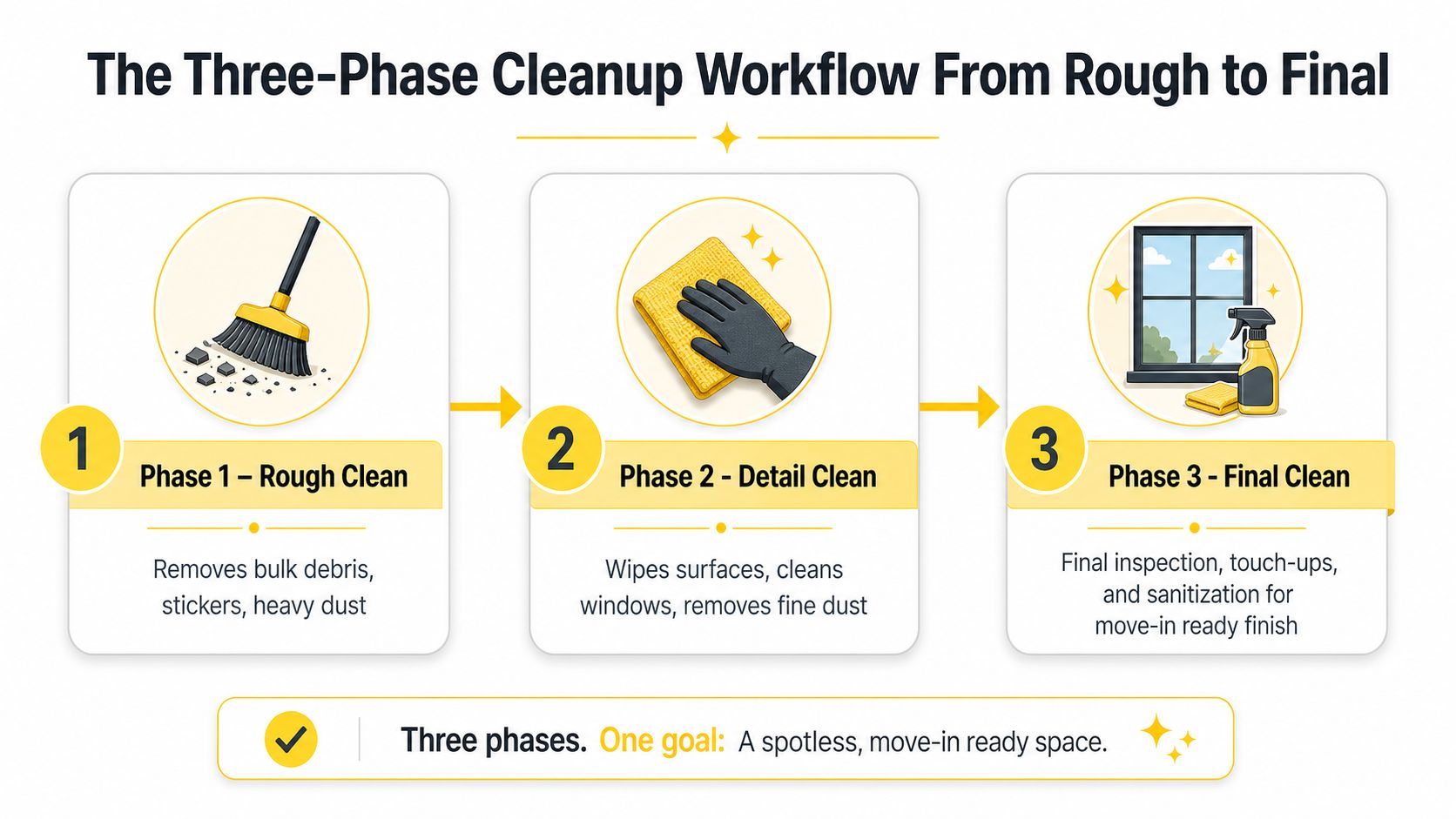
The handoff works better when the crew follows a simple sequence instead of improvising:
Keep a written checklist on site and compare it with a professional deep cleaning checklist. That keeps the crew from guessing, and guessing is how turnover jobs lose money.
A post-construction crew doesn't need fancy branding first. It needs the right equipment, staged correctly, and enough of it to keep moving without returning to the truck every ten minutes. If you're buying gear in the first month, build the kit around the work, not around what looks impressive in a social post.
Heavy-duty equipment should include HEPA vacuums, commercial extractors, microfiber systems, extension poles, ladders, and floor machines. Those tools matter because construction dust gets into seams, vents, and texture, and cheap household gear just throws it back into the air. Trimaco's construction-cleaning guidance also points to industrial-grade vacuums with HEPA filters as a practical standard for fine dust removal tool guidance.
Consumable supplies should include degreasers, neutral cleaners, adhesive removers, glass cleaners, and color-coded microfiber. For a product reference point, commercial sanitisers and degreasers are the kind of cleaning chemistry you want available for site-ready surfaces, not fragile residential wipes. The wrong chemical on a new finish can cost you more than the job paid.
Personal protective equipment is essential. Use P100 respirators, safety glasses, cut-resistant gloves, knee protection, and hi-vis where the site demands it. Post-construction environments can expose crews to silica dust, lead paint in older renovations, and fall hazards around incomplete railings, so the safety plan has to be written, not improvised.
A clean supply list keeps the crew from overbuying junk. I'd keep it tied to a cleaning supplies list and review it before each new type of project.
Operator rule: if a tool only helps once in a while, rent it. If it speeds every job, buy it early.
Most new operators underprice post-construction work because they quote it like labor and discover too late that they sold a scope problem. Price the job by square footage, phase, or hourly labor with materials markup, depending on how predictable the site is and how much access you get before the crew starts. Scope clarity wins here. The contractor who gets the handoff right keeps the margin; the one who guesses eats the overage.
The market gives you a starting point, not a final answer. Typical U.S. post-construction cleaning totals land between $274 and $708, with some jobs falling as low as $144 and others reaching $1,300, depending on the scope pricing guide. National rates often sit around $0.15 to $0.80 per square foot, and many commercial final cleans fall between $0.30 and $0.75 per square foot pricing guide. A 5,000-square-foot commercial space can land around $1,500 to $3,000, while 50,000+ square-foot facilities can run $20,000 to $50,000+ pricing guide. Use those figures as a floor for your estimate, not as permission to quote blind.
| Pricing Model | Best Fit For | Margin Profile | Risk If Misused |
|---|---|---|---|
| Per square foot | Standard commercial spaces with repeatable scope | Strong when access and finish level stay consistent | You underbid detail-heavy jobs if the scope is vague |
| Per phase | Large projects with clear rough, detail, and touch-up handoffs | Good control when trades are staged well | You lose money if the site is not ready for the phase you priced |
| Hourly with materials markup | Small, messy, unpredictable jobs | Better for unknowns and change-heavy work | You invite scope creep if you do not track labor tightly |
One regional benchmark from southern Oregon reports 18¢ to 20¢ per square foot for post-construction cleaning, based on living space rather than the garage regional benchmark. That is useful because it shows this work is usually quoted by area, not by guesswork.
Use a system to estimate cleaning jobs accurately before you send a number. Labor, supplies, overhead, and margin all need to be on the page. I also keep the estimate format standardized with a post-construction cleaning pricing guide so every rep quotes the same way, every time.
Add-ons belong in the estimate, not in your apology later. Window cleaning, HVAC duct cleaning, floor waxing, and exterior cleaning all change the scope materially, so spell them out before the client signs. That is where weak quotes bleed money, one small add-on at a time.
Post-construction work punishes generic cleaners. The right hire can handle debris, detail, and schedule pressure. The wrong hire slows the whole site, damages finishes, and turns your lead tech into a babysitter.
A practical starting point is one lead for every four cleaners, then layer in specialists as jobs get larger. Window work, floor care, and detail work each need people who can move fast without scratching new surfaces. If you dump all duties on one crew, quality drops and callbacks climb.
Training has to focus on execution. That means HEPA vacuum discipline, ceiling-to-floor sequencing, product selection by finish type, ladder use, and respirator use. A new hire should know how to clean drywall dust without smearing it into every seam, and they should know what not to touch until the rough trades are done.
Hard truth: speed without sequence is just expensive damage.
Use role-based hiring, not generic job posts. If you're sourcing through pipehirehrm.com, screen for work history, comfort around ladders, and the ability to follow a checklist under pressure. For tracking applicants and sorting who's ready, a simple applicant tracking system beats a stack of random resumes every time.
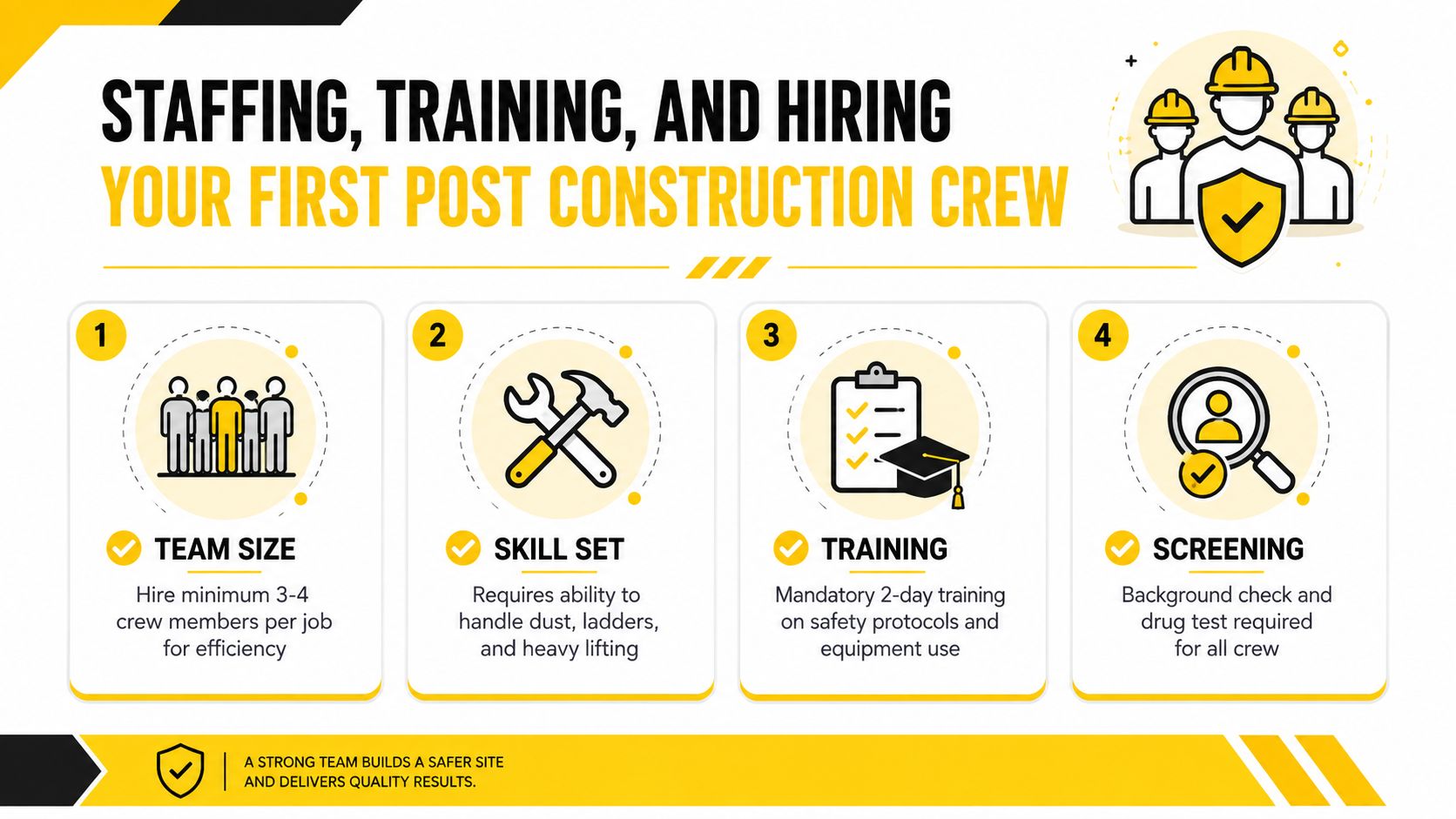
A 30-day onboarding plan should be simple. Week one is shadowing. Week two is supervised task ownership. Week three is phase-specific responsibility. Week four is enough to let the hire run a defined section without constant correction.
The biggest losses on post-construction jobs usually do not come from one blowup. They come from five small misses that repeat until the job goes soft. Scope clarity and quote discipline decide whether you keep margin or donate it to rework, callbacks, and frustrated clients.
Skipping the settling-dust window is the first mistake. Final-clean too early and the site gets dusty again, which means you clean the same surfaces twice. Dust can keep settling for several days, so the touch-up pass belongs close to handover, after the rough work has stopped and the air has had time to settle.
Under-scoping add-ons is the second. Windows, ducts, floor waxing, and exterior areas do not belong in the “we'll see” bucket. If they are not in writing, they are not in your margin, and they will show up later as free labor.
Working without a written punch list is the third. Crews miss vents, trim, switch plates, and late trade residue when there is no site-specific checklist. Use a punch list tied to sign-off, and make the foreman own it.
Ignoring handoff between trades is the fourth. If painters, electricians, and flooring crews are still cycling through, finished surfaces stay exposed to fresh damage. Tie the final clean to trade completion, not to wishful scheduling, and do not send a crew into a job that is still active.
Quoting by hourly labor on a fixed-scope job is the fifth. That is how a clean estimate turns into a labor sink. Price the defined scope as a scope-based job, then charge change orders the moment the work expands.
SERVPRO's guidance on post-construction cleanup makes the scope split plain, the construction company typically handles the initial cleanup, while the owner handles additional cleaning after the crew leaves. That is why your contract language has to be tight.
The hiring side matters too, because weak screening turns into weak crews and messy jobs. Review legal compliance in pre-hire testing before you put people on site, especially if your process includes screening and you need your records clean.
The estimate conversation decides whether a post-construction lead turns into revenue or disappears into voicemail. If a prospect has to wait for a callback, you're already behind. Fast, standardized estimating wins these jobs because commercial clients hate uncertainty more than they hate dust.
That's where an estimator system matters. Estimatty's AI estimator captures square footage, surfaces, urgency, and add-ons, then sends an instant estimate by SMS and email so the prospect gets a number while the job is still top of mind. It also reduces the back-and-forth that usually kills scope clarity on cleanup work. You can see how that looks in practice in the screenshot below.

The bigger move is turning one-off cleanup into account work. Sell recurring maintenance after handover, then bundle window care, floor care, and exterior pressure washing where it fits. That keeps your crews in front of the same property manager instead of chasing a fresh bid every week.
If you want cleaner scopes, faster estimates, and fewer pricing mistakes on post-construction work, use Estimatty to standardize the way your business quotes and books. It's built to capture the details that matter on commercial cleaning jobs, send instant estimates, and keep your crew moving instead of waiting on callbacks.