
November 26, 2026
Window Cleaning Business Guide: Pricing, Quotes and Setup
Learn how a window cleaning business makes money, prices jobs, builds accurate estimates, and wins recurring accounts. Practical numbers included for 2026.

Friday, November 27, 2026
Learn how an instant auto quote works for cleaning businesses, from the first web visit to a booked job, and how it speeds estimates and bookings.

A form lands at 9:47 on a Tuesday night. You're off the clock, the van is parked, and your phone is charging in the kitchen. By the time you read it Wednesday morning, work out a number on your spreadsheet, and text it back, the homeowner has already booked the company that answered at 9:48.
That gap is the entire argument for an instant auto quote on a cleaning site. The phrase gets searched by homeowners who want a price without a phone call, and what they mean is simple: show me a number now, before I keep comparing. An instant estimate does that by turning your pricing rules into a live answer the prospect can see while they're still on the page, at 9:47 pm or 6 am on a holiday.
Most cleaning operators already know their prices. What they don't have is a way to deliver those prices without stopping work, calling back, and asking the same eight questions. That's a systems problem, not a marketing one, and it's fixable in a week.
A prospect searching for a cleaner at 9 pm wants a number before bed. Not a form confirmation, not a promise to call tomorrow, an actual price they can compare against the two other tabs open on their phone. Here's the sequence that gets them there.
The whole flow runs in under a minute on a normal job. Say a three-bed, two-bath house, last cleaned two months ago, with an inside-oven add-on. The prospect starts at 9:47, picks "standard clean" at 9:48, gets a figure at 9:48, receives the same estimate by text, and books Thursday at 9:51. You read the alert on the sofa and do nothing, because the job is already priced, scheduled, and paid.
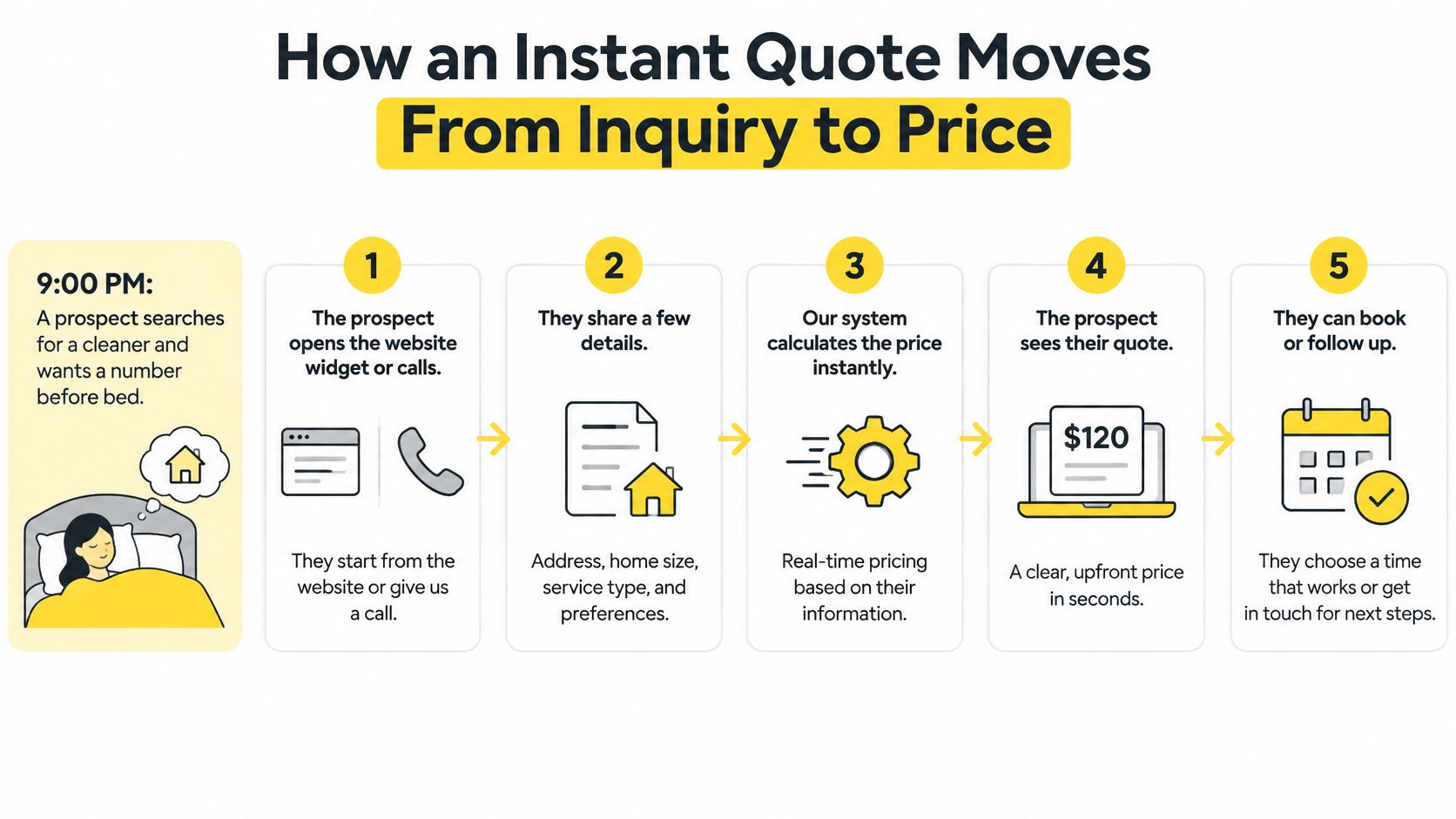
One step belongs in that flow that most operators skip: the privacy line. State in the widget who receives the details and whether they're shared or sold, and give the prospect a clear opt-out before any follow-up SMS goes out. People comparing cleaners are already wary of handing over an address and a phone number to a business that might resell them. Saying plainly "we use this to price your clean, we don't sell it" removes an objection you'd otherwise never hear about.
Estimatty works 24/7/365 on the business's website to deliver instant estimates to potential customers, so the 2 am version of that same prospect gets the same treatment.
A prospect comparing cleaners is shopping right now. Not next week, not after your callback. The moment they submit a request, the clock is running against every other company they contacted in the same sitting, and the first credible price usually wins.
The evidence on response time is unusually blunt. A Harvard Business Review study of 2,241 companies found that firms attempting to contact an online lead within one hour were nearly seven times more likely to qualify that lead than firms waiting an additional hour, where qualification meant reaching a real conversation with a decision-maker. Firms that waited 24 hours or longer were more than 60 times less likely to qualify a lead than those responding within the first hour.
| Response window | Qualification effect | Source |
|---|---|---|
| Within 1 hour | Nearly 7x more likely to qualify than a firm that waits an additional hour | HBR audit of 2,241 companies |
| 5 minutes vs 30 minutes | Odds of qualifying fall about 21x at the 30-minute mark | Lead-response study of 15,000+ leads |
| 24 hours or longer | More than 60x less likely to qualify than a firm responding within the first hour | HBR audit of 2,241 companies |
Read the middle row again. Moving from a five-minute reply to a thirty-minute reply doesn't shave your chances, it guts them. And a callback scheduled for tomorrow morning isn't thirty minutes late, it's twelve hours late.
The callback gap: every hour between a prospect's request and your price is an hour another cleaner can close them.
An instant estimate deletes that gap rather than shortening it. The AI steps in the moment a prospect raises their hand, gives a price and chats with them, and owners can be notified immediately by SMS when someone engages with their website. You're not racing to respond faster than the other guy. You've already responded before he opened his laptop.
The practical rule I'd give any operator: an estimate delivered while the prospect is still on the page beats any callback you could schedule, no matter how good the callback is. If you want the operational version of this, the guide on how to improve response time covers what to measure and where the delays hide.
An estimate is only as good as the inputs behind it. A standard clean of a 1,200 sq ft apartment and a move-out clean of a 3,000 sq ft house are different jobs with different labor hours, and they should never share one price. The whole point of a guided flow is that it collects the difference.
| Input | Why it changes the price | Example |
|---|---|---|
| Service type | Sets the base task list | Standard clean vs move-out clean |
| Last clean date | Shows whether a deep clean is needed | Last cleaned six months ago triggers a deep-clean surcharge |
| Home size in square feet | Drives labor hours | 1,200 sq ft vs 3,000 sq ft roughly doubles the time on site |
| Beds and baths | Sets room count and time on site | Two beds and one bath vs four beds and three baths |
| Pets | Adds hair and odor work | Two dogs |
| Add-ons | Prices extra tasks separately | Inside oven, steam cleaning, AC vents, blinds |
The last-clean date is the input operators underuse most. A home cleaned two weeks ago needs surface work. A home that hasn't seen a mop since spring needs baseboards, buildup, and probably an extra hour. Asking that one question prevents the classic scene where a cleaner arrives expecting a maintenance job and walks into a deep clean at maintenance pricing.
Add-ons belong in the flow, not in a follow-up email. Inside oven, steam cleaning, AC vents and blinds appear automatically during the booking flow, so the prospect sees the options and prices them without you having to upsell by phone. Estimatty collects the information it needs upfront, so the business can go straight to sending the estimate instead of spending two callbacks on basic questions.
Why it matters commercially: the details you capture before the first reply are the details you'd otherwise chase for a day.
If you want a model for how another trade itemizes inputs before it prices, the bathroom remodel cost calculator guide from Trademaster Construction shows how materials, scope, and site conditions get separated into line items. Cleaning is simpler, but the discipline is the same.
Audit your own intake form against this checklist:
Getting the qualification logic right matters as much as the fields. The breakdown of lead qualification criteria is worth reading before you decide which inputs should trigger a human review.
Labor is the largest variable in any cleaning price, and it's not a guess. The U.S. Bureau of Labor Statistics reports a 2025 median wage of $17.71 per hour for janitors and building cleaners, an occupation with roughly 2,432,600 jobs that generally requires no formal credential and short-term on-the-job training. Load that wage with payroll taxes, insurance, supplies, and travel, and you have a floor under every estimate you publish.
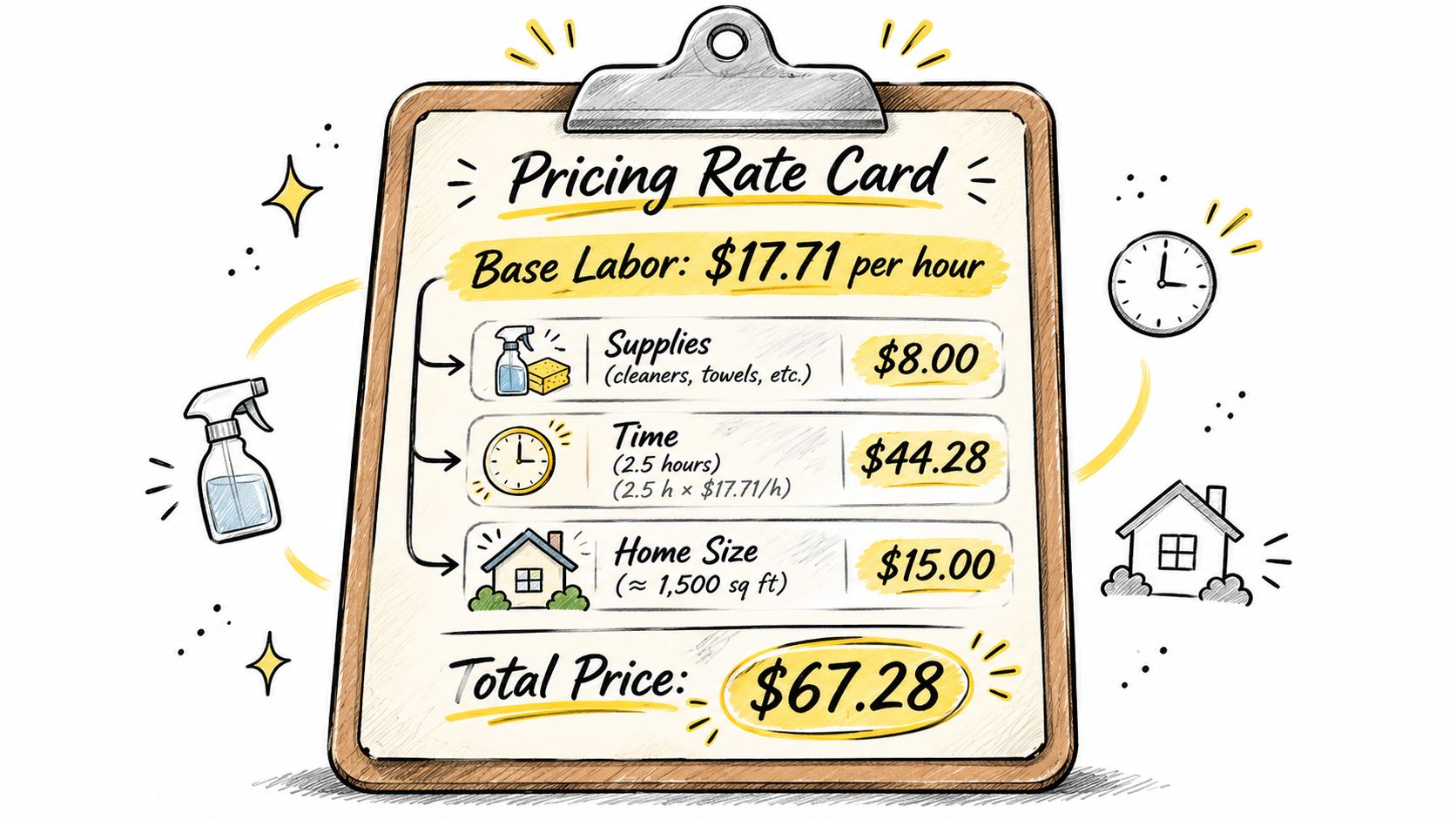
A pricing engine builds one number in a fixed order, and the order matters:
Base price for the service. Standard, deep, or move-out. This anchors the task list before anything else is added.
Labor estimate from square footage and surfaces. Square feet, beds, baths, floor types, and how much scrubbing the kitchen and bathrooms realistically need. Here, the wage figure above becomes hours multiplied by rate.
Deep-clean or pet adjustment. Applied as a multiplier or a flat surcharge, depending on how your rate card is written. Two dogs and a six-month gap both add time.
Add-ons. Priced separately and visibly, so the prospect can accept or decline each one.
Travel or location adjustment. A zone fee or a per-mile charge. Keep it explicit rather than baking it into the base rate, because prospects in your core area shouldn't subsidize the ones forty minutes out.
The same discipline applies when you're pricing other trades on a property. If you ever need to compare new air conditioner installation quotes for a rental or your own home, you'll notice the good contractors separate equipment, labor, and site conditions rather than quoting one lump figure. That's a rate card talking, and it's what makes a number defensible when someone asks why.
Estimatty's Pricebook computes prices across every service, home size and configuration, and every estimate the agent gives is built from it. Two prospects with the same home, the same service, and the same add-ons get the same number, whether they ask at 8 am or 11 pm.
Governance is the part that separates a pricing system from a chatbot. Use versioned rate cards so you can tell which prices were live on the date of any estimate. Set explicit minimum charges so a small job never gets quoted below your cost of showing up. Keep an audit trail that stores each input, rule, surcharge, and discount, which lets you spot an underpriced service line before it eats a month of margin.
The real cost of inconsistency: when one cleaner quotes from memory and another quotes from the rate card, the same house gets two prices and the customer learns not to trust either.
Consistency also protects you in the conversation after the estimate. When a prospect asks why their number is higher than a neighbor's, you can point to specific inputs rather than shrugging. The labor and burden side of that calculation is covered in more depth in the guide on labor and burden.
Automation should know what it can't price. The jobs that break a rate card are predictable: post-construction cleanups with drywall dust in every seam, hoarding situations where the scope isn't visible from the doorway, very large homes, and commercial spaces with their own frequency and access rules. Those need eyes.
The mechanism is a confidence threshold. When inputs are unusual or incomplete, the system flags the estimate and routes it to a person rather than publishing a confident number. A fast wrong number costs more than a slower right one, because a wrong instant price gets accepted, then reversed at the door. That reversal damages trust in a way a short delay never does.
Practical rule: publish the price when the inputs are ordinary, route the job when they aren't, and say which one is happening.
This is why the widget should draw a clear line between an estimate and a final price. The estimate is based only on the details supplied. A site walk-through can change it. Show that plainly, in language the prospect reads before they book, so nobody feels ambushed later.
The line I'd put on the screen: "This estimate is based on the details you provided. If the home needs more work than described, we'll confirm the final price before we start." It's honest, it sets expectations, and it protects the price you quoted.
Eliana J., owner of Sweet Home Cleaning Services, put the operational benefit this way: "It reduces back-and-forth questions, allowing us to go straight to providing an estimate and converting the lead."
Send a job to a human when any of these is true:
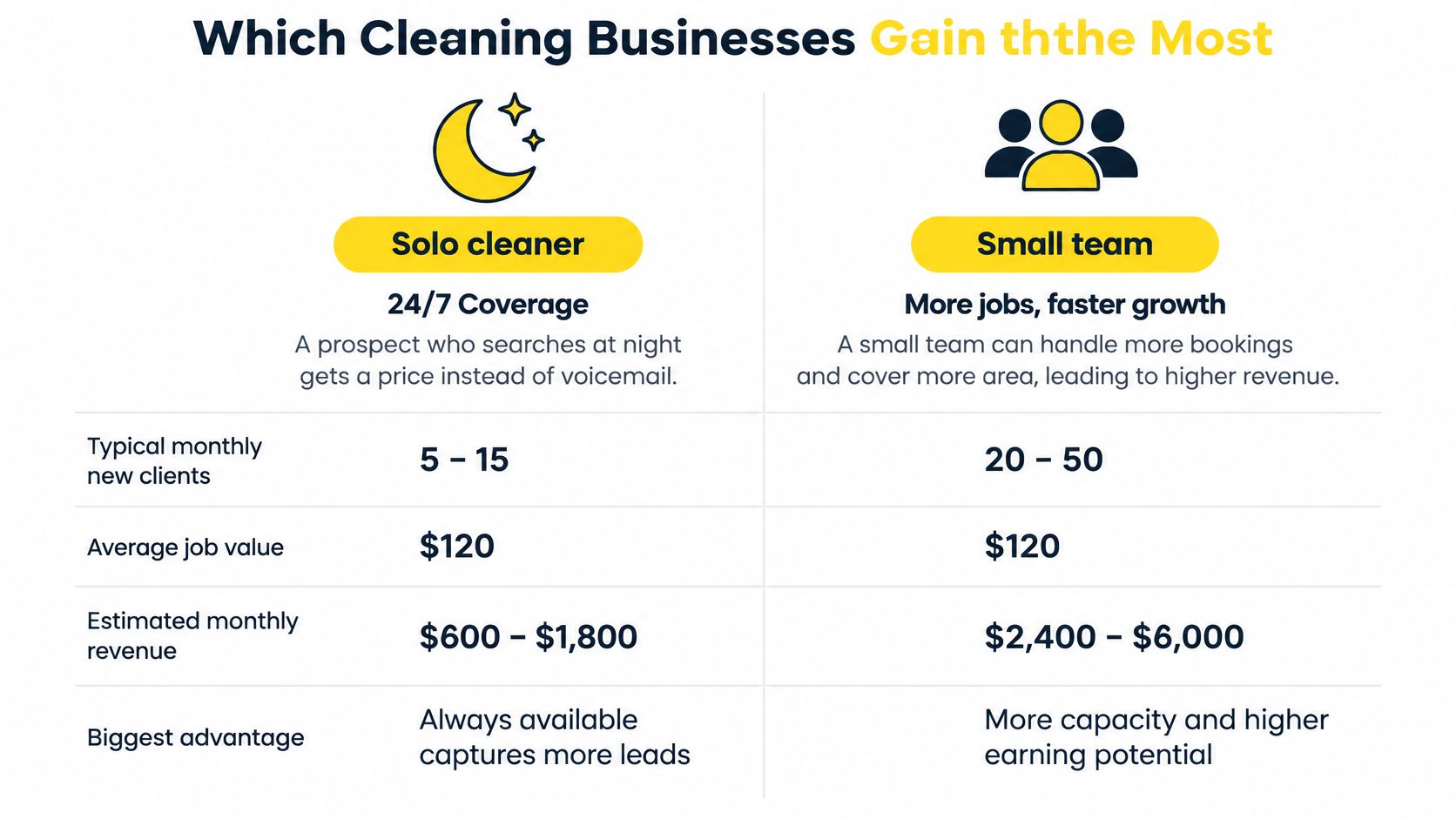
The clearest case is the solo cleaner finishing a job at 7 pm with three missed calls on the phone. Each one is a prospect who wanted a price and got voicemail. Instant estimates change what happens in that window, but the gain looks different depending on how the business is built.
| Business type | Main gap | What to configure | Route to a human when |
|---|---|---|---|
| Solo cleaner | Missed calls after hours | Base pricing, FAQs, SMS alerts | A site visit is needed |
| Small team of 2-5 cleaners | Quotes waiting on the owner | Pricing by service, add-ons | Large or post-construction job |
| Multi-location or franchise brand | Inconsistent estimates by branch | Shared rate card per location | Price falls outside the approved rate card |
| Residential house cleaning company | Slow web forms | Frequency discounts, add-ons | High-value recurring contract |
For the solo operator, the gain is coverage, not speed. You can't answer at 9 pm because you're cleaning or sleeping, and no amount of good intentions fixes that. A system that answers for you recovers leads that used to go straight to a competitor with a live chat widget.
For the two-to-five person team, the bigger win is a single pricing standard. The owner stops being the only person who can produce a number, and nobody quotes from memory on a Friday afternoon. Add-ons get attached consistently, which steadily lifts average order value.
A franchise or multi-location brand has the hardest version of the problem, because every branch has its own habits and its own local costs. Shared rate cards per location plus one audit trail give the head office a view it can't get from a spreadsheet that four managers update differently.
The residential company already running a web form gains speed with the least disruption. The form becomes a guided estimate with add-ons and a price at the end, instead of a submission that sits in an inbox. Estimatty is a 24/7 AI sales and estimating agent for residential cleaning companies, and it starts working immediately once the widget is live on the customer's website. Most owners see their first Estimatty-generated lead within 24 to 48 hours of going live.
The common thread: configure once, review the exceptions, and let the system handle the routine prospects.
The distinction between residential and commercial setups is worth understanding before you configure anything. This comparison of commercial and residential cleaning covers where the two diverge on pricing logic and scheduling.
Don't rebuild the site. Launch on one page this week: your highest-traffic page, one service, and the most common home size you clean. That's enough to prove the flow works and to see whether prospects really use it.

Setup runs in three steps, in this order:
Estimatty starts at $25/week, so a single extra booking covers the cost of the month. That's the arithmetic that makes the decision easy: you're not buying software, you're buying the jobs that currently go to voicemail.
Before you widen the scope to every service, compare your first batch of estimates against the actual invoices for those jobs. The gaps tell you exactly where your rate card is wrong. Maybe the deep-clean surcharge is too low, or travel to one suburb is eating the margin. Fix the rule, not the individual estimate.
If you've seen how another home service business handles this, the Barefoot Organics instant estimate tool is a useful reference for how a simple guided flow looks from the customer's side.
Then track four numbers weekly:
The technical setup details, including how the snippet works, are covered in the guide on code setup, and estimatty.com/blog has the rest of the setup material. Before you compare the instant estimate with your current form and callback process, run one week side by side and watch which path prospects end up completing.
The action is small and specific: publish the widget on your highest-traffic page this week, set the rules for one service, and let the next 9:47 pm form get a price instead of silence.
Estimatty gives cleaning businesses a 24/7 AI sales and estimating agent that answers the moment a prospect visits your site or calls, sends an instant estimate by SMS and email, and books the job while you're still working. If your quotes currently wait on a callback, you can put your pricing rules to work tonight and see which prospects were slipping away. Visit Estimatty to set up your first estimate flow.