November 25, 2026
Cleaning Fort Lauderdale: Prices and How to Choose
Cleaning Fort Lauderdale explained: service types, typical prices, what changes your estimate, and how to choose a provider you can trust.

Thursday, November 26, 2026
Learn how a window cleaning business makes money, prices jobs, builds accurate estimates, and wins recurring accounts. Practical numbers included for 2026.

The global contract window-cleaning market generated approximately $93.16 billion in revenue in 2024, according to Grand View Research as reported by Gaugius. That's a substantial maintenance market, but its size won't make an underpriced job profitable. A window cleaning business succeeds by charging for the work required to deliver clean glass, including access, water treatment, setup and crew time, not just the glass customers can count.
The cheapest estimate often leaves those costs unexplained or unpaid. Build yours around a clear scope and a workable service method, then compete on reliability rather than an artificially low starting price.
A window cleaning business sells safe, clear glass on a recurring schedule. Customers pay for a defined result, the crew delivers it, and the business collects payment against the agreed scope. The squeegee is a tool, not the product.
Say a homeowner books exterior cleaning before hosting guests. You confirm the windows, identify removable screens, check exterior access and offer a return appointment. The first visit produces revenue; the return appointment creates another opportunity without starting the customer-acquisition process from scratch.
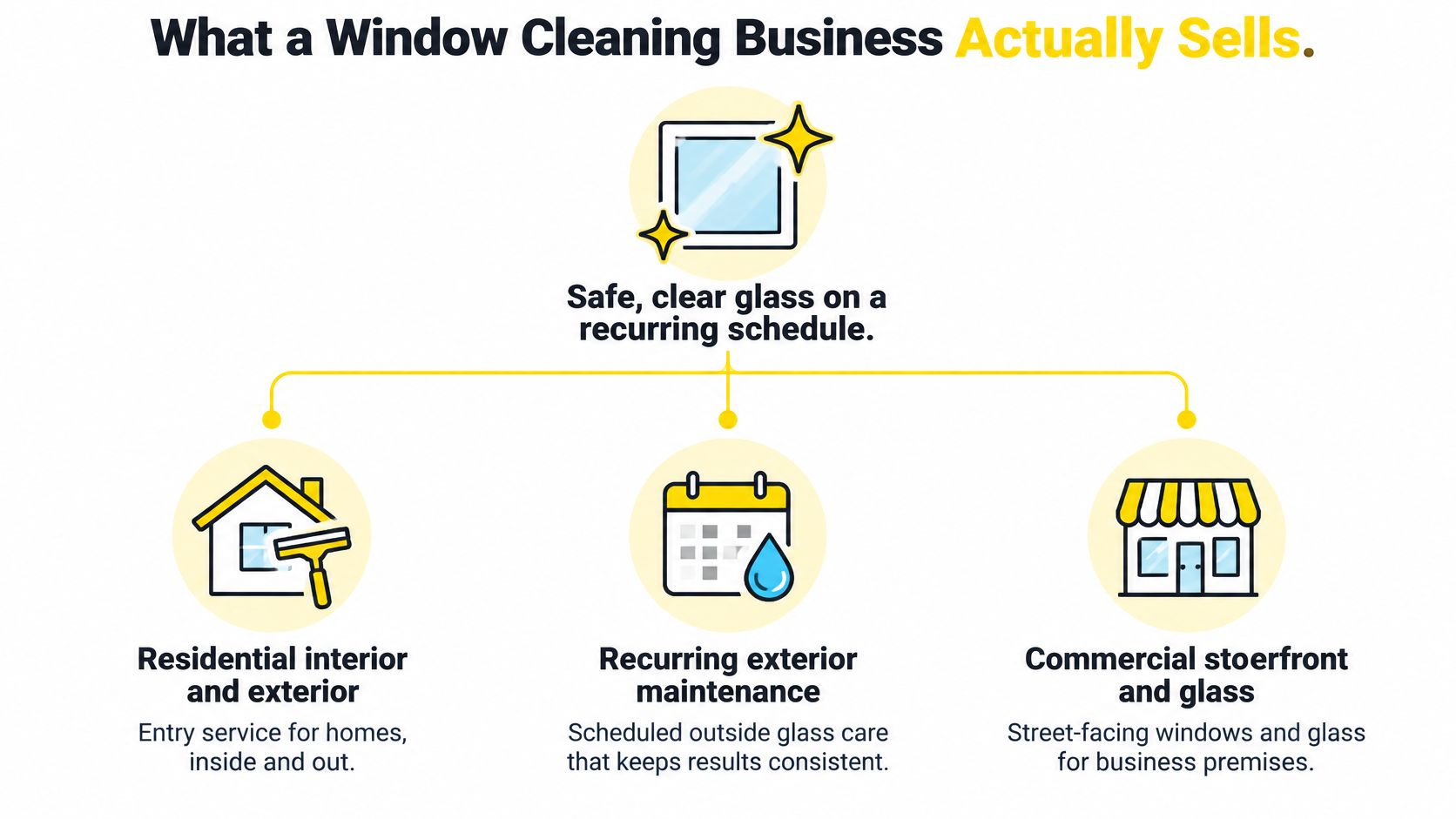
Organize the business around distinct service lines rather than accepting every glass-related request.
Add-ons should be equally clear: screens, window tracks, sill wipe-downs and hard-water removal. Don't casually include restoration in routine cleaning. Identify the condition, explain the treatment and price it separately.
The trade's development explains why access matters: Chicago's Home Insurance Building, completed in 1885, helped create demand for professional exterior-glass maintenance as buildings grew taller, according to J. Racenstein's history of window cleaning.
Keep the operating sequence simple: a lead arrives, someone confirms the scope, the business sets an estimate, the crew completes the visit and the invoice follows. Put the same scope information in the customer's confirmation and the crew's work order.
Recurring visits carry additional value because you don't need to acquire that customer again for every appointment. They aren't automatically profitable, however; the service still needs to fit your route and capacity.
Test your positioning now. Write a sentence naming your core service, another naming your three most common add-ons, and another stating your current share of recurring revenue. If you can't answer cleanly, tighten the offer before expanding it.
Choose between traditional squeegee service and pure-water pole service before setting the production allowance. Each method changes equipment, water use, labor time and the risk of leaving an unsatisfactory finish.
The mechanism is straightforward. Water left on glass evaporates, but its dissolved minerals remain. Those deposits can appear as spots or haze, so reducing total dissolved solids, or TDS, reduces the residue available to settle on the glass.
The My Filthy Windows pure-water technical guide identifies these operating reference values:
These aren't interchangeable acceptance standards. A building-surface target isn't permission to rinse glass with water that leaves visible deposits.
Reverse-osmosis output can still contain dissolved solids. Deionization polishing can remove the residual mineral load before the water reaches the brush. Buy and maintain the treatment system for your source water, rather than assuming every tap will produce the same operating cost.
Use a TDS meter to test source water and treated output. Log both readings with the property, equipment configuration and any finish problems, then replace resin or change treatment when output exceeds your company's validated threshold.
Practical rule: Don't troubleshoot spotting by repeatedly washing the same pane before checking the rinse water.
Also inspect the brush and rinse technique. Clean water doesn't excuse contaminated equipment, incomplete agitation or an inadequate final rinse. Use the squeaky-clean window-cleaning guide to help turn the desired finish into a repeatable service standard.
Price upper-story pole work with treatment as a distinct service allowance or line item. Include filtration consumables, equipment handling and the actual labor involved, rather than copying the rate for accessible ground-level squeegee work.
Start a reading log for your next five jobs. Compare the readings with the finish and treatment used, then adjust your operating threshold using actual field results.
Window cleaning pricing units and typical ranges
| Pricing unit | Typical range | Best for | Worked example |
|---|---|---|---|
| Per window | $10–$18 | Countable residential glass | 20 windows at $12 = $240 |
| Per pane | $4–$8 | Divided and French windows | Pane count multiplied by the selected pane rate |
| Per cleaner-hour | $45–$75 | Uncertain or mixed scopes | Hypothetical calculation: 3 hours at $60 = $180 |
| Per square foot | $0.10–$0.35 | Large exterior surfaces | Measured glass area multiplied by the selected rate |
| Minimum service charge | $100–$150 or higher | Small jobs with travel and setup | Applied when the base falls below the minimum |
The benchmarks in this table come from Workly's published 2026 pricing guide, including its example of 20 windows at $12 each producing a $240 base estimate before add-ons. Treat these as reference points, not instructions to copy a competitor's economics.
Per-window pricing is easy to explain when the property contains reasonably consistent window types. Define what counts as a window, though. Otherwise, your estimator and customer may count the same opening differently.
Use per-pane pricing when frames divide the glass into separately cleaned surfaces. A large opening with divided panes can require more edge work than a simple picture window, even when the overall area is similar.
Cleaner-hour pricing works when condition or scope makes production uncertain. State the assumptions and how additional work will be authorized. Don't confuse the customer's billable rate with the cleaner's wage.
For large exterior surfaces, area can provide a useful starting unit. The window-cleaning price-per-square-foot guide offers further context, but the measurement still needs an access and condition assessment.
Commercial pricing makes the difference particularly clear. Squeegee Squad Tulsa's commercial FAQ lists recurring exterior work at $0.11–$0.18 per square foot and first-time work at $0.24–$0.36, while identifying access, glass condition, safety planning and obstacles as price drivers.
Don't turn that spread into an automatic discount for anyone who promises repeat business. Establish the initial condition first, then price maintenance around a repeatable scope and service interval.
A pricing unit organizes the calculation. It doesn't replace a production estimate.
Before sending a total, check whether the expected crew time leaves room for overhead and profit. If it doesn't, investigate the cause: an unsuitable unit, missed setup, underestimated condition or an unrealistic production allowance.
Choose the unit for each job type you serve, write down your minimum charge and test the result against three real past jobs. Compare estimated labor with actual labor, not just the final invoice.
Residential whole-property scope ranges
| Scope | Typical range | What the estimate must list |
|---|---|---|
| Interior and exterior | $115–$395 | Interior glass, exterior glass, screens, tracks, flagged access |
| Exterior only | $96–$285 | Exterior glass, screens, access notes |
Housecall Pro's window-cleaning pricing guide gives these whole-property ranges and illustrates a $240 base for 20 windows at $12 each, plus $40 for screens, producing a $280 total. Listing screens or tracks in an estimate means identifying whether they're included, optional or excluded, rather than bundling them into every service.
Count windows by floor, side and type. Record unusual assemblies separately and label photographs by elevation. This gives the field crew a count they can reconcile without calling the office.
Set the base scope. Choose interior, exterior or both, and identify customer preparation requirements. Interior work may require furniture access, while exterior work may depend on gates being open.
Multiply by the appropriate unit price. Apply your window or pane rate to the classified count. Keep the calculation in your internal record even if you present the customer with a fixed total.
Add optional work as separate line items. Use the worked calculation above to distinguish the glass-cleaning base from screen cleaning. Tracks and hard-water removal should receive the same explicit treatment.
Apply your minimum-charge rule. If the base falls below the minimum, show the applicable service charge clearly. Don't hide it inside an unexplained adjustment.
Flag access concerns before sending. Upper-story work, questionable sills or unresolved anchorage should interrupt routine pricing. Assign a reviewer rather than sending an estimate the crew may be unable to honor.
Send the total with the scope attached. Include service timing, exclusions and how changes will be approved. Give the customer a straightforward way to accept the defined work.
The finished estimate should show how scope and operating conditions lead to the total.
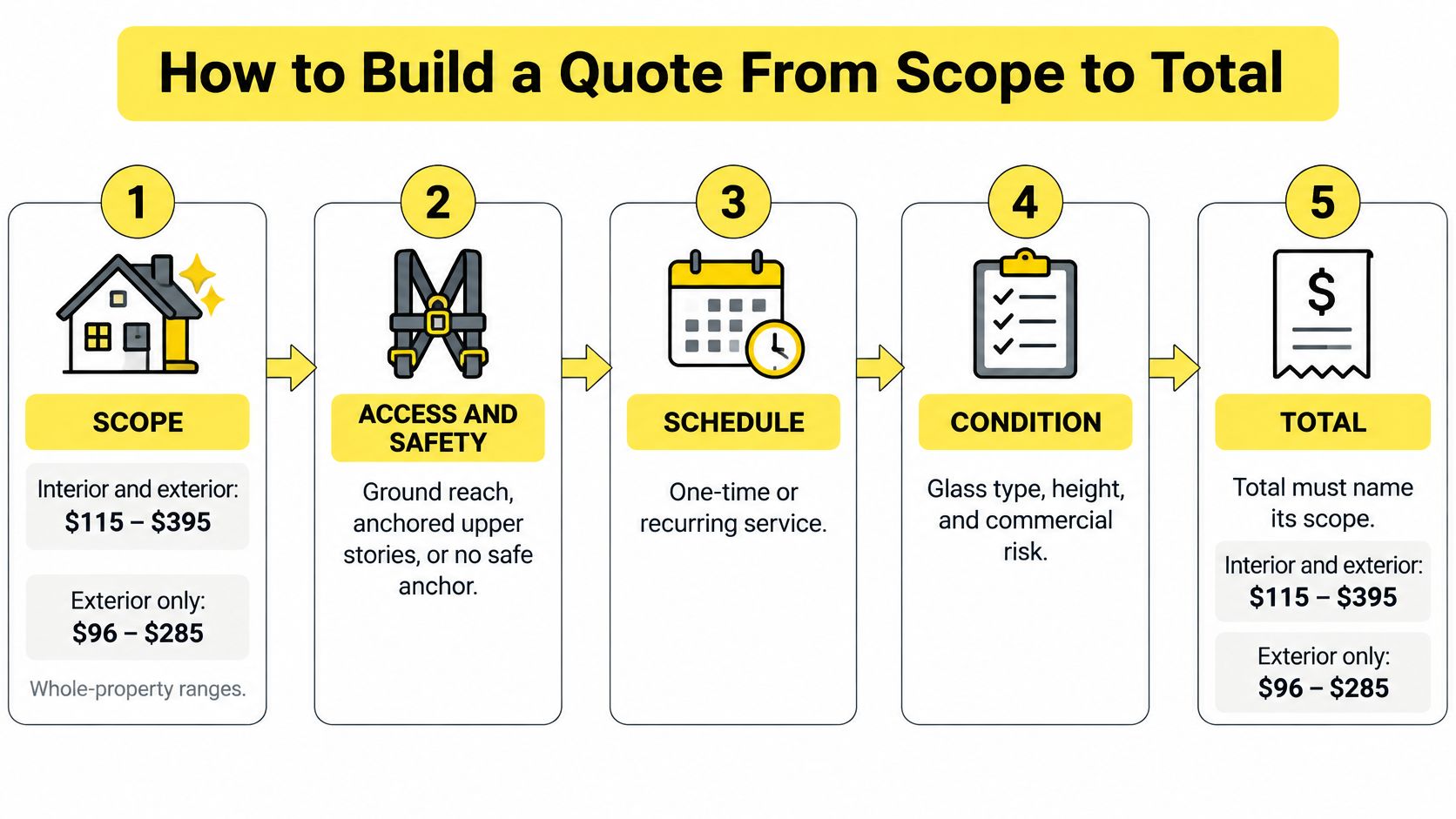
Separate line items prevent a familiar dispute: the customer expects detailed track cleaning while the crew was scheduled only for glass. They also make omissions easier to spot before dispatch.
When conditions change, document the additional work and get approval before proceeding. Don't ask technicians to recover estimating mistakes through unpaid effort or rushed cleaning.
Produce a scope-labelled estimate from a recent job and compare it with what you charged. Identify every task the crew performed that the customer never saw in writing.
The lowest price doesn't win if the contractor can't safely complete the promised work. A cheap estimate that excludes access equipment or setup is an incomplete offer, not an efficient one.
Use site conditions to decide whether a request belongs in routine estimating or needs human review.
| Site condition | Likely method | Estimate impact | Routing |
|---|---|---|---|
| Ground-level windows with clear reach | Hand tools or an appropriate ladder | Standard base rate | Automated estimate |
| Upper stories with compliant anchors | Water-fed pole or lift, subject to assessment | Access surcharge and extra labor time | Estimate with photos |
| Upper stories with weak or narrow sills | Rope-access specialist or site assessment | Estimate after inspection | Human review |
| No compliant anchorage | Lift or specialist assessment | Estimate after inspection | Human review |
These are screening routes, not equipment approvals. A pole or lift has its own operating limits, and a specialist must establish a compliant method rather than work around missing protection.
OSHA's fall-protection framework limits personal fall-arrest free fall to 6 feet, requires window-cleaning positioning systems to withstand a 6-foot drop test using a 250-pound weight, and specifies window anchors supporting at least 6,000 pounds; it also prohibits using sills with snow, ice, slippery contamination or structural deterioration.
Don't treat those requirements as a checklist an estimator can certify from a customer's description. They explain why access details can change the method, staffing and equipment required.
Use the following visual as a reminder to assess the complete working arrangement.
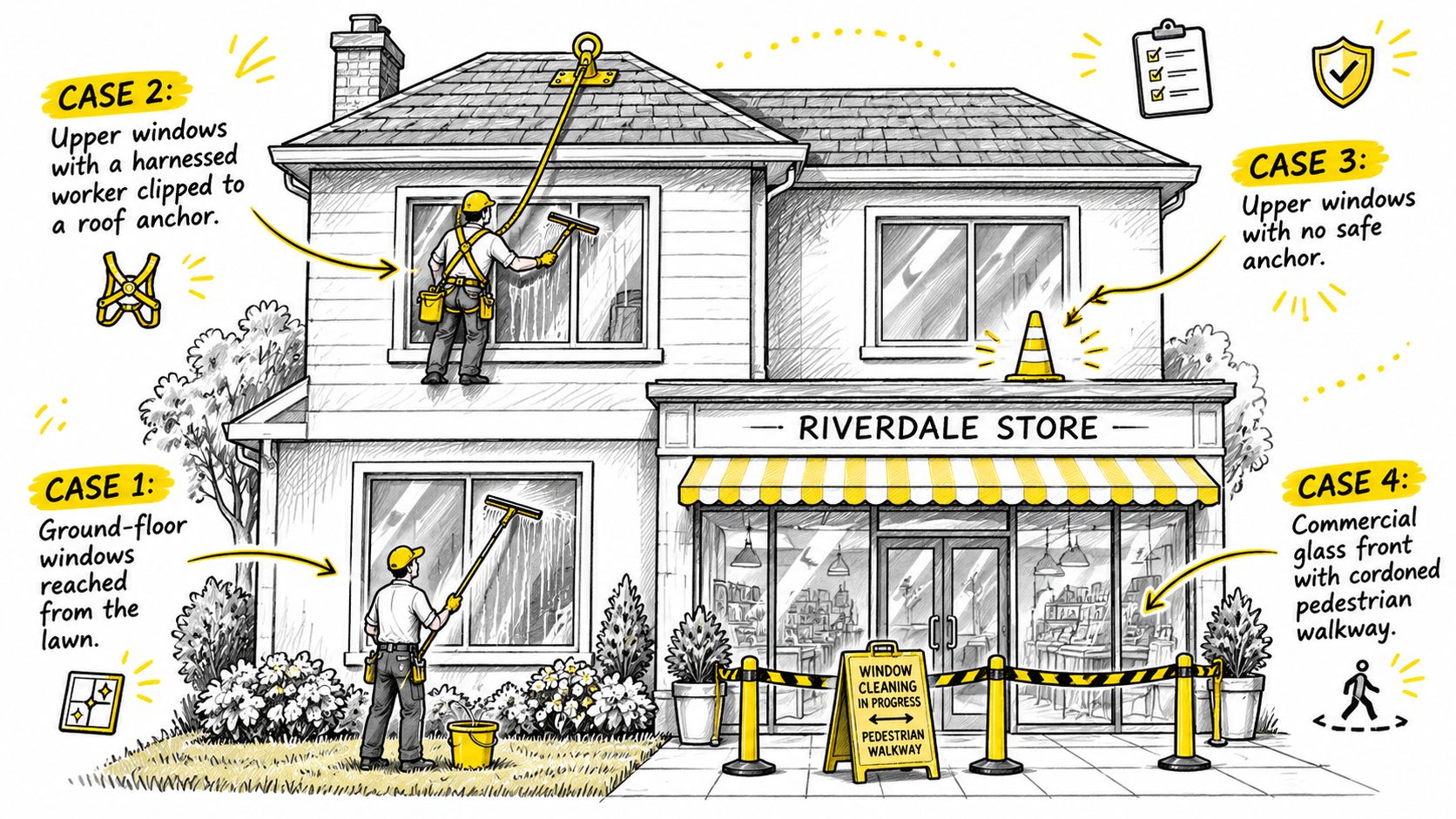
Capture story count, exterior access, sill and ledge condition, obstructions and photographs during intake. Ask about locked areas, pedestrian traffic and restricted service hours before committing a crew.
Maintenance work with established access belongs in a different production category from an initial visit with obstacles and unresolved setup. Charge for that difference instead of expecting technicians to absorb it.
Commercial test: Can you explain how the crew will reach the glass and where the setup time appears in the estimate?
Review insurance alongside the service method. The ABS Insurance Brokers cleaning cover guide from ABS Insurance Brokers Pty Ltd is a useful resource for preparing coverage questions; the cleaning-company liability insurance guide provides additional context for reviewing business exposure.
Route high-risk requests to a named reviewer. An automated price does not confirm that a job is safe or compliant.
The U.S. Bureau of Labor Statistics reports a 2025 median wage of $17.71 per hour, or $36,840 annually, for janitors and building cleaners, an occupation with about 2.43 million jobs, typically no formal educational credential, short-term on-the-job training and projected growth of 2% from 2025 to 2035. This is a broad cleaning-occupation benchmark, not a specialist window-cleaner pay schedule.
The wage is only your starting point. You also pay for time and resources that never appear as cleaning minutes on a customer's invoice.
Use a consistent accounting period and build the calculation in this order:
Avoid double-counting travel wages if they're already included in total payroll. The labor-and-burden guide can help you distinguish the wage from the broader cost of delivering service.
The IRS employee-versus-contractor guidance says classification depends on the degree of control and independence, not the contract's label, and employers generally must withhold and deposit employment taxes for employees.
If you set methods, hours and tools, don't assume calling someone a contractor settles the question. Evaluate the relationship and meet the applicable payroll obligations.
When hiring cleaning employees, Pipehire is a resource to consider. Give new hires a documented workflow covering glass identification, equipment checks, customer-property protection and escalation when conditions differ from the work order.
Price against loaded hourly cost, not the advertised wage. Otherwise, a full schedule can still leave too little money to replace equipment, supervise crews or retain capable cleaners.
Start with customer channels you can maintain consistently: reviews from completed residential jobs, referrals from satisfied customers, an accurate local listing and a website form that returns estimates promptly. Show the service area, explain what's included and use photographs of work you're authorized to publish.
Ask for the next appointment while the customer is satisfied with the result. For practical acquisition ideas, use the guide to getting more cleaning clients, then concentrate your effort where you can build a serviceable route.
Commercial recurring accounts can become valuable anchors. The Boring Riches window-cleaning business guide cites commercial accounts around $300–$2,000 monthly, but a monthly contract value alone doesn't tell you whether to accept the work.
A low-priced account can consume peak-season capacity, leave long travel gaps or require visits when access is difficult. Judge the account using operating measures rather than the appeal of predictable billing.
Keep the definitions consistent. Crew-hours must include each worker's time, not just the elapsed time shown on the calendar.
Consider a hypothetical monthly commercial contract paying $1,500 and requiring 30 crew-hours, including 40% travel time. It produces $50 per crew-hour before costs.
Compare it with a hypothetical dense residential route producing $2,400 across 24 crew-hours, including 10% travel time. That route produces $100 per crew-hour before costs.
These aren't market benchmarks or profit figures. They show why you should compare revenue against the complete time commitment, then subtract the relevant costs before deciding which work deserves capacity.
Reject a recurring account when it displaces better work during your busiest periods or requires access arrangements you can't reliably deliver. An annual relationship doesn't justify an operating loss.
Protect the schedule before offering a discount. A fixed service slot can be more useful to both parties than a lower price.
Offer a defined recurring slot, a narrower scope or a service interval that fits the property's condition. If none produces acceptable economics, decline the account professionally.
For residential cleaning companies, Estimatty is an AI-powered sales estimator that gives existing business websites instant estimates, online booking and 24/7 voice sales. Customers enter details on the business's website and receive instant estimates, while the owner only visits when a job is high-value or already booked.
Keep improving the operating process through the Estimatty blog and the Pipehire hiring blog. Better lead handling and better staffing should support the same goal: accepting work your team can deliver profitably.
Score each prospect against the operating measures before sending a price. Then review the first ten estimates you send against actual scope, crew time and account quality, and adjust the rules before increasing lead volume.
Estimatty gives residential cleaning businesses instant website estimates, online booking and 24/7 voice sales, so prospects can take the next step without waiting for a callback. Define your scope, add-ons and review boundaries first, then visit Estimatty to put a more consistent estimating process on your existing website.