September 21, 2026
Inside and Out Cleaning: A Practical Pricing Guide
Learn what inside and out cleaning really includes, how pricing works, and which add-ons actually pay off for residential and commercial estimates.

Tuesday, June 16, 2026
Discover how much should i charge for your residential cleaning business. Our 2026 guide covers rates, overhead, profit, & tools for consistent estimates.
.png)
A lot of residential cleaning owners ask How much should I charge? when what they really mean is, “How do I stop undercharging without scaring people off?”
I know that spot. A lead texts. You stare at the phone. If you go too high, you think you'll lose the job. If you go too low, you win the job and hate it by the second visit. That's not a pricing problem. That's a system problem.
When I was cleaning solo, I thought pricing was about picking a number that felt reasonable. Once I started building a team, I learned the hard way that “reasonable” is what broke owners say right before payroll, supplies, gas, and reschedules eat the week. Profitable cleaning companies don't guess. They build a pricing system that covers cost, protects margin, and stays consistent when different leads ask for different things.
The worst pricing conversations happen when you haven't decided what your service is worth before the client asks. Then you start negotiating against yourself.
A homeowner says, “What do you charge for a standard clean?” You ask a few rushed questions, throw out a number, and hope it works. Later, you realize the house has pet hair packed into baseboards, two kids, one home office, a neglected primary bath, and a kitchen that needed a reset, not a maintenance clean. You didn't price the job. You volunteered to learn an expensive lesson.
That's why I stopped treating price like a reaction and started treating it like a process.
Modern service pricing has shifted from charging only by time to charging by value, and that matters for cleaning because the client isn't buying your labor alone. They're buying a clean, peaceful home and the relief that comes with it, as explained in Better Proposals' service pricing guide.
That doesn't mean you ignore labor. It means labor is your floor, not your sales story.
You shouldn't be paid less because you got faster, better organized, and more consistent.
In residential cleaning, speed comes from systems, route planning, checklists, better hiring, tighter training, and repeat visits. If you only charge by time, every improvement you make can reduce your income. That's backward.
When owners ask me how much should I charge, I tell them this first: stop looking for one perfect number. Build a repeatable way to price every home.
Your system should answer these questions every time:
If you need a starting point to organize that logic, this free cleaning estimate calculator article is useful because it forces you to think in inputs, not guesses.
Most owners don't need more courage. They need a pricing framework they trust enough to use without flinching.
If you don't know your numbers, you don't have pricing. You have hope.
A lot of cleaners copy local competitors, scan Facebook groups, or ask what other companies charge per hour. That's lazy pricing. It ignores your payroll, your route, your supplies, your admin load, your software, and the jobs that lose money because you priced the visible work and forgot the business wrapped around it.
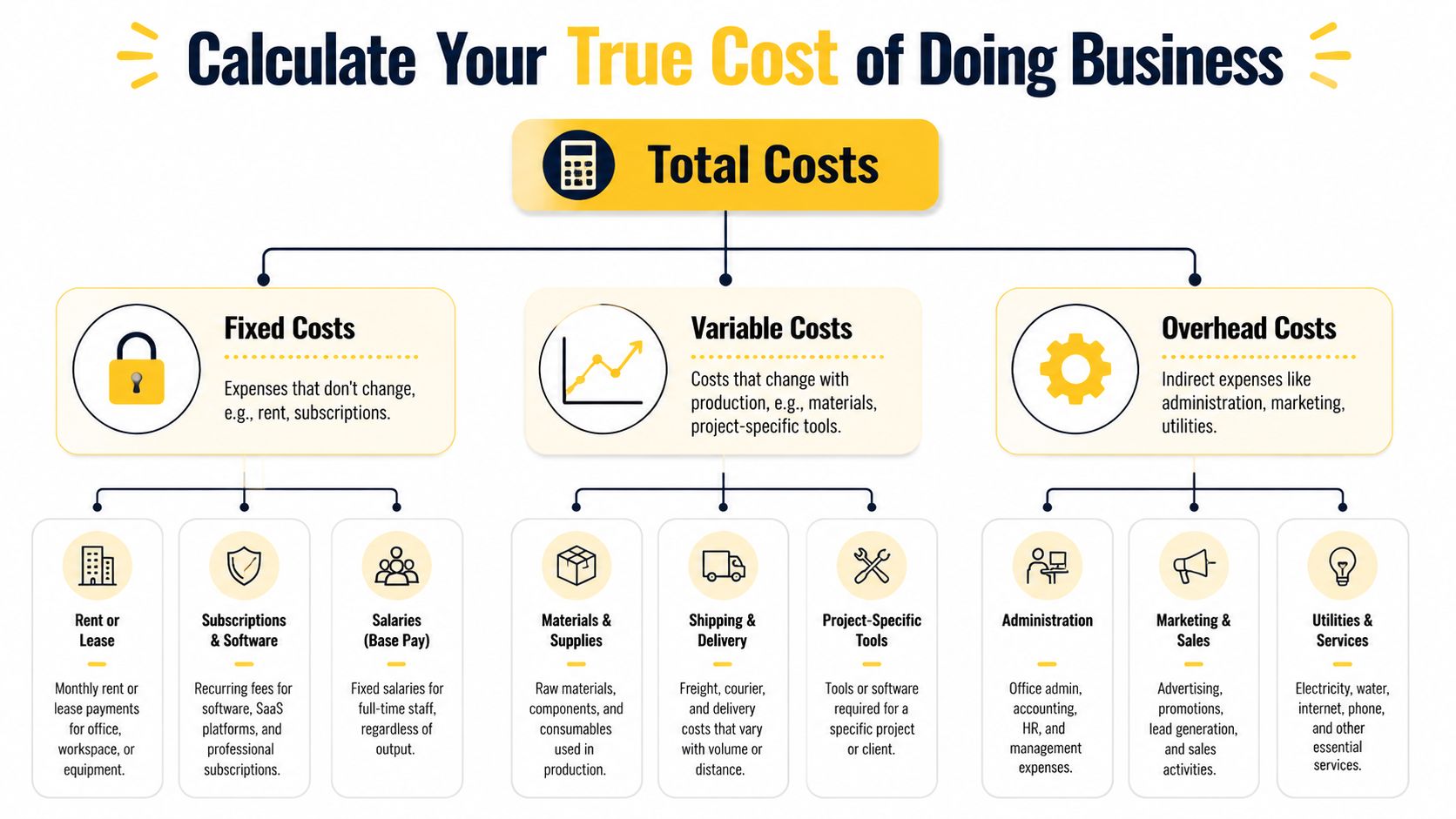
A sound pricing method starts with cost structure. Business guidance recommends separating fixed costs and variable costs, then calculating cost per unit from total fixed costs plus total variable costs divided by total units delivered. It also stresses that underpricing happens when owners ignore overhead, administration, or rising input costs. The same guidance gives the formula gross margin = gross profit / revenues × 100, which is why you need full cost visibility before you choose any markup, as outlined in Bank of America's pricing guidance for small businesses.
For a residential cleaning business, I'd break costs into these buckets:
If your overhead still feels fuzzy, this guide on how to calculate overhead costs is worth reviewing before you set another estimate.
Most owners underprice because they lie to themselves about labor.
They count the time inside the house, then ignore loading, driving, supply restocking, laundry, client texting, key pickup, lockout delays, and the time spent fixing mistakes. Labor isn't just what happens with a vacuum in hand.
If you're solo, pay yourself a real wage in your numbers. If you're building a team, include payroll burden, training time, and replacement costs. Hiring matters here too. If you need a better process for recruiting and managing cleaners, PipehireHRM's blog is a practical place to look.
Practical rule: If a task steals time every week, it belongs in your pricing model even if the client never sees it.
I like a simple sequence:
That gives you a break-even baseline. Not your final selling price. Your floor.
Here's the mistake I see constantly. Owners pick a selling price first, then try to make the math work afterward. Do the opposite. Build from cost first, then decide where profit goes.
Your competitor may have cheaper labor, tighter density, lower insurance, older equipment, a smaller service area, or lower standards. Their price is not your math.
You can charge less than your cost and stay busy for months. Busy isn't profitable. It just hides the problem until you need cash.
Once you know what it costs to run your residential cleaning company, you stop asking “What do people around here charge?” and start asking “What price keeps this business healthy?”
Once you know your baseline cost, the next decision is how to package it for the client.
For residential cleaning, most owners end up choosing between hourly and flat rate. I've used both. Hourly is easier when you're new. Flat rate is better when you want a business that scales cleanly.
Hourly pricing is simple. You track time, multiply by your rate, and bill from there. That's why newer cleaning owners lean on it.
It also creates problems fast. The client watches the clock. Your team slows down because efficiency lowers revenue. And every estimate turns into a vague conversation about how long something “should” take.
A practical way to set an hourly rate is to anchor it to market compensation. Consulting guidance suggests looking at comparable salary data, converting that using a reduced utilization assumption, and then increasing rates by 10–20% every six months until you hit market resistance, which gives you a disciplined way to test pricing without changing everything at once, according to Consulting Success.
That's useful as a baseline. It is not the business model I'd build around long term for home cleaning.
Flat rate pricing gives the client certainty. It also lets you keep the upside when your systems improve.
If your team gets faster because training improves, route density gets tighter, and your checklists are sharper, your profit should go up. Flat rate allows that. Hourly punishes it.
Here's the simple way to use both without getting stuck in both. Build your internal estimate around labor time and cost. Present the client a flat rate tied to scope.
Clients want to know what the clean will cost. They don't want to sponsor your stopwatch.
| Factor | Hourly Rate | Flat Rate |
|---|---|---|
| Client expectation | Can feel open-ended | Clear total before work starts |
| Your efficiency | Faster work can reduce revenue | Faster work can improve margin |
| Scope changes | Often leads to billing disputes | Easier if scope is defined upfront |
| Sales process | Simple to explain | Stronger for packaged services |
| Team scaling | Harder to standardize | Easier to train and sell consistently |
| Repeat cleaning | Can vary too much visit to visit | Easier to lock into recurring service |
If you want examples of how other cleaners package services, this cleaning service price list guide gives useful structure.
Use hourly math behind the scenes. Sell flat-rate estimates to clients.
That gives you the control of labor-based calculation without forcing the customer into hourly uncertainty. For first-time cleans, deep cleans, and homes with obvious unknowns, build in enough room for condition, clutter, and reset work. For recurring cleans, tighten the scope and keep the estimate predictable.
If you insist on hourly, use it selectively. Good uses include overflow work, unusual one-offs, and edge cases where scope is impossible to define upfront. But for your core residential offers, flat rate is the cleaner model.
A break-even number keeps you from losing money. It does not build a strong company.
A common pitfall for many cleaning owners is that they stall out. They do the math once, pick a price, and never adjust it for difficulty, geography, home condition, or service mix. Then they wonder why some jobs feel great and others feel like punishment.
First, decide that profit is not leftovers. It belongs in the estimate from the start.
If you don't build profit into the price, the business runs on whatever is left after payroll, supplies, and chaos. Some weeks that's fine. Some weeks it's nothing. That's not control.
Your base estimate should cover costs. Then you add enough room for business health, hiring, equipment replacement, training, and the messes that show up in real operations.
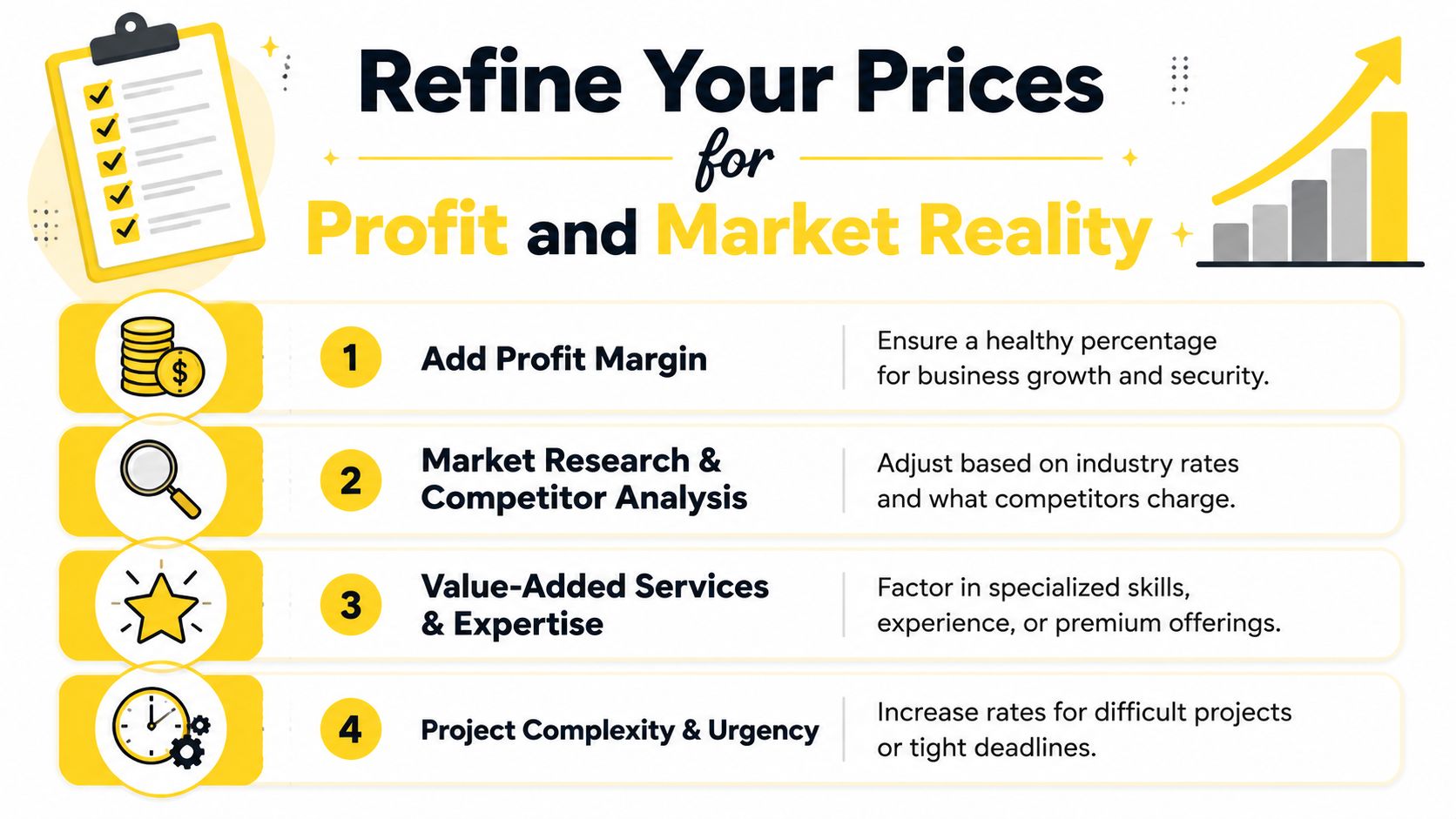
A residential cleaning price should change when the work changes.
What deserves an adjustment?
Don't apologize for these adjustments. They're not penalties. They reflect real labor and real cost.
Pricing also has to reflect where the home sits in your service area. Density matters.
One analysis of home-service expansion found the cost per location was about $13,243 below 5 housing units per square mile, $9,154 at 5 to 10, $6,015 at the modal 20 to 50 range, and $1,150 in the densest areas, with an overall average of $5,266, which shows how sharply cost to serve changes with geography in field-service businesses, according to this density analysis.
You don't need to copy those figures into your own client-facing pricing. You do need to learn the lesson. A suburban route with long drive gaps costs more to operate than a tight urban cluster. If you charge the same across both, one territory subsidizes the other.
A house is not just a house. It sits inside a route, and the route changes the economics.
Too many cleaning owners treat add-ons like favors. Stop that.
Build a menu. Use it consistently. Offer it every time it fits.
Good residential add-ons often include:
These extras do two things. They raise ticket value and they help clients buy exactly what they want instead of forcing one generic package onto every house.
I prefer a simple menu structure: recurring maintenance clean, first-time reset clean, deep clean, and add-ons. That's easier to train, easier to sell, and much easier to estimate consistently than custom pricing on every inquiry.
When owners ask how much should I charge, the better question is this: “What variables should change the estimate every single time?” Once you answer that, your prices stop drifting.
A pricing strategy only works if you can deliver it quickly and consistently when a lead shows up.
The money leak isn't just undercharging. It's slow follow-up, vague phone pricing, forgotten add-ons, and estimates that change depending on which employee answered the message.
If you're giving prices from memory, you're probably missing scope.
That isn't a personal flaw. It's a system flaw. Cost estimating guidance points to three common errors: incomplete scope definition, optimistic productivity assumptions, and missing indirect costs. It also recommends checking estimate vs. actual variance on past jobs to refine accuracy over time, as explained by Nomitech's cost estimating overview.
That applies directly to house cleaning. If you don't define the scope well, your estimate is weak before the crew even arrives.
Common misses include:
If your estimates often swing after the walkthrough or first clean, study your own estimate-versus-actual pattern. That tells you where your intake is too loose.
Software helps in this regard. You want the same questions asked every time, the same adjustment rules applied every time, and the same estimate structure sent every time.
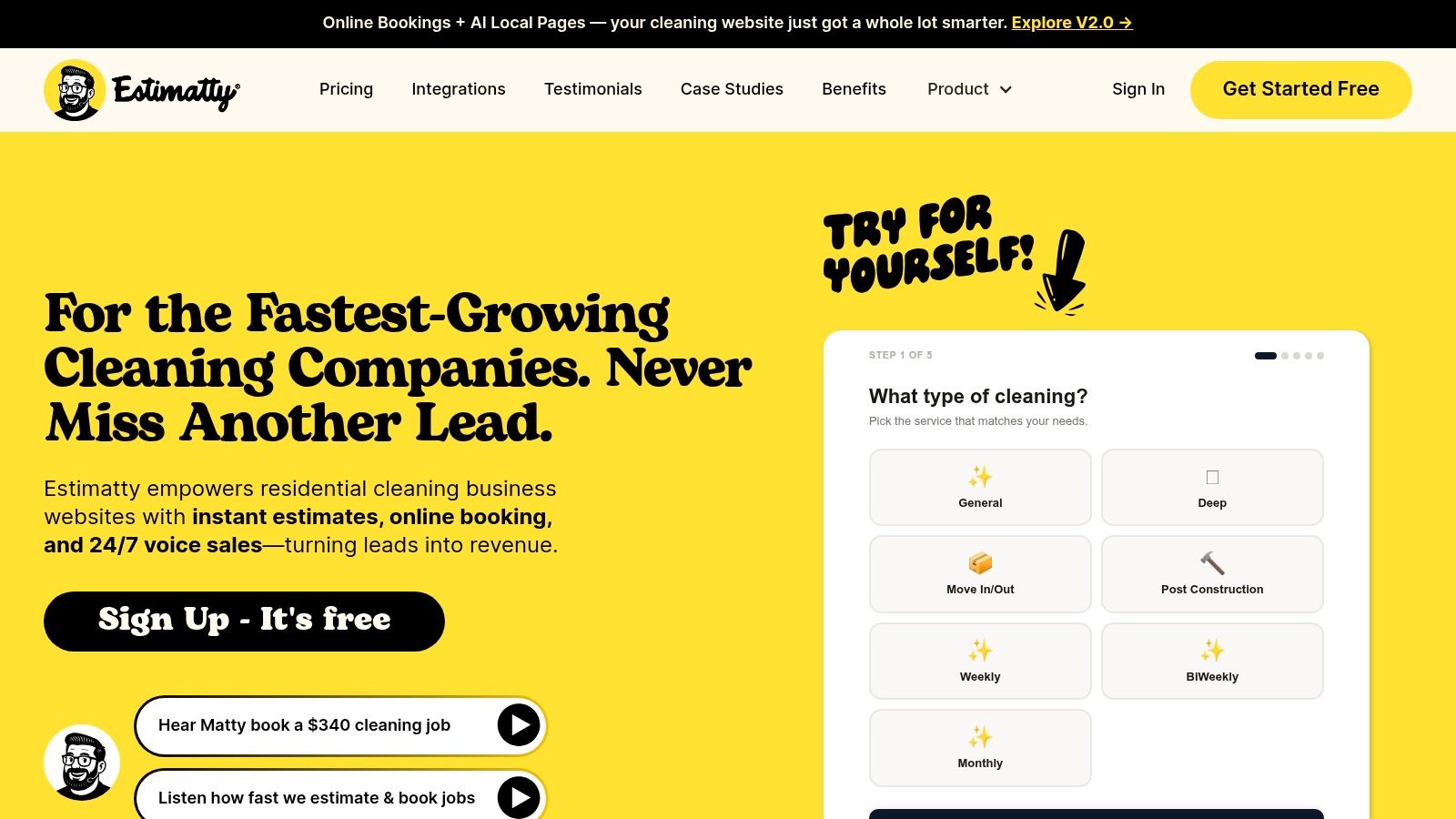
One option built for cleaning companies is Estimatty, which captures details like square footage, surfaces, urgency, and add-ons, then sends standardized estimates by SMS and email. The main value isn't hype. It's consistency.
That's the shift. Instead of one owner carrying the whole pricing model in their head, the business uses a repeatable intake system.
For a practical breakdown of what inputs matter, this article on how to estimate house cleaning jobs is a good reference.
A fast bad estimate is still bad. A slow good estimate still loses jobs. You need both speed and structure.
Use a standard flow like this:
Later, once your workflow is set, a short demo like this can help you think about how automation fits into lead handling:
A consistent estimate does more than save time. It protects margin, reduces awkward revisions, and gives every lead the same professional experience whether they contact you at noon or after dinner.
Most cleaning owners don't lose the sale because the number was too high. They lose it because they presented the number like they didn't believe it.
If you sound unsure, the client gets nervous. If you sound apologetic, the price sounds inflated. If you rush to discount, you train the client to question everything else too.

Don't say, “I know this might sound high.”
Say, “Based on the home size, current condition, and the scope you requested, your estimate is X.”
Short. Calm. No apology.
Then tie it to the result. A residential cleaning client isn't comparing your estimate to abstract labor units. They're comparing it to their time, stress, and the reliability of having the home handled properly.
“We priced this based on the work needed to get the home to the standard you described and keep it there.”
That line works because it puts the focus where it belongs. Outcome and scope.
If a lead says the estimate is more than they expected, don't race to lower the price.
Adjust scope instead.
Try responses like these:
For budget concerns
“We can reduce the scope and focus on the kitchen, bathrooms, floors, and main living areas.”
For recurring service hesitation
“We can start with a more thorough first visit, then move to a maintenance schedule that keeps future visits more manageable.”
For add-on resistance
“Those items are optional. I separated them so you can decide what matters most.”
This protects your pricing logic. You're not saying the estimate was wrong. You're saying the client can choose a smaller package.
Verbal pricing gets fuzzy fast. Written estimates close cleaner.
Use a format that includes scope, service frequency, exclusions, add-ons, and the total estimate. If you need structure, this proposal template for services is a useful model.
A confident close sounds like a business owner, not a hopeful freelancer. You did the cost work. You built the system. You know what the job requires. Present the estimate clearly and let the client decide if they want the service.
If you want fewer pricing mistakes and more consistent follow-up, Estimatty gives residential cleaning companies a way to standardize estimates on their website and over the phone, capture job details, and send written pricing without relying on gut feel every time a lead comes in.