October 14, 2026
Average Commercial Cleaning Rates: Your 2026 Pricing Guide
Discover average commercial cleaning rates by facility type and size. Learn pricing models, hidden cost drivers, and how to quote with Estimatty in minutes.

Friday, April 17, 2026
Searching for the best free cleaning estimate calculator? Uncover their flaws & see why an AI estimator is the smarter choice for your business.
.png)
Most owners who search for the best free cleaning estimate calculator are dealing with the same problem. You're on a job, your gloves are on, your phone buzzes, and by the time you listen to the voicemail, the prospect has already called two other companies.
That missed call isn't just an inconvenience. It's the start of a chain reaction. You call back later, the customer doesn't answer, then you text, then they ask for a ballpark number, and now you're trying to price a home or office from half a conversation while standing in a driveway.
I've seen this over and over in cleaning businesses. The issue usually isn't effort. It's the system. Free calculators can help, but only if you understand where they fit, where they break, and when they start costing you more than they save.
A new lead almost always arrives at the wrong time. You're finishing a deep clean, driving between jobs, managing a callout, or trying to fix a staffing gap. The phone rings, you miss it, and the voicemail says some version of, "Hi, I need pricing for my house. Call me back."

That moment feels small, but it creates work fast. First you have to return the call. Then you have to collect the details you should've captured the first time. Then you still need to send an estimate. If the customer asks about extras, recurring service, or timing, you're now running a sales process from your lock screen.
Voicemail is only the visible part of the problem. The issue is that most cleaning companies still depend on a manual chain of callbacks, handwritten notes, rough mental math, and delayed follow-up.
That creates three kinds of friction:
A lot of owners think they need to get faster on the phone. Usually they need to stop relying on the phone as the first and only sales tool. That's why resources like 24-hour phone answering for cleaning businesses matter. The goal isn't just answering more calls. It's capturing the lead while intent is still high.
Practical rule: If your process starts with "I'll call them back after this job," you're already giving slower service than the prospect wants.
Customers can hear uncertainty. If you say, "It depends," "roughly," or "I'd have to look at it," they don't hear professionalism. They hear risk. Sometimes that's fair. Some jobs do require a closer look. But a lot of residential leads just want a clean, consistent starting estimate without waiting on you.
The best free cleaning estimate calculator matters because it removes that awkward middle stage. It gives prospects a way to self-serve basic pricing, and it gives your business a repeatable starting point instead of another voicemail thread.
Free tools won't solve everything. But they do solve the first and most expensive delay. That matters because speed wins attention long before your cleaning quality gets a chance to win the job.
A free calculator isn't magic. It's a formula with a nicer front end.
Most tools ask for a short set of inputs, then apply a pricing logic behind the scenes. At a minimum, that usually includes property size, room count, cleaning frequency, and service type. As Janitorial Leads Pro explains in its commercial cleaning calculator overview, free cleaning calculators use multi-variable algorithmic systems that process square footage, room count, cleaning frequency, and service type, but they still rely on simplified algorithms and can't account for site-specific variables like access difficulty or existing contamination levels.
A free calculator is like a simple recipe card. If the kitchen is stocked, the ingredients are fresh, and the person cooking follows the steps, the result is decent. But it won't adjust like a chef would.
A cleaner or estimator notices things a basic tool misses:
Those details affect labor. Labor affects margin. A free calculator can only price what it asks about.
The stronger calculators at least give you a structured base. They often let you collect:
| Input | Why it matters |
|---|---|
| Square footage | Sets the size baseline |
| Bedrooms and bathrooms | Helps estimate labor by room complexity |
| Frequency | Recurring service usually takes less effort than a one-time clean |
| Service type | Distinguishes standard cleaning from deeper or specialty work |
| Add-ons | Captures extra tasks that shouldn't be buried inside the base price |
This is why lead capture matters as much as calculation. If your tool gives a number but doesn't gather contact details cleanly, you've only built half a system. That's also why many owners pair calculators with better intake tools such as lead form builders that make it easier to collect usable customer information without making the process feel heavy.
The break usually happens in two places. First, the customer enters incomplete or vague information. Second, the tool doesn't let you adjust the logic enough for how your company prices.
A calculator should produce a starting estimate, not a false promise. If you want to compare how this kind of tool is typically set up for cleaning businesses, the examples in this cleaning estimate calculator guide show why structure matters as much as the final number.
A calculator is only as good as the inputs you require and the pricing rules you control.
That's the main trade-off. Free tools are useful because they're fast. They're limited because speed comes from simplification.
Most free tools look similar at first glance. They have a few fields, a button, and a result. That doesn't mean they'll help your business equally.
Some calculators create clarity. Others create cleanup work. If you're evaluating the best free cleaning estimate calculator, use a short checklist and be picky.
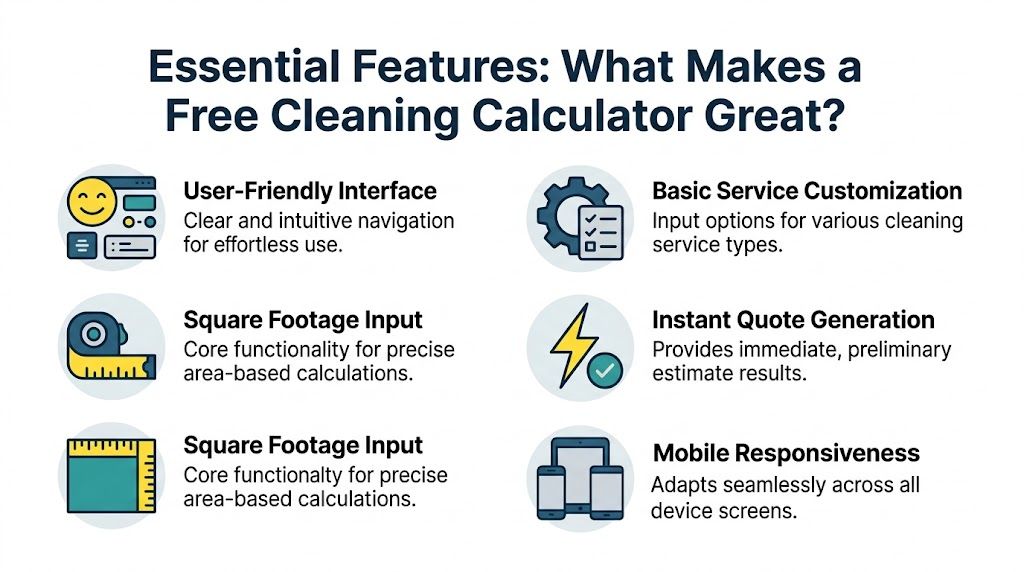
A decent free calculator should handle the basics without confusing the customer or boxing you into bad pricing logic.
Clear input flow
The prospect should know what to enter without guessing. If they have to stop and decode your form, drop-off starts before you ever send an estimate.
Service customization
You need room to reflect your real offer. Standard clean, deep clean, move-in, move-out, and recurring service don't belong in one generic bucket.
Add-on support
Windows, oven, fridge, laundry, organization, inside cabinets, and similar tasks need their own logic. If a calculator can't surface extras well, it quietly limits revenue.
Mobile usability
A lot of prospects check pricing on their phone. If the calculator is clunky on mobile, it loses the convenience that makes these tools valuable in the first place.
The stronger tools also show their work in a way customers can accept. That means they don't just spit out one total. They make the result feel tied to the information entered.
Look for these signals:
| Feature | Why it helps |
|---|---|
| Itemized structure | Reduces confusion about what is included |
| Frequency logic | Lets recurring service differ from one-time work |
| Editable pricing rules | Helps match your market and service model |
| Clean interface | Builds trust before a human ever steps in |
Field test: If you wouldn't feel comfortable sending the result to a picky customer, the tool isn't ready for your site.
This gets overlooked. Owners focus on whether the calculator can produce a number. They should also ask whether it fits the rest of the sales process.
If the tool doesn't connect with your response time, intake flow, and follow-up process, it becomes a stand-alone widget that creates more manual work later. That's why many growth-minded operators look beyond simple calculators and study systems around AI sales automation for cleaning services, where the estimate is part of a larger lead-handling workflow.
The best free option is the one that gives enough structure to be useful without pretending to be more accurate than it is. That's a narrow lane. Many free tools don't stay in it.
Free isn't always cheap. In cleaning, it can be expensive in ways owners don't notice until months later.
The visible cost of a paid system is a subscription. The invisible cost of a free tool is underpriced work, missed add-ons, back-and-forth with customers, and hours spent correcting weak estimates.

Manual or basic quoting processes often lead to 30-50% revenue loss from underpricing or delays, and while over 3,000 cleaning companies have adopted free calculators to address that problem, those same tools can still leave 10-15% of potential revenue on the table when they don't properly price add-ons, according to Connecteam's house cleaning calculator discussion.
That should change how you think about "free." You're not comparing free versus paid. You're comparing visible software cost versus hidden revenue leakage.
A weak calculator doesn't just produce a weak estimate. It creates follow-up work across the business.
At this point, many owners start reading beyond cleaning-specific tools and compare broader systems such as estimating software for contractors, because the issue isn't only price math. It's process control.
Customers rarely say, "Your calculator is too simplistic." They say things like, "That's not the number I got," "I thought windows were included," or "Why did the price change after I submitted the form?"
Those moments chip away at trust. A calculator that gives fast but flimsy estimates can make your company look less organized than a competitor with a slower but more structured system.
Free tools save money only if they reduce labor and improve estimate quality. If they create corrections, callbacks, and awkward price changes, they aren't saving anything.
The trap is easy to fall into. A business owner sees a free widget, adds it to the website, and checks "online estimates" off the list. But the key question is whether that widget protects margin, captures add-ons, and reduces admin work. If it doesn't, you've added a leak, not a solution.
Don't trust a calculator because it looks polished. Test it against your own jobs.
The fastest way to judge a tool is to run real work through it and see how close it gets to the way you price and deliver service. You don't need a lab. You need a few past jobs, your current pricing logic, and a willingness to find flaws before your prospects do.
Use one simple job, one average job, and one messy job with enough complexity to reveal blind spots. Enter each one exactly as a customer would.
Then compare the result against what you charged and what the job required.
Pick a clean baseline
Use a straightforward recurring home or office that matched expectations. This tells you whether the calculator can at least handle normal work.
Use a realistic middle case
Choose a job with a few variables, maybe extra bathrooms, interior windows, or a heavier kitchen. This shows whether the logic bends without breaking.
Use a problem job
Feed it a property that had access issues, unusual buildup, awkward layout, or unusual requests. That exposes whether the calculator gives a false sense of precision.
A lot of free tools can produce a basic number. Fewer can handle the things that protect profit.
Check whether the calculator can surface and price common extras clearly:
If those aren't handled well, the tool may attract leads while still shorting your revenue.
Don't ask only, "Can it estimate?" Ask, "Can it estimate the work I actually want to sell?"
Hand the calculator to a friend, spouse, admin, or even a current customer and say nothing. Watch where they hesitate. That's your friction.
A good test checklist looks like this:
| Question | What you're checking |
|---|---|
| Did they know what each field meant? | Clarity |
| Did they understand what was included? | Scope communication |
| Did they notice add-ons easily? | Revenue opportunity |
| Did the final result feel believable? | Trust |
This part matters as much as the math. Once the number appears, what happens next?
If the customer can't easily submit details, request follow-up, or move toward booking, the calculator acts more like a novelty than a sales tool. A usable estimate system should reduce handoffs, not create another one.
A stress test usually reveals the truth fast. If the calculator only works on your easiest jobs and creates confusion on everything else, you don't have a pricing system. You have a rough sorter. That can still be useful, but only if you treat it for what it is.
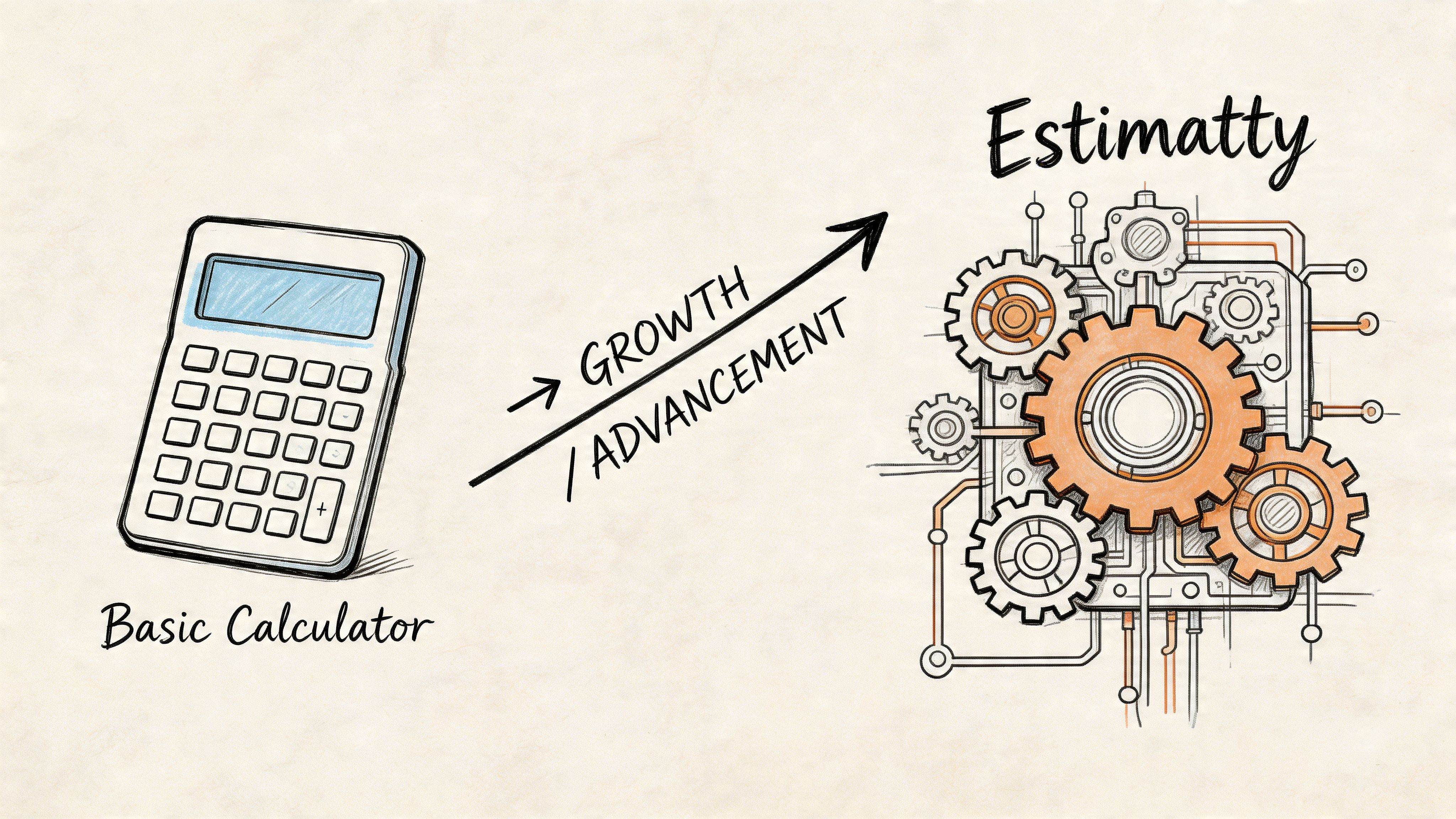
Free calculators have a place. They help owners get off the ground, standardize rough pricing, and stop some of the phone-tag chaos. But once lead volume picks up, free stops being enough.
The main reason is simple. A calculator gives a number. A sales engine handles the whole interaction.
The next wave of cleaning sales tech is moving beyond static forms. According to Matthew Marks' commercial cleaning calculator analysis, post-2025 AI adoption in cleaning is projected to rise 35%, and older static calculators often result in 20-40% estimate revisions because they produce broad, inaccurate ranges instead of handling more complex variables.
That matters because revisions create drag. They force your team to step back into jobs the software should've screened better in the first place.
An AI estimator doesn't just ask for square footage and spit out a rough total. It can guide the customer, clarify scope, gather missing details, and pass cleaner information into your team.
That's the leap from tool to system.
For example, Estimatty is built to handle web and voice estimate intake for cleaning businesses, capturing details, sending instant estimates by SMS and email, and handing the lead off when a person needs to step in. In practice, that means fewer dead-end forms and fewer voicemails waiting for a callback.
If you're evaluating your stack more broadly, it also helps to understand how estimate automation fits into AI growth platforms for service businesses and larger operations software, including categories like all-in-one business management software, where estimating, scheduling, communication, and follow-up need to work together.
No sales process stays strong if you can't hire and keep reliable cleaners. As your estimate flow gets tighter, hiring pressure gets more obvious. That's where teams often look at operational content from places like estimatty.com/blog and get.pipehirehrm.com/blog, especially when they need to improve recruiting and screening through platforms like pipehirehrm.com.
The point isn't to replace people. It's to stop wasting people on tasks software should already be handling.
A short demo helps make that difference visible:
When owners upgrade from a free calculator to an automated estimate system, they usually aren't buying a nicer widget. They're plugging leaks. They want fewer missed leads, cleaner intake, more consistent estimates, better upsell capture, and less admin drag on evenings and weekends.
That's why the ROI conversation changes. The question stops being, "How much does the software cost?" and becomes, "How much is the current process already costing me?"
If you're done chasing voicemails, reworking rough estimates, and leaving add-on revenue behind, take a look at Estimatty. It gives cleaning businesses a way to capture leads, deliver instant estimates, and keep the sales process moving when the owner or office team can't get to the phone.