October 24, 2026
Area of Service for Cleaning Businesses: How to Map Yours
Learn how to define and map your area of service for a cleaning business using drive time, travel fees and job minimums that protect profit.

Sunday, August 30, 2026
Wondering how much do janitorial services cost in 2026? Get real hourly, per-square-foot, and monthly pricing benchmarks plus tips to quote faster.
Most commercial janitorial jobs in 2026 fall between roughly $20 and $90 per hour per cleaner, with a typical national average near $39 per hour. A 2,000-square-foot office usually lands near $220 per visit, while monthly contracts commonly range from about $715 to $2,800.
That's the number range a property manager sees, but it doesn't answer the question that matters when a prospect wants an estimate tonight. You need to know why one building lands near the low end, why another requires a much higher rate, and how to produce a defensible number before a competitor responds.
A recurring office, a medical suite, and a warehouse shouldn't share the same pricing logic. The building's layout, restroom intensity, cleaning frequency, supplies, labor burden, and compliance requirements all change the math. This guide turns those variables into a practical estimating process, so you can stop undercharging and stop losing leads to slow estimates.
At 9 PM, a prospect asks for a price. Your phone pings while you're closing out the day. You open a calculator in one tab, a spreadsheet in another, then push the estimate to tomorrow because you still need to confirm how many visits the building needs and whether supplies are included.
That delay creates a pricing problem, not just an administrative one. The question behind “how much do janitorial services cost?” is what should a fair, defensible number for this building look like in 2026?
Commercial pricing guides place the broad national hourly range around $20 to $90 per cleaner hour, with a national average near $39 per hour and standard office work often falling between $25 and $45 per cleaner hour (Angi's commercial cleaning cost guide). A 2,000-square-foot office averages near $220 total, while monthly commercial cleaning commonly falls between $715 and $2,800, depending on size and frequency (the FRED janitorial services price index).
For recurring office work, square-foot pricing often lands around $0.10 to $0.20 per square foot, while standard office benchmarks can range from $0.07 to $0.20 per square foot (ProMatcher's commercial cleaning cost data). Medical and industrial environments generally command more because disinfection, documentation, specialized training, and site complexity raise the labor requirement.
A useful starting point is to calculate three ways, then choose the model that matches the work. The commercial cleaning cost breakdown can help you organize those inputs, but the final estimate still needs to reflect the actual building.
By Monday morning, you should be able to explain the rate in plain language: how many labor hours it requires, what the visit includes, how often the crew arrives, and which conditions justify an adjustment. That explanation protects your margin and gives the buyer confidence that they're comparing equivalent service.
Buyers usually see one of three pricing models. Each can work. The mistake is treating them as interchangeable after the scope has already been defined.
Hourly pricing bills for cleaner time. It works well when the work is irregular, the site condition is unknown, or the buyer wants a one-time service.
For example, a 1,500-square-foot office cleaned by one cleaner for 2.5 hours at $35 per hour produces an estimate of $87.50 per visit. That format is easy to understand, but the buyer carries more uncertainty because the final cost depends on the time spent.
Square-foot pricing multiplies cleanable area by a visit rate. It's a strong fit for stable recurring accounts where the layout and service checklist are clear.
A 5,000-square-foot office at $0.12 per square foot per visit produces $600 per visit. At five visits per week, using the stated monthly planning assumption, that becomes roughly $2,400 per month. The number is predictable, but only if both sides agree on what “cleanable square feet” includes.
A flat monthly contract packages a defined scope and schedule into one recurring amount. It works best when the building, visit cadence, staffing plan, and add-ons are stable.
A 10,000-square-foot warehouse priced at $0.06 per square foot per visit, using the stated monthly planning assumption, produces approximately $10,400 per month. That structure can simplify budgeting, but it leaves the provider exposed if the scope is vague or the facility changes.
| Pricing Model | Formula | Example Calculation | Best Fit For |
|---|---|---|---|
| Hourly per cleaner | Cleaner hours × hourly rate | 2.5 hours × $35 = $87.50 per visit | Small, irregular, or uncertain jobs |
| Per square foot per visit | Cleanable area × visit rate | 5,000 × $0.12 = $600 per visit | Stable mid-size offices |
| Flat monthly contract | Defined monthly scope and schedule | 10,000 sq. ft. × $0.06 × stated monthly visits = about $10,400 | Predictable accounts with clear scopes |
Practical rule: Pick the pricing model before the negotiation starts. Mixing an hourly estimate with a square-foot comparison makes both sides argue about format instead of value.
Hourly pricing favors flexibility. Square-foot pricing favors repeatability. Flat monthly pricing favors operational control. Choose one, document the assumptions, and don't switch models just to make a difficult estimate look cheaper.
The headline rate is only the surface. Five variables determine whether a janitorial estimate holds up after the first month or gradually depletes the budget.
Base wages aren't the full cost of a cleaner. Payroll taxes, workers' compensation, paid time off, supervision, equipment, and operating overhead all sit behind the labor line.
A fully burdened general janitorial labor benchmark falls between $22 and $38 per hour, while day porter work ranges from $24 to $42, floor care specialists from $30 to $55, and post-construction cleanup from $35 to $65 (National Janitorial Authority's pricing guide). If your estimate sits below the labor floor, you're likely funding the job with unpaid owner time, rushed work, or missed maintenance.
Use the labor cost per hour calculation guide to separate wage cost from the rate you need to charge.
Square footage starts the conversation, but it doesn't determine the workload by itself. A segmented office with many rooms, private restrooms, kitchens, and high-touch areas can require more labor than a larger open floor plan.
Restroom count, fixtures, trash stations, elevators, entry glass, and touchpoints often explain the difference between two buildings with similar floor area.
Five-night service isn't a weekly price multiplied by five. Each visit has setup, travel, opening, closing, and supply-handling requirements. Less frequent service may receive a lower schedule multiplier in some pricing models, while the buildup between visits can increase the labor required per visit (CleanCraft's commercial cleaning rates).
Floor care, window cleaning, disinfection, post-construction cleanup, and day portering shouldn't disappear inside “general cleaning.” Each needs its own task list, labor assumption, and estimate line.
A buyer who asks for a low base rate may still expect polished floors, stocked restrooms, interior glass, and high-touch disinfection. If those tasks aren't listed, the provider either absorbs the work or triggers an uncomfortable change order.
For facilities that prioritize safer product choices, a resource on a non-toxic household cleaner can support a separate supplies conversation without hiding product assumptions inside labor.
Medical, food-service, and industrial facilities carry more than ordinary cleaning expectations. They may require specialized procedures, documentation, training, protective equipment, and additional insurance. That complexity raises the minimum viable estimate even when the square footage looks modest.
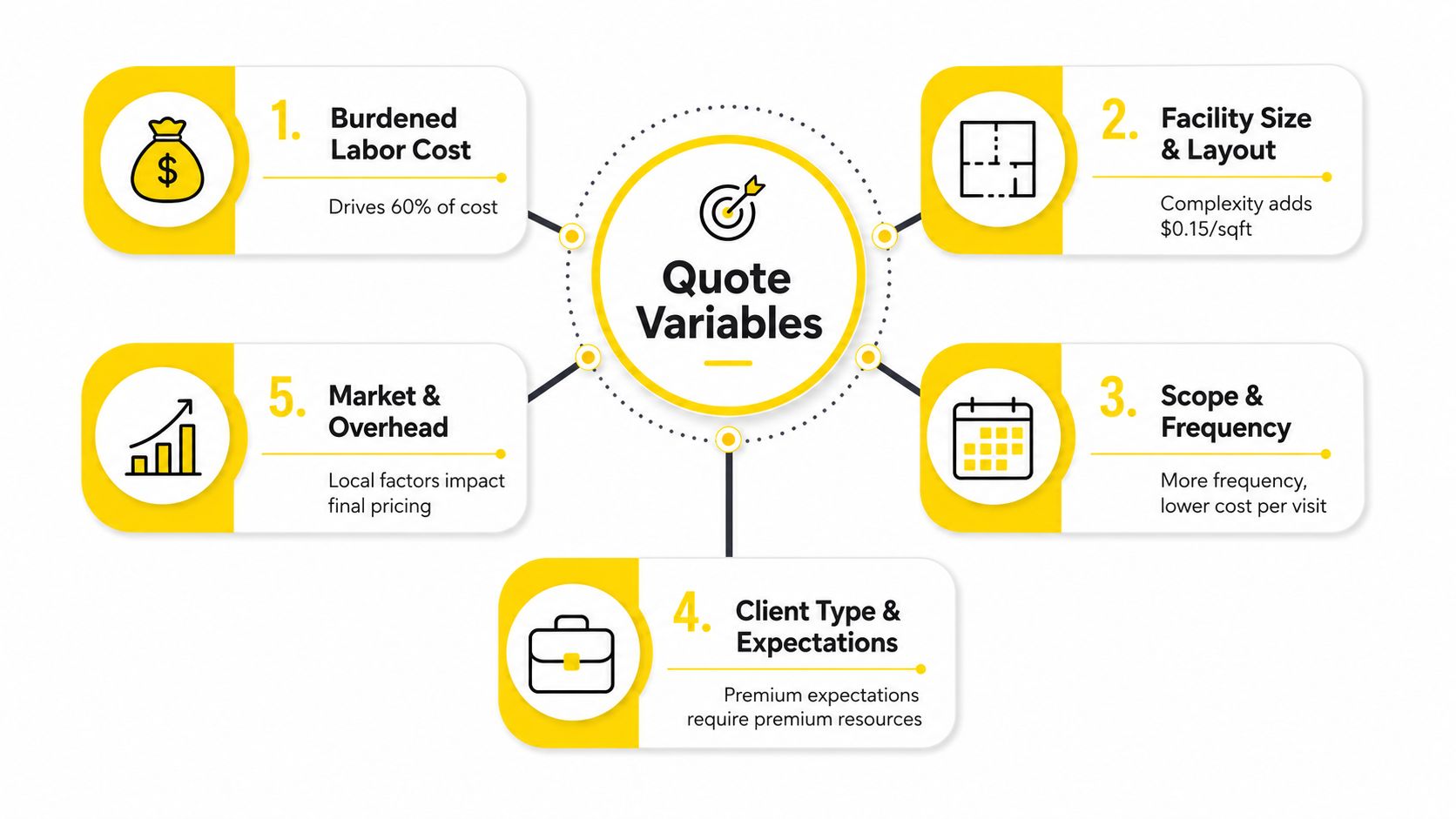
A defensible estimate makes these variables visible. It doesn't apologize for them.
The fastest way to understand janitorial math is to run the same formula against different building shapes. The figures below are planning examples built from the assumptions shown in the table, not universal market prices.
For the small office, assume one cleaner works 2.5 hours per visit at a burdened rate of $30 per hour, with a five-night weekly schedule and a modest supplies allowance. For the medical clinic, assume more time per visit and a higher burdened rate because exam-room turnover and disinfection require additional labor. For the warehouse, assume a large open area with nightly sweeping and a separate monthly detail component.
The exact assumptions matter more than the apparent precision. If your building has more restrooms, tighter scheduling, or a heavier soil load, replace the hours and rate rather than forcing the facility into someone else's template.
| Building Type | Square Footage | Visits / Month | Hours per Visit | Burdened Rate | Monthly Total |
|---|---|---|---|---|---|
| Small office | 1,500 | 20 | 2.5 | $30 | $1,500 before supplies and margin |
| Medical clinic | 4,000 | 20 | 5 | $38 | $3,800 before supplies and margin |
| Warehouse | 25,000 | 20 | 8 | $30 | $4,800 before supplies and margin |
The small office illustrates why minimum visit charges matter. A modest building still requires arrival, setup, restroom service, waste removal, floor care, and closeout. The owner can't price it only by the number of square feet.
The medical clinic shows why facility type changes the estimate. A clinic may have exam rooms, sinks, touchpoints, regulated waste procedures, and turnover expectations that an open office doesn't carry.
The warehouse demonstrates the opposite pattern. Large open areas may clean efficiently by square foot, but the total monthly commitment still grows with visit frequency, labor hours, equipment, and detail work.
For more detail on recurring contracts, use this commercial cleaning cost per square foot guide to build a worksheet with cleanable area, visits, labor hours, supplies, and target margin. Recalculate the estimate whenever the scope changes. Don't preserve an old rate because the building's square footage stayed the same.
The cheapest-looking estimate often wins the first comparison and loses the account later. Buyers discover that the vendor excluded supplies, skipped periodic floor work, or interpreted “general cleaning” differently. Providers then face callbacks, unpaid labor, and a relationship damaged by expectations nobody documented.
An hourly estimate and a per-square-foot estimate can't be compared until you normalize labor hours, visit frequency, supplies, restrooms, kitchens, and add-ons. A lower hourly rate may require more hours. A lower square-foot rate may exclude important tasks.
Ask every provider to show the same core fields:
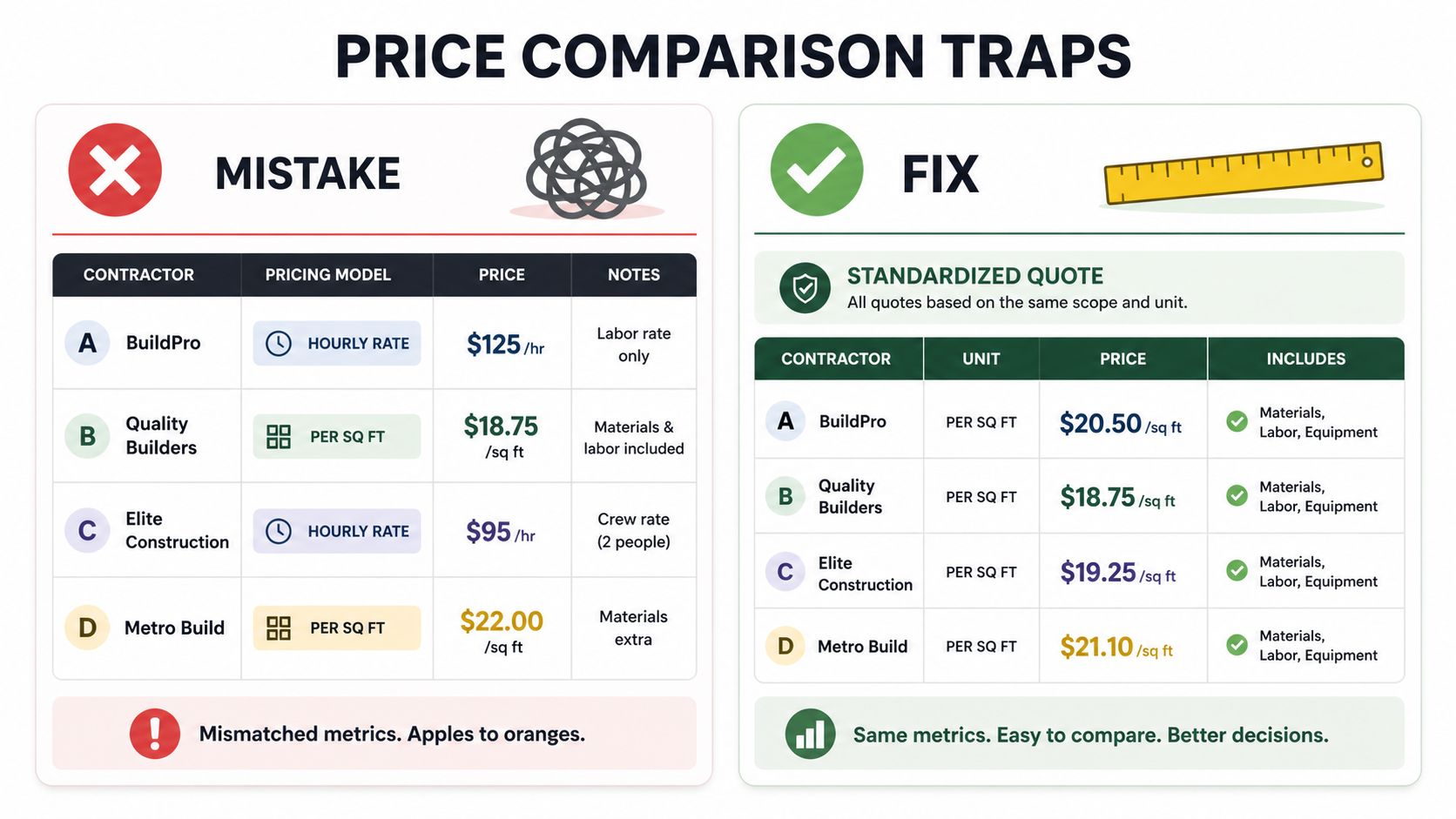
A provider who prices below a sustainable labor floor may be underestimating time or excluding obligations. That doesn't make the buyer a bargain hunter. It makes the proposal incomplete.
“General cleaning” is not a scope. It's a dispute waiting to happen. Define what gets cleaned, how often, with which supplies, and who handles periodic tasks.
Small sites and scattered locations carry setup and travel burdens that don't shrink with square footage. Price each site fairly, then show any route or volume adjustment separately.
Medical, dental, industrial, and post-construction jobs need a different labor and compliance calculation. If you use an office formula for a specialized facility, the error begins before the buyer ever sees the estimate.
Every underpriced account starts with an under-specified estimate. Fix the intake, and many margin problems disappear before they reach operations.
Most janitorial owners don't lose opportunities because demand disappeared. They lose them because the estimate process depends on whoever happens to be available, awake, and comfortable with the spreadsheet.
Estimatty applies consistent hourly and square-foot formulas to incoming leads, captures building type, square footage, frequency, urgency, and add-on scope through a short interaction, then sends an estimate by SMS or email. The system is designed to return pricing in under a minute, which gives an owner a repeatable response outside normal office hours.

The important point isn't automation for its own sake. It's consistency. A 10,000-square-foot warehouse and a 2,500-square-foot medical office should pass through the same decision logic, while their inputs produce different labor, scope, and pricing outputs.
A standardized estimator also makes minimums easier to defend. You can set a floor for small sites, add a higher labor assumption for medical work, and separate periodic floor care instead of improvising every time a prospect pushes back. The cleaning price book can help operators organize service assumptions before they publish an estimate flow.
Hiring remains the supply-side constraint. If new contracts require more cleaners, use the hiring resources at Pipehirehrm to support recruiting and onboarding without pretending the labor problem can be solved inside a pricing spreadsheet.
For operators, the before-and-after is straightforward. Before standardization, a late inquiry waits for a manual review and may receive a different number from a similar account. After standardization, the prospect receives a structured estimate quickly, the owner sees the captured scope, and the team can follow up with a human when the job needs judgment.
Use automation to enforce your pricing rules, not to hide them. Buyers trust a clear estimate that explains its assumptions.
Negotiation works when both sides negotiate the same scope. It fails when the buyer asks for a lower number without changing frequency, tasks, access, or supplies.
Start with three competing estimates and normalize them by square footage, visits, labor assumptions, and included work. Don't compare hourly rates until you know how long each provider expects to spend on site.
Then use these moves on the next bid:
Don't negotiate from a vague demand to “sharpen the pencil.” Use the guide to handling price objections to keep the discussion tied to scope and outcomes.
Revisit the task list quarterly. Savings disappear when the buyer adds responsibilities informally and the provider keeps absorbing them.
Consistent pricing beats discounted pricing because property managers evaluate clarity and response speed alongside the final number. A fast, complete estimate signals that your operation understands labor, scope, and accountability.
Build a one-page rate card this week. Include your approved hourly ranges, square-foot bands, minimum visit rule, supply policy, frequency assumptions, and add-on categories. Then require every inbound lead to receive a written estimate within two hours of inquiry, even if the first response is a qualified range pending a site review.
The intake should force the same questions for every facility:
Use one calculator for every lead. A 10,000-square-foot warehouse should follow the same estimating workflow as a 2,500-square-foot medical office, even though the labor and compliance inputs differ.
Set aside one hour each week to review lost opportunities. Tag each loss as price, scope, speed, or trust. Don't cut rates until you know which category caused the loss. Many quote problems come from slow follow-up or unclear assumptions, and lowering the price won't repair either one.
Estimatty can help you build the first standardized estimate template and respond when your team is unavailable. For the staffing side, Pipehirehrm offers hiring checklists and related resources that help protect the labor assumptions behind every estimate.
Estimatty helps cleaning businesses collect job details, apply consistent pricing rules, and send estimates by text or email without waiting for manual spreadsheet work. Visit Estimatty to build a standardized janitorial estimating workflow that responds faster while keeping scope and labor assumptions visible.