
October 10, 2026
How to Increase Qualified Leads for Cleaners
Learn how to increase qualified leads for your cleaning business. Discover AI estimators, speed-to-lead tactics, and scoring strategies that book more jobs.

Wednesday, August 19, 2026
Build a holiday cleaning service that books solid year after year with proven pricing, staffing, booking, and marketing playbooks for cleaning owners.

The phone starts ringing before the holiday menu is finalized. A homeowner wants the house guest-ready by Friday, an Airbnb host needs a same-day turnover, and an office manager needs a shutdown clean while half the regular crew is already requesting time off. If your team is still pricing each request manually, you're not running a holiday cleaning service. You're running a queue of urgent exceptions.
Peak season rewards operators who treat the work as a separate operating system. Prices must reflect surge labor, estimates must arrive while the buyer is still searching, deposits must protect reserved capacity, and schedules must include backup coverage before the first callout happens. The cleaning checklist matters, but the business usually breaks earlier, at pricing, staffing, or response time.
Holiday cleaning follows a compressed booking cycle anchored to Thanksgiving, Christmas, Hanukkah, New Year's, and Eid al-Fitr or Eid al-Adha. The practical window often runs from mid-November through the first week of January, with revenue concentrated around a small set of high-demand dates. Customers aren't buying ordinary maintenance. They're buying a finished result before guests arrive, after guests leave, or before a property changes hands.
The demand is also large enough to justify its own systems. One 2026 market estimate valued the global holiday cleaning services market at USD 7.55 billion in 2025, compared with USD 7.18 billion in 2024, and projected USD 12.4 billion by 2035, implying a 5.1% CAGR from 2026 through 2035. That forecast is a projection, not a guarantee, but it supports a useful operator conclusion: holiday-related work can support specialized pricing, staffing, and booking infrastructure rather than being treated as a casual seasonal add-on. (holiday cleaning services market estimate)
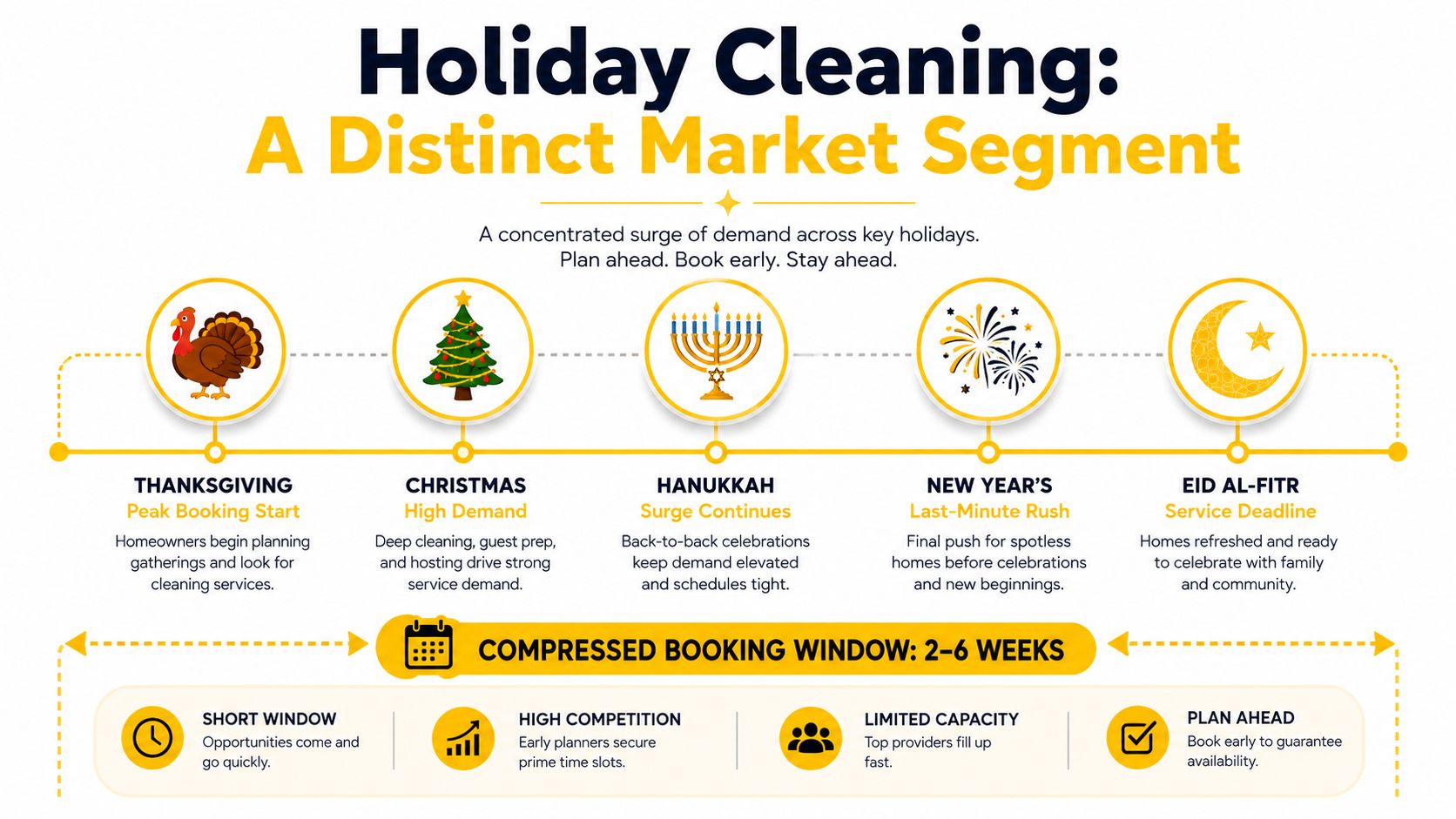
A weekly residential client buys consistency. A holiday client buys certainty at a specific time. That difference changes everything from the intake form to the cancellation clause.
A 2024 holiday-cleaning survey summary reported that 84% of people participate in thorough cleaning as the holidays approach, and 76% clean their homes before the festive season. The same summary found that 30% start more than ten days before hosting, while another 30% wait until the day they host, creating two very different buying patterns. (holiday cleaning consumer survey summary)
Don't spread holiday capacity evenly across every date. Mark the service deadlines first, then work backward to identify booking cutoffs, supply-loading days, inspection windows, and backup coverage. A holiday cleaning service needs policies that differ from weekly work because demand, labor cost, and operational risk rise together.
Treat each peak date as a constrained inventory item. Once the crew slots are gone, the customer isn't just waiting for a convenient appointment. They're competing for a deadline, and your scheduling system must make that scarcity visible.
A December 23 booking can look profitable until rush routing, premium labor, supplies, and rework are deducted. Adding a vague “holiday fee” to an ordinary estimate hides those costs from the customer and from the operator. Set a transparent base rate first, then apply documented adjustments.
Use this structure:
Base Rate × Surcharge Multiplier × Rush Factor + Add-ons + Distance Surcharge
The holiday multiplier should match the local labor market and your payroll rules. A 15% to 30% holiday surcharge can cover premium labor, while same-day or next-day requests may require a 20% to 40% rush premium. Test those ranges against local labor requirements and actual crew costs. Copying them into every market can erase the margin created by the surcharge.
Suppose the ordinary base rate is $55 per labor hour. A four-hour deep clean on December 23 could use a 1.25 holiday multiplier and a 1.30 rush factor. The labor portion is $55 × 4 × 1.25 × 1.30, before the oven add-on and distance charge. Show a fixed oven service separately rather than burying it in the hourly calculation. Customers can see the choice, and managers can audit the estimate.
Pricing rule: Show the holiday uplift before checkout. Do not introduce it through a dispatcher after the customer has committed to the date.
Publish ordinary starting prices, define the scope of a standard deep clean, and explain that date urgency, holiday labor, travel zone, and add-ons can change the final estimate. A minimum job fee, such as an $185 minimum, protects a reserved crew slot when a small room count still consumes an expensive peak-date opening. It keeps a one-bedroom request from taking a slot at an unprofitable ticket.
| Date Window | Surcharge Multiplier | Minimum Fee | Rush Premium | Deposit Required |
|---|---|---|---|---|
| More than 21 days out | Base holiday tier | Published minimum | None unless urgent | Standard deposit |
| 14 to 21 days out | Holiday tier | Published minimum | Apply if next-day service is requested | Standard deposit |
| 7 to 13 days out | Higher holiday tier | Peak-date minimum | Apply for compressed scheduling | Required before slot lock |
| 1 to 6 days out | Highest approved tier | Peak-date minimum | Rush factor applies | Required before dispatch |
| Same day | Manager-approved tier | Peak-date minimum | Rush factor plus distance review | Full prepayment may apply |
Use the table as an estimator decision framework, not as a universal price list. Your cleaning service price list should separate baseline scope from holiday adjustments, so the customer can identify exactly what changed.
Offer a grace period for customers who book 21 or more days out, then state when deposits become non-refundable. Put that policy in the estimate, confirmation, and payment screen. Feed the estimator square footage, bedrooms, bathrooms, add-ons, service date, urgency, and service zone. It can then apply the formula consistently without waiting for manager approval, while still routing exceptions for review.
A normal crew plan can look healthy right up until the holiday calendar fills. A standard two-person crew may cover 6 to 8 standard cleans per week, but peak dates often require 3 to 4 person crews completing 1 to 2 jobs per day. That pushes required labor capacity to roughly 1.5x to 2x normal levels, before accounting for sickness, late access, supply runs, or rework.
The first scheduling mistake is packing jobs too tightly. Start crews between 7 AM and 9 AM, keep travel buffers at 15 minutes, and reserve time for inspections. Any job that exceeds 8 hours or runs past 6 PM on a peak date should trigger 2x pay under the stated operating rule. If the schedule depends on every team finishing exactly on time, it isn't a schedule. It's a wish.
A floater cleaner on call is essential during peak dates. One no-show can force a refund or lost revenue of $400, so the cost of standby coverage needs to be compared with the cost of leaving a customer without service. The floater should have access to supplies, route information, property notes, and a clear escalation contact.
Recruitment should begin 60 to 90 days before the season. Post listings on Indeed and ZipRecruiter, then screen candidates with a paid 2-hour trial clean. A trial reveals pace, detail awareness, communication habits, and whether the cleaner can follow your inspection checklist without constant supervision.
pipehirehrm.com can be used as a sourcing option for vetted seasonal cleaners. Its filters for background checks and availability can reduce the manual sorting involved when you need people who can work peak dates, not just applicants who clicked on a listing.
Assign staff according to both availability and strengths. Put fast bathroom and kitchen cleaners on tight turnovers, place detail-oriented cleaners on inspection-sensitive homes, and cross-train every person who may be moved into a different crew. Create written rules for overtime approval, late arrivals, client lockouts, supply shortages, and same-day rework.
Use an online employee scheduling workflow to keep availability, assignments, and changes in one place. Retention starts before the rush ends. Offer year-round rehire opportunities to top performers and consider a $50 to $100 peak-season bonus per clean for zero-callout reliability, provided the payment fits your local payroll and margin structure.
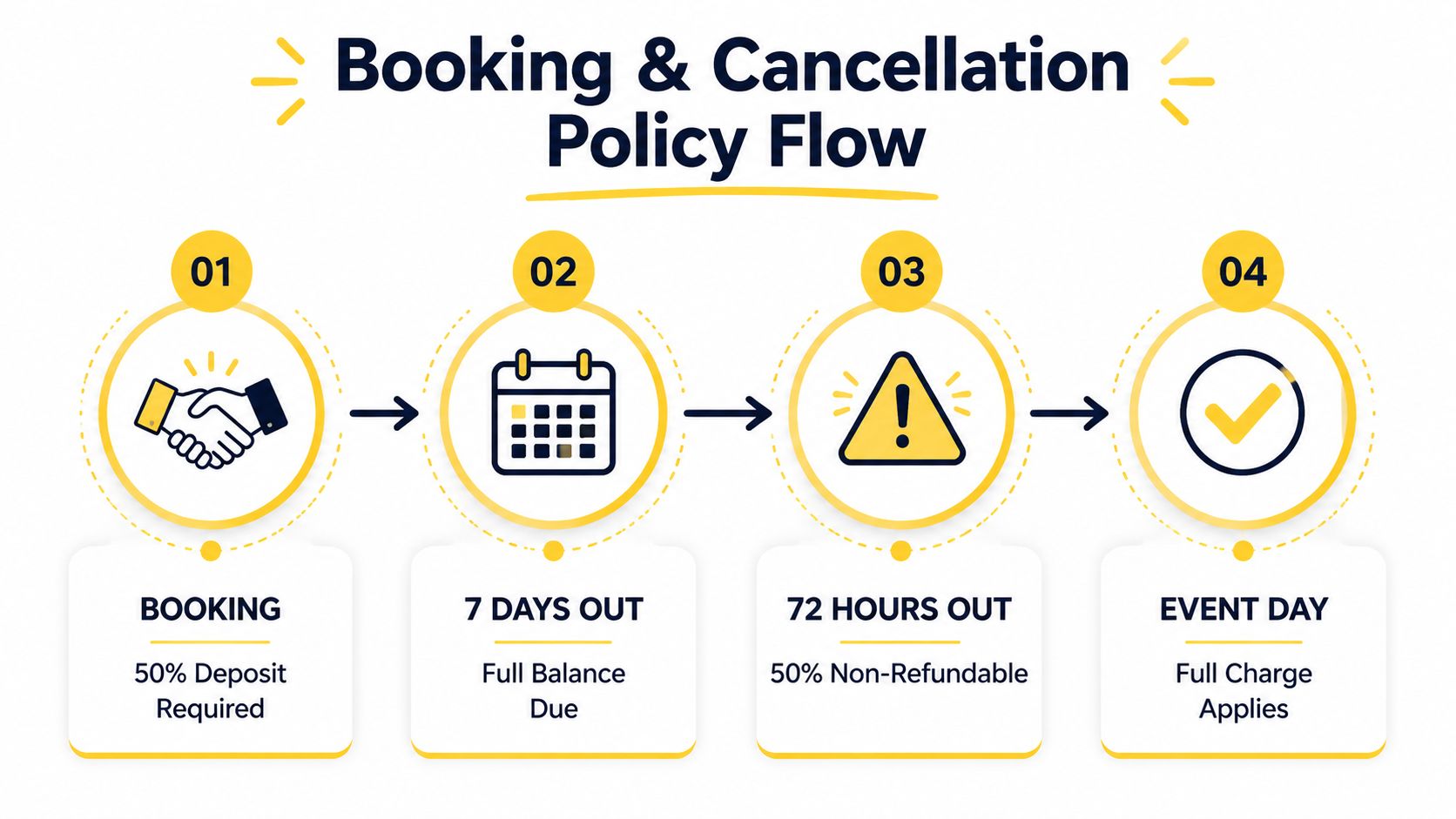
A holiday booking reserves more than a time on the calendar. It reserves a crew, travel capacity, supplies, supervision, and the opportunity to sell that slot to someone else. Your policy should make that commitment clear before payment.
A practical tiered structure for the 14-day pre-event window is:
The policy should define a holiday service as date-specific, time-specific, and supply-inclusive. That's different from a standard deep clean that may have more flexible scheduling and fewer deadline consequences. The deposit becomes non-refundable because the business has committed labor that may not be replaceable inside the locked window.
Use plain language in the confirmation:
Holiday service confirmation: Your holiday cleaning service is scheduled for [date] during the [arrival window]. The assigned crew includes [crew count] cleaners. Your service includes [scope], with [add-ons] included. A 50% deposit is required to reserve the date, and the remaining balance is due seven days before service.
The reminder should repeat the operational details:
Service reminder: Your crew will arrive on [date] between [time] and [time]. Please provide access, clear personal items from service areas, and confirm that the requested scope has not changed. Rescheduling inside the locked cancellation window may retain part or all of the service charge according to the holiday policy.
Add separate language for weather, illness, and lockouts. State whether the business will reschedule, send a replacement crew, or refund an unavailable service. A lockout caused by missing access instructions should not be treated the same as a documented emergency, but the policy must say so before the event.
For refund exceptions, train front-desk staff to say:
“I understand the situation. This date was reserved with a crew commitment, so the holiday policy applies. I can review whether a reschedule is available, but I can't promise a refund outside the stated terms.”
Configure deposits, balance deadlines, cancellation windows, automated reminders, access notes, and rescheduling permissions inside your scheduling software before the season opens. A Wix Booking System 2026 guide can help when you're reviewing booking-system mechanics, while this cancellation policy reference is useful for tightening the wording customers see.
At 8 p.m., a homeowner submits a vague holiday-cleaning request while the office is closed. By morning, another operator may already have answered with a clear price and arrival window. Manual estimates lose these jobs because the delay occurs during the busiest booking period, not because the cleaning company lacks demand.
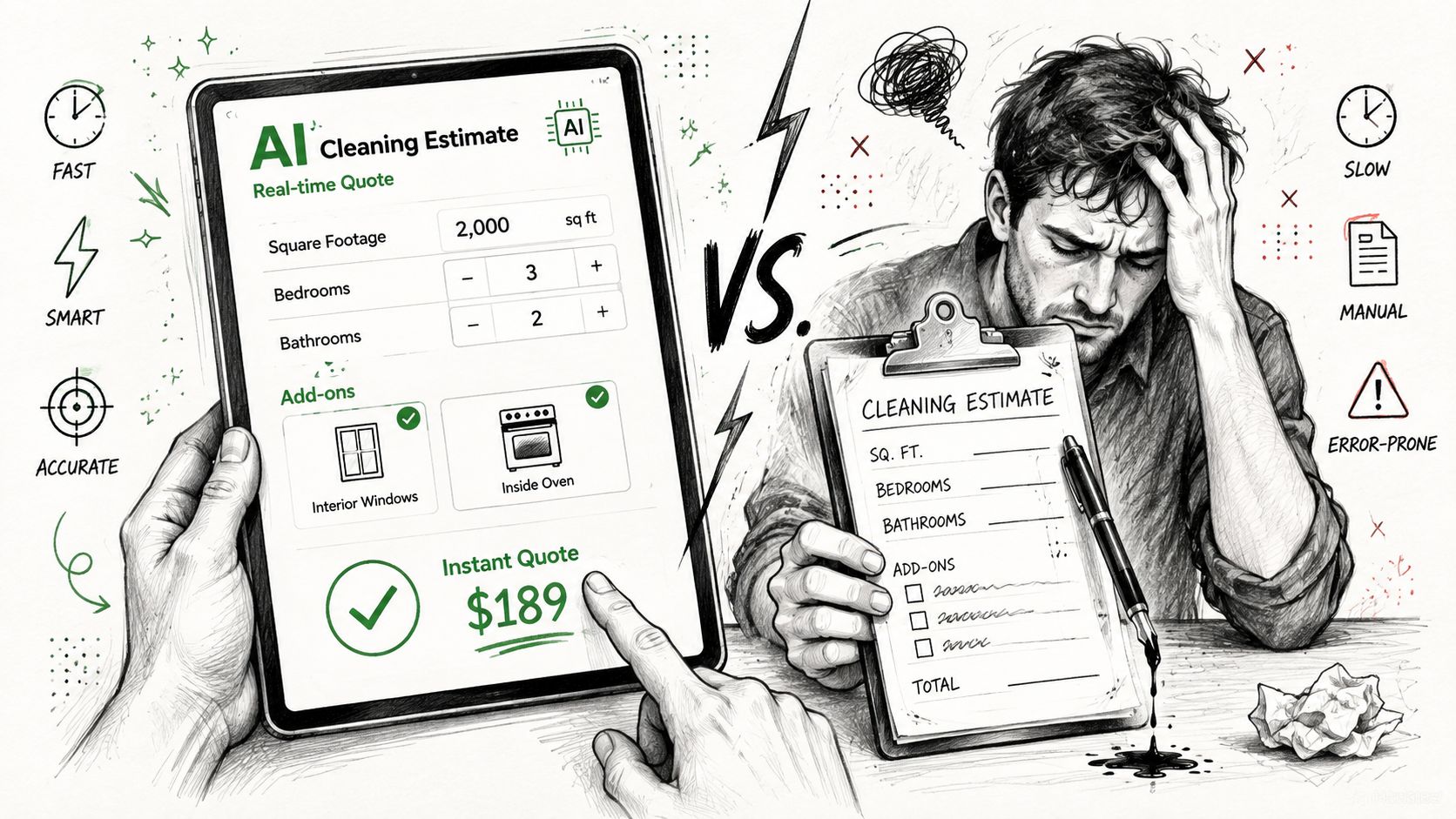
A dependable capture-to-booking flow has four steps:
The estimator must show its limits. If the customer does not know the square footage, use a structured bedroom-and-bathroom fallback and flag unusual layouts for review. Hoarding conditions, active construction dust, severe pet odor, exterior windows, or work outside the catalog should trigger an in-person walkthrough. Forcing those jobs through a digital quote is how crews inherit unpaid labor.
Estimatty can manage the capture-to-estimate workflow for cleaning businesses, including branded SMS and email templates and routing for confirmed jobs. The control that protects margin is one approved pricing logic. Without it, one dispatcher may discount a peak-date booking while another adds a different surcharge, leaving the crew to absorb the difference.
Collect operational details before payment is finalized: preferred arrival windows, parking restrictions, alarm or lockbox instructions, linen requirements, and whether the customer wants a pre-event or post-event clean. These fields reduce callbacks and expose access problems before the crew is committed.
Use this AI estimates software for cleaning businesses when comparing tools. Set a clear hand-off rule: a defined scope receives an instant estimate, an uncertain scope receives human review, and confirmed work receives a calendar slot only after payment and access details are complete.
Holiday marketing works better when each message names the event and the operational outcome. “Book a deep clean” is broad. “Get the kitchen, guest bath, and entryway ready before Thanksgiving” gives the buyer a reason to act.
Use three seasonal angles: pre-Thanksgiving preparation, host-and-hostess gifting, and the New Year reset. Early-bird pricing can reward bookings made 30 or more days out, past clients can receive a referral credit, and slow weekdays can use a last-minute fill rate without discounting the peak dates that already have constrained capacity.
Don't add every possible extra. Add services with clear scope, predictable time, and enough retail value to cover direct labor and supplies.
| Bundle | Added Labor (hrs) | Retail Price | Contribution Margin |
|---|---|---|---|
| Oven and fridge interior | 1.5 | $95 | Above 70% when labor and supplies stay within the approved cost ceiling |
| Interior windows | 1 | $85 | Above 70% when window count and access are defined |
| Linen and towel change | 0.5 | $45 | Above 70% when linens are supplied and staging is simple |
| Post-party trash and recycling haul | 1 | $75 | Above 70% when disposal distance and volume stay within the service scope |
These are operating targets, not universal prices. Confirm actual contribution after payroll, supplies, travel, disposal, and payment costs. If a bundle's labor expands beyond its defined scope, reprice it or remove it from the instant catalog.
The crew script should be brief:
“We can add the oven and fridge interiors while we're already working in the kitchen. It adds about [time] to the visit and costs [price]. Would you like that included?”
Send this follow-up the day before:
“Your holiday cleaning service is confirmed for [date] during [arrival window]. Reply with any access changes, linen instructions, or approved add-ons before the crew arrives.”
After completion:
“Thanks for trusting us with your holiday clean. If the service met expectations, please leave a review. We'll use your feedback to help plan next year's holiday availability.”
For promotion mechanics, test one subject line against another, such as “Make the house guest-ready before Thanksgiving” versus “Your New Year reset starts here.” Pair them with CTAs such as “Get my estimate” and “Reserve my holiday date.” Keep a holdout group that receives the ordinary campaign so you can compare booked work instead of guessing. This local SEO guide for home services from Transactional LLC can support the local discovery side, while your cleaning service advertising playbook should connect each campaign to a dedicated estimate path.
The season should be built before the first urgent inquiry arrives. Work backward from the peak dates and lock the commercial rules before marketing creates demand.
Set the holiday service catalog inside Estimatty. Load base pricing, minimums, date multipliers, rush factors, distance zones, add-ons, deposit rules, and the properties that require a walkthrough. Write the scope for each bundle so dispatchers and crews sell the same service.
Open the hiring funnel through pipehirehrm.com, Indeed, and ZipRecruiter. Run trial cleans, verify availability, and pre-train approved cleaners on inspection, restocking, access, customer communication, and escalation procedures. Publish the seasonal landing page, then queue the SMS and email templates for early booking, referrals, gifts, and New Year resets.
Enable deposits and balance reminders. Confirm booking cutoff dates, load surcharge tiers into the scheduler, assign floaters, and brief crews on the 8-hour and 6 PM overtime triggers. Check supplies by bundle, confirm vehicle capacity, and review every peak-date route for realistic travel time.
During weeks 2 through 0, run daily stand-ups. Track close rate, average ticket, crew utilization, and rebook rate, then act on the direction of each metric rather than waiting for the season to finish.
The operating targets are close rate above 35%, average ticket up 25% or more, utilization above 85%, and cancellation rate below 8%. If close rate falls below target, simplify the estimator or tighten response time. If average ticket lags, review scope and bundle attachment. If utilization drops, consolidate routes or pause weak weekday promotions. If cancellations rise, strengthen deposits, reminders, and access confirmation.
Pause any bundle that drags labor economics below a 60% margin during the season, even if customers like it. A short AI implementation roadmap from Stimulead can help structure the rollout of automation, but the operating owner still has to validate pricing, staffing, and hand-off rules against real jobs.
Estimatty gives cleaning businesses a way to capture holiday inquiries, collect property details, apply consistent pricing, and send estimates by SMS or email without waiting for office hours. Visit Estimatty to set up an instant-estimate workflow that connects peak-date demand with deposits, scheduling, and booked work.