September 29, 2026
Commercial and Residential Cleaning in 2026
Compare commercial and residential cleaning markets in 2026. Explore pricing, staffing, compliance, and how AI estimators streamline operations.

Sunday, July 5, 2026
Stop losing leads. Our guide to contractor lead generation builds a complete system to attract, convert, and book more jobs for your cleaning business.
Your phone rings while you're on a job. A website form comes in while you're driving. A prospect asks for pricing at night, gets sent to voicemail, and calls the next cleaner on Google.
That is how most contractor lead generation fails. Not because the service is bad. Not because demand isn't there. It fails because the system between inquiry and booking is slow, inconsistent, and built around whoever happens to be available.
For cleaning businesses, that gap is expensive. Residential prospects want fast answers. Commercial buyers want professionalism, consistency, and a clear next step. If your process depends on calling people back later, typing custom estimates by hand, and remembering to follow up, you'll keep leaking jobs you already paid to attract.
The fix isn't another random marketing tactic. It's a working system. You need inbound channels that attract demand, outbound plays that create it, and an automated estimate process that handles speed better than a human can. That's what gets the phone ringing and jobs booked.
Most owners think they have a lead problem. A lot of the time, they have a response problem.
A prospect finds your cleaning business through Google, a referral, a Facebook ad, or a yard sign. They fill out your form or call your number. Then nothing happens for twenty minutes, an hour, or until the crew gets back to the office. By then, the buyer has already contacted other companies.
That delay kills good leads. According to Website Depot's home services lead generation guide, contractors who respond to lead inquiries within 5 minutes achieve conversion rates that are 400% higher than those with slower response times. If you're spending money to get attention and then answering later, your marketing isn't broken. Your handoff is.
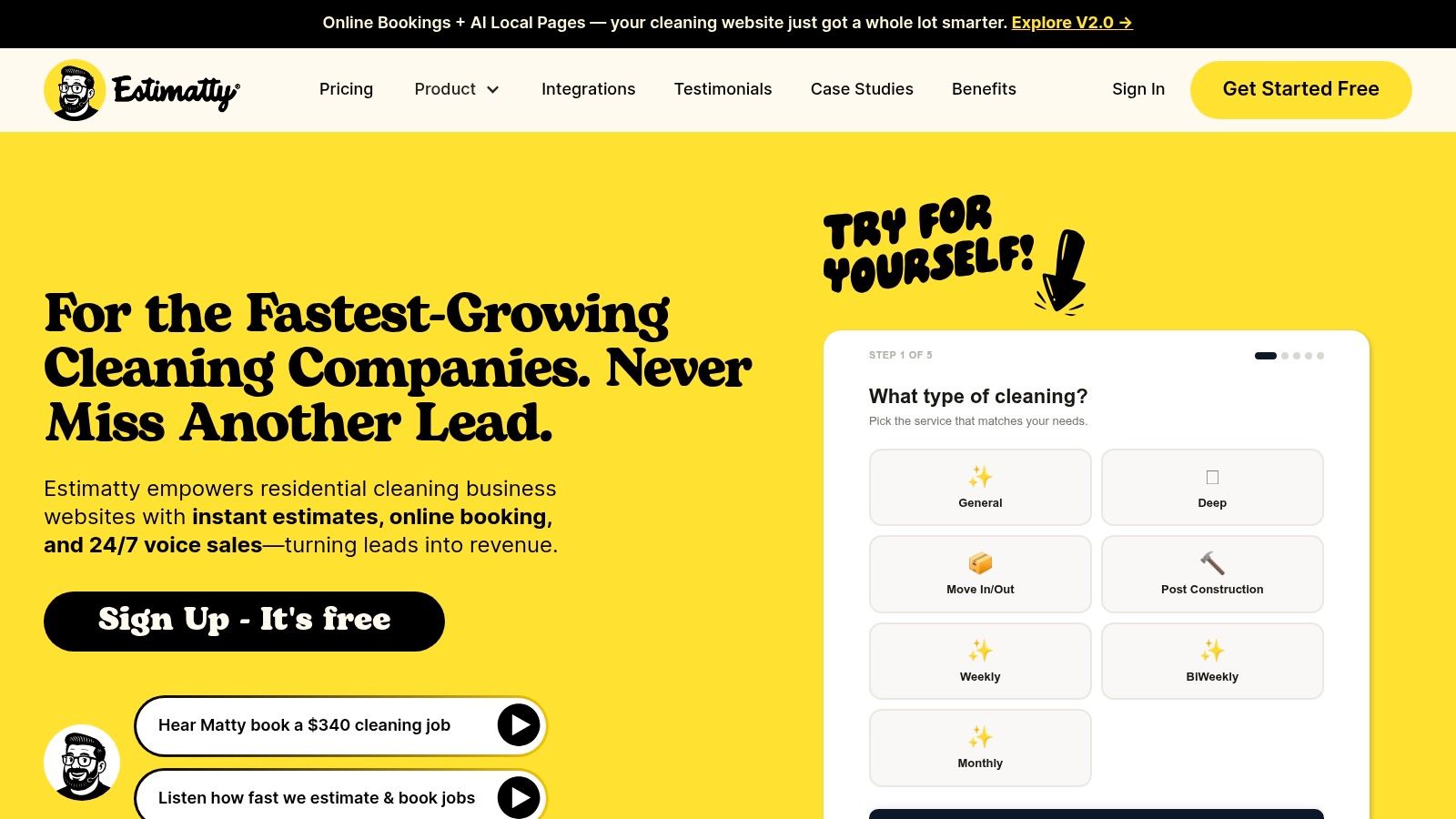
A lot of contractor websites still act like digital business cards. They show a logo, a list of services, maybe a gallery, and a contact form that disappears into someone's inbox.
That setup worked when buyers were patient. They aren't now.
Your website needs to do three jobs immediately:
If you want a broader view of how modern teams structure pipeline creation, these effective B2B lead generation methods are useful because they show the same principle across more complex sales environments. Fast contact and clean process beat scattered activity.
Practical rule: If a lead can arrive when your team is busy, asleep, or cleaning a building, your intake process must work without your team.
Owners usually notice missed calls. They don't notice the silent losses. The form inquiry that sat unanswered. The voicemail from after hours. The office manager who meant to reply but got pulled into scheduling. The prospect who wanted rough pricing but didn't want a sales call.
Those are expensive leaks because you're already paying for attention through SEO, reviews, referrals, local networking, and ads. If the handoff from interest to estimate is weak, every channel underperforms.
A better way to think about contractor lead generation is this:
| Stage | Weak setup | Strong setup |
|---|---|---|
| Inquiry | Form or voicemail | Instant capture on site and phone |
| Qualification | Staff asks different questions every time | Standardized intake |
| Estimate | Sent later if someone has time | Prompt estimate delivery |
| Follow-up | Manual and inconsistent | Automated reminders and nurture |
| Booking | Prospect must chase you | Clear scheduling path |
For cleaning businesses, this matters even more because many jobs are straightforward enough to pre-qualify fast. If your company already knows how you price deep cleans, move-outs, recurring service, office cleaning, and add-ons, the system should collect those inputs instantly and move the lead forward.
If your acquisition costs feel too high, fix the response layer before you buy more traffic. This breakdown on how to reduce customer acquisition cost is worth reading because it forces you to look at conversion waste, not just ad spend.
Inbound works best when it does one thing well. It makes local buyers feel like they've already found the right cleaner before they contact you.
For a cleaning business, three assets pull more weight than ten scattered marketing ideas: your Google Business Profile, your website content, and your review engine. Build those first.
Your Google Business Profile is often the first thing a homeowner or office manager sees. If it's incomplete, stale, or thin on reviews, you lose trust before the conversation starts.
Use a simple weekly maintenance checklist:
Most cleaners write generic blog posts no one searches for. A better move is a practical pricing article. Something like "How much does house cleaning cost in [your city]?" or "What's included in a move-out cleaning?"
That kind of content qualifies leads before they call. It also reduces friction with buyers who are hesitant to ask about budget.
The best versions include:
If you want a strong model for this kind of local visibility work, SEO for cleaning services is a useful reference because it focuses on service intent, not vanity traffic.
Reviews don't happen because you did good work. They happen because you ask at the right moment and make it easy.
According to Strongtie's guide to construction lead generation strategies, leveraging customer reviews on multiple sites and attending tradeshows or local HOA meetings helps build network credibility and visibility, which is exactly how contractors become the familiar choice when someone needs service. Cleaning companies can apply the same principle locally. Be visible online, then show up where property decision-makers already gather.
Use a process like this:
A business with strong reviews gets more than clicks. It gets the benefit of the doubt.
Social proof can also spill into social channels if you repurpose it well. If you're using short videos, before-and-after visuals, or local proof posts, these organic Instagram lead generation techniques can help turn casual attention into inquiries without making your feed look like a hard sell.
Inbound attracts people who are already looking. Outbound creates conversations before your competitors know the opportunity exists.
For cleaning companies, outbound works best when it's local, specific, and tied to a real reason for contact. Skip spam blasts. Use proximity, partnerships, and targeted ads.
If you're cleaning a home, apartment turnover, office suite, or post-construction site, nearby properties are your warmest geography. They already see activity. They already understand the context. They already know service providers are in the area.
Simple outreach beats polished branding.
According to Projul's article on getting more construction leads, door knocking near active job sites and joining local HBA, chamber of commerce, or BNI groups provide direct access to high-intent homeowners, while also pairing well with retargeting ads and high-intent Google Ads. For cleaning businesses, the local lesson is obvious. Use the job you already won to create the next one nearby.
A basic neighbor campaign can include:
Property managers, real estate agents, builders, and office managers can send cleaning work consistently if you make their life easier.
Don't open with "Do you have referrals for me?" Lead with a useful offer and a narrow service promise.
Try a script like this:
Hi [Name], we help with fast-turn cleaning for homes and properties that need to be ready for showings, move-ins, tenant transitions, or post-project handoff. If you ever need a dependable crew that communicates clearly and shows up on schedule, I'm happy to be a backup resource. I can send over our service sheet and turnaround process.
That works better than a generic pitch because it names the problem you solve. It also tells the partner you're operationally reliable, which matters more than clever marketing.
If you're growing volume from outbound and need help staffing cleaners reliably, PipehireHRM's blog is worth keeping on your radar for hiring process ideas tied to service businesses.
A simple social campaign can support both neighborhood visibility and partnerships. Keep it narrow. One service. One audience. One area.
Here's the cleanest setup:
| Campaign piece | What to do |
|---|---|
| Geography | Target a small service area, not your entire region |
| Offer | Match the local need, such as recurring cleaning or move-out cleaning |
| Creative | Use actual team photos, vehicles, checklists, or local job visuals |
| Landing page | Send traffic to a dedicated page, not your homepage |
| Follow-up | Route every lead into one intake workflow |
If you're comparing lead vendors, aggregators, and performance channels, this guide on lead services for contractors is helpful because it frames the trade-offs clearly. Some sources look cheap until you factor in low intent and weak close rates.
Most lead systems break after the form fill. That's where the actual work starts.
You need a sequence that captures the inquiry, qualifies the lead, sends an estimate fast, follows up without reminders from staff, and creates a clean path to booking. When that machine works, contractor lead generation stops feeling random.
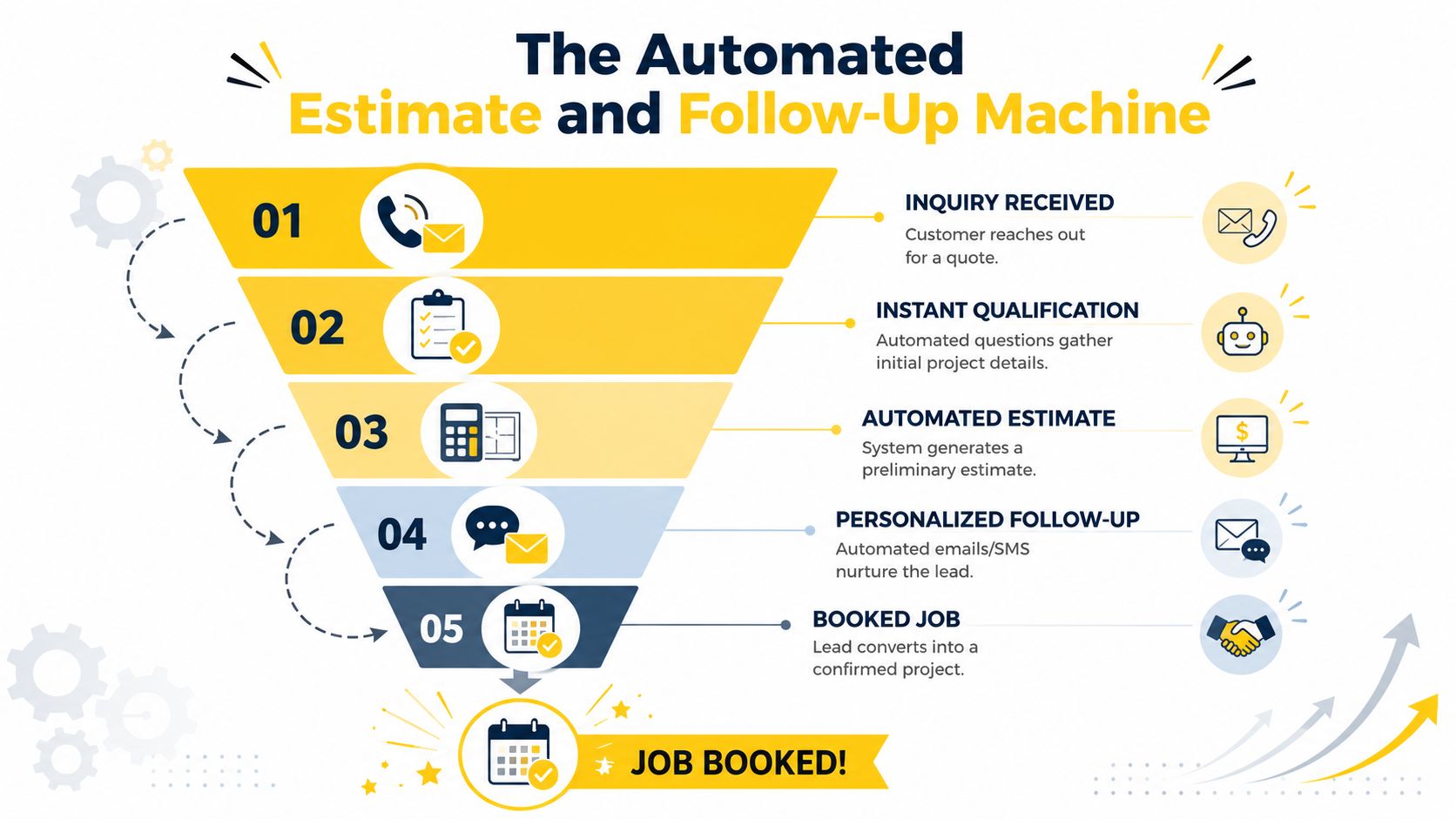
For cleaning companies, the best automated flow usually looks like this:
Inquiry received
The lead comes in through your website, chat widget, call flow, lead form, or ad.
Instant qualification
The system asks the same core questions every time. Property type, size, service type, frequency, urgency, surfaces, and special conditions.
Estimate delivery
The prospect receives a professional estimate by SMS and email. Not a vague "we'll get back to you."
Structured follow-up
If they don't book, the system sends reminders, trust builders, and objection-handling messages.
Booking or human handoff
Ready buyers schedule. Complex leads get routed to a person with context already captured.
Automation excels over human effort. Humans are better at exceptions, edge cases, and closing nuanced deals. Systems are better at speed, consistency, and not forgetting.
A lot of owners still treat estimates like custom paperwork that starts after the call. That slows everything down. In cleaning, many inquiries can be pre-qualified and priced within a controlled range right away if your pricing logic is already defined.
Not every lead books on the first interaction. Some are comparing. Some need to check with a spouse. Some are collecting options for later in the month. Some want recurring service but aren't ready today.
That is why follow-up can't be a random mix of missed calls and "just checking in" texts.
According to ProjectMark's lead generation article for contractors, companies that excel at lead nurturing generate 50% more sales-ready leads at 33% lower cost per lead. The takeaway isn't just that follow-up matters. It's that a systematic qualification and nurturing process produces better leads more efficiently than ad hoc manual chasing.
A practical nurture sequence for cleaning leads might look like this:
Don't make prospects ask the same questions twice. If the system already captured bedrooms, bathrooms, square footage, and service type, every follow-up should reflect that context.
This is also where CRM integration matters. Whether you use HubSpot, Jobber, Housecall Pro, GoHighLevel, Zapier, or a simpler stack, the rule is the same. The intake tool should write data into one place so staff can see source, service requested, estimate status, and next action without piecing it together manually.
For a practical look at where AI fits into this workflow, AI sales automation for cleaning services is useful because it focuses on the conversion side, not just front-end marketing.
A quick demonstration helps make the workflow concrete:
Weak follow-up sounds like this: "Just following up on my previous message."
Strong follow-up does one of three things:
That's how automated contractor lead generation turns interest into booked work. Not with noise. With fast context, clean estimates, and follow-up that feels specific.
A lead system can fill your pipeline and still leave you frustrated if the offer is weak. A lot of cleaning companies lose jobs because they present pricing with no structure, no packaging, and no reason to say yes now.
The goal isn't to be cheapest. The goal is to make the first decision easy and the economics sustainable.
Most cleaning businesses use some mix of hourly pricing, flat-rate pricing, and recurring subscription-style pricing. Each has a place.
| Model | Best use | Strength | Risk |
|---|---|---|---|
| Hourly | Unpredictable jobs or special requests | Flexible when scope is unclear | Buyers may worry about runaway time |
| Flat-rate | Standard residential and repeatable services | Easy to sell and easy to compare internally | You need accurate scoping |
| Recurring plan | Ongoing house cleaning or office cleaning | Improves retention and scheduling stability | Requires clear expectations and service boundaries |
Hourly works when the scope is messy. Flat-rate works when your intake process is strong. Recurring plans work when you want steadier routing, repeat revenue, and better crew utilization.
For most residential cleaners, flat-rate paired with clear service tiers is the easiest model to sell. It feels cleaner to the buyer and simpler for the office.
If you need help organizing service packages and presentation, this cleaning service price list guide is a solid reference point.
A first-job offer should make trying you feel low risk. It should not train the market to expect permanent discounts.
Good examples include:
What doesn't work is vague discounting. "Call for specials" is weak. So is heavy discounting with no plan to recover margin.
Your first offer should open the door to a second job. If it attracts bargain hunters who never repeat, it isn't helping.
The easiest profit in cleaning often sits in add-ons buyers already want but weren't shown clearly. Inside fridge, inside oven, baseboards, interior windows, laundry fold, supply upgrades, and priority scheduling all belong in the estimate flow when relevant.
A better estimate process does three things:
That consistency matters. If one office person prices by instinct, another rounds down to win the job, and a third forgets add-ons entirely, your sales process becomes chaos.
For contractor lead generation, pricing isn't separate from conversion. It is conversion. A clear offer with a professional estimate closes better than a vague promise to "take a look and let you know."
You can't improve contractor lead generation by gut feel. You need a small scoreboard that tells you where leads come from, what they cost, and which ones turn into profitable jobs.
Most owners look at lead count first. That's a mistake. Lead count without conversion and value data will push you toward noisy channels that keep your phone busy and your schedule messy.
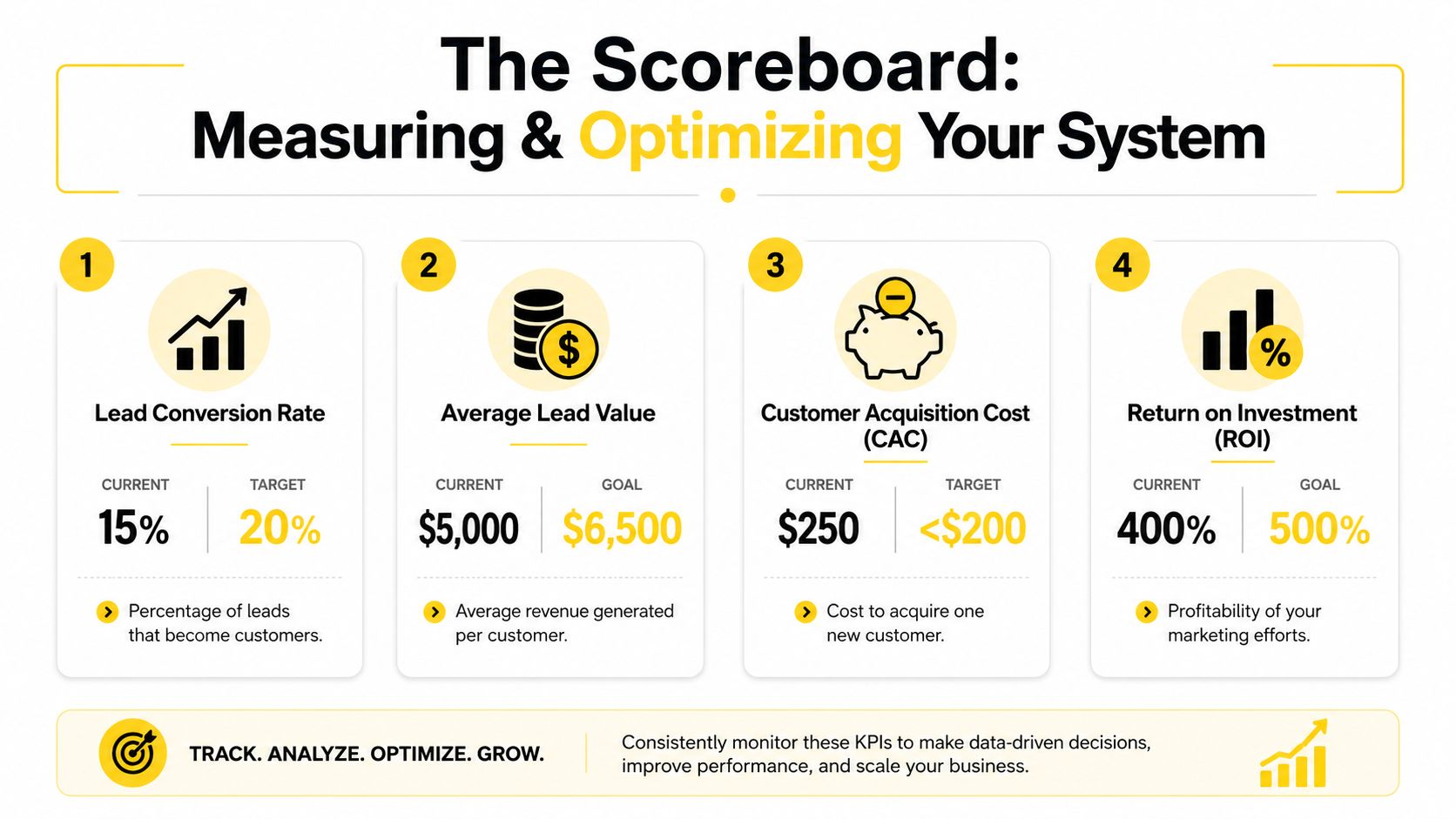
Use these four metrics first:
Cost per lead
Formula: total channel spend ÷ number of leads from that channel
Cost per acquisition
Formula: total channel spend ÷ number of closed jobs from that channel
Lead-to-booked-job rate
Formula: booked jobs ÷ total leads
Average job value
Formula: total revenue from closed jobs ÷ number of closed jobs
These are simple enough to track in a spreadsheet if you don't have a full reporting stack. Source, date, service type, outcome, and revenue are enough to start.
The pressure on this matters. According to Exploding Topics lead generation statistics, 45% of B2B businesses in 2024 say generating enough leads is a major marketing challenge, 41% struggle to follow up quickly with qualified leads, and the mean cost per lead across all industries has reached $198.44. That doesn't mean your cleaning leads should cost that amount. It means wasted follow-up and weak conversion are expensive problems across the market.
Say you run two channels. Google Ads and a partnership program with property managers and real estate contacts.
Google Ads brings faster volume. The partnership channel brings fewer leads, but they tend to be more qualified and easier to close. Which do you scale?
Use a comparison like this:
| Question | Google Ads | Partnerships |
|---|---|---|
| Are leads booking fast? | Check lead-to-booked-job rate | Check lead-to-booked-job rate |
| Are jobs worth enough? | Check average job value | Check average job value |
| Is the channel efficient? | Check cost per acquisition | Check cost per acquisition |
| Is the process sustainable? | Review team capacity and lead quality | Review partner consistency and fit |
If Google Ads generates lots of estimate requests but your booked-job rate is weak, the problem might be your landing page, your intake, or your follow-up. If partnerships send fewer leads but the close quality is stronger, you may want to invest more time there even if the raw lead count looks smaller.
Review these numbers every month. Don't overcomplicate it.
Look for patterns like:
A channel isn't good because it sends leads. It's good because it sends jobs you want at a cost you can live with.
That's the scoreboard. If you track it consistently, decisions stop being emotional. You can cut channels that waste time, fix stages that drag conversion down, and double down on what produces profitable work.
You don't need a six-month rebuild to fix contractor lead generation. You need one month of focused action and a rule that nothing new gets added until the intake and follow-up process work.
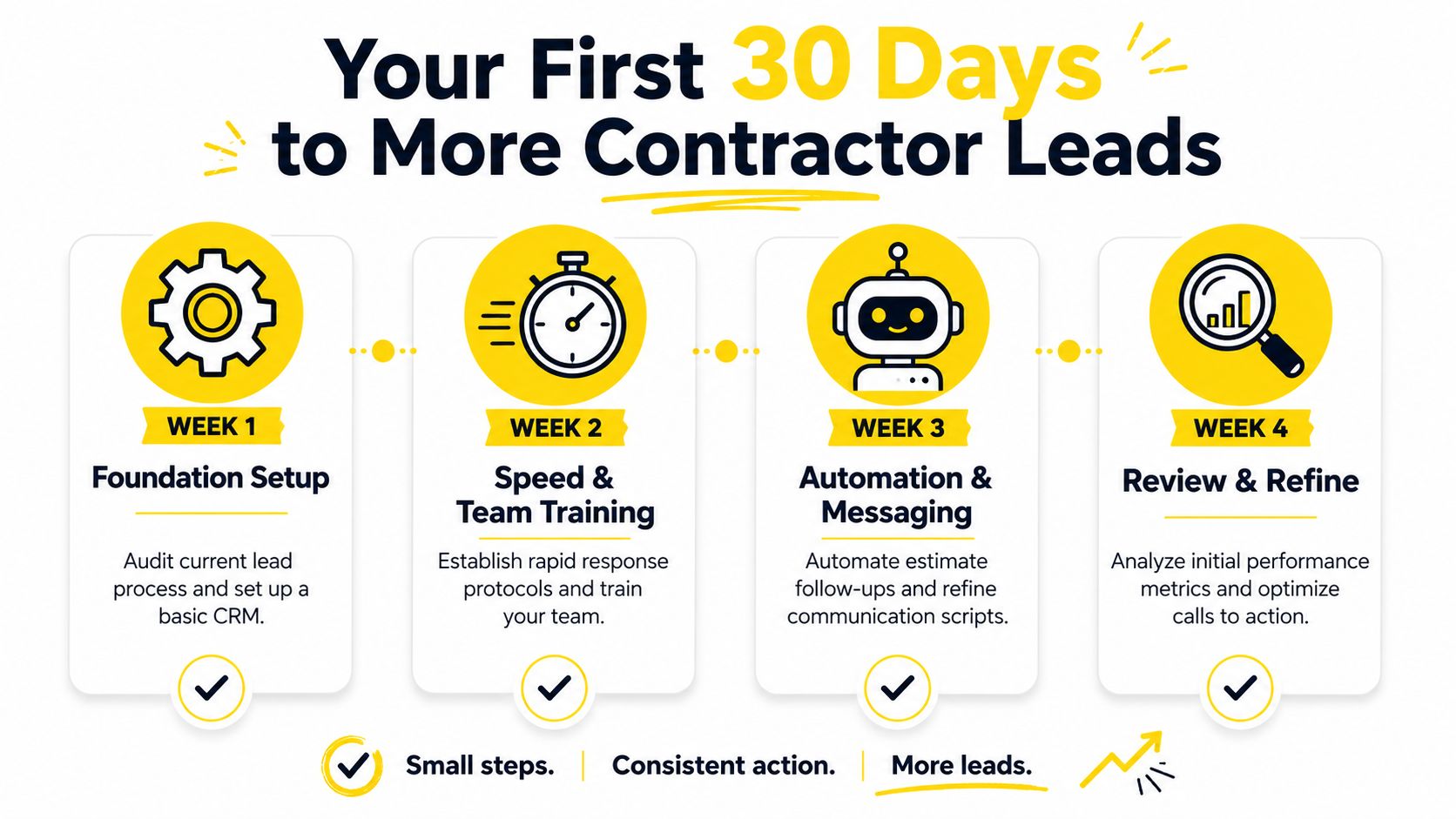
Audit every path a lead can take. Website form, phone calls, Google Business Profile, Facebook lead form, referrals, and direct messages.
Write down:
If you can't explain your current process on one page, the process is already too loose.
Set one essential rule. Every inquiry gets an immediate response path, even after hours.
Train your team to use one intake script and one estimate framework. Stop letting each person ask different questions or send different service descriptions. If you have office staff, route all incoming inquiries into one shared system so nobody is guessing what happened last.
Pick one inbound move. Usually that means improving your Google Business Profile and publishing one strong pricing or service explainer article on a blog like Estimatty's blog.
Pick one outbound move. A neighbor campaign, a property manager outreach list, or a tightly targeted local ad. One is enough. The point is to build repeatable motion, not to spray effort everywhere.
Review source, booked jobs, estimate acceptance, and average job value. Look at where prospects stalled. Was it the estimate? The response delay? The offer? The service area? The add-ons?
Make one round of changes:
The businesses that win don't always have the biggest ad budget. They usually have the cleanest system. Fast intake. Clear estimates. Better follow-up. Simple measurement.
If you want that system without relying on after-hours voicemail, manual pricing, or inconsistent follow-up, Estimatty gives cleaning businesses an AI-powered way to capture inquiries, qualify prospects, send estimates by SMS and email, and keep leads moving toward a booked job around the clock.