September 21, 2026
Inside and Out Cleaning: A Practical Pricing Guide
Learn what inside and out cleaning really includes, how pricing works, and which add-ons actually pay off for residential and commercial estimates.

Wednesday, September 16, 2026
Learn how to create accurate commercial cleaning quotes that win jobs. Pricing factors, templates, upsells and automation with Estimatty estimates.

A facility manager asks for a commercial cleaning quote at 4:30 p.m. Your estimator is on-site, the office phone is going to voicemail, and the spreadsheet still needs square footage, labor assumptions, supplies, and margin. By the time the estimate arrives, another cleaning company has already responded with a clear monthly price and scope.
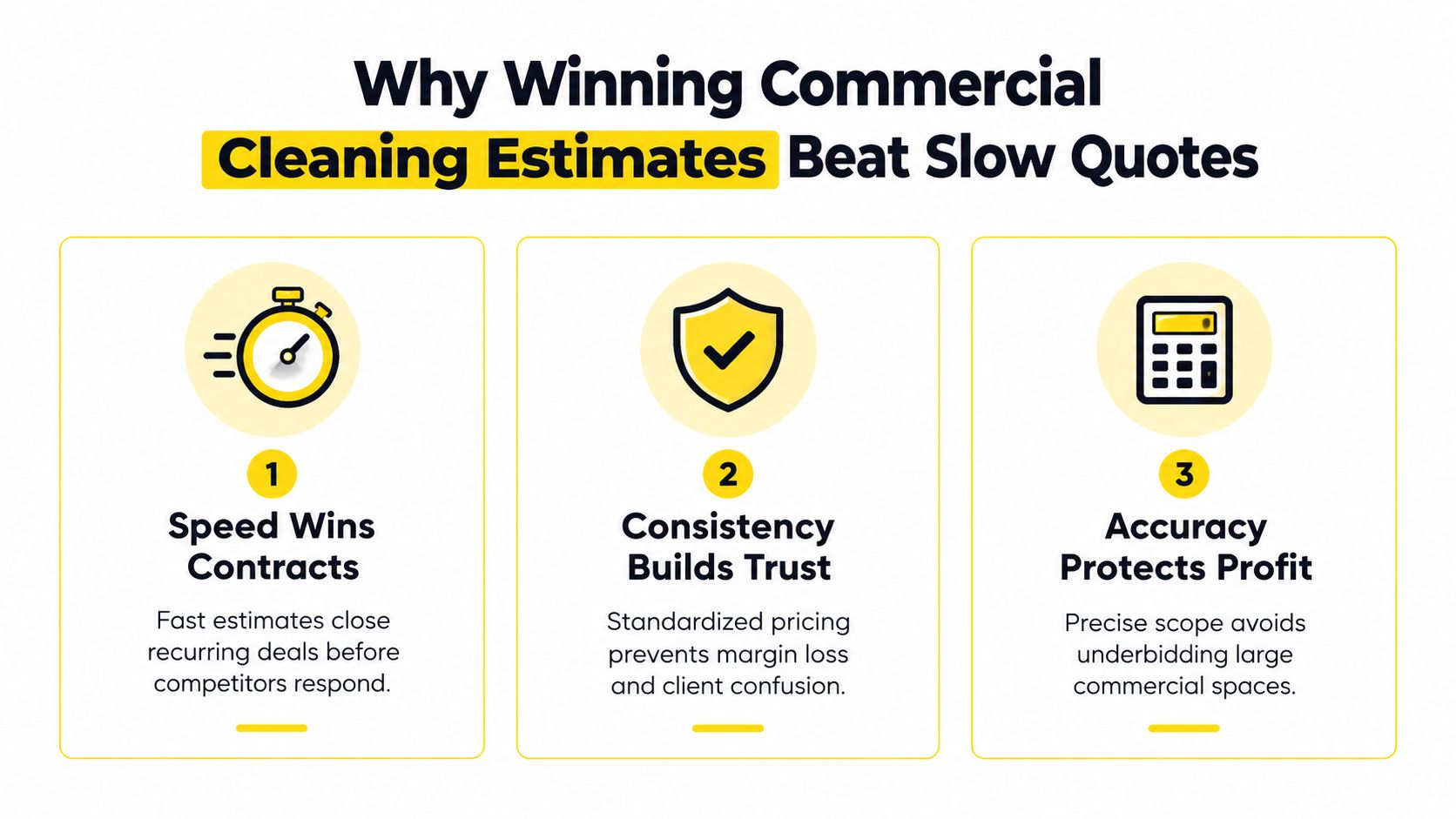
That lost contract usually isn't caused by a dramatic pricing error. It happens because the process is slow, inconsistent, or based on a guessed rate per square foot. Commercial cleaning estimates win more work when they connect actual scope to labor hours, show the buyer exactly what's included, and reach the prospect while the buying conversation is still active.
A facility manager requests pricing while your estimator is still walking another site. The quote waits for a spreadsheet, the scope lives in scattered notes, and a competitor responds with a clear proposal first. In commercial cleaning, that delay can cost the contract before the buyer compares labor assumptions, service frequency, or margin.
Manual quoting creates a second problem: inconsistent economics. Two estimators can review the same facility and produce different prices because they guessed production rates, missed restrooms, or treated square footage as the main pricing input. A reliable estimate starts with the work required, converts that scope into labor hours, and presents the result in a format the buyer can approve.
The market opportunity is substantial. One industry projection places the commercial cleaning market at USD 72.4 billion in 2026 and USD 140.4 billion by 2035, with a 7.6% compound annual growth rate. Another projects USD 225.24 billion in 2025 and USD 336.32 billion by 2031, with a 6.9% CAGR. These separate forecasts point to continued demand for recurring facility services. Review the commercial cleaning market analysis for the underlying projection.
The U.S. cleaning market is fragmented across solo cleaners, regional operators, and multi-location brands. An industry snapshot reports about 60,000 janitorial establishments generating roughly USD 50 billion in combined annual revenue, plus about 7,500 carpet and upholstery cleaning establishments generating about USD 3 billion. A separate government-linked snapshot reports USD 74.03 billion in receipts, 1,067,762 payroll workers, 89.0% of firms employing fewer than 20 workers, and 43.1% of workers concentrated in 294 large firms. These figures appear in the U.S. cleaning services industry snapshot.
That variety does not change the operating constraint. Owners cannot stay inside every inquiry, and a gut-feel price can win revenue while losing profit. Standardized estimating collects the same scope information, applies labor-based cost logic, and sends a professional proposal before interest cools.
Practical rule: Speed earns attention, consistency builds confidence, and labor-based accuracy protects the contract after the sale.
Capture facility type, cleanable area, frequency, access schedule, restroom density, flooring, kitchens, specialty sanitation, and add-ons. Preserve the assumptions behind the price so the team can explain the estimate rather than defend an unexplained total. An automated workflow such as Estimatty's always-on estimate process can collect those details and deliver estimates while staff are on-site or unavailable.
The most defensible commercial cleaning estimate starts with cleanable square footage, not the number printed on a lease or property listing. A tenant may occupy a large footprint but exclude storage rooms, mechanical areas, private suites, or spaces outside the requested scope. Pricing the wrong area corrupts every later calculation.
Confirm the service boundary during the walkthrough or intake conversation. Record the total cleanable area, floor surfaces, room layout, restrooms, kitchens, high-touch zones, and any sections that require separate protocols. Two facilities with the same area can demand very different labor because one has an open layout and the other has segmented rooms, dense fixtures, and more touchpoints.
Next, apply a conservative production rate for the facility type. Offices, medical facilities, retail sites, and warehouses don't support one universal productivity assumption. Start with a rate your crew can consistently achieve, then refine it after actual visits provide reliable operating evidence. Optimistic productivity makes an estimate look competitive while leaving the team with too few hours to complete the scope.
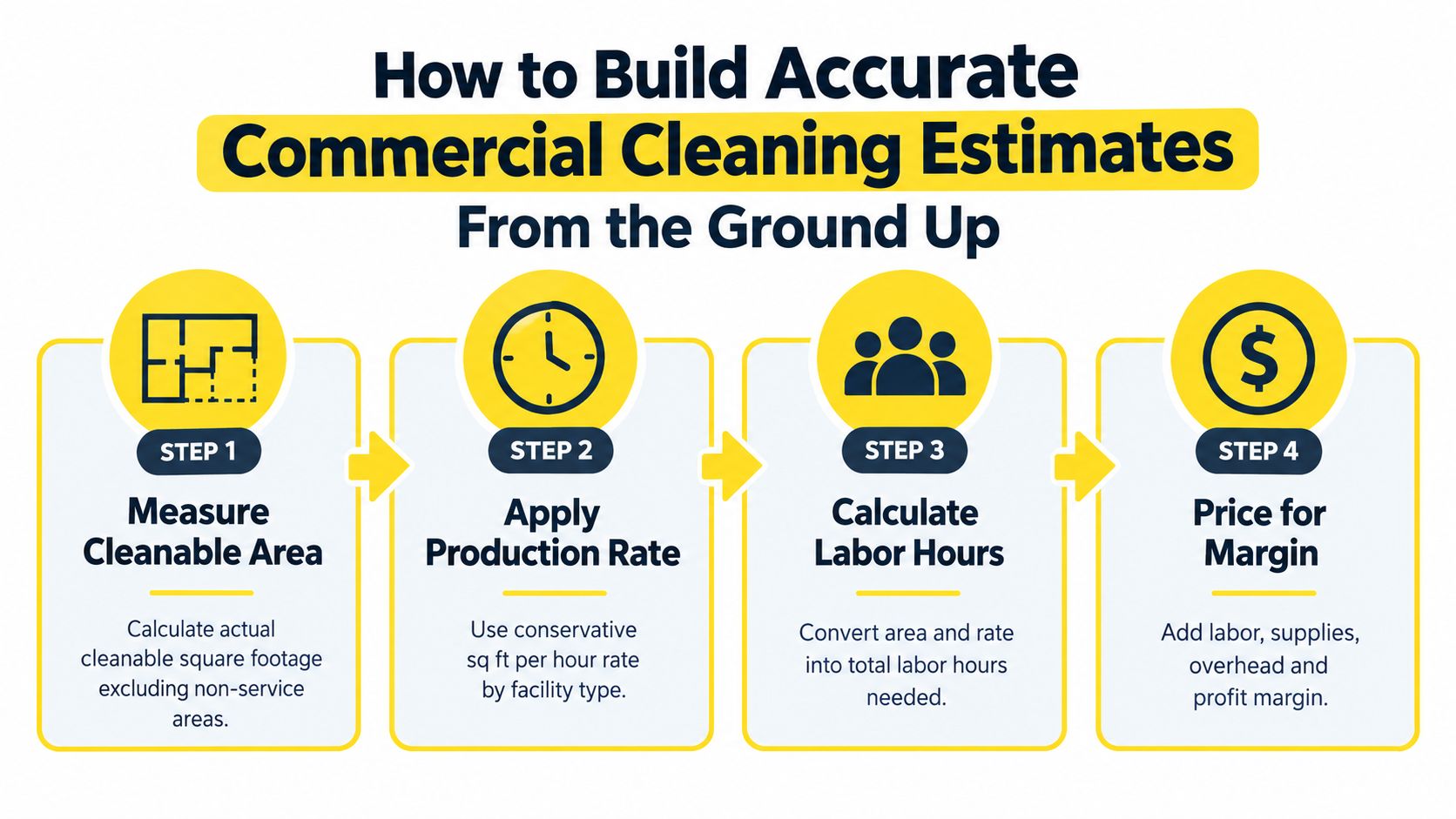
Use this sequence:
Industry bidding guidance commonly places supplies around 5% to 12% of labor, overhead around 15% to 25%, and sustainable gross margin targets around 25% to 40%, depending on contract type and risk profile. These are planning benchmarks, not substitutes for your own cost records. The commercial cleaning bidding glossary provides the cited cost-stack guidance.
The practical formula is:
Monthly estimate = labor hours per visit × fully burdened hourly rate, plus supplies and allocated overhead, adjusted for visit frequency, then priced for target margin.
Per-square-foot pricing remains useful for recurring janitorial work because buyers can compare it easily, but the rate should be an output of labor planning. It shouldn't be the starting guess.
For a deeper calculation workflow, use the commercial cleaning estimate calculator guide. It helps organize the inputs that determine whether a price is commercially viable.
Margin protection starts before markup. If the labor hours are wrong or the burdened rate is incomplete, a polished proposal only makes an unprofitable contract easier to sell.
A credible estimate also separates recurring work from one-time work. Routine nightly service, periodic floor care, carpet cleaning, post-construction cleaning, and specialty sanitation shouldn't be blended into one vague monthly figure. The buyer gets clarity, and your team gets a clean operational baseline.
Square footage gives you scale, but labor usually drives the price. Industry guidance places labor at roughly 50% to 80% of total job cost, while another source puts labor alone at 50% to 70% of cost. That explains why two same-size buildings can produce very different commercial cleaning estimates. The commercial cleaning pricing guidance from Housecall Pro details this labor-centered view.
Facility type changes the required production rate and the amount of supervision, documentation, and sanitation control. A warehouse may have broad open areas and relatively low touchpoint density. A medical facility can require more careful procedures, higher-touch cleaning, and stricter consistency. Timing matters too. Daytime service may require occupied-space coordination, while after-hours work can create access, security, or staffing constraints.
Capture these details before your system calculates the estimate:
Reported market ranges for standard recurring service commonly run from $0.05 to $0.25 per square foot, while hourly work is often listed at $25 to $75 per cleaner, depending on facility type, region, and scope. Warehouse work is often listed near $0.05 to $0.07 per square foot, while medical facilities can reach about $0.15 to $0.18 per square foot because of stricter sanitation requirements. These figures come from Jani-King's commercial cleaning cost guide.
| Facility Type | Typical Rate Range | Why It Changes the Estimate |
|---|---|---|
| Warehouse | $0.05 to $0.07 per square foot | Open areas can support efficient production, but floor condition and traffic still matter |
| Medical facility | $0.15 to $0.18 per square foot | Stricter sanitation requirements and higher-touch areas increase labor |
| Standard recurring service | $0.05 to $0.25 per square foot | Region, facility layout, frequency, and scope create a broad range |
| Variable or specialized work | $25 to $75 per hour per cleaner | Deep cleaning and specialized labor are easier to price by time |
A practical guide to cleaning service budgeting is useful when a client asks why the same square-foot rate doesn't apply to every building. It reinforces the point that area-based pricing works only when the underlying scope and labor assumptions are comparable.
Don't let a prospect reduce the conversation to price per square foot. Explain that the rate reflects the labor required to service the building at the promised standard. Your commercial cleaning pricing guide can help your team apply facility-specific rules instead of forcing every account into one blanket rate.
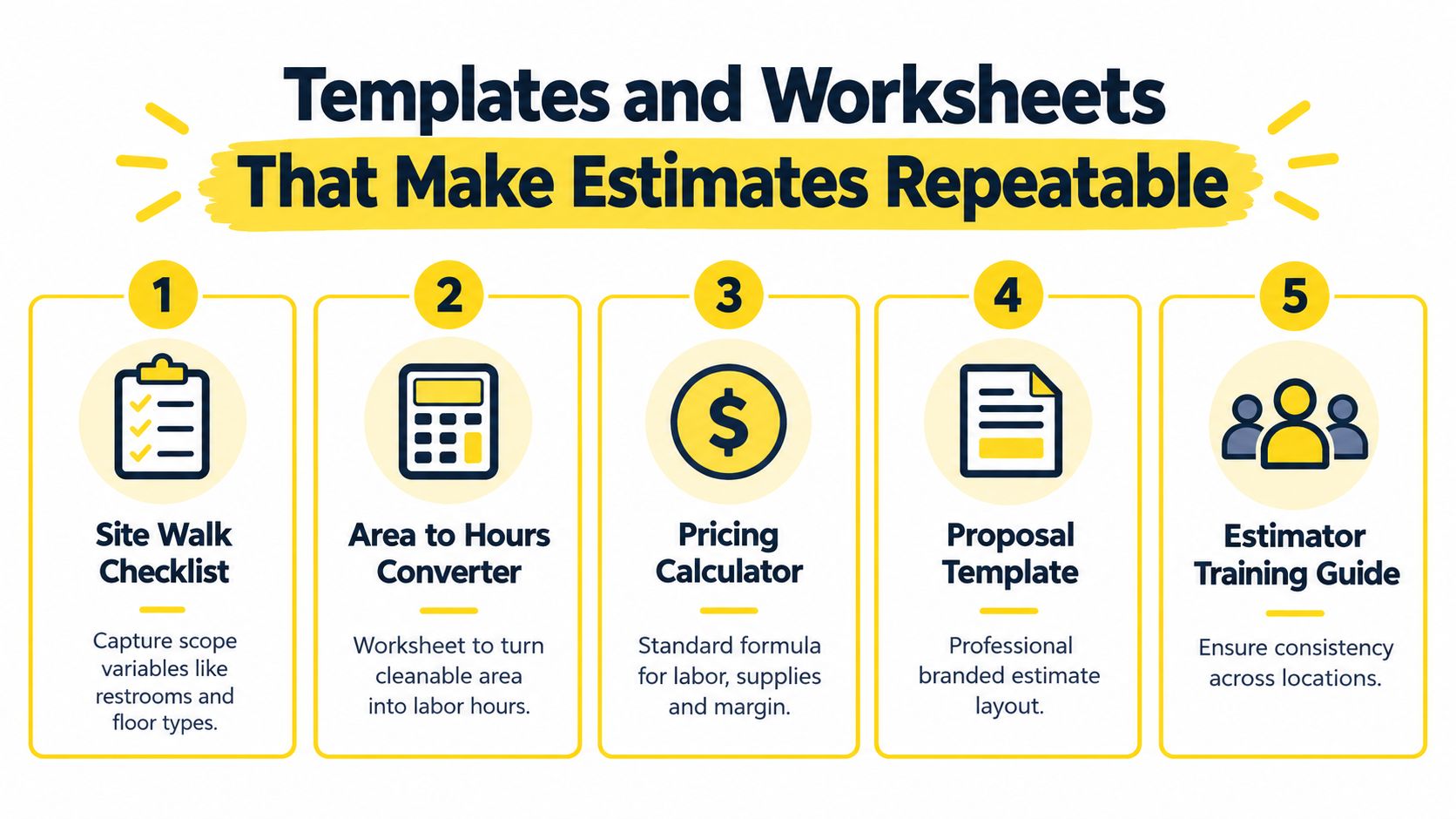
A worksheet should make the cost stack visible without making the estimator rebuild it from memory. I recommend a single intake structure that begins with site facts, converts area into labor hours per visit, and then converts visit pricing into a monthly estimate based on the agreed cadence.
The core fields are straightforward:
A recurring estimate should show both the per-visit rate and the monthly total. That structure lets a facility manager understand what happens on each visit while giving the purchasing team the recurring number it needs for budgeting. It also makes scope changes easier to price when the client adds a restroom, changes frequency, or requests a periodic floor service.
| Workflow | What works | What breaks |
|---|---|---|
| Spreadsheet template | Flexible formulas and familiar inputs | Version drift, manual follow-up, and inconsistent assumptions |
| PDF proposal template | Clear presentation for buyers | Doesn't calculate scope or prevent upstream pricing errors |
| Shared intake form | Standardized information collection | Still needs a person to review, price, and respond |
| Automated estimate workflow | Faster response, consistent rules, and direct delivery | Requires careful setup and periodic review of pricing logic |
A spreadsheet remains useful for validating your model and testing scenarios. It becomes a liability when every estimator keeps a private copy or overrides the production rate without documenting why. Automation should preserve the logic, not hide it. Your staff should be able to see which inputs produced the estimate and update rules when real production data changes.
The estimate form template resources can help structure the intake side. For hiring and training cleaners, operators can also review workforce resources from pipehirehrm.com, then train new estimators against the same worksheet rather than relying on informal shadowing.
A template isn't a strategy until two different people can use it and reach the same commercial conclusion from the same site information.
Review estimates after the first service cycle. Compare planned hours with actual hours, identify scope items that were missed, and update the production assumption only when the evidence supports a change. That feedback loop turns a static worksheet into an operating system for pricing.
Add-ons should solve a visible facility problem, not serve as random extras tacked onto the bottom of an estimate. A buyer who requests recurring office cleaning may also need carpet care, window washing, high-touch disinfection, floor maintenance, or day porter coverage. Present those services as separate, optional line items with clear frequency and scope. That protects the base margin and gives the buyer control without forcing a discount.
Follow-up matters just as much. One industry dataset reports janitorial and cleaning services converting at 27.15% of sales calls on average, with top performers above 30% to 33%, as reported in Swept's commercial cleaning quoting guidance. The same source says a structured 2 to 3 message follow-up sequence can move quote conversion from about 20% to 30% toward 40% to 55%. Those figures are benchmarks from the cited industry sources, not guarantees for every operator.

A workable sequence is short and useful:
Each message should answer a question or remove friction. Repeating “just following up” doesn't create a reason to respond. A short note about an optional floor-care schedule or a clarification about after-hours access gives the prospect something concrete to decide.
Automation also helps capture demand outside business hours. Estimatty is an AI-powered web and voice sales estimator for residential and commercial cleaning businesses. It can collect details such as square footage, surfaces, and urgency, send estimates by SMS and email, notify the team in real time, and connect with Zapier or a CRM. Setup uses no-code configuration, including pricing rules, FAQs, a website widget, and voice selection. The AI sales automation guide for cleaning services provides more detail on that workflow.
Static schedules don't always reflect how a facility is used. Traffic, occupancy, events, and compliance needs can change the required intervention even when the building's square footage stays the same. Recent market coverage reports that janitorial budgets declined 4% in Q1 2025 compared with 2024, while 63% of contractors identified staffing as their biggest risk factor. Those figures are reported in the commercial cleaning services market report.
That pressure makes optional services and clear service tiers important. Instead of lowering the base price, offer a defined maintenance package, a higher-touch option, or a separate response service. The buyer sees a choice, and your team preserves the labor economics behind the contract.
A profitable estimate starts with a pricing model your team can explain, not with software. Define the cleanable area, facility-specific production assumptions, fully burdened labor, supplies, overhead, and target margin. Then identify the scope questions required before any price reaches the buyer. Labor should drive the estimate, while automation makes the calculation repeatable.
Choose the workflow that fits your operation:
The U.S. cleaning industry includes many small operators alongside fewer large employers, as shown in the cleaning services market snapshot. That fragmented structure favors businesses that can respond with larger-company consistency without building a large administrative team. Standardized estimates give solo cleaners repeatability and give multi-location brands a common commercial language.
Convert your current spreadsheet into a controlled worksheet. List each scope variable, show the labor calculation, separate recurring work from add-ons, and set a follow-up sequence that requires no improvisation. Then automate estimate capture around the clock, send delivery through SMS and email, and track booked contracts, actual labor performance, callbacks, and margin after service begins.
Estimatty provides an AI-powered web and voice estimator for cleaning businesses. It captures commercial scope, applies your pricing rules, and sends consistent estimates by SMS and email. Visit Estimatty to configure no-code estimate automation and respond faster without adding headcount.