
November 27, 2026
Instant Auto Quote for Cleaning Companies: How It Works
Learn how an instant auto quote works for cleaning businesses, from the first web visit to a booked job, and how it speeds estimates and bookings.

Saturday, November 28, 2026
Cleaning up quotes starts with one standard intake, labor-hour math and clear scope. Learn how to cut follow-up work and win more jobs.

Companies that contact a web lead within one hour are nearly seven times more likely to qualify that buyer than companies that wait another hour, and more than 60 times more likely than teams that wait 24 hours or longer, according to a 2011 Harvard Business Review analysis of over 1.25 million leads across 2,241 businesses summarized in EngageBay's review of lead response time research. The same review cites 2007 InsideSales.com and MIT findings showing that the odds of contacting a web lead drop 100-fold when the first call happens after 30 minutes instead of within five minutes, and fall fivefold between the fifth and tenth minutes.
Most cleaning company owners read those numbers and try to talk faster on the phone. Speed alone won't save your margin if you fire off a wild guess just to beat a competitor. In a U.S. residential cleaning market valued at approximately $18.8 billion in 2024 based on IBISWorld figures reported by Trafft's cleaning industry statistics, buyers compare options fast, and messy pricing creates callbacks, underbid jobs, and awkward arguments on the client's doorstep.
Cleaning up quotes starts with one operational shift: stop treating a price sheet like a napkin guess and treat it as a scope contract built from labor hours. Just as important, label the document as an estimate or a quote before a single mop touches the floor. When every member of your office prices from the same inputs, production rates, and written boundaries, you send numbers fast without bleeding profit.
Small cleaning companies don't have the luxury of an estimating department. According to 2022 U.S. Census Bureau County Business Patterns data for NAICS 561720, 89.0% of the nation's 62,970 janitorial-services firms employed fewer than 20 people, even as total industry revenue climbed roughly 64.7% from about $44.2 billion in 2015 to $72.8 billion in 2022. In a sub-20-person shop, the owner or office manager writes estimates, dispatches crews, and closes sales in the same afternoon.
Without a fixed sequence, two staff members will price the exact same three-bedroom house at two different numbers. The customer spots the gap, distrusts your team, and starts asking for discounts. Here's the six-step visual workflow that removes guesswork from every residential and commercial bid.
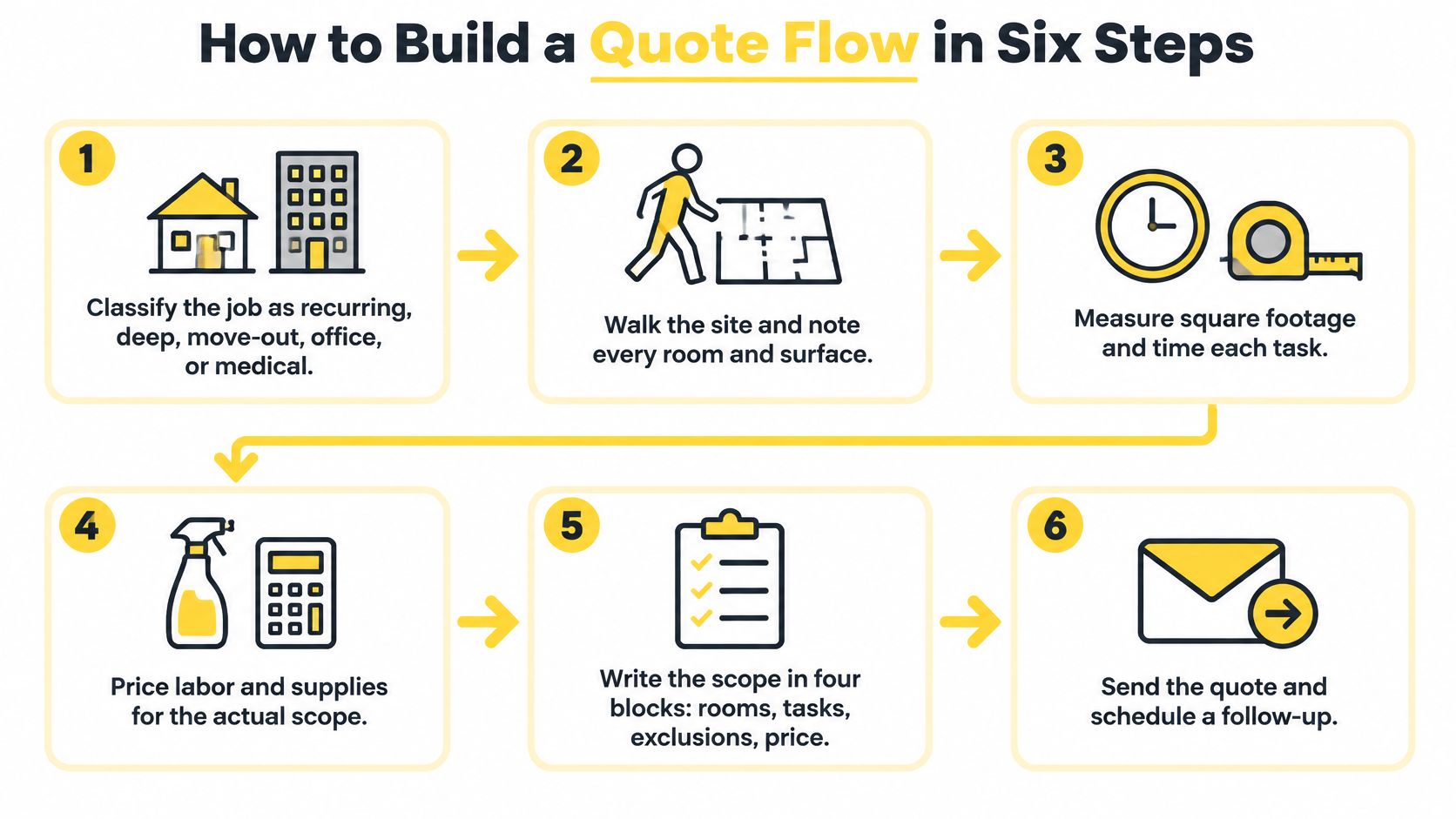
Run every inquiry through these steps without skipping ahead to a dollar amount.
Most estimators jump straight from step one to step four because they carry a rough mental rate per square foot. That shortcut hides labor spikes inside kitchens, bathrooms, and high-touch rooms until your crew is already an hour behind schedule.
Operational rule: Lock the sequence in your CRM or intake form so nobody can generate a final price until the service category, site inputs, and labor-hour math are filled in.
When every staff member follows steps one through six in order, an inquiry handled at 9:00 a.m. produces the same price and scope as an inquiry handled at 4:30 p.m. Consistency stops internal rework and builds buyer confidence before your crew even parks the van.
Every revised bill and angry phone call traces back to one root cause: a missing input during intake. A crew shows up expecting a tidy recurring visit, walks into heavy pet hair, cluttered counters, and twelve months of soap scum, and suddenly your office has to call the homeowner to raise the price. Stop letting incomplete notes reach your schedule by collecting the exact same seven inputs on every job.
| Input | What It Changes | Example |
|---|---|---|
| Home or facility size | Labor hours through the production rate | 2,000 sq ft home versus 1,000 sq ft home |
| Rooms and fixtures | Bathroom, kitchen and detail time | Three bathrooms add more hours than one |
| Service type | Production rate applied | Recurring, deep or move-out |
| Last professional clean | Labor level of the first visit | No clean in the last 12 months |
| Pets, clutter and soil | Time per surface and surcharges | Heavy pet hair in every room |
| Access and timing | Travel, setup and urgency charges | Same-day booking request |
| Add-ons | Separately priced tasks | Inside oven, interior refrigerator, interior windows |
Published U.S. pricing benchmarks show how wide the gap gets once those variables change. According to Skynova's house cleaning estimate guide, standard residential cleaning commonly falls around $25 to $50 per cleaner per hour, roughly $0.07 to $0.15 per square foot, and approximately $150 to $250 for a 2,000-square-foot home, while deep cleaning commonly rises to $0.20 per square foot or more. Broad residential benchmarks compiled by The Pricer's house cleaning cost breakdown show a similar spread: standard visits land around $118 to $238 with a typical visit near $176, deep cleans reach about $380, and homes under 1,000 square feet often start near $70.
Those ranges aren't random. They reflect how each of the seven intake fields shifts real crew time on site:
Use one blunt test to verify whether your intake form works: hand a completed record to a different employee who never spoke with the customer. If that person can calculate the exact estimate without calling the prospect back for clarification, your intake is complete.
If they have to ask how many showers are in the house or whether the client wants the fridge emptied, your form has holes. Standardizing your intake with structured estimate form templates guarantees that every prospect answers the same seven questions, making your bids faster to produce and easy for buyers to compare.
Quoting by a single dollar-per-square-foot multiplier feels easy, which is why so many small cleaning companies stay broke while staying busy. Square footage measures floor area, not hand effort. Baseboards, cabinet fronts, soap buildup, clinical disinfection protocols, and room transitions all drive labor hours, and labor hours drive your payroll.
Look at how dramatically output per labor-hour shifts across four common job types. Residential production rates come from Blue Collar Clean's benchmark guides, while commercial rates draw on ISSA 612-derived benchmarks outlined in The Fennec Lab's commercial square-foot pricing calculator guide.
| Job type | Sq ft per labor-hour | Hours for 2,000 sq ft | Hours for 10,000 sq ft |
|---|---|---|---|
| Recurring residential maintenance | 400-600 | 3.3-5.0 | Divide sq ft by rate |
| Deep or move-out residential | 250-350 | 5.7-8.0 | Divide sq ft by rate |
| General office | 3,500-4,500 | Divide sq ft by rate plus minimum | 2.2-2.9 |
| Medical facility | 1,500-2,500 | Divide sq ft by rate plus minimum | 4.0-6.7 |
Compare the first two rows on a 2,000-square-foot home. On recurring residential maintenance at 400 to 600 square feet per labor-hour, the job takes roughly 3.3 to 5.0 labor-hours before travel or unusual soil adjustments. Switch that exact same 2,000-square-foot house to a deep clean or move-out at 250 to 350 square feet per labor-hour, and the time jumps to 5.7 to 8.0 labor-hours. Hand-scrubbing baseboards, wiping cabinet interiors, and detailing appliances cuts hourly square-foot coverage almost in half.
The commercial gap is even more unforgiving. Under ISSA 612-derived benchmarks, general office cleaning runs at roughly 3,500 to 4,500 square feet per labor-hour, which puts a 10,000-square-foot office at about 2.2 to 2.9 labor-hours. A medical clinic of the exact same 10,000 square feet drops to 1,500 to 2,500 square feet per labor-hour because of high-touch disinfection, compliance procedures, and disinfectant dwell times, requiring roughly 4.0 to 6.7 labor-hours before setup, travel, supply replenishment, or inspection.
If your sales rep prices that 10,000-square-foot clinic using an office production rate, you've just budgeted roughly half the labor hours the crew needs. The same trap hits specialty handovers and post-renovation work, where dust extraction and adhesive removal collapse normal cleaning speeds; operators reviewing specialty bids can see how job complexity reshapes pricing when comparing condo handover cleaning bids from Canes Cleaners. Once your labor hours are right, multiply them by your true hourly wage plus payroll taxes, insurance, supplies, and margin, as broken down in our guide to labor and burden rates.
Industry benchmarks are a safe starting point, not permanent gospel. Every cleaning company should track quoted hours versus actual clocked hours by service category every month. When your crews consistently run 45 minutes over budget on move-out cleans, don't blame the cleaners or tell one veteran estimator to "pad it next time." Lower your move-out production rate in your pricing table by 50 square feet per hour and retest next month.
Relying on one experienced person's intuition breaks down fast in a high-turnover industry. According to U.S. Bureau of Labor Statistics data cited in RapidEye Inspections' cleaning industry employee turnover statistics, the BLS projects approximately 351,300 annual openings for janitors and building cleaners from 2024 through 2034, driven mostly by workers leaving or transferring, while median tenure in building and grounds cleaning and maintenance occupations dropped to 3.5 years in January 2024, down from 4.3 years a decade earlier.
A documented production-rate table survives staff turnover. A pricing formula trapped in one manager's head walks out the door the day they resign.
Because crew capacity and retention directly govern how many quoted hours you can reliably deliver each week, keep your hiring pipeline just as structured as your pricing system. Dedicated cleaning recruitment tools like Pipehire help owners screen and hire cleaners consistently, and the Pipehire blog shares practical hiring and retention playbooks built specifically for cleaning companies.
Cleaning business owners use "estimate" and "quote" interchangeably all day long, and it costs them trust on both sides of the sale. Those two words carry completely different commercial promises.
An estimate is a provisional price built from the facts you have right now, usually delivered online, by text, or over the phone before anyone walks the property. A quote is a binding price commitment for a clearly defined scope, issued only after an on-site walkthrough or a complete, verified intake confirms every variable.
Consumer law reflects that divide. Under New Zealand's Consumer Protection guide on quotes and estimates, accepting a quote generally locks in the provider's price so the customer can't be charged more unless they approve extra work or the scope changes, whereas a final bill based on an estimate should generally remain within 10% to 15% of the original figure. Even outside New Zealand, that expectation matches how homeowners and facility managers think everywhere.
| Document | Price Status | When to Use It | Customer Expectation |
|---|---|---|---|
| Estimate | Provisional, based on the scope stated so far | Before a site visit or when details are missing | The final price may move within a stated range |
| Quote | Binding price for the stated scope | After inspection or once the scope is confirmed | The price holds unless the scope changes |
| Revised quote | Reissued price after a scope change | When access, condition or requests change | The customer approves the change in writing |
Call an unverified phone guess a "quote," and you've boxed yourself in. When your crew arrives, sees heavy grease buildup, and needs another two hours, raising the price feels like a bait-and-switch to the client, even if your extra charge is completely fair.
The flip side hurts just as much. If you hand a commercial property manager a sloppy number labeled "estimate" after doing a full walkthrough, they wonder why you still aren't sure what the job costs. Using the exact right document label, alongside understanding the broader boundaries in a proposal vs. quote workflow, sets expectations before money changes hands.
Enforce this exact rule across your website, phone scripts, email templates, and field team so nobody invents their own wording:
"How do I compare two cleaning quotes fairly when each company defines a clean differently?"
Homeowners and office managers ask that question every week, and most cleaning companies fail to answer it. They send a single dollar figure with a vague line reading "Standard House Clean" and hope the buyer picks them. Coverage in Cleanfax and Cleaning & Maintenance Management's BSC survey report highlights how building-service contractors constantly struggle to balance client expectations, facility image, and the customer's price point. That friction happens because price gets presented without measurable scope.
Here's the counterintuitive truth most owners resist: false pricing precision lowers trust when the scope is vague. A razor-sharp down-to-the-cent figure attached to a two-line description makes seasoned buyers suspicious about hidden fees, while a transparent estimate range paired with crystal-clear inclusions and exclusions reads like an honest professional. Reviewing those boundaries face to face or in writing before work starts eliminates nearly all post-job friction.
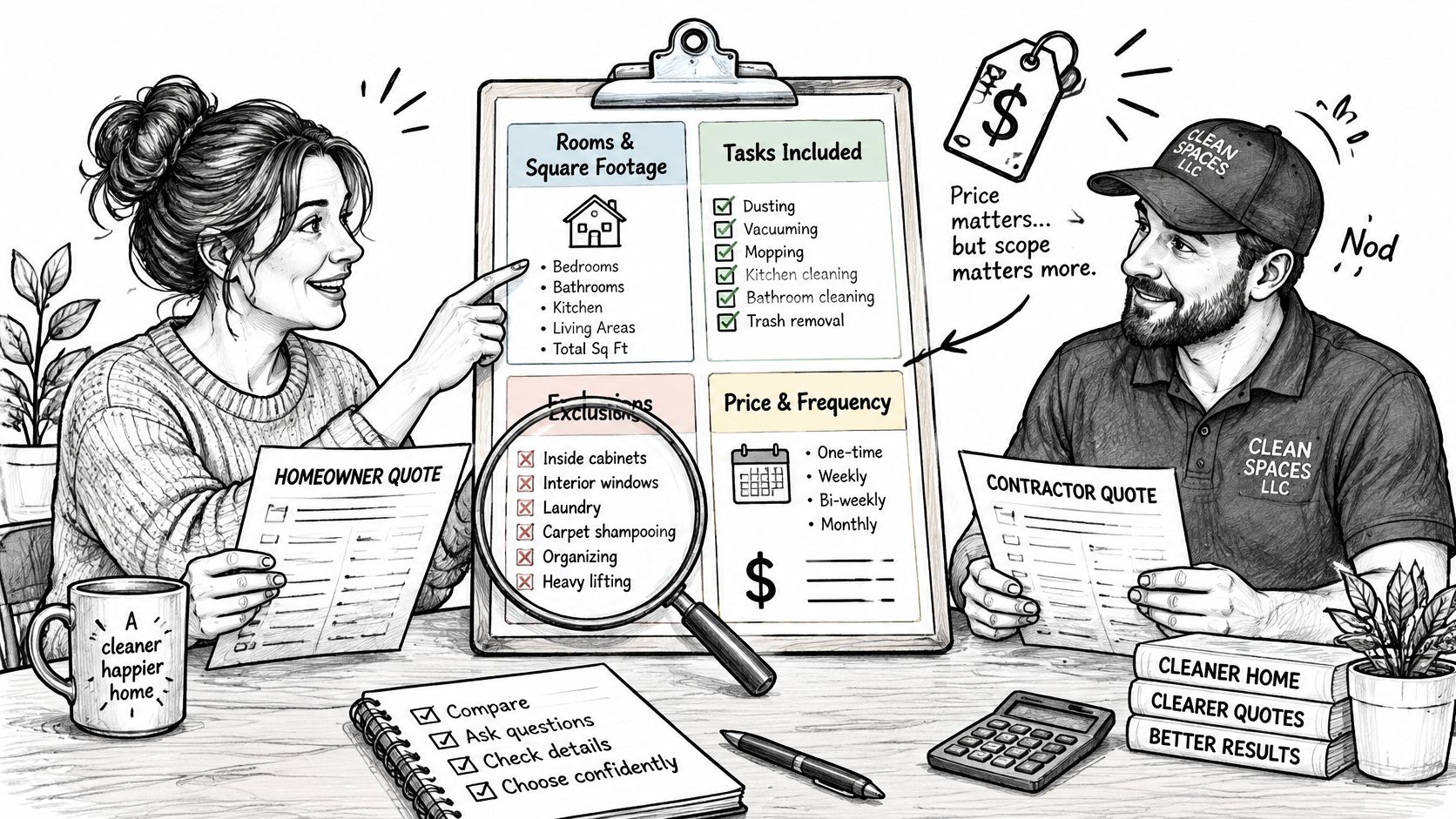
Attach these four blocks to every residential estimate and commercial quote so there's zero room for interpretation:
Consider a realistic comparison on the same 2,000-square-foot home. Company A sends a lower-priced "Standard Clean" with no task list. Company B sends a higher-priced "Initial Deep Clean" that lists bathroom descaling, baseboard wiping, interior refrigerator detailing, and a lower recurring maintenance rate on future visits. Company A looks cheaper on the surface, yet the homeowner gets a vastly smaller clean and ends up disappointed when the fridge and baseboards go untouched.
Before putting a change-order policy into your templates, watch how clear scope boundaries protect both your crew and your customer relationship.
Your scope document also cuts down tedious follow-up calls. When a prospect reads the inclusions, exclusions, and pricing assumptions upfront, they stop calling to ask whether you wipe ceiling fans or clean inside cabinets, freeing your office to book jobs instead of repeating checklists.
Any task outside the written scope requires a written add-on approval before work starts, and provisional estimates may move only within the stated condition range after on-site inspection.
Put that exact change-order rule right above the signature or booking button. Backing it up with a clear system for how to handle scope creep gives your field team the backing they need to hold boundaries politely without eating unbilled hours.
Calculating an accurate price means very little if your phone goes to voicemail at 6:15 p.m. and the prospect hires whoever answers at 6:20 p.m. Speed gets prospects into the funnel, yet coverage after the first response is where most cleaning businesses lose revenue.
Look at the numbers from 2025 benchmark reporting analyzing 1.1 million small-business conversations cited in CrewRobin's missed-call statistics for home service businesses: home-services companies missed 14% of calls, and among the calls they did answer, 38% were leads and 45% of those leads converted right during the call. The same source cites separate 2025 homeowner survey data showing that 73% of homeowners say response time influences hiring decisions, alongside transparent pricing. Every unanswered evening call or abandoned web form isn't a minor inconvenience; it's a high-intent buyer handing recurring revenue to the company down the street.
Don't make the mistake of trying to automate every messy conversation. Smart 24/7 quoting works as a continuity system, not a dumb widget. Your automated path should capture all seven intake inputs, deliver a clearly labeled estimate or range with saved assumptions, answer routine FAQ questions, and push the exact same record to both the prospect and your staff while following up automatically if the buyer hasn't booked yet.
Just as critical, set hard human escalation triggers. Route the conversation straight to a live person whenever a prospect mentions:
Pairing instant intake with a structured after-hours answering service for small business stops revenue leaks without sacrificing pricing accuracy. For residential cleaning companies ready to automate that exact workflow, Estimatty plugs straight into your existing website, asks for service type, last clean date, square footage, bedrooms, bathrooms, pets, and add-ons, sends instant estimates by SMS and email, and gets most owners up and running the same day they sign up.
"It reduces back-and-forth questions, allowing us to go straight to providing an estimate and converting the lead," says Eliana J., Owner, Sweet Home Cleaning Services.
Stop tinkering with generic hourly rate calculators and execute these three fixes in order:
For deeper pricing templates, intake checklists, and booking playbooks for cleaning operators, explore the practical guides on the Estimatty blog.
Estimatty gives residential and commercial cleaning companies a 24/7 AI web and voice sales estimator that turns your pricing rules into consistent, instant estimates by SMS and email without adding office headcount. Built by cleaning industry veterans, it captures every critical job input, standardizes your pricing across channels, and hands off high-intent leads smoothly so you stop losing bookings to slow callbacks or messy quotes. See how fast you can standardize your estimating process at Estimatty.