October 23, 2026
How to Start Commercial Cleaning in 2026
Learn how to start commercial cleaning in 2026 with proven steps for pricing, staffing, licensing, and automation that win recurring contracts.

Saturday, August 29, 2026
Explore 8 cleaning business cards ideas with mockups, CTAs, finishes, QR and SMS placement, Estimatty estimates, and tracking tips.
A business card can do more than preserve your phone number. It can move a prospect from a hallway conversation, neighborhood referral, or commercial networking event straight into a booking path. That shift matters because digital business cards were adopted by 37% of businesses in 2025, up from 16% in 2020, according to Supercode's analysis of QR-enabled business cards. The printed card still starts the interaction, but the digital destination captures the opportunity.
The strongest cleaning business cards ideas combine visual proof or memorability with a readable phone and SMS route, a QR code leading to Estimatty's estimate system, and a distribution plan you can track. A homeowner may want an estimate immediately. An office manager may need a service menu. A premium client may judge your positioning by the stock, texture, and restraint of the design.
The eight concepts below match each card to a specific audience, budget, tactile format, CTA placement, estimate access, and tracking goal. Use them to choose a card that fits residential or commercial selling, practical or premium branding, and the follow-up behavior you want after the handoff. For an extra visual branding idea, pair your card strategy with a dirty hands clean money decal on a vehicle or work surface.
The most practical card for lead capture puts a prominent QR code beside a direct invitation to get an estimate. The code should open Estimatty's mobile estimate experience, where a prospect can enter details about the property, surfaces, urgency, and requested service without searching through your website.
This format suits residential cleaners meeting homeowners at community events, supply stores, real estate offices, and referral appointments. It also works for commercial teams handing cards to property managers who want a fast starting point before arranging a detailed conversation. The card stays simple: logo, service area, phone number, SMS option, and one dominant action.
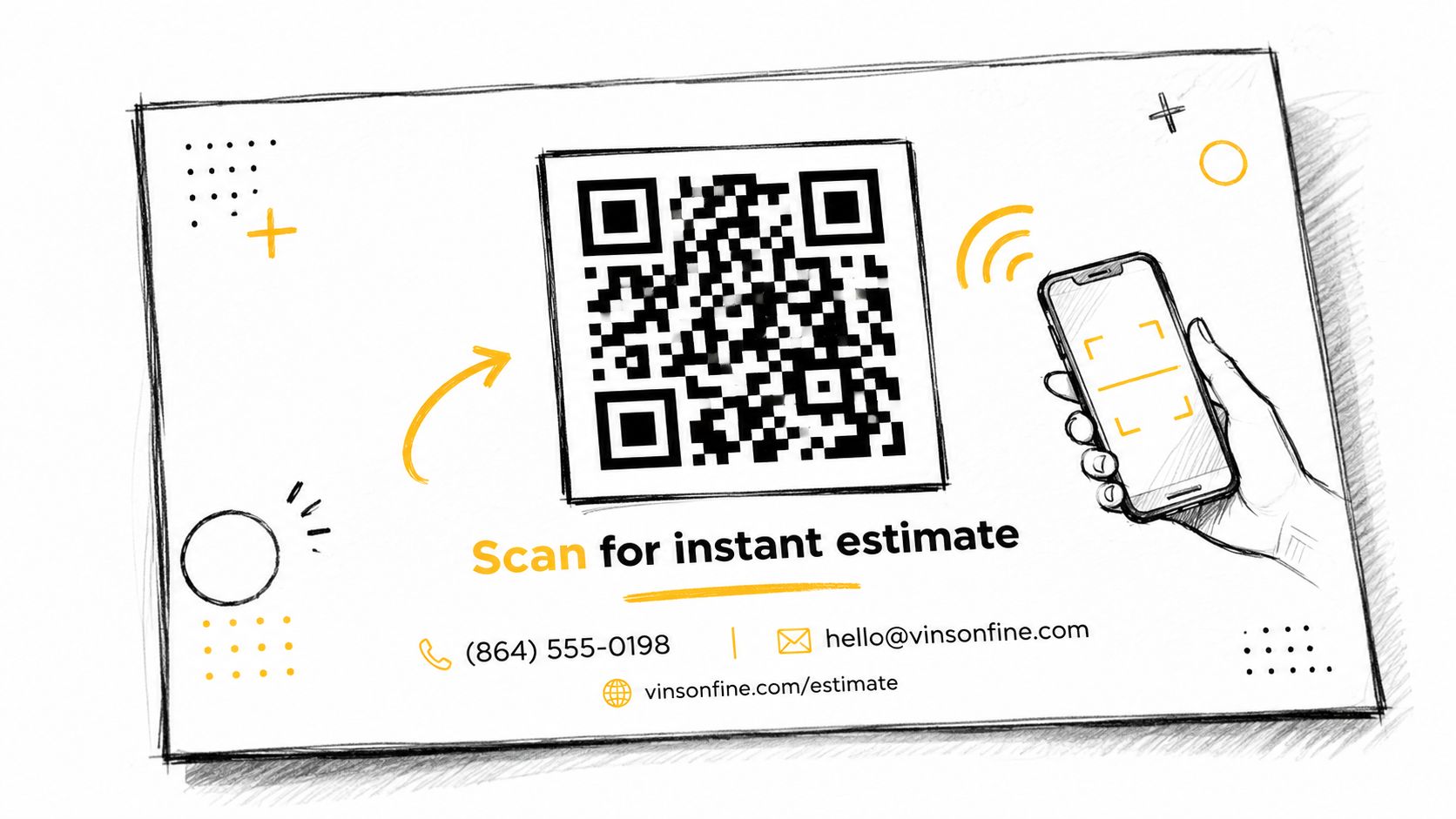
Place “Scan for an instant estimate” directly above or below the code. Don't hide the QR code among social icons or contact details. Estimatty can collect the information needed for a consistent estimate, send the result by SMS or email, and notify your team when the prospect is ready for human follow-up.
Practical rule: The card should explain the action before the prospect scans it, and the destination should deliver exactly what the card promised.
Test the printed code on multiple phones, under bright and low light, and from normal handoff distance. Keep a backup instruction such as a short website address or SMS prompt for people who don't scan. Estimatty's guide to moving from in-home estimates to online estimates gives this card concept a natural digital follow-up path.
For tracking, assign different QR destinations to neighborhood canvassing, referral partners, vehicle distribution, and commercial networking. Multi-location brands can use location-specific codes, while solo cleaners can compare channels without changing the card's core design. This is the best low-cost option when your priority is measurable estimate access rather than premium texture.
A before-and-after card sells through visible proof. Instead of asking a prospect to trust a claim about deep cleaning, show a transformation they can understand immediately. Use the front for one strong image pair, with consistent lighting, matching angles, and enough contrast to make the result credible rather than theatrical.
This design fits residential cleaners targeting homeowners who care about kitchens, bathrooms, neglected rooms, and move-out results. It also works for commercial companies that want to show an office before opening and after a deep clean. The card behaves like a miniature portfolio, so distribute it where people already discuss property condition, including real estate offices, apartment communities, and facility-management meetings.

Use the reverse side for your business name, service area, phone number, SMS option, and Estimatty estimate CTA. Add one concise testimonial or review cue only if it remains readable. The card should not become a collage of tiny images, icons, and promises.
Update the featured transformation when your service mix changes or when a particular job type becomes a priority. A residential team could use a bright kitchen transformation for homeowner referrals, then switch to a move-out example when apartment turnover becomes the main source of work. Commercial teams can feature floor care, restroom restoration, or post-construction cleaning, but each card should lead with one recognizable result.
Use a QR code that opens the estimate flow, not a generic social profile. A prospect who has just seen proof should be able to request an estimate without another search. Estimatty's content ideas for cleaning companies can help you select photo themes that carry consistently across the card, website, and social channels.
Choose a laminated finish when the card will circulate through property offices or be handled frequently. The trade-off is cost and image maintenance. Photos demand strong production quality, but they create more immediate credibility than a text-only card when your audience needs to see the work before committing.
A die-cut card earns attention through shape before the prospect reads a word. A spray bottle silhouette signals residential cleaning immediately. A broom handle or simplified mop profile can suit a commercial brand distributed in office buildings, maintenance departments, and facility-management conversations.
This format works best when memorability is the priority. It costs more than a conventional rectangle and leaves less room for information, so don't use it as a full service catalog. Use the unusual outline to win recall, then direct the recipient to Estimatty for the details and estimate.

Keep the brand name, phone number, and QR instruction large enough to read at a glance. Limit the palette to one or two brand colors so the shape remains clear. A complicated silhouette with thin lettering may look clever on screen and fail in a real handoff.
For a residential spray-bottle card, place the logo near the bottle label and the CTA where a recipient naturally looks after identifying the object. For a commercial broom-handle card, reserve the broader area for the company name, service category, and estimate access. Include a readable phone and SMS option because some facility managers will want a direct conversation rather than a scan.
A distinctive shape earns the second look. A clear estimate path earns the response.
Order a physical prototype before approving a larger run. Check whether the corners bend, whether the QR code sits on a flat enough area, and whether the card fits the folders, wallets, or badge holders used by your intended audience. Add structural reinforcement if the design has narrow extensions.
Track distribution by audience rather than chasing novelty. Give spray-bottle cards to homeowners and referral partners, and broom-oriented cards to commercial prospects. This concept is a strong networking tool for a brand that needs to be remembered, but it's a poor choice if you need maximum information per card at the lowest print cost.
A magnetic card turns a one-time handoff into repeat visibility. Homeowners can place it on a refrigerator, while office managers may attach it to a filing cabinet, whiteboard, or maintenance area. The card stays useful because the prospect doesn't need to remember where it was stored.
This format fits solo cleaners and small teams serving recurring residential customers. It also suits seasonal services, such as spring deep cleaning, post-holiday cleaning, or preparation before a property listing. Give the first batch to existing customers and referral partners, because those people already know when someone in their network needs help.
Put the Estimatty estimate CTA on the most visible side. Use a large QR code with an instruction such as “Scan for your cleaning estimate”, then place the phone number and SMS option below it. Use colors that contrast with a white refrigerator without making the card look like a discount flyer.
Design the text so it remains readable when the magnet is placed horizontally or vertically. A homeowner may keep it near a shopping list, while an office manager may place it on a cabinet door. Keep the service area short and specific, such as the communities or business districts you serve.
Retention principle: A magnet should answer three questions without being picked up, what you do, how to reach you, and what happens after the scan.
Use a durable finish suited to kitchen handling and occasional moisture. Lightly clean paper cards with a soft cloth that has only a small amount of water. Avoid excessive wetting, chemical cleaners, and abrasive materials, which can damage the surface, as explained in this guide to cleaning cards safely.
The trade-off is size and production cost. A magnet occupies more physical space than a standard card and may require a larger distribution budget, but it can remain visible long after a paper card disappears into a drawer. Use batch-specific QR destinations for existing customers, realtor referrals, and seasonal campaigns so repeat visibility leads to measurable estimate activity.
Premium cleaning services need a card that feels deliberate before the prospect reads it. Linen, felt, and recycled kraft stock create a tactile signal that standard coated paper can't provide. Emboss the company name, logo, or a simple water-drop mark, then let the texture carry the visual identity.
Choose this concept for affluent homeowners, concierge-style residential cleaning, estate support, or eco-conscious customers. A linen card supports a refined positioning. Recycled kraft communicates a natural, lower-waste direction. Neither choice should be decorative for its own sake. The material needs to match the service experience you sell.
Keep the design restrained, with a small color palette and generous breathing room. Embossing can reduce legibility when applied to small contact details, so use it for the brand mark rather than the phone number or estimate instructions. The Estimatty CTA must remain flat, high-contrast, and immediately visible.
A premium residential card might use a warm neutral background, an embossed logo, and a clean QR block reading “Get an estimate online.” An eco-focused team could use kraft stock, dark green type, and a concise statement about plant-based or pet-safe cleaning practices, provided those claims accurately reflect the service.
Request printer samples before production. Test how the QR code scans over the selected paper, whether the embossing distorts nearby text, and whether the stock feels appropriate for the customer segment. Metallic ink can highlight a logo, but overuse can make a cleaning brand feel more like a luxury retailer than a reliable service provider.
Use this format when each handoff is high value and personal. It's less efficient for broad neighborhood distribution because the premium production adds cost without guaranteeing a scan. For a cleaning owner who meets clients through interior designers, property managers, or high-end real estate referrals, the tactile experience supports the premium price position while Estimatty handles the next step.
A tear-off card gives the prospect a physical reminder without requiring them to save the entire card. The main section carries your brand and contact information. The detachable stub repeats the business name and Estimatty estimate CTA, giving a busy homeowner something small to place beside a calendar, planner, or household task list.
This concept suits residential cleaners selling to busy professionals, parents, landlords, and property owners who may want service but aren't ready to act during the conversation. It also works for seasonal campaigns where you need to compare distribution channels. A stub can carry a batch identifier, allowing you to connect response behavior to a neighborhood, referral source, or event.
Print the estimate link and QR code on the main card and the stub. The prospect shouldn't lose the action when tearing off the reminder. Use contrasting color around the perforation, and make the stub close to a practical reminder size without shrinking the text.
The physical tear needs to feel intentional. Test the perforation with real hands, not only a digital proof. If the stub tears unevenly or removes part of the contact information, the design will feel cheap and the brand will suffer.
Best use: Treat the stub as a reminder, not a second brochure. Give it one action, one brand cue, and one easy route to an estimate.
Add a simple phone and SMS option for prospects who prefer direct contact. Use a durable finish on the main section if the card will remain in kitchens, vehicles, or property folders, but keep the tear line functional. Estimatty's article on online booking software for cleaning businesses provides a relevant destination for owners connecting a reminder card to a booking workflow.
Track stub performance with batch codes or distinct QR destinations. A cleaning company could hand one batch to real estate agents and another to apartment managers, then compare estimate starts and booked jobs. This format costs more to produce than a plain card, but it creates a stronger offline reminder and gives you a clear operational test.
An NFC card removes the scan step. A prospect taps a compatible smartphone against the card, and the embedded chip opens your Estimatty estimate experience. The physical exchange remains familiar, but the digital handoff feels faster and more polished.
Use NFC selectively for tech-forward residential brands, younger homeowners, premium service providers, and commercial networking with facility managers. It's particularly useful when the person receiving the card is already holding a phone and expects a digital next step. Keep traditional cards available because NFC won't work for every recipient or device setting.
Print “Tap for an instant estimate” beside a subtle NFC symbol. Don't assume the recipient knows what to do. The front should remain clean, with the company name, service area, and short value proposition. The reverse can carry a QR code as a fallback, along with phone and SMS details.
Program the chip to open a mobile-first Estimatty page rather than a general homepage. The destination should ask only for information that supports a useful estimate, then offer SMS or email delivery and a route to human follow-up. Test the tap on multiple phone brands and models before distribution, including devices with NFC disabled.
Use analytics to compare tap-through quality with QR activity. For a commercial sales manager, distribute NFC cards to high-value prospects rather than using them for every door hanger or local handoff. A premium card can reinforce a modern, organized brand, while the selective distribution keeps the cost tied to accounts worth pursuing.
The physical card should also connect to your wider operating system. Estimatty's Zapier integration tools can support workflows that notify your team or route captured information into connected systems. The card itself doesn't create the sale. It creates a frictionless entry point, and your estimate, follow-up, and booking process must finish the job.
A service menu card qualifies the lead before the first call. It lists your core services, service area, and clear starting points, then sends the prospect to Estimatty for a personalized estimate based on property details, surfaces, urgency, and requested work.
This concept is ideal for solo cleaners and small teams that need prospects to understand their offer quickly. It also helps franchises standardize the information used across locations. Keep the menu focused on your most important services, such as recurring house cleaning, deep cleaning, move-out cleaning, office cleaning, and post-construction cleanup. Don't cram every add-on onto a small card.
The CTA should dominate the layout. Use a high-contrast block with language such as “Get your cleaning estimate online” and a QR code that leads directly to Estimatty. Put your phone number and SMS option in a secondary but readable position for prospects who want to talk first.
Use price ranges only when they accurately reflect your current pricing strategy. A service menu can show starting language or ranges without pretending that every property costs the same. Explain that the estimate is customized to the customer's needs, so the prospect understands why the digital path asks for details.
A residential card might separate recurring, deep, and move-out services. A commercial card could organize office, restroom, floor, and turnover work by service category. Use different versions when the buying context is materially different. Homeowners don't need the same menu as facility managers.
Qualification beats clutter. List the services you want to sell, then let the estimate flow handle the variables.
Update inventory when your service mix, coverage area, or pricing changes. Estimatty's cleaning service price list guidance supports the content and pricing decisions behind this format. The trade-off is maintenance. A menu card can qualify prospects better than a logo-only card, but outdated information damages trust quickly.
| Design Option | Implementation complexity | Resource requirements | Expected outcomes | Ideal use cases | Key advantages |
|---|---|---|---|---|---|
| QR Code Integration with Digital Estimate Link | Low, generate QR and link | Minimal: QR generator, mobile landing, tracking | Immediate, measurable estimates; 24/7 access | Networking, mass distribution, events | Low cost, easy tracking, instant access |
| Before/After Photo Showcase Card | Moderate, photo selection & layout | Professional photography, high-res printing | Strong trust and recall; higher retention | Portfolio-driven pitches, referrals, walk-ins | Visual proof, persuasive, memorable |
| Die-Cut Shaped Cards (Spray Bottle or Broom) | High, custom die design & tooling | Specialized die-cut printer, premium cardstock | High brand recall; standout in stacks | Networking, branding campaigns, social media | Distinctive, attention-grabbing, shareable |
| Magnetic Back Card Design | Moderate, magnetic production setup | Magnetic backing, durable print, higher cost | Extended visibility over months/years | Residential/homeowner targeting, existing clients | Long shelf-life, frequent exposure, practical |
| Specialty Paper with Embossed Texture | Moderate, embossing and stock selection | Specialty paper, embossing press, samples | Premium perception; stronger brand trust | High-end residential, eco-conscious brands | Tactile quality, sophisticated, eco options |
| Appointment Booking Card with Tear-Off Stub | Moderate, perforation & multi-piece design | Precise perforation, slightly higher print cost | Multiple touchpoints; physical reminders; trackable | Seasonal promos, local distribution, events | Reminders, engagement, batch tracking |
| Digital NFC (Near Field Communication) Smart Card | High, NFC embedding & programming | NFC chips, specialized printers, testing, higher cost | Tap-to-estimate UX; strong tech image; analytics | High-value targets, tech-savvy prospects, B2B | Single-tap convenience, modern brand positioning |
| Service Menu Card with Pricing and Estimate CTA | Low–Moderate, content prioritization | Clear service list, concise pricing, QR/CTA | Faster qualification; reduced hesitation; informed leads | First-contact distributions, franchises, walk-ups | Transparent pricing, educates prospects, drives estimates |
Start with the conversion goal, not the finish. If you want measurable digital action from every handoff, choose the QR estimate card and send each distribution channel to a trackable Estimatty destination. If prospects need proof before they commit, use the before-and-after card and make the image do the first part of the selling.
Choose a die-cut card when memorability matters most at networking events, referral meetings, or local partnerships. Choose NFC when you're targeting people who are comfortable with tap-based interactions and the account value justifies selective distribution. These formats stand out, but both need a backup path. A readable phone number, SMS option, and QR code protect the handoff when the recipient doesn't use the primary technology.
Use a magnetic card for repeat visibility in homes, offices, and seasonal campaigns. It earns its place by remaining available when the cleaning need appears later. Give magnets to current customers and referral sources first, then measure estimate activity by batch. The magnet costs more than a paper card, but it can keep your brand visible in the exact environment where the next cleaning decision happens.
Select textured stock with embossing for premium residential positioning or an eco-conscious brand that wants material choices to reinforce the service promise. Choose a tear-off card when the lead needs a reminder and your team wants to compare response by channel. Choose the service menu when prospects need help identifying the right service before they enter the estimate process.
Whatever format you choose, apply the same production standards. Keep the business name, phone number, and SMS route readable. Place the Estimatty estimate CTA where the eye lands quickly, not in a crowded corner. Test every QR destination and NFC tap on real devices. Confirm that the destination opens on mobile, captures the right property details, delivers the estimate, and alerts your team for follow-up.
Distribution determines whether the design gets used. Give residential cards to real estate agents, property managers, existing customers, neighborhood partners, and local businesses that homeowners already visit. Take commercial cards to facility managers, office administrators, building owners, and vendor meetings. A polished design handed to the wrong audience won't produce qualified estimates.
Track estimate starts, completed estimates, follow-up conversations, and booked jobs by card version. Don't judge a card by scans alone. The winning design is the one that produces the strongest booked-job pattern from the audience you want. For broader planning support, use this resource on marketing your cleaning business alongside your card distribution plan.
Start with one design and one audience. Print a controlled batch, assign the card a distinct tracking path, and measure estimates and booked jobs before expanding. Keep the format that produces the strongest results, then adapt it for the next audience instead of ordering every concept at once.
Estimatty gives cleaning businesses an AI-powered web and voice sales estimator that delivers consistent estimates, captures property details, sends results by SMS and email, and keeps your team informed around the clock. Turn your next business card into a direct estimate path by visiting Estimatty and connecting your printed CTA to a faster booking workflow.