July 29, 2026
Operational Efficiency Metrics: Boost Cleaning Profits In
Master operational efficiency metrics for residential and commercial cleaning. Learn formulas, benchmarks, and how Estimatty automates tracking.

Wednesday, July 22, 2026
Stop losing cleaning leads after 5 PM. Our guide to after-hours answering service helps you pick the best option to capture calls & book more jobs 24/7.

Friday night, your best move-out clean for next week can still vanish into voicemail. The caller is ready to book, they just want a price, a time window, and a fast answer, but your office is closed and your phone keeps ringing until they give up. By Monday, another cleaning company has already sent the estimate, booked the job, and locked in the revenue.
That leak is bigger than most owners admit. Independent industry research found that 62% of inbound calls to small businesses go unanswered, and 85% of callers who reach voicemail never leave a message and never call back. For service businesses, 38% to 55% of inbound calls arrive outside standard business hours as summarized in the industry research, which means the phone is most likely to ring when your team is least able to respond.
A cleaning business loses more than one phone call when it sends an after-hours lead to voicemail. It loses the estimate request, the follow-up conversation, and often the first impression that would have turned a one-time inquiry into recurring work. A caller who needs a deep clean, move-out clean, or post-construction clean is usually comparing a few options, and the company that answers first usually gets the edge.
Voicemail feels harmless because nobody sees it happen. No one sees the caller who hung up after the third ring, and no one sees the prospect who searched the next business on Google Maps and booked there instead. That is why missed calls hurt cleaning companies more than many owners realize, especially when the job is tied to a move date or a fast turnaround.
Practical rule: if a caller is asking for an estimate after hours, treat that as a warm lead, not a callback task.
The behavior behind that rule is blunt. When 85% of voicemail callers don't leave a message and don't call back according to the industry summary, your voicemail is not a safety net. It is a dead end. For a cleaning company, that usually means the prospect goes to the competitor who answered, asked a few qualifying questions, and sent a price right away.
The problem gets worse because after-hours demand is not rare. A large share of inbound service calls happens at night, on weekends, and during holidays, exactly when the office is quiet. If your line goes to voicemail during those hours, you are making the customer do the work of chasing you. Most will not.
A smarter benchmark is speed, not hope. If your current setup cannot capture the caller, identify the job type, and trigger the next step before they hang up, you are not running a follow-up system. You are running a filter that drops revenue.
For cleaning owners who want to tighten response time, a practical next step is improving response speed with a clearer call-handling process. That shift matters because the first company to answer with a useful next step usually gets the estimate conversation.
A modern after-hours answering service should act like a digital employee who never sleeps, never misses the script, and never leaves a prospect waiting in silence. For a cleaning company, that means more than taking a name and number. It means qualifying the lead, sorting the job type, and moving the caller toward an estimate, a booking, or a useful handoff.
A good service answers every call with your business greeting, asks the right questions, and collects the details that shape a cleaning quote. Square footage, property type, urgency, service type, and access notes all affect the estimate. If the caller needs a move-out clean or recurring house cleaning, the conversation should move toward a price or a booked slot, not a generic message.
That shift fits where the market is already heading. The global after-hours answering service market was valued at over USD 2 billion in 2025, which shows that 24/7 response is becoming standard business infrastructure rather than an optional extra as reported in the market study. Cleaning companies compete in the same space as HVAC, plumbing, and pest control, where fast response now shapes revenue.
A good service also handles common questions without forcing the caller to wait until morning. Hours, service area, minimums, recurring service frequency, and whether you use eco-friendly products are all straightforward answers if the system is trained correctly. Automated customer service workflows can handle that kind of intake, answer routing, and follow-up without adding more work to your office team.
The goal isn't to sound impressive on the phone. The goal is to remove friction between the caller and the booking.
For a cleaning company, the best outcome is plain. The caller gets an instant answer, your team gets a qualified lead, and the job does not sit in a voicemail box until the next business day. If the system cannot do those three things, it is not really an answering service. It is just a more polished voicemail greeting.
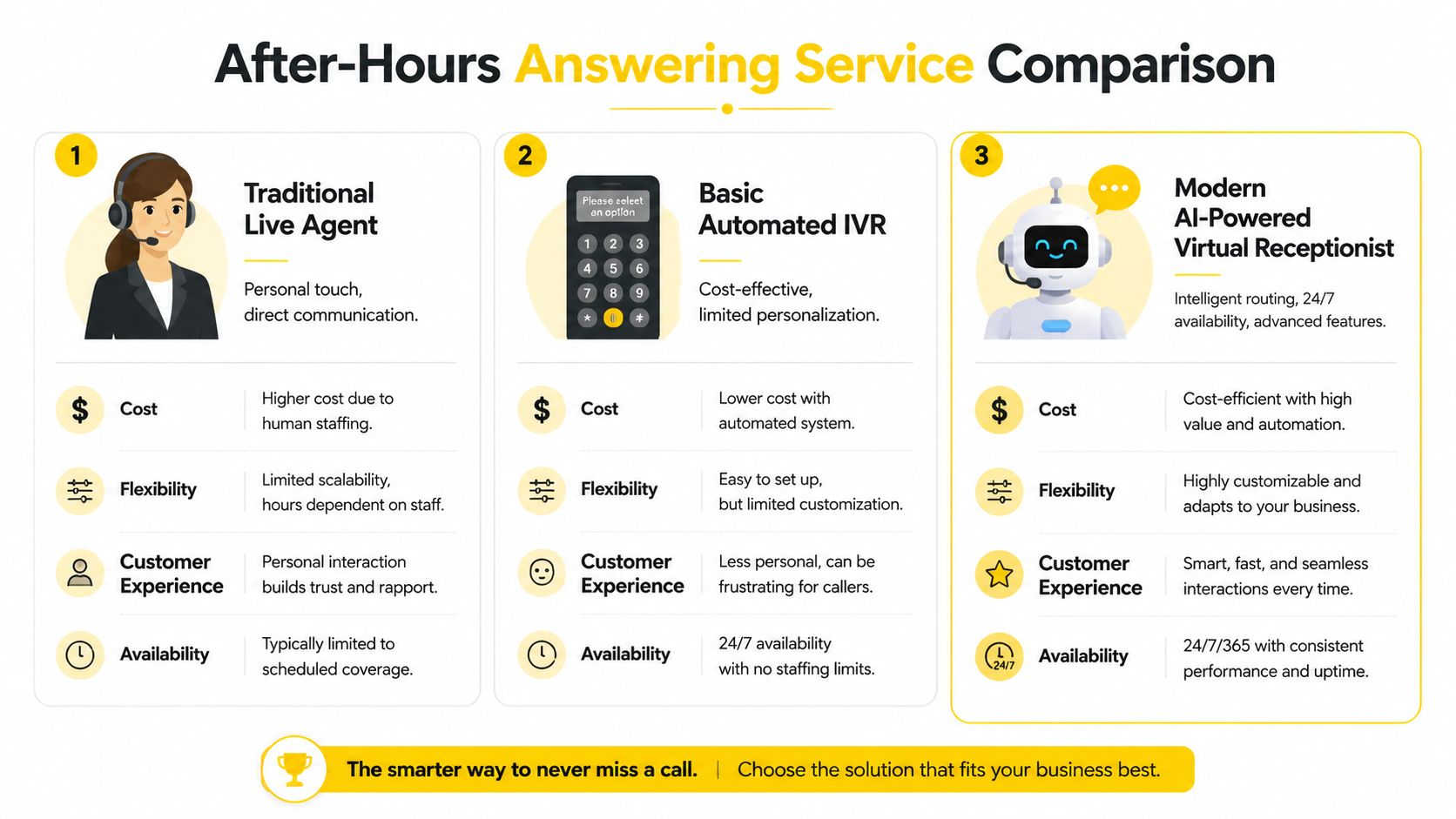
Cleaning owners usually compare three options, live agents, basic IVR, and AI virtual receptionists. The right choice depends on whether you care more about script fidelity, cost control, or moving callers into an estimate fast. If you want to judge the trade-offs, compare them on what they do for actual booking outcomes.
| Feature | Live Receptionist | AI Virtual Receptionist (e.g., Estimatty) | Basic Automated/IVR |
|---|---|---|---|
| Caller experience | Human conversation with nuance | Natural, fast, consistent intake | Menu-based, rigid, easy to abandon |
| Cost structure | Higher, often labor-linked | More predictable, often flat-rate | Usually low, but limited utility |
| Lead qualification | Strong when trained well | Strong on structured cleaning intake | Weak, mostly routing only |
| Scheduling and handoff | Possible, but depends on staffing | Built for booking, notes, and follow-up | Usually not built for it |
| Scalability | Depends on agent availability | Handles spikes well | Scales technically, not conversationally |
Modern implementations often use AI voice agents to handle the majority of calls, escalating only 5% to 10% that require human judgment as described by the industry example. That model makes sense for cleaning businesses because most after-hours calls are routine, but a small slice needs a human if the caller is upset, confused, or dealing with a special case.
The biggest advantage is consistency. A live receptionist can be excellent, but quality changes with training, fatigue, and staffing. Basic IVR is cheap, but callers hate repeating themselves or pressing through menus just to ask for a house cleaning estimate. A well-tuned AI receptionist can answer the same way every time, pull the same data every time, and push each lead into the same workflow.
For a cleaning company, that means less chance of a lead being lost because one agent forgot to ask about bedrooms, pets, or add-ons. It also means the system can keep working when call volume spikes after a storm, holiday, or move-out rush. A virtual receptionist setup makes the most sense when your main goal is capturing the lead, not just acknowledging the call.
The decision usually isn't about whether live help is “better.” It's about whether the caller needs empathy or just a fast path to booking. Cleaning businesses usually need both, but not on every call.

A cleaning business does not need a fancy answering service. It needs one that turns a late-night inquiry into a booked job, or at least into a qualified lead with a clear next step. The test is simple, can the system move the caller from interest to action without extra back-and-forth?
Instant estimate delivery should be built in from the start. If a caller asks for pricing, the system should send an estimate by SMS or email right away instead of telling them someone will reach out tomorrow. That matters on move-out cleans, recurring house cleaning, and one-time deep cleans, where the first company to answer clearly often gets the job.
Calendar booking matters just as much. If the service can check availability, offer open time slots, and place the job on the schedule, you remove one more reason for the lead to stall. Online booking software for cleaning businesses works best when the phone path and the website path use the same booking logic, because callers should not have to start over.
Custom scripts and FAQs help the conversation stay on track. A cleaning caller usually wants plain answers, what is included, what costs extra, what service area you cover, and whether your crew brings supplies. If the system cannot answer those basics, it creates doubt, and doubtful callers keep shopping.
CRM integration keeps the lead from slipping through the cracks. The call should enter your system with the right tags, service type, urgency, and contact details so your team can follow up without guessing. A clean handoff like that saves time and keeps the process organized, especially when the lead starts on the phone and finishes in your office workflow.
A useful service also knows which calls deserve immediate attention. A routine quote request can move through automation, while a high-value estimate or a complicated cleaning job may still need a person to step in and close it.
The call should not end with, “We'll get back to you.” It should end with a booking, an estimate sent, or a handoff that gives your team enough detail to close the sale. If a provider cannot do that, it is only adding friction between you and the customer, and that lost time costs real bookings.

Most owners ask the wrong first question. They ask what an answering service costs, when the better question is what one missed lead costs them. The right pricing model depends on how often your phone rings, how much of that volume lands after hours, and whether you need human backup or a system that can convert a caller before your office opens.
AI answering services typically cost $99 to $299 per month with unlimited calls, while live receptionist services run $149 to $649 per month and often charge per minute according to the pricing page. A full-time in-house receptionist is estimated at around $35,000 per year, or about $2,900 per month, plus benefits. For a small cleaning business, that gap can decide whether you cover after-hours leads or leave them sitting in voicemail until the next day.
Flat-rate AI usually fits a cleaning company that wants predictable overhead and fast lead handling. Per-minute live coverage can work if call volume stays low, but it gets expensive when callers ask for service area details, pricing ranges, and availability one question at a time. A basic IVR may look inexpensive on paper, but it rarely moves a homeowner from curiosity to booked estimate.
A cleaning business owner should judge the service by what it produces, not by the lowest monthly bill. If the system cannot qualify the caller, route the lead, or send an estimate request fast enough to keep the customer engaged, the price is not the issue.
A simple ROI check is enough to start. Multiply the number of missed after-hours leads you capture by the average value of a cleaning job, then subtract the monthly service cost. If the result stays positive and the service is closing gaps that used to go to voicemail, the model is earning its keep.
For a cleaning company that gets move-out cleans, recurring home cleanings, and urgent turnover requests, one recovered call can cover a surprising amount of the monthly fee. That is why the decision should be measured in booked jobs and saved revenue, not in software subscriptions alone. If the system helps you answer, quote, and follow up before the lead shops around, it is doing more than message-taking.

A good rollout starts before the first call is forwarded. Cleaning businesses need the service to know what to ask, what to capture, and when to wake someone up. If the handoff is sloppy, you'll still miss revenue, just in a more expensive way.
Define the call types first. Separate emergencies, estimate requests, reschedules, and general questions. A move-out clean request should not follow the same path as a complaint about a missed appointment.
Write the intake details the service must capture. For cleaning, that usually includes property type, approximate size, urgency, service type, and best contact method. If you want a clean estimate later, those details have to be captured now.
Decide who gets alerted. The after-hours workflow should know when to notify an owner, a dispatcher, or the next-day office team. The Zapier and CRM integration flow is useful here because it keeps the lead moving without manual re-entry.
Set escalation rules carefully. A well-defined workflow maps emergencies, estimate requests, and simple questions to different actions so high-value calls aren't treated like noise as noted in the workflow guidance.
Train the internal follow-up. If someone receives a lead at 7 a.m. and waits until lunch to reply, the answering service can't fix that. The handoff only works when your team is ready to act fast.
A lot of owners focus on the phone system and ignore the employee side. That's a mistake. If you're hiring people to handle inbound follow-up or booking support, pipehirehrm.com belongs in the hiring workflow alongside your service setup.
The cleanest handoff is the one your team can repeat without guessing. If the caller asked for pricing, your staff should know whether an estimate already went out, whether the job was booked, and who owns the next step. That discipline is what keeps after-hours leads from turning into morning chaos.
If the service is working, the numbers will show it. A cleaning business doesn't need a huge dashboard, just a few KPIs that tell the truth about missed leads and booked revenue. The point is to stop treating after-hours coverage like a cost and start treating it like a sales channel.
Track missed-call reduction first. If voicemail used to catch a steady share of your night calls, that number should fall after the service goes live. Next, measure after-hours leads captured, because that tells you whether the system is answering with purpose.
You should also watch call-to-booked-job conversion rate. A lot of services can answer phones, but only some can move callers into scheduled work. If bookings rise while missed calls fall, you've got a real operational win.
Good KPI set: missed calls, leads captured, booked jobs, and response time to handoffs.
Finally, check cost per acquired customer. If the service is helping you land recurring house cleaning clients or larger move-out jobs, that cost should look better over time. If it's not improving, the workflow probably needs better scripting, faster callbacks, or a tighter escalation rule.
The main mistake is measuring activity instead of outcomes. Call counts matter, but booked jobs pay the bills. Once you know how many leads the service captures and how many turn into paying customers, you can decide whether to keep the setup, refine it, or replace it.
A CTA for Estimatty.