September 21, 2026
Inside and Out Cleaning: A Practical Pricing Guide
Learn what inside and out cleaning really includes, how pricing works, and which add-ons actually pay off for residential and commercial estimates.

Saturday, May 9, 2026
Learn how to use AI in sales with our step-by-step guide for cleaning businesses. Automate estimates, convert leads 24/7, and grow your revenue.
.png)
If you're running a cleaning business, you already know where sales breaks down. Leads come in while you're on a job. Website forms sit unanswered until the evening. A prospect wants pricing now, not tomorrow, and by the time you call back, they've already hired someone else.
That's why learning how to use ai in sales matters so much for cleaners. Not in the abstract. In the daily sense of getting instant estimates out, answering common questions fast, and giving your team a cleaner handoff from inquiry to booked job.
The old system looks normal because so many cleaning companies still use it. A missed call goes to voicemail. A website visitor fills out a contact form. Someone on your team promises to “get back to them with an estimate.” Then the day gets away from you.
By the time you reply, the lead is colder, your staff is rushed, and the estimate may depend more on who answered the phone than on any pricing standard you trust. That's where sales leaks start.
Most owners don't lose jobs because they don't know how to clean. They lose jobs because the buying experience is slow and inconsistent.
A prospect checks your site at night, wants a move-out clean, and can't get pricing without waiting. Another caller asks two staff members the same question and hears two different answers about add-ons, timing, or scope. That damages trust before your crew ever steps on site.
If this sounds familiar, you're not dealing with a marketing problem alone. You're dealing with a sales process problem.
Old-school sales doesn't just waste time. It makes your business look harder to buy from.
Manual sales can work when you're tiny and every inquiry comes straight to the owner. It starts breaking once volume picks up, once you add office staff, or once you offer multiple service types across residential and commercial work.
Then every estimate depends on memory, tribal knowledge, and whoever happens to be available. That's not scale. That's controlled chaos.
If you want a good example of how cleaners are reducing that front-desk friction, automating customer service for cleaning inquiries shows the same core shift. Stop relying on delayed callbacks for questions your system should answer instantly.
A good AI sales workflow for a cleaning business isn't a chatbot bolted onto your website. It's a full front-end system that captures the lead, qualifies the job, delivers an estimate, and routes the next step without making the customer wait.
That's the practical version of how to use ai in sales for cleaning companies. AI handles the first layer fast. Your team handles the parts that need judgment.

Generic AI tools often fail because they answer loosely and estimate poorly. Cleaning sales needs structure. You need pricing logic, service rules, exclusions, and a clean handoff to humans.
That hybrid model matters. According to ZoomInfo's AI sales implementation analysis, up to 33% of companies struggle to integrate AI into existing workflows, and a similar number face resistance from employees. The same source notes that successful setups use a hybrid approach where AI handles initial engagement and humans finalize bookings to avoid robotic interactions.
Let AI do the instant response. Let humans handle edge cases, objections, and relationship building.
There's a broader sales lesson behind this. As Highspot's examples of AI in sales point out, teams using AI to automate tasks and provide instant sales intelligence see stronger selling effectiveness. One SaaS team doubled pipeline coverage in two months, and another improved win rates by analyzing call transcripts. Cleaning companies aren't selling software, but the principle is the same. Faster qualification and better follow-up create more booked conversations.
If you want help mapping this kind of workflow beyond the estimator itself, an AI automation agency can be useful when you're connecting lead capture, notifications, CRM updates, and follow-up actions across tools.
For a cleaner view of the website side of this process, converting website visitors into customers shows where the handoff often breaks and what a better path looks like.
Before you pick any AI tool, get your pricing logic in order. Most failures don't come from the software first. They come from messy inputs.
In cleaning, “data” isn't some abstract tech term. It's your actual estimating rules. What you charge for square footage. How you price kitchens and bathrooms. What counts as a deep clean. Which add-ons stack. When travel, urgency, condition, or frequency should change the estimate.
Start with the rules you already use, even if they're currently sitting in someone's head or buried in a spreadsheet.
Here's the core checklist:
Data quality is the number one factor for AI success. According to Creatio's guide to AI for sales, 51% of implementation barriers stem from poor data quality or integration, and clean, well-structured datasets can improve AI accuracy by 40% to 50%.
A cleaning company doesn't need the same thing as a generic B2B sales team. You need estimating logic, not just conversation fluff.
Look for these traits:
If you're comparing front-end intake options, a high-converting AI form platform is worth reviewing for the broader design side of conversion. But form builders and AI estimators aren't the same thing. A form collects data. A sales estimator qualifies, prices, and moves the lead forward.
One cleaning-specific option is Estimatty, which lets owners set pricing rules, collect job details, send instant estimates by SMS and email, and notify staff without code. That's very different from trying to train a general chatbot to act like an estimator.
A stronger sales system creates another pressure point. Fulfillment.
If AI helps you capture more demand, you need a plan for hiring and scheduling the cleaners who will service those jobs. That's where operations tools and recruiting workflows start to matter. Content on estimatty.com/blog can help on the sales side, while get.pipehirehrm.com/blog and platforms like pipehirehrm.com are useful when job flow starts outpacing your hiring process.
For a closer look at software built around estimating logic for cleaners, AI estimates software for cleaning is the right place to compare what matters and what doesn't.
The fastest way to make AI useful is to stop thinking about it like magic and start treating it like a trained front-desk rep. It needs clear instructions, approved answers, and a defined lane.
That means your AI estimator should sound helpful, brief, and confident. Not robotic. Not overly chatty. Not vague.
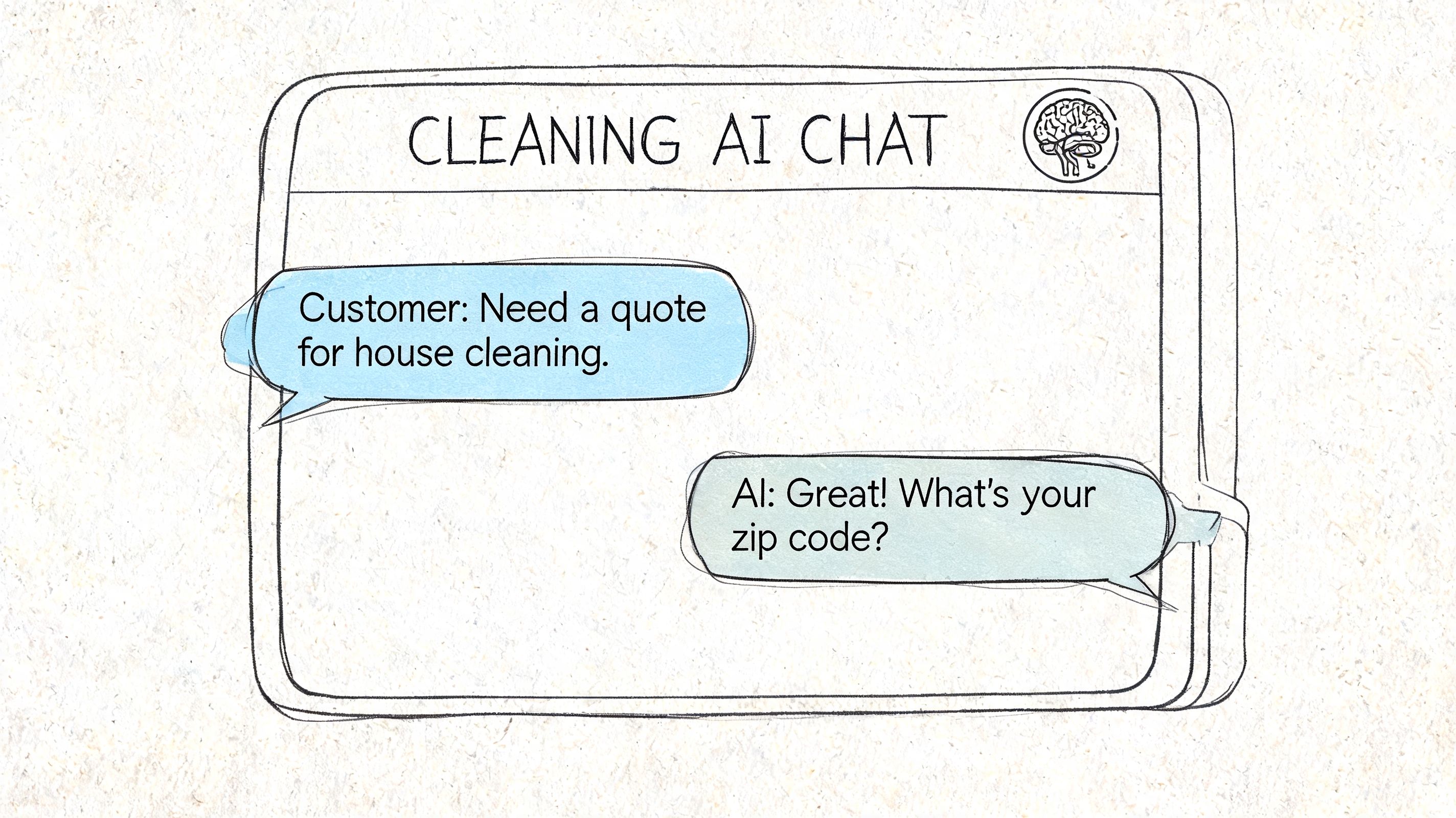
Use an opener that moves straight into qualification.
Prompt example:
You are a cleaning service sales estimator. Greet the visitor warmly, ask what type of cleaning they need, then gather only the details required to produce an estimate. Keep replies short. Ask one question at a time when possible. If the request is unusual or outside pricing rules, tell the customer a team member will review it.
That instruction does three important things. It defines the role, limits the behavior, and gives the AI a safe fallback for exceptions.
A simple live script might look like this:
Hi, I can help you get a fast cleaning estimate. What type of service do you need today: standard cleaning, deep cleaning, move-in/move-out, or commercial cleaning?
Then move into the right branch.
Don't ask everything. Ask the fields that change pricing and booking quality.
For residential cleaning, a practical sequence is:
Ask questions that affect the estimate. Skip questions that only satisfy curiosity.
If you also take phone inquiries, handling quote by phone for cleaning leads is useful because voice workflows need tighter prompts than web chat.
Customers ask the same confidence questions over and over. Your AI should answer them consistently.
Use canned prompt blocks like these:
Insurance answer template:
If a customer asks whether we are insured or bonded, provide the approved company response exactly as written in the knowledge base. Do not improvise.
Pricing explanation template:
If a customer asks how pricing works, explain that estimates are based on factors such as property size, service type, condition, frequency, and selected add-ons. Keep the answer concise and transparent.
Upsell prompt:
After generating an estimate, suggest relevant add-ons only if they match the service type. Offer them as optional upgrades, not pressure tactics.
That last point matters. A good upsell feels like convenience, not a script.
Here's a quick demo of how this can look in practice:
A lot of AI setups break at the finish line. The estimate goes out, but the team doesn't know when to step in.
Use a handoff rule like this:
Handoff instruction:
If the customer asks for custom scope, post-construction details, specialty surfaces, multi-site commercial pricing, or anything outside approved rules, collect contact details and alert a human team member to review before booking.
That matches what works operationally. AI should handle initial engagement. Humans should close exceptions and higher-stakes jobs. As noted earlier from the same ZoomInfo analysis, many teams struggle with integration and employee resistance, and hybrid handoff is what keeps the process from feeling robotic.
A cleaning owner can get fooled fast by a busy dashboard. The estimator is sending quotes, chats are coming in, and the phone is quieter because AI is handling first contact. None of that matters if close rates stay flat, jobs come in underpriced, or your office still has to fix bad estimates by hand.
Measure the sales process the same way you would inspect a finished cleaning job. Look for the spots where quality breaks.
For cleaning companies, generic engagement metrics do not help much. What matters is whether AI is producing usable estimates, booking more work, and reducing the admin time that used to slow the office down.
According to monday.com's guide on how to use AI in sales, teams using AI should track estimate-to-book ratio, lead qualification time, and revenue per lead. Those are the right categories for a cleaning business too, because they tie directly to booked jobs and margin.
MetricWhat it measuresGood targetEstimate-to-book ratioHow many sent estimates turn into booked jobsSet a baseline, then improve it month over monthLead qualification timeHow quickly a new inquiry becomes usable sales dataMinutes, not hoursRevenue per leadHow much value each inquiry producesTrack by service type and lead sourceQualified estimates sentVolume of estimates sent to leads that match your service rulesTrack weekly and compare by lead sourceAdd-on attachment rateHow often customers accept extras like oven or fridge cleaningTrack trend over timeHuman takeover rateHow often AI has to pass the lead to staffReview for avoidable handoffs and high-value exceptions
One warning here. A lower human takeover rate is not always better. In commercial cleaning, post-construction work, and one-time deep cleans with unusual scope, the right answer is often a fast handoff to a person who can price the job correctly.
If estimate volume goes up but bookings do not, the issue is usually one of four things. The pricing rules are off. The lead source is weak. The follow-up after the estimate is weak. Or the AI answered the facts but failed to build confidence.
I have seen owners blame the tool when the underlying problem was a slow callback on commercial requests or a service page bringing in bad-fit leads.
Use a weekly review that stays close to operations:
For that first step, lead source tracking for cleaning companies helps you separate channels that only generate form fills from channels that produce real revenue.
Bad inputs create bad estimates. If your team prices the same 2,000-square-foot house three different ways, AI will not fix that. It will repeat the inconsistency at scale.
Over-automation creates a different problem. Residential buyers want speed, but they also want reassurance. Commercial buyers want accuracy, scope control, and a clear point of contact. If every reply sounds canned, trust drops and close rates usually follow.
Another mistake is copying generic AI sales advice built for software companies and trying to force it onto cleaning. A residential maid service and a multi-site janitorial contract do not belong in the same automation flow. The first win in cleaning is usually faster response, tighter qualification, and more consistent estimating. Fancy forecasting can wait.
Traffic quality matters too. If your estimator sits on a weak page or low-intent visitors keep hitting it, the tool can look worse than it is. That is one reason some owners pair AI intake with stronger top-of-funnel content and consistent demand generation. If you are working on that side of the funnel too, resources on mastering social media automation can support steadier inbound traffic.
Start narrow. One service. One pricing model. One review cadence.
Then tighten the system every week. Remove questions that do not affect price. Add the ones your office keeps chasing down later. Rewrite answers that sound robotic. Review every missed handoff. Keep the AI where it is strong, fast qualification, standard estimates, basic upsells, and clean routing. Keep people where judgment matters most.
That is how cleaning companies get better sales results from AI without creating a bigger mess behind the scenes.
A cleaning lead comes in at 7:40 p.m. from a property manager who needs three office suites priced before morning. Another homeowner fills out your quote form during dinner and hires the first company that replies. That is where small AI changes pay for themselves fast. You do not need a full rebuild to get results this week.
Start with the front end of one service and tighten the handoff.
Pull the last 30 days of missed calls, voicemails, web forms, and text inquiries into one list. Mark which ones got a same-day response, which ones got a quote, and which ones booked. Cleaning companies usually find the same problem here. Leads did come in, but they waited too long, got an incomplete reply, or never got a usable estimate.
That review gives you a baseline. You cannot fix response time if your inbox, call log, and website forms all live in separate places.
Build one pricing sheet for one offer. Start with a standard house cleaning, move-out clean, or small office recurring job. Write down the inputs that change price, such as square footage, bed and bath count, condition level, frequency, pet hair, and approved add-ons like inside oven or inside fridge.
Keep it tight. If a question does not change price, scheduling, or scope, leave it out.
Put your AI estimator or intake assistant on a page where buyers already show intent. Your contact page is an easy start. A service page or ad landing page is often better because the visitor already knows what they want. If you are also trying to keep lead flow steady, resources on mastering social media automation can support more consistent inbound demand.
Then test it yourself. Submit five fake leads with real-world messiness. Missing square footage. Vague notes. After-hours requests. Commercial prospects asking for walkthroughs instead of instant pricing. You want to see whether the tool gives a useful next step, not just whether it technically responds.
The first wins in cleaning are simple. Faster replies. Fewer back-and-forth messages. More estimates sent while the lead is still paying attention. As noted earlier, AI tends to help most when it handles speed, qualification, and routine quoting, while your team steps in for exceptions, site visits, and larger contracts.
If you want a practical way to put this into action, Estimatty gives cleaning businesses an AI-powered web and voice estimator that captures leads, asks the right questions, sends instant estimates by SMS and email, and helps your team turn more inquiries into booked jobs without relying on after-hours callbacks or manual follow-up.