October 16, 2026
Journeyman Electrician License Requirements Explained
Understand journeyman electrician license requirements, training hours, and reciprocity rules. Learn how jurisdiction impacts scope and hiring decisions.

Sunday, March 1, 2026
Stop guessing your house cleaning rates. Learn how to calculate profitable prices, automate estimates, and grow your cleaning business in 2026.
.png)
Figuring out your house cleaning rates can feel like trying to hit a moving target, but it really comes down to a few standard approaches. On a national level, you’ll see rates floating between $20 to $50 per hour for each cleaner on a standard job. If you’re sending a flat-fee estimate, that often lands somewhere in the $100 to $170 range for a typical single-family home. Think of these numbers as your starting point for crafting a pricing strategy that actually makes you money.
Let’s be honest: setting your prices is probably the most critical decision you'll make for the health of your cleaning business. It’s not about guesswork or picking a number that feels right. It's a strategic move that needs to reflect your true value, the going rates in your area, and what it actually costs to run a top-notch service.
So, let's cut through the confusion and look at what successful cleaning companies are really charging. This isn't just a price list; it's a launchpad to help you benchmark your own rates and make sure you’re never selling yourself short again.
Your rates do more than just pay the bills—they send a powerful message about the quality and professionalism of your brand. Getting a handle on the common pricing structures is the first step to mastering your business's finances. The most popular models you'll encounter are:
Deciding which model to use—or maybe even a mix of them—really depends on your business goals, how efficient your team is, and what your local clients prefer. This choice directly shapes how potential customers see your value. To get even more specific, check out our comprehensive guide on how much to charge for house cleaning.
To help you get a quick snapshot of the landscape, here's a look at the typical rate structures and their national averages for 2026.
Use these figures as a compass, not a rulebook. They’ll help you see where you stand in the market and ensure your pricing is competitive yet profitable.
You've jumped into a massive, fast-growing market. The global cleaning services industry clocked in at an incredible USD 442.09 billion in 2025 and is on track to soar to USD 770.76 billion by 2033, growing at a healthy clip of 7.3% each year.
What’s fueling this? More dual-income households with less time for chores, an aging population needing extra help, and a much bigger focus on hygiene in general. With North America holding over 31.85% of the market share, your skills are in higher demand than ever.
Your pricing is a direct reflection of your value proposition. A low price signals a commodity service, while a premium rate backed by professionalism, reliability, and excellent results attracts clients who are willing to pay for quality.
The secret to grabbing your piece of this growing pie is to deliver consistent, market-savvy estimates every single time. This is where an automated tool like an AI estimator from Estimatty becomes essential. It makes sure every lead gets a fair and accurate estimate instantly, so you stop leaving money on the table and establish your brand as a professional leader from that very first conversation. To find more insights like this, check out the estimatty.com/blog.
Figuring out how to set your house cleaning rates can feel like a real puzzle. There's no single "right" answer, but it really boils down to four main strategies. Each one comes with its own set of pros and cons, and picking the right one is a big deal—it directly affects your profits, how happy your clients are, and how smoothly your whole operation runs.
Think of your pricing model as more than just a number on an estimate. It’s a core part of your business strategy. It tells clients what you value and sets the tone for your entire working relationship. Let’s break down the main playbooks to help you find the perfect fit.
Charging by the hour is the classic, most direct approach. It's simple for everyone to grasp, and it's a great safety net when you’re walking into the unknown, like a first-time deep clean or a home that's a bit of a mystery. Nationally, you’ll see this landing somewhere between $25 and $75 per hour for each cleaner on the job.
But there’s a catch, and it's a big one: this model can actually punish efficiency. If you have a rockstar cleaner who can get a job done in two hours that takes a rookie three, they end up earning less for the same result. It can create a weird incentive to slow down, which ultimately puts a ceiling on what you can earn per job.
I like to think of flat-rate pricing as the "prix-fixe menu" of cleaning. You offer one solid, all-in price for a clearly defined service—say, a standard clean for a 3-bedroom, 2-bathroom house. Clients absolutely love this. It gives them peace of mind and they don't have to stress about watching the clock.
The flip side? All the risk lands squarely on your shoulders. If you send a flat-fee estimate and walk into a home that's way messier than you expected, you’re stuck. You could easily end up working extra hours for no extra pay, completely tanking your profit margin. To make this work, your initial walkthroughs and estimates have to be dead-on.
A well-chosen pricing model aligns your revenue directly with the value you deliver. The goal is to find a structure that rewards your team's skill and efficiency while giving clients the clarity and confidence to book your services.
This flowchart can help you see which path might make the most sense for your business, depending on the job and what your clients are looking for.
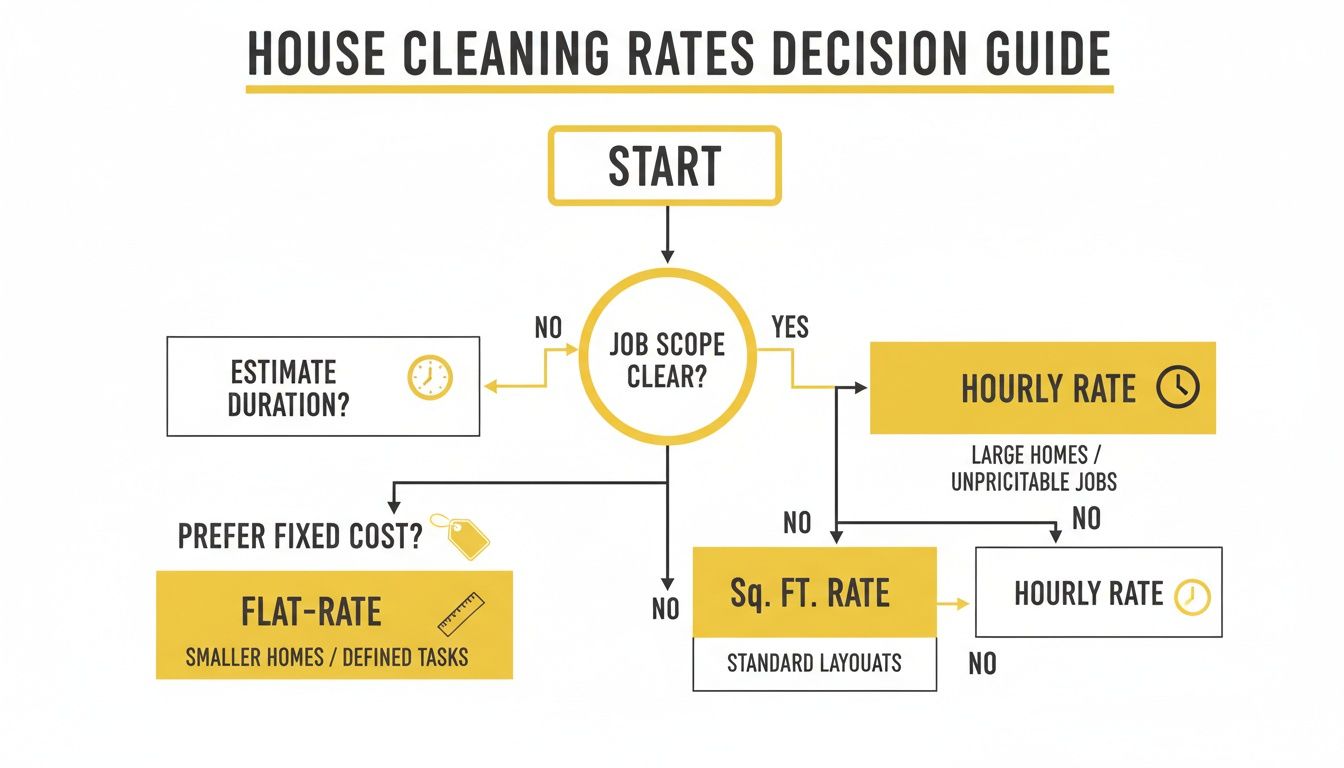
As you can see, predictability is the name of the game. Flat rates are fantastic for those steady, recurring jobs you know like the back of your hand. For projects with more variables, hourly or square-foot pricing gives you the flexibility you need.
If you’re someone who likes to base your pricing on hard data, these next two models are for you.
Both of these methods give you more precision than a simple flat rate, but they do require you to get more information from the client upfront. Trying to collect all those details manually can become a real time-sink and leaves room for mistakes.
This is exactly where a sharp estimation tool becomes your best friend. An AI-powered system like Estimatty can handle any of these models—or even a hybrid of them—without breaking a sweat. It can instantly gather the necessary property details from a potential customer, run the numbers based on your pricing rules, and generate a perfect, professional estimate every single time. It gives you the freedom to adjust your strategy as you grow, without getting buried in administrative work.
If you want to move beyond just having a "job" and build a truly profitable cleaning business, you have to look past the industry averages. Learning to calculate your house cleaning rates with precision is the engine that will drive your growth. It’s all about creating a financial model that guarantees you make money on every single visit.
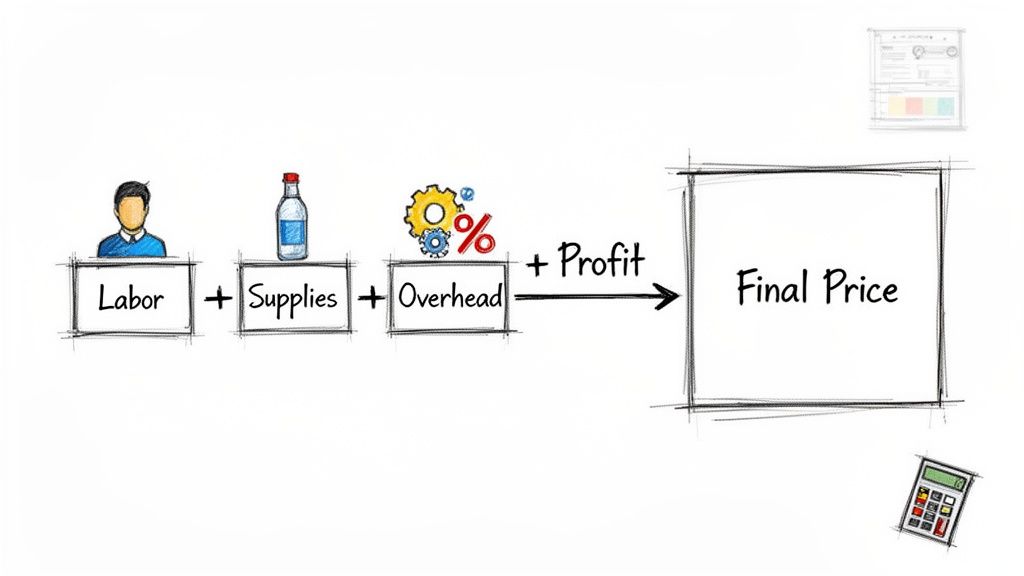
The secret lies in a simple but powerful formula. It’s designed to ensure you cover all your bases and—most importantly—build in the profit you need to thrive, not just survive.
Your Costs (Labor + Supplies + Overhead) + Your Desired Profit = Your Final Price
Let's break down each piece of that puzzle. This isn't just theory; it’s your step-by-step guide to building a price that works for you every single time.
Before you can even think about sending a price estimate, you need to know exactly what it costs you to walk in and do the work. A classic mistake many new owners make is only thinking about the time spent inside the client's home. The reality is, your true costs run much deeper.
Your total cost is the sum of three key areas: labor, supplies, and overhead. Getting a rock-solid handle on these numbers is non-negotiable for setting profitable house cleaning rates.
Labor will almost always be your single biggest expense. But it's not just about the hourly wage you pay your cleaners. You have to think in terms of the "fully-loaded cost"—the true price of having that person on your team.
This includes all the extras that come with having cleaning employees:
When you hire staff, you have to factor these extra costs into every hour they work. You can learn more about hiring at get.pipehirehrm.com/blog. As a simple rule of thumb, plan on adding 20-30% on top of their base hourly wage to get a much more accurate picture of your true labor cost.
Next up are the tangible things you use on every job—the cleaners, cloths, vacuums, and other tools. Don't forget to account for the depreciation of your more expensive equipment, too. An easy way to track this is to add up your total supply spending for a month and divide it by the number of jobs you did to get an average cost per cleaning.
Then you have overhead. These are the "hidden" expenses of running a business that are all too easy to forget. If you don't account for them in your pricing, they will quietly eat away at your profits.
These are things like:
Add up these monthly overhead costs and divide that total by the number of jobs you typically complete in a month. This gives you an "overhead cost per job" that has to be baked into every estimate you send. For a more detailed look, you might find our guide on building a https://www.estimatty.com/blog/cleaning-estimate-calculator really helpful.
Okay, you've tallied up all your costs. Now for the best part: your profit. Profit is not what’s leftover at the end of the month if you're lucky. It's a specific amount you deliberately build into your price from the very start.
For a healthy cleaning business, a profit margin typically falls somewhere between 20% and 40%.
Let's put it into practice. Say your total cost for a job (labor + supplies + overhead) comes out to $100. A 30% profit margin means you need to add $30 to that cost, making your final price $130. This is the money that funds your growth, allows you to reinvest in better equipment, and ultimately pays you as the business owner.
Thinking beyond a single job, understanding the long-term potential of each client through a smart customer lifetime value calculation can also dramatically influence your pricing strategy.
This approach puts you right in line with where the market is headed. Valued at USD 40.1 billion in 2025, the household cleaners market is projected to hit USD 55.7 billion by 2034. This explosion is fueled by a greater focus on hygiene and rising demand for both cleaning products and professional services—confirming that a well-priced, professional clean is more valuable than ever.
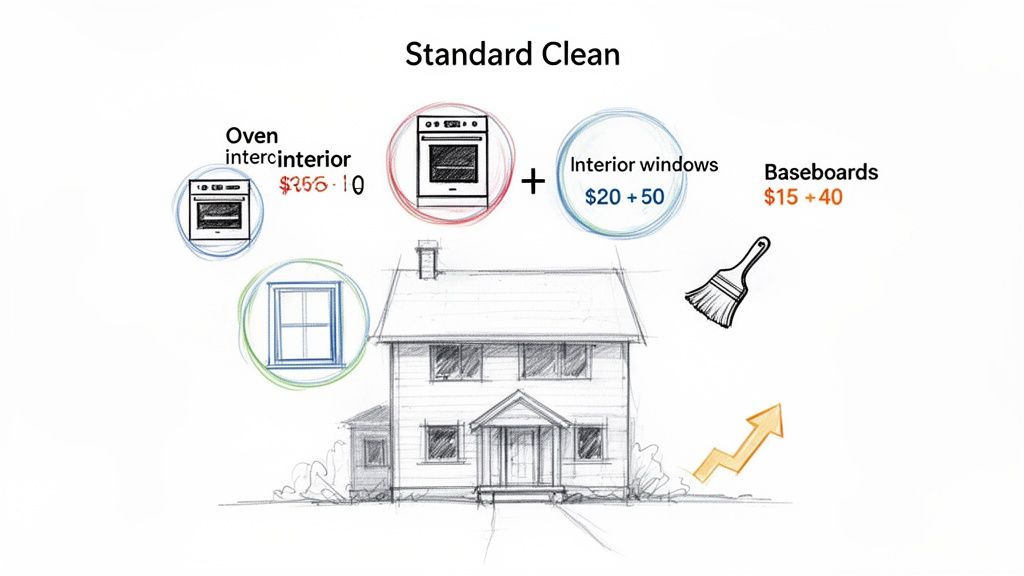
If you feel like you’re constantly chasing new clients just to grow your revenue, I’ve got good news. The real secret to increasing your average job value is already right in front of you: the upsell. It's all about turning a standard cleaning job into a premium, high-ticket service, and it's much simpler than you might think.
Think of your standard cleaning package as the main course. Add-ons are the profitable side dishes that customers are more than happy to order. These are the detailed, time-consuming tasks that people hate doing themselves, which makes them the perfect opportunity for an easy upsell.
The best add-ons are tasks that your clients see as high-value but that your trained team can complete efficiently. By pricing them separately, you give customers the power to build their own perfect clean while you create new revenue streams for your business. It's a win-win.
Some of the most popular and profitable extras are the jobs everyone puts off:
When you present these options as a menu, you empower your clients. They get to customize their service, and you get to watch your revenue per visit climb.
Getting the price right is crucial. You want your add-ons to be an easy "yes" for the client but still profitable enough to be worth your team's time. Don't just think about the cost—think about the value you're providing.
The real magic of add-ons is that they increase your earnings on jobs you've already booked. This means zero extra marketing costs to acquire that additional revenue, which flows almost directly to your bottom line.
To give you a starting point, here’s a look at what other successful cleaning companies are charging for common add-on services. You’ll want to tweak these numbers based on your local market and labor costs, but they provide a solid foundation.
The table below breaks down some popular add-on services, their typical price ranges, and the potential profit margin you can expect. Think of this as your cheat sheet for building out a more profitable service menu.
By incorporating even a few of these into your offerings, you can significantly increase the value of each and every appointment without needing to find a single new customer.
So, how do you consistently offer these add-ons without turning every phone call into a lengthy sales pitch? Manually walking every customer through a dozen options is a recipe for missed opportunities and inconsistent estimates. This is where automation becomes your best friend.
Imagine a tool like the AI estimator from Estimatty doing the work for you. When a potential client visits your website for an estimate, the system automatically presents your menu of add-on services. They can simply check the boxes for the extras they want, and the AI instantly recalculates their total in real time.
This simple, automated process works for you 24/7, turning every visitor into a potential premium customer. It guarantees that every single lead sees your full range of services, maximizing your earning potential on every job. If you're looking for a great starting point, this free cleaning estimate template is an excellent resource for structuring your offers effectively.
It’s time to ditch the back-of-the-napkin math and the endless games of phone tag. The old way of coming up with house cleaning rates—relying on gut feelings and slow, manual follow-ups—isn't just inefficient. It’s actively costing you customers and leaving money on the table. There’s a better way, and it’s all about smart automation.
Think about the old method versus the new. A potential client calls, leaves a voicemail, and waits. You call back, play phone tag for a day or two, maybe schedule an in-person visit, and then, days later, you finally send an estimate. By that time, your once-motivated lead has already hired another company that gave them an instant estimate.
Now, picture this instead: A lead lands on your website at 10 PM on a Tuesday. An AI-powered tool like Estimatty instantly engages them, asks all the right questions, and zips a professional, accurate estimate to their phone and email in less than 60 seconds. You just won a new client while you were asleep.
One of the biggest headaches for any growing cleaning business is keeping your pricing consistent. If you and your office manager both give estimates, do they always line up? Even small differences in how you calculate house cleaning rates can confuse customers and make your business look unprofessional.
Automation wipes this problem out completely. You set your pricing rules just once in a central system, guaranteeing every single estimate is calculated the exact same way. No more guesswork, no more "whoops." Every client gets a fair, standard price based on the profit model you've already worked out.
This consistency does more than just build trust with customers. It hands you back your most precious resource: your time. Instead of burning hours crunching numbers and chasing down leads, you can finally focus on what really matters.
Your website should be your hardest-working employee, bringing in leads around the clock. By adding a simple, no-code AI widget, you can transform your site from a static online brochure into a powerful sales engine. It works 24/7, making sure you never miss an opportunity just because you're out on a job or it's after business hours.
When you automate the first step of the sales process, you instantly professionalize your brand. An immediate, perfectly formatted estimate tells a potential customer that you are a serious, modern business, putting you miles ahead of competitors stuck in the past.
This isn't just about being fast; it's about creating an experience that's smooth and easy for the customer. The system automatically sends beautifully branded estimates straight to a prospect’s phone and email, making it incredibly simple for them to see your rates and book your services. Implementing smart tools is a game-changer, and understanding how automation can boost your bottom line shows just how big the impact can be.
For so many cleaning business owners, this is the secret to breaking through a growth plateau. We’ve watched solo cleaners grow into thriving, multi-team operations because they finally removed themselves as the bottleneck in their own sales process. To learn more, check out our blog post on AI sales automation for cleaning services. Adopting these tools is a critical step toward building a brand and a business that’s built to scale.
Alright, let's talk about those nagging questions that pop up even after you've landed on what feels like the perfect pricing. It's totally normal. You set your rates, but then a new situation comes along and makes you second-guess everything.
Think of this as your real-world troubleshooting guide. We're going to tackle the most common pricing puzzles that cleaning business owners face, giving you clear, straightforward answers so you can price your services with complete confidence.
This is a big one. My rule of thumb? You should be taking a hard look at your cleaning rates at least once a year. This annual check-in is your chance to make sure your pricing isn't just surviving, but actually thriving in the real world.
It's not about randomly hiking prices. You need to watch for specific business triggers.
Don't be shy about implementing small, steady increases of 3-5% just to keep up with inflation. When you do raise prices, always give your clients a heads-up—at least 30 days' notice is professional courtesy. Just be sure to frame it positively, reminding them that this allows you to maintain the high-quality, reliable service they love.
This is where a centralized system like Estimatty becomes your best friend. You just update your rates in one spot, and every single estimate you generate from that moment on is automatically correct. No sweat.
Yes, a thousand times yes! Offering a discount for recurring clients is one of the smartest things you can do to build a stable, predictable business. It’s a classic for a reason. Giving something like 10-15% off for weekly service or 5-10% off for bi-weekly is a no-brainer.
These regular clients are the financial backbone of your company. Sure, you might make a little less on each individual visit, but their lifetime value is through the roof. Plus, they slash your marketing costs because you aren't constantly scrambling to find new one-off jobs.
It's the ultimate win-win. Clients get rewarded for their loyalty, and you get a steady, reliable income stream that makes planning your finances a whole lot easier.
The best part is you can build these discounts right into an AI estimator. The system will automatically apply the right discount when a client selects a recurring schedule, keeping everything consistent without you lifting a finger.
This used to be the million-dollar question, filled with risky guesswork. Today, technology gives us a much better answer. You stop relying on a simple square footage number and start using a guided, data-driven questionnaire.
Think of an AI-powered tool like Estimatty as your 24/7 virtual assistant. It doesn't just ask for square footage; it intelligently walks a potential client through all the questions you would ask if you were there in person.
The system will gather crucial details like:
By collecting all this rich information upfront, the AI can generate a surprisingly accurate estimate that truly reflects the work involved. This is your safety net, protecting you from the nightmare of underbidding a job you’ve never laid eyes on. If you want to dive deeper into this, be sure to check out our complete guide on how much to charge for cleaning services.
Simple: you don’t. At least, not on price. Competing to be the cheapest is a race to the bottom, and nobody wins that game. It just leads to burnout, corner-cutting, and a business that can't last.
Instead, you need to compete on value. You have to confidently justify your rates by showing clients exactly what they get for their money. This means clearly communicating what makes your service a premium choice.
Make sure your marketing and sales process highlights that you are:
Honestly, a professional, instant estimate from a tool like Estimatty does half the work for you. It immediately sets you apart from the low-ballers who are fumbling with text message estimates and handwritten notes. It proves you're in a different league before you've even washed a single window.
Ready to stop guessing and start growing? Estimatty gives you the tools to deliver instant, accurate, and professional estimates 24/7, turning more leads into profitable jobs.