September 8, 2026
How Much Should a House Cleaning Cost in 2026
How Much Should a House Cleaning Cost. Learn how much a house cleaning should cost in 2026, with real pricing ranges by home size, service type, and tips

Saturday, June 13, 2026
Craft a winning business plan for house cleaning services with our 2026 step-by-step guide. Covers financials, marketing, operations, & templates to launch

You're probably staring at a mess of tabs right now. Licensing requirements. Supply lists. Insurance. Local competitors. A half-finished spreadsheet. Maybe a note on your phone that says “figure out pricing.” That's normal.
Most owners who want to start a residential cleaning company don't have a motivation problem. They have a clarity problem. They know people need the service. They know they can clean, organize, manage people, or sell. What they don't know yet is how to turn that into a business that stays profitable after the first few busy weeks.
A business plan for house cleaning services fixes that, but only if you use it like an operator, not like a student filling in a template. The document isn't the point. The decisions inside it are.
The fastest way to build a fragile cleaning company is to treat the business plan like paperwork for a loan. That's how people end up with pretty mission statements, weak pricing, chaotic scheduling, and no idea why cash keeps disappearing.
A usable business plan for house cleaning services should answer practical questions you'll face every week. Which jobs do you want. Which jobs should you refuse. How fast do you need to respond to inquiries. When do you hire. How many homes can one cleaner handle without quality slipping. What happens when drive time starts eating your margin.
The plan has to function like a field manual. If you open it and it doesn't help you make a decision, it's too generic.
Here's what I'd expect to see in a working plan:
Practical rule: If your plan only describes the business but doesn't control the business, it's incomplete.
A lot of new owners write a document that sounds professional but leaves out the pressure points that decide whether the company works. They'll spend time on logo ideas and almost none on route density, estimate speed, or staffing reliability. That's backward.
The old way was to start manual, then “add systems later.” That usually means you build bad habits first and pay to fix them later. A stronger approach is to design the company around the way customers buy now. They want fast answers, easy booking, and consistent service.
That means your business plan should include technology and workflow from day one. Not because software is trendy, but because slow intake, inconsistent estimates, and sloppy hiring create problems that don't go away with volume. They get worse.
The owners who scale cleanly don't just clean well. They standardize how leads come in, how jobs are priced, how staff are trained, and how quality is checked. That's what turns a side hustle into a company.
Many individuals write the executive summary first and make it vague. That's why it usually reads like filler. Write it last, once you know what the business is.
Your executive summary should explain the business in a way that a lender, partner, or future manager can understand in a minute or two. More important, it should keep you from drifting. If your summary says you serve busy families with reliable recurring house cleaning, don't build your schedule around random one-time jobs that wreck your routes.
People don't buy cleaning. They buy relief, consistency, trust, and time back. Your summary should reflect that.
A strong version usually includes:
Here's the test. If your summary could apply to any cleaning company in any city, it's too weak.
Vision isn't motivational wallpaper. It should shape operating choices.
If your vision is to build a premium residential brand, your pricing, uniforms, communication style, estimate process, and hiring standards should all support that. If your vision is to dominate realtor and property-manager turnover work, your systems need speed, flexibility, and dependable coverage.
A useful executive summary often includes short answers to questions like these:
For owners thinking about positioning, the guide on branding for cleaning services is worth reading because branding decisions only work when they match the market and service model.
The summary should be short enough to remember and strong enough to reject bad opportunities.
Use a compact structure instead of writing a long narrative.
| Element | What to include |
|---|---|
| Business concept | Residential cleaning company focused on a clearly defined customer segment |
| Core offer | The primary services you sell and the delivery model |
| Market focus | Your service area and customer type |
| Competitive edge | The operational advantage clients actually notice |
| Growth direction | What the business should look like after the first stage of traction |
That's enough. The executive summary doesn't need drama. It needs direction.
A lot of owners say their market is “anyone who needs their house cleaned.” That sounds broad and safe. In reality, it creates weak marketing, messy operations, and pricing confusion.
The opportunity is real. The global cleaning services market is projected to grow from $481.75 billion in 2026 to $859.20 billion by 2034, a 7.50% CAGR, and residential cleaning profit margins can range from 10% to 28% according to Fortune Business Insights. That's a strong reason to enter the category. It's not a reason to stay generic.
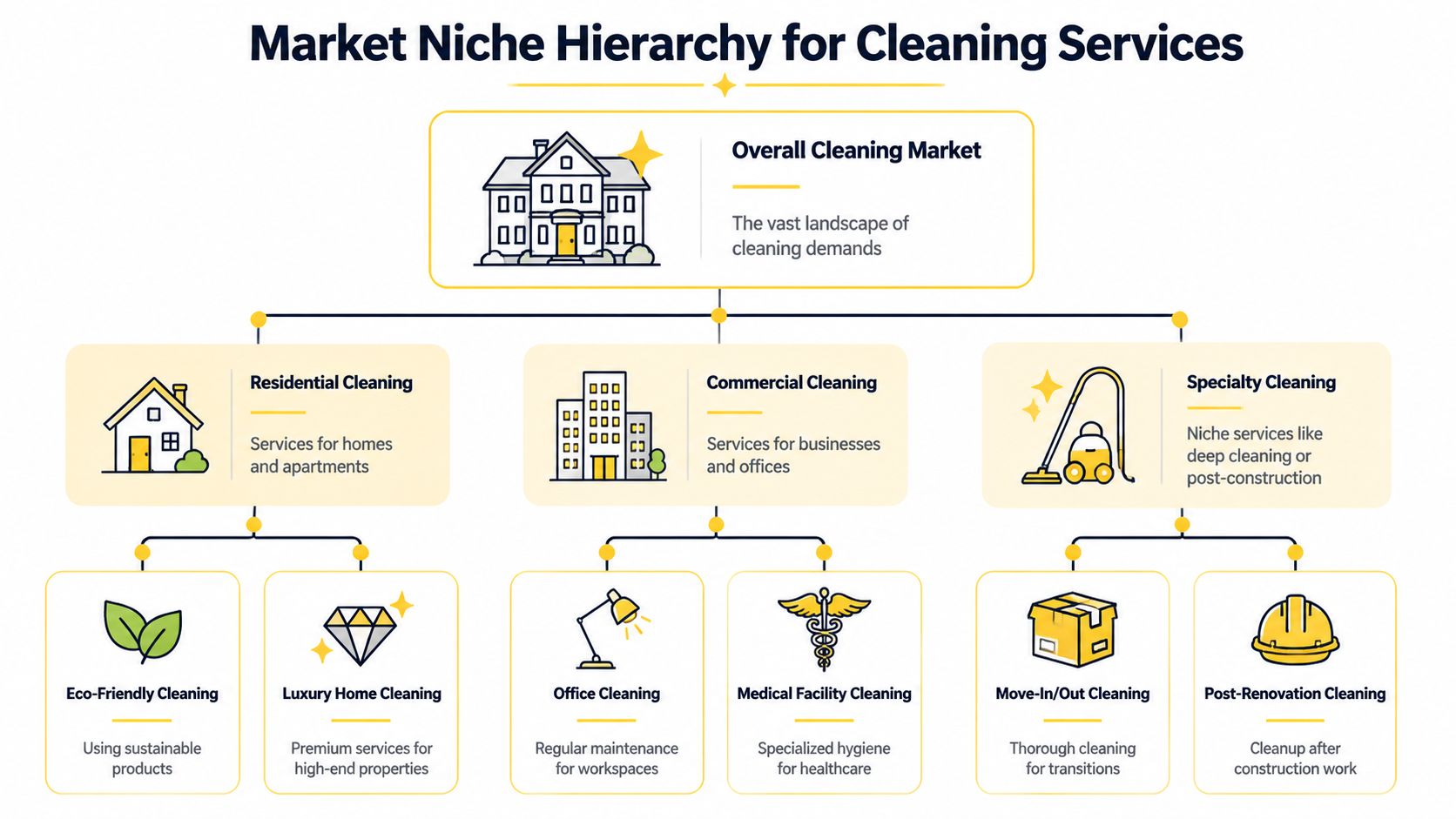
When you target everybody, you start accepting jobs that don't fit each other. One customer wants recurring maintenance. Another wants a labor-heavy deep clean far outside your normal area. Another wants a rushed turnover with custom requests and no flexibility. Revenue comes in, but operations get uglier.
Niche selection fixes that because it creates alignment between:
A good niche doesn't make the market smaller in a bad way. It makes your business easier to run.
You don't need a giant spreadsheet to analyze your local market. Act like a customer and pay attention to friction.
Check local competitors and note things like:
That's where the openings usually are. Many cleaners do acceptable work. Fewer make the buying process simple.
One practical resource for tightening your demand strategy is this guide on house cleaning leads. It's useful when you move from “Who might buy” to “How do I consistently attract the right inquiries.”
Not every profitable niche fits every owner.
Here's a simple decision view:
| Niche | Good fit if you want | Main operational challenge |
|---|---|---|
| Recurring family homes | Predictable schedules and retention | Consistency across visits |
| Luxury homes | Higher expectations and detail-focused service | Training and trust |
| Eco-conscious households | Differentiation through product choice and process | Higher supply discipline |
| Move-in or move-out cleaning | Bigger one-time jobs | Scheduling volatility |
| Realtor or property-manager work | Repeat referral relationships | Fast turnaround demands |
If you're solo, a recurring residential niche is often easier to stabilize than highly variable project work. If you're building crews, turnover and recurring work can complement each other if your scheduling system is disciplined.
Most owners don't lose because there's no demand. They lose because they accept a mix of work that their systems can't support.
Once you know your niche, the rest of the business plan gets easier.
Your messaging becomes sharper. Your estimate process gets more consistent. Your service checklists stop changing with every job. Hiring gets easier because you know what kind of work style the team needs to handle.
That's the purpose of market analysis. It's not a research exercise. It's a filter for better decisions.
Pricing is where a lot of cleaning businesses struggle. The work looks busy, the calendar fills up, and the owner still feels squeezed. That usually comes from one mistake. They price for volume before they price for margin.
The median hourly wage for cleaners was $18.17 in May 2024 according to the U.S. BLS, as cited in Tailor Brands. Add wage pressure, supplies, fuel, and the cost of rework, and a static price list becomes dangerous fast.
Discount pricing attracts shoppers who compare you on the easiest thing to compare. Once price becomes your main message, clients expect more for less, and every increase feels like a fight.
A better position is to sell clarity, consistency, and convenience. That means customers understand what's included, what costs extra, how the team works, and why your estimate is what it is.
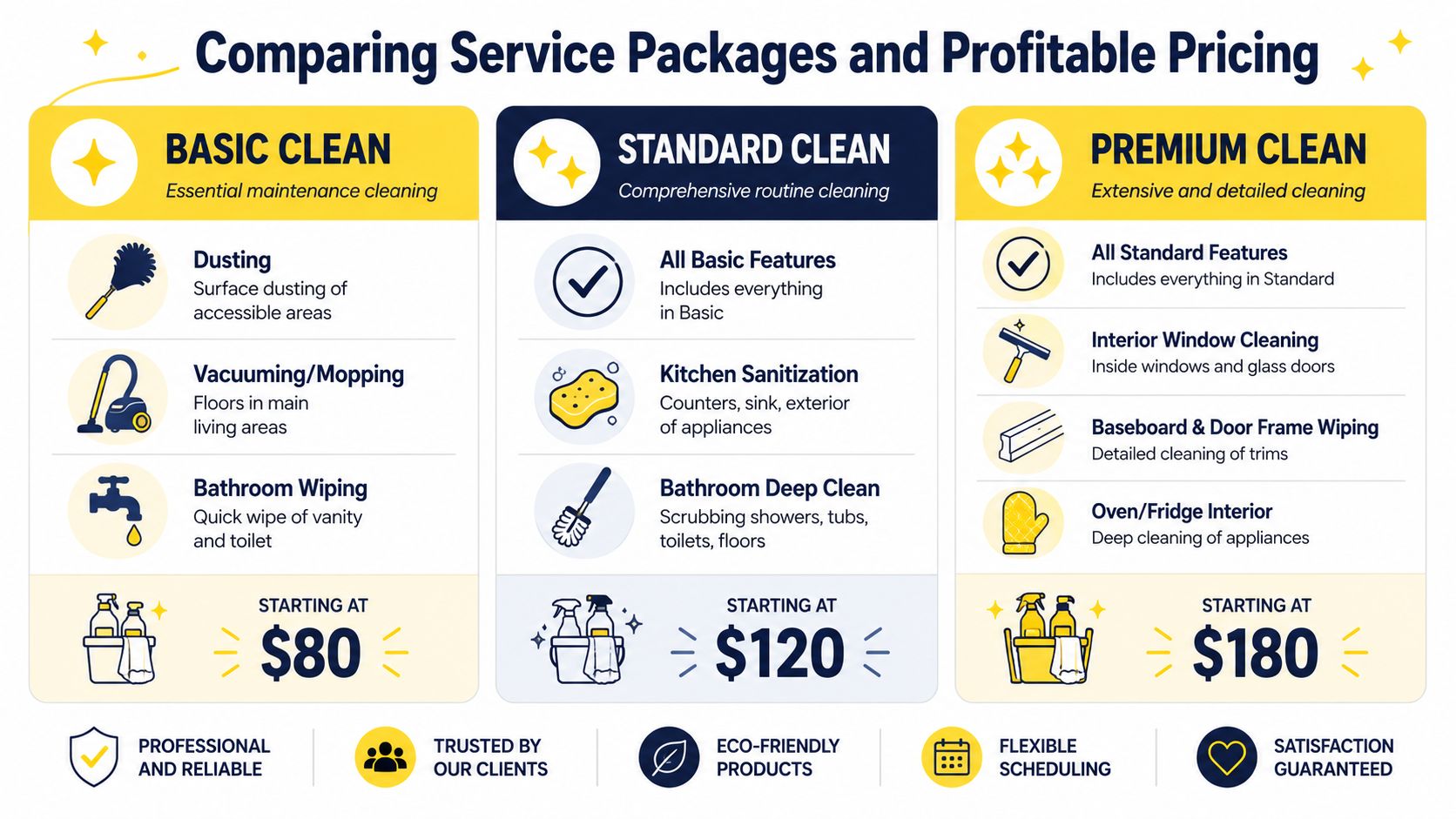
The strongest cleaning companies usually package services clearly instead of improvising every job.
Your service menu should do two jobs. It should help customers choose, and it should protect your margin.
A clean structure often looks like this:
When the package structure is weak, the team ends up negotiating scope on site. That's where profit disappears.
For service-menu ideas and positioning examples, this guide on cleaning service price lists is a useful reference point.
Most owners look at competitor rates first. That's useful, but it shouldn't be the foundation. Start with your own delivery model.
A pricing system should account for:
Industry planning guidance discussed by ISSA recommends building the plan around a break-even model tied to labor hours, travel time, supplies, insurance, and route density, and it recommends aiming for a 20%–30% profit margin while being realistic about booked jobs and available cleaning capacity.
That's a much stronger approach than copying whatever a competitor puts on their website.
If your estimate ignores drive time and complexity, you're not pricing the job. You're pricing the fantasy version of the job.
This decision matters because it affects client trust and internal discipline.
| Model | Works well when | Risk |
|---|---|---|
| Hourly pricing | Scope is unclear or highly variable | Clients may feel uncertainty |
| Flat-rate pricing | You have strong intake and standardized packages | Bad scoping can crush margin |
For most residential businesses, flat-rate pricing gets easier to scale once your intake questions and checklists are tight. Hourly pricing can still work for unusual or clutter-heavy jobs where scope is hard to define in advance.
A pricing model isn't something you set once and admire. It needs scheduled review. If labor costs rise, routes stretch, or average job difficulty changes, your prices need to reflect that.
Write review triggers directly into the business plan:
Owners who skip this step often think they have a sales problem. Sometimes they have a packaging problem. Other times they have an estimate problem. The point is the same. Your pricing system should be adjusted deliberately, not emotionally.
A cleaning company scales when three things work together. The customer inquiry gets handled fast. The job gets assigned cleanly. The team shows up prepared and performs the service the same way every time.
If one part breaks, the whole operation gets noisy. Leads go cold. Schedules get patched together. Cleaners improvise. Customers notice.
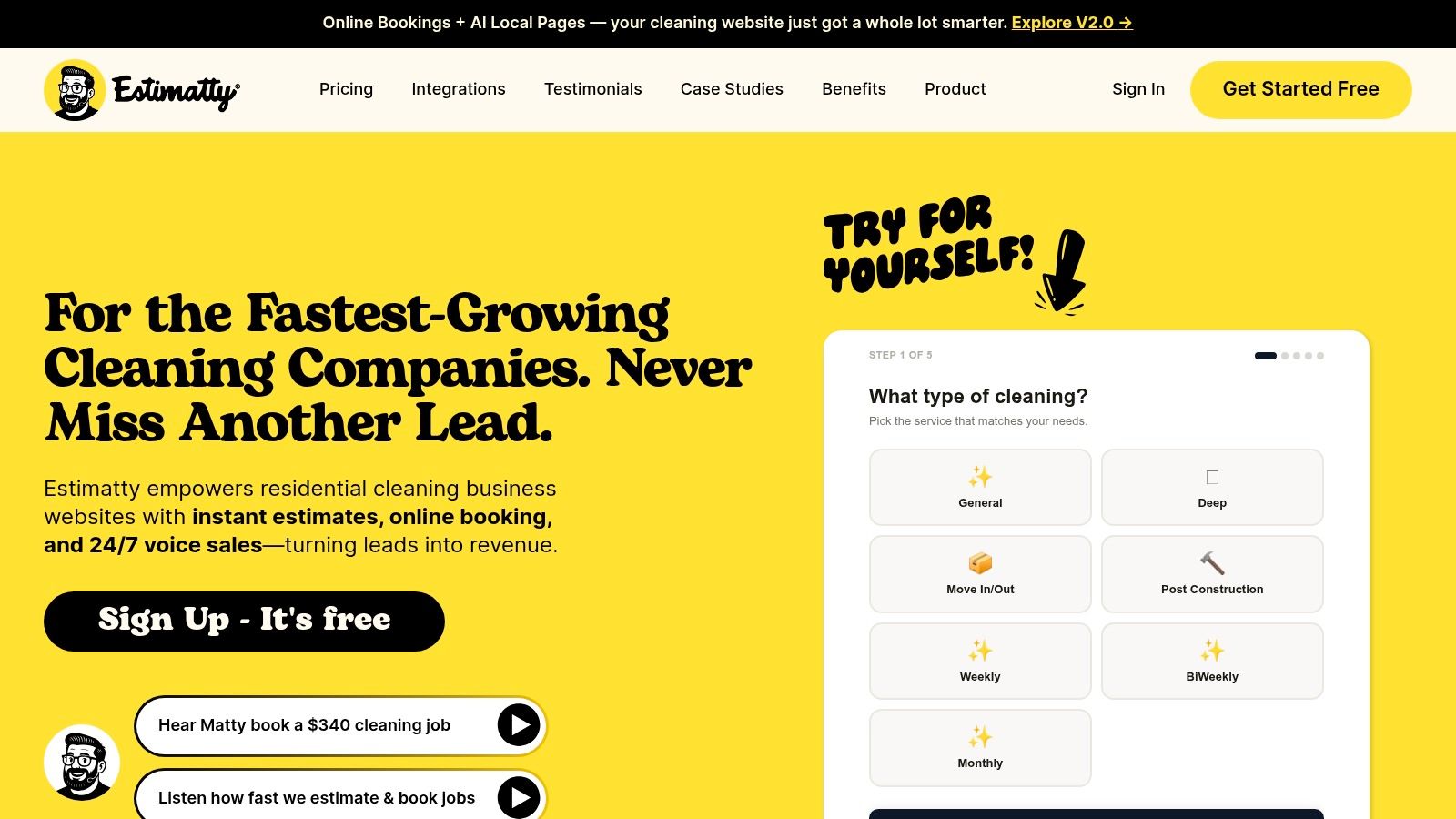
Google consumer research cited by GorillaDesk found that 82% of U.S. shoppers say it is important to be able to book appointments digitally. That's why a business plan that depends on voicemail and slow callbacks is already starting behind.
Most cleaning owners underestimate how much revenue leaks out before a job is ever scheduled. A person visits the website at night, calls during another client visit, or wants an answer before comparing two or three providers. If nobody responds quickly, the job goes elsewhere.
Your operating plan should spell out how inquiries are handled:
One practical setup is to pair automated intake with live backup. For businesses that still want human coverage when the owner is cleaning, driving, or off the clock, a service like home service phone support can help close the gap that voicemail creates.
A lot of owners obsess over cleaning checklists and ignore intake consistency. That's backwards. Bad intake causes bad scheduling, wrong expectations, and underpriced work.
A strong intake form or call flow should capture details such as:
| Intake item | Why it matters |
|---|---|
| Home size or layout | Affects labor and service time |
| Service type | Determines checklist and staffing |
| Condition level | Flags deep clean versus maintenance |
| Special surfaces or requests | Prevents underestimating complexity |
| Timing urgency | Helps schedule and pricing decisions |
This is also where tools matter. Estimatty is one option for handling web and voice inquiries with automated estimates, captured job details, and follow-up delivery by text or email. That type of system belongs in the business plan if your goal is to reduce after-hours leakage and standardize pricing intake from the beginning.
Hiring because you're overwhelmed feels logical, but it usually means you hired late. Hiring because your pipeline, schedule, and service standards show sustained need is smarter.
A practical staffing section in your business plan should define:
If you need a cleaner hiring workflow, the resources at hiring cleaning employees and content from pipehirehrm.com can help you think through sourcing, screening, and retention in a way that fits cleaning operations rather than generic hiring advice.
After the systems are in place, this kind of walkthrough is useful for pressure-testing how the workflow should look in practice:
Good operations remove heroics. The owner shouldn't need to rescue every day.
The hidden work in cleaning businesses sits between the obvious tasks. Not cleaning itself, but the transitions.
Write down what happens between:
That handoff map is what makes the business repeatable. Without it, growth just creates more confusion.
Marketing for a house cleaning company shouldn't revolve around hope. “Post on social media and ask for referrals” isn't a plan. It's a habit.
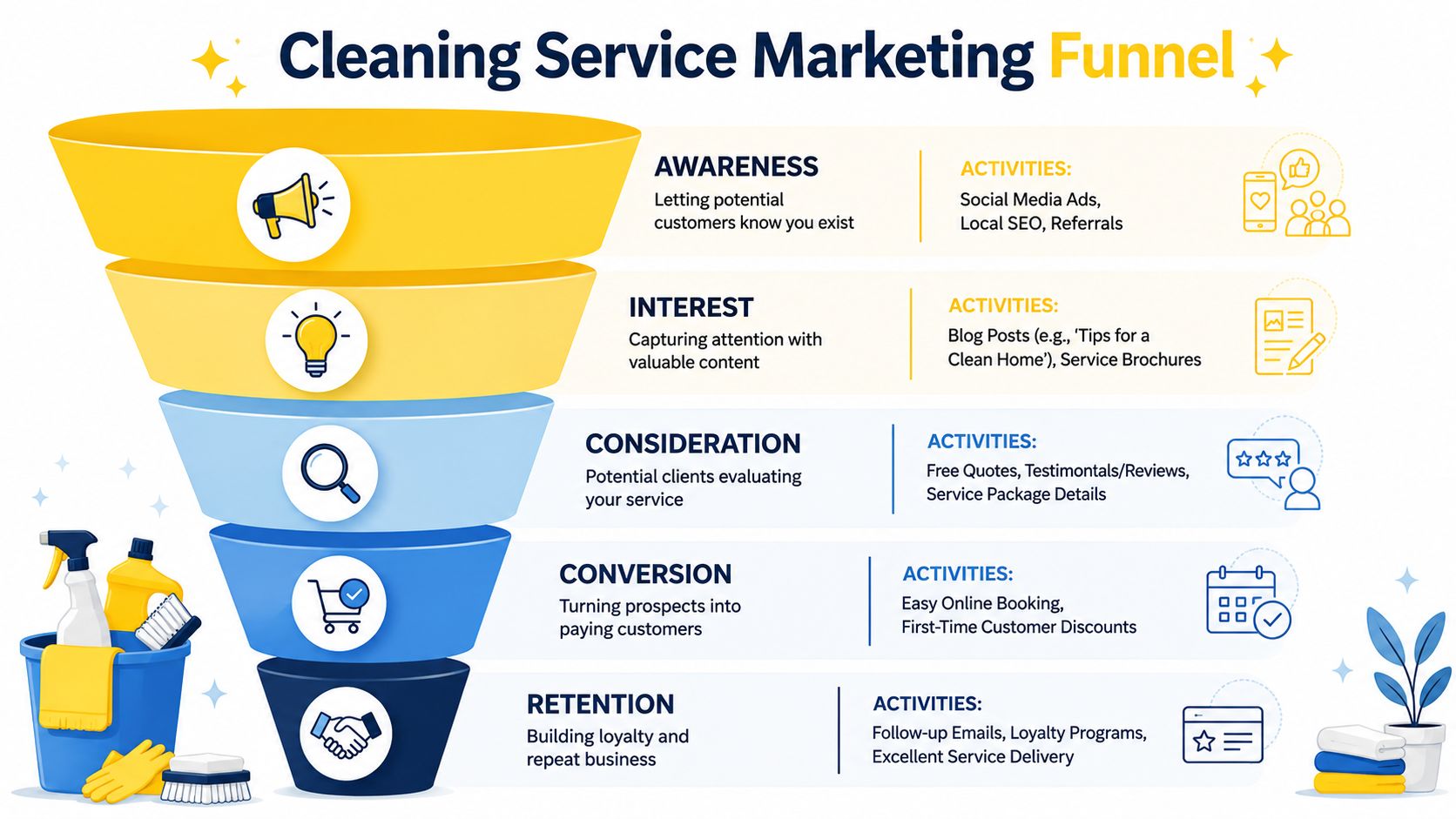
A predictable sales system starts with the funnel. How many people find you, how many request an estimate, how many book, and how many become recurring clients. Industry training guidance summarized in this YouTube resource on cleaning sales math suggests aiming for a 40%–60% close rate from leads to booked jobs. That's why vague growth goals aren't enough. You need conversion math.
New owners often spread themselves too thin. They try flyers, social media, door hangers, paid ads, networking groups, and random promotions all at once. That creates activity, not traction.
A stronger plan usually begins with a short stack:
If you want a deeper look at local visibility and customer acquisition, these strategies for cleaning business success are a helpful supplement for the SEO side of the plan.
A lot of cleaning businesses celebrate lead volume and miss the point. Leads don't pay you. Booked jobs and recurring revenue do.
At minimum, your sales plan should track:
| Metric | Why it matters |
|---|---|
| Lead source | Shows which channels produce serious buyers |
| Estimate response time | Speed affects conversion |
| Estimate acceptance rate | Tells you whether pricing and scope are aligned |
| Repeat booking rate | Shows customer satisfaction and retention strength |
| Service mix | Reveals which jobs support margin and scheduling best |
Owners quickly gain clarity. If one channel sends lots of inquiries but few bookings, the issue may be lead quality. If estimate acceptance is weak across all channels, your pricing, packaging, or communication may need work.
Too many companies treat estimating like admin. It is sales.
A good estimate should be fast, consistent, and easy to accept. It should also define scope clearly enough that the client knows what they're buying. If your process requires multiple calls, vague follow-up, or handwritten adjustments, you're adding friction that buyers don't want.
Slow estimates don't just delay revenue. They lower trust.
The cheapest customer to market to is usually the one who already knows your team and trusts your work. That's why your plan should include what happens after the first cleaning.
Retention systems can include:
A business plan for house cleaning services gets much stronger when marketing and operations connect. Fast estimates improve close rate. Clear service packages reduce confusion. Good service delivery boosts reviews and referrals. Retention lowers pressure on acquisition.
That's the loop you want.
This is the section where optimism has to answer to math. If the numbers don't work on paper, they won't work in the field just because you stay busy.
Startup costs for a small cleaning business typically range from $2,000 to $10,000 for equipment, supplies, licensing, and initial marketing according to SBDCNet's cleaning services business overview. Some industry guidance also places small cleaning-business startup costs in a broader range of roughly $5,000 to $15,000. That gap is exactly why your own plan needs conservative assumptions.
Keep the financial section simple enough to manage and detailed enough to trust.
Start with three buckets:
Startup costs
Everything you need before launch. Equipment, supplies, registration, insurance, branding, and initial marketing.
Operating expenses
The recurring cost of staying open. Fuel, replenishment supplies, payroll, software, and admin costs.
Revenue assumptions
How many inquiries you expect, how many turn into booked jobs, average ticket by service type, and how recurring work builds over time.
Industry planning guidance from ISSA emphasizes startup costs, ongoing operating expenses, revenue projections, and break-even analysis, while warning owners not to overestimate capacity or assume every lead converts to a booked job, as covered earlier.
| Expense Category | Estimated Cost Low End | Estimated Cost High End |
|---|---|---|
| Equipment and tools | Included within startup range | Included within startup range |
| Cleaning supplies | Included within startup range | Included within startup range |
| Licensing and registration | Included within startup range | Included within startup range |
| Insurance | Included within startup range | Included within startup range |
| Initial marketing and branding | Included within startup range | Included within startup range |
| Total startup budget | $2,000 | $10,000 |
The point of this table isn't to pretend every category has a universal fixed amount. It's to force you to list every cost and keep the full launch budget inside a realistic band unless your local model clearly requires more.
If you're borrowing money, spell out what the funds buy and how they improve the business. Lenders care less about ambition than they do about whether the request is disciplined.
For owners preparing for financing, reviewing SBA loan business plan requirements can help you structure the funding request in a way lenders expect.
A good funding section should answer:
For the bookkeeping side of this, cleaning business accounting is worth reviewing because a weak chart of accounts can hide profitability problems until they become painful.
Your projections don't need to impress anyone with complexity. They need to help you see cash needs, break-even timing, and whether the business survives slower ramp-up than you hoped.
If your plan still depends on manual callbacks, inconsistent pricing, and after-hours voicemail, tighten that before you spend more on marketing. Estimatty gives cleaning businesses a way to handle web and voice inquiries with automated estimates, standardized intake, and faster follow-up so the business plan can operate the way it was designed.