
September 21, 2026
Inside and Out Cleaning: A Practical Pricing Guide
Learn what inside and out cleaning really includes, how pricing works, and which add-ons actually pay off for residential and commercial estimates.

Thursday, September 17, 2026
Explore Boston house cleaning services, pricing, coverage areas and how to book fast. Get instant estimates and find the right clean for your home.

Most Boston house-cleaning visits fall between $120 and $400, with typical homes landing around $145 to $320 and a bi-weekly cleaning for a three-bedroom home near $200 (Recommended). Instant estimates beat waiting for callbacks because they give a shopper a usable number while they're ready to book.
It's often 10 p.m. in a Boston apartment when the search starts. A renter has guests arriving, a homeowner has a move approaching, or a family can't keep up with bathrooms, floors, kitchen surfaces, and pet hair. They submit a form, wait for a response, and lose interest when the provider doesn't reply until the next day.
That delay costs cleaning companies more than a lead. It creates uncertainty around scope, staffing, travel, and add-ons, while the customer compares incomplete answers from several providers. A fast estimate, delivered by text or email, gives both sides a clearer starting point.
A Back Bay condo, a Somerville apartment with shedding pets, and a suburban family home can all request “a cleaning” while requiring different labor, supplies, travel time, and checklist depth. Boston house cleaning is a fragmented market, not one standardized product with one dependable price.
The useful question is specific: what should this home, service type, and schedule cost? Independent market data places recurring standard visits around $120 to $400, deep cleaning around $250 to $450, and move-in or move-out cleaning around $280 to $500 (Care.com). Those ranges only become useful after the estimate reflects the property and requested work.
A shopper searching after work usually needs three answers:
A form that asks only for a ZIP code and bedroom count cannot separate a maintained recurring clean from a neglected deep clean. It also misses details such as pets, access instructions, add-ons, and the condition of kitchens or bathrooms. Those gaps force cleaners to guess, then correct the price later.
That creates lost bookings for customers and margin leaks for cleaning companies. A practical guide to house cleaning services near me can help shoppers compare local options, but the estimate still needs to match the actual home.
The stronger process captures the details that change the work and returns an estimate immediately. Customers get a usable number while they are ready to choose. Owners get the scope needed to assign labor, account for travel, price add-ons, and follow up with purpose.
Fast response does not replace trust or service quality. It removes the first obstacle, uncertainty. Once a customer sees a sensible estimate and understands its scope, they can compare availability, reviews, insurance, guarantees, and workmanship instead of waiting to learn whether anyone will respond.
For owners, instant estimates also make pricing more consistent. Manual quotes invite missed add-ons, undercounted labor, and different prices for similar homes. A system that answers around the clock captures demand when it appears and gives the team clearer job details before the booking is confirmed.
Boston cleaning is a fragmented market. A bi-weekly South End condo upkeep has a different scope from a post-winter deep clean for salt and pet hair in a Somerville triple-decker. Standard recurring cleaning maintains an orderly home, deep cleaning addresses buildup and neglected areas, and move-in or move-out cleaning prepares a property for its next occupant. Choose the service by condition, frequency, and required result, not by the label alone.
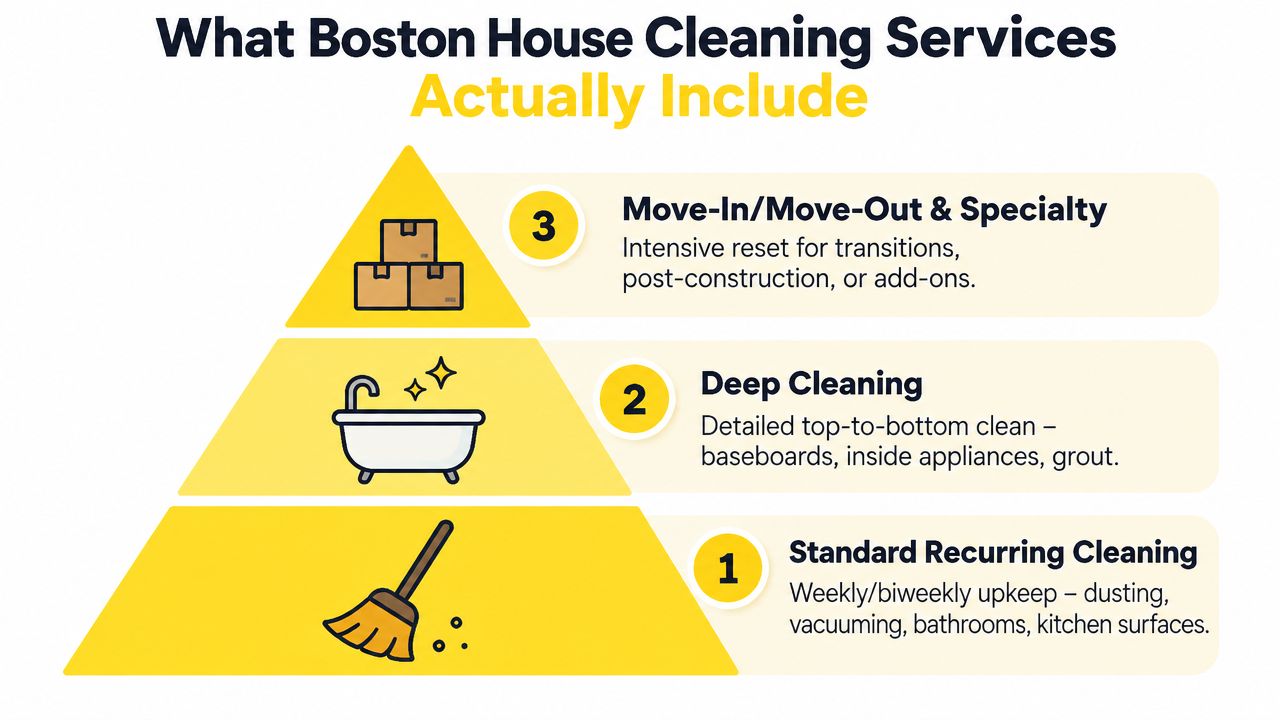
Standard service handles upkeep. It commonly covers dusting, vacuuming, mopping, bathroom cleaning, kitchen surfaces, and visible floor care. It fits a home that is already reasonably maintained and needs a predictable reset on a weekly, bi-weekly, or monthly schedule.
Consistency creates the value. The team can repeat the work that preserves the home's condition instead of restoring neglected details at every visit. Frequency, room count, floor type, and household activity still affect the estimate.
Deep cleaning adds labor and detail. The scope may include baseboards, buildup around fixtures, difficult bathroom areas, high-touch details, and selected interior appliance work. Clutter, grease, pet hair, and long gaps between visits slow the team and raise the required work.
A Somerville triple-decker after winter may need salt residue removed from entry floors, pet hair cleared from stairs, and buildup handled in bathrooms and kitchens. A maintained South End condo on a bi-weekly schedule usually needs routine upkeep instead. The home's condition should determine the service tier.
Move-related cleaning prepares an empty or changing property. Dust from work, marks from previous occupants, and landlord or buyer expectations can expand the checklist to cabinets, closets, floors, fixtures, and areas furniture normally hides.
Name add-ons before accepting the estimate. Inside refrigerators, ovens, and cabinets, along with windows, wall marks, heavy pet-hair removal, and post-construction dust, can change labor time. Customers should confirm whether each task is included, optional, or excluded.
For a room-by-room breakdown, review this guide to the duties of a cleaner. Cleaning companies building home-service workflows can use BatchData for proptech for property information.
A useful estimate captures home size, service type, frequency, condition, pets, clutter, add-ons, and urgency. That scope prevents an attractive generic number from turning into a correction after arrival.
A small Boston apartment, a large suburban home, and a one-time move-out clean do not belong on the same price sheet. Boston pricing reflects labor, home size, service type, frequency, access, and condition. Treating the market as one average creates two problems: shoppers receive vague quotes, and cleaning businesses lose margin when the actual work takes longer than expected.
Labor sets the floor. A cleaner's paid time includes travel, parking, setup, supplies, scheduling, customer service, payroll costs, and the cleaning itself. Massachusetts employed 15,210 maids and housekeeping cleaners in May 2023, with a mean hourly wage of $20.05 and an annual mean wage of $41,700, according to BLS-based data summarized by ZipRecruiter. The same data for 2022 reported 14,810 workers, a mean hourly wage of $18.64, and an annual mean wage of $38,780.
The year-over-year figures show an increase of 400 workers and a wage gain of $1.41 per hour in the cited Massachusetts occupation data. An old rate sheet can become unprofitable when wages and operating costs rise.
The 2023 Massachusetts location quotient was 0.76, meaning the occupation was less concentrated than the national average even while pay remained relatively strong. That helps explain why a Boston provider may charge more than a similar-looking service in a lower-cost city.
Boston pricing also varies by billing method. Hourly rates average around $52, with a typical range of $25 to $85. Flat-rate visits average about $183, commonly ranging from $119 to $252 (Angi). These figures describe different scopes, so compare the rooms, tasks, team size, and add-ons before comparing the price.
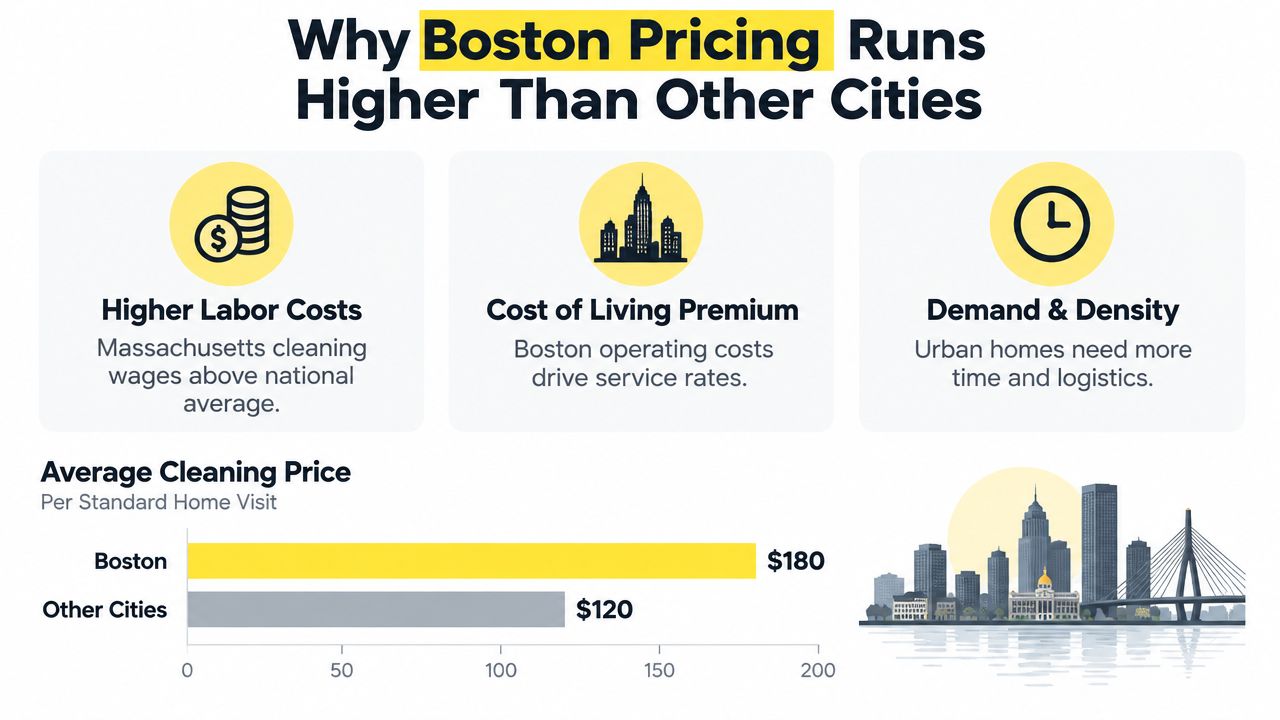
Dense neighborhoods create parking and access delays. Larger homes require more time, supplies, and coordination. Square footage alone misses bathrooms, stairs, clutter, pets, delicate surfaces, and tight deadlines.
Massachusetts benchmarks place cleaner earnings around $18.20 to $19.50 per hour. Boston-specific salary data reports about $26.28 per hour, with a citywide range of $15.90 to $30.24 (BidMaker). The customer's estimate must cover more than direct wages.
Use an Boston cleaning service cost breakdown to separate recurring upkeep, deep cleaning, and specialty work. For owners, an instant estimate protects margin. For shoppers, it shows why a clearly scoped quote may exceed the cheapest number on a search page, while preventing lost bookings caused by slow or uncertain pricing.
A quote can look attractive until the cleaner arrives and finds extra bathrooms, stairs, pet hair, or heavy buildup. Boston pricing is a fragmented market, so one citywide average cannot price every home. Read the scope before judging the number.
Hourly and flat-rate pricing answer different questions. An hourly rate shows the labor price, while the final bill depends on the time required. A flat-rate estimate offers better predictability when it identifies rooms, tasks, condition assumptions, team size, and add-ons.
Published Boston figures place hourly pricing near $23.29 in one dataset and about $52 in another. The difference reflects pricing method, service type, worker count, and job scope. Treat neither figure as a universal rate.
A four-hour deep clean is estimated at about $210 on average. Confirm whether that means one cleaner working four hours or a team finishing sooner. Ask whether appliance interiors, baseboards, windows, and heavy clutter are included.
| Service Type | Typical Estimate Range | What Drives Variation |
|---|---|---|
| Standard recurring visit | $120 to $400 per visit | Home size, frequency, condition, pets, and routine scope |
| Deep cleaning | $250 to $450 | Buildup, clutter, detail level, bathrooms, kitchens, and add-ons |
| Move-in or move-out | $280 to $500 | Empty-home condition, cabinets, appliances, floors, and deadline |
| Flat-rate visit | $119 to $252 | Defined checklist, team size, access, and job complexity |
The table gives useful boundaries, not a guaranteed price. A two-bedroom apartment with one bathroom should not be compared with a larger home requiring detailed kitchen and bathroom work.
Recurring service can save 25% to 30% per visit, according to a Boston-specific pricing guide (Brabos Cleaning). The lower visit price reflects a known baseline, fewer restoration tasks, and more predictable scheduling.
Use this rule:
A reliable estimate names the factors that raise the price, including pets, clutter, larger layouts, urgent timing, and special tasks. Providers should offer a fast, itemized estimate because slow replies lose bookings, while vague quotes create margin leaks after arrival. Customers can review this guide to estimate house cleaning services and compare written scope instead of headline prices.
Price gets attention, but trust gets the appointment. A Boston customer is allowing workers into a private home, so a professional provider must make safety, accountability, and service boundaries visible before asking for payment or access.
The strongest providers show verified reviews, a satisfaction guarantee, insurance, background-checked staff, and secure booking. These signals reduce the mental work a shopper has to do before choosing a company, especially when several providers present similar prices.
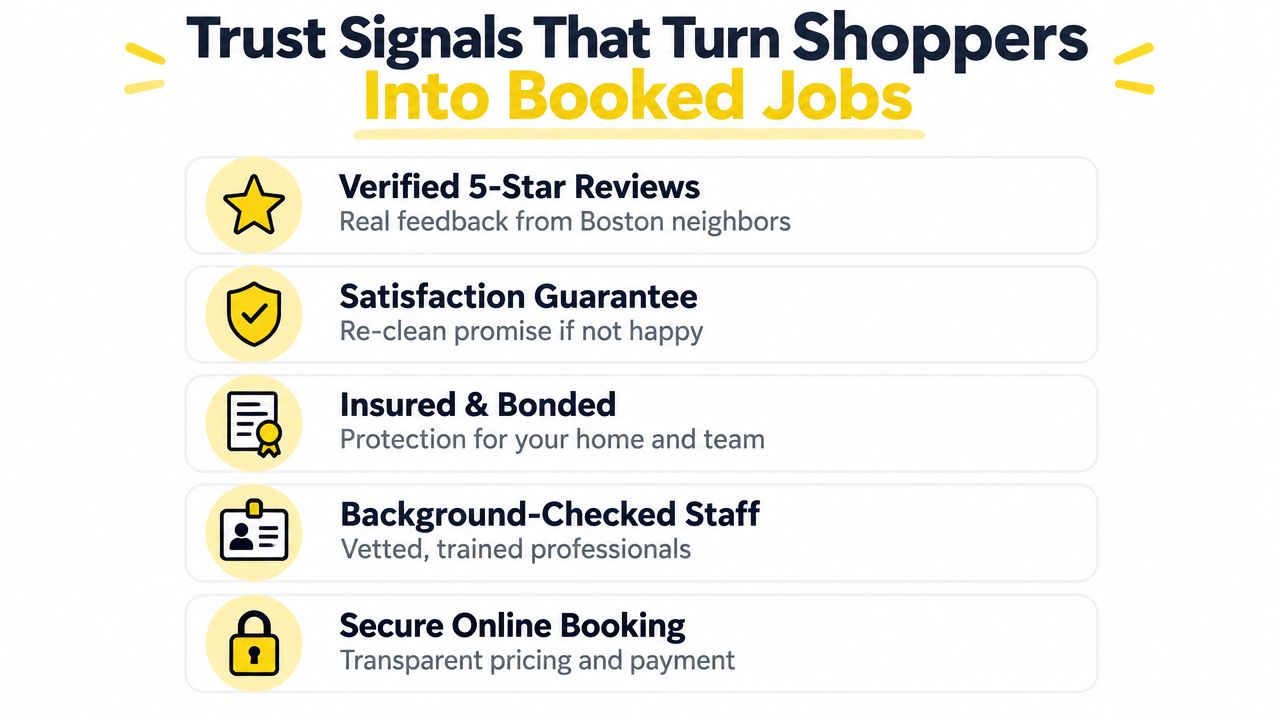
Reviews should describe real service experiences, not display star graphics. Look for comments about punctuality, communication, care around belongings, consistency, and how the company handled a concern. Cleaning owners can study resources on how to boost cleaning business reviews on Google without pressuring customers to leave artificial praise.
A satisfaction guarantee is meaningful when it explains the remedy. A clear re-clean policy tells the customer what happens if an agreed task is missed. Insurance and bonding provide another layer of reassurance, while background checks and training show that the company takes home access seriously.
A polished website can still lose a booking if the customer waits hours for a response. Instant SMS and email delivery, consistent estimates, real-time team notifications, and access to U.S.-based human support make the process feel managed rather than improvised.
Practical rule: Never make a customer guess what the estimate includes, who will arrive, or what happens if the result falls short.
Cleaning owners also need operational support behind the customer experience. Hiring workflows can be explored through pipehirehrm.com, while practical business resources are available through Estimatty's blog and get.pipehirehrm.com/blog. The principle is simple. Reliable staff and reliable communication reinforce each other.
A frictionless booking starts with a short conversation, not a long form. The customer enters basic home information, answers questions about service and condition, sees the estimate, selects a time, and confirms the appointment. Each question should earn its place by improving scope or price accuracy.
An AI sales estimator such as Estimatty can engage website visitors and callers, answer FAQs, capture those job details, send estimates through SMS and email, and notify the team. Owners can customize pricing, add a website widget, select a voice, connect Zapier or a CRM, and use U.S.-based human receptionists when a customer wants assistance.
The best estimate is fast enough to capture intent and detailed enough to prevent surprises.
This approach also makes add-ons easier to present. Instead of forcing a customer to discover later that an oven interior or pet-hair detail costs extra, the flow can surface the option while the customer is already deciding. That improves clarity for the shopper and protects the cleaner from unpaid labor.
For owners comparing systems and workflows, this guide to house cleaning booking software provides useful context. The goal isn't to automate every human interaction. It's to remove avoidable waiting and give the team better information when human follow-up matters.
Boston house cleaning becomes easier to buy when the estimate reflects the actual job. Start with the service tier, then check the home's condition, frequency, pets, clutter, access, deadline, and add-ons. Those details explain the difference between a routine recurring visit and a labor-intensive reset.
Don't judge providers by the lowest advertised average. Ask what the estimate includes, whether the price is hourly or flat-rate, how the company handles special tasks, and what happens if the agreed scope changes. Confirm reviews, insurance, staff screening, booking security, and the satisfaction policy before you hand over access to your home.
For cleaning businesses, the same logic applies from the other side of the transaction. A fragmented Boston market creates opportunities for the provider that responds quickly, prices consistently, and explains scope without making the customer chase answers. An estimate delivered day or night can capture a prospect who would otherwise move to the next search result.
Whether you're cleaning a Back Bay condo, a Cambridge apartment, or a suburban family home, the right service starts with a specific estimate. Get the scope right, verify the provider, and choose the schedule that matches how quickly your household returns to its normal level of mess.
Estimatty helps cleaning businesses engage Boston prospects immediately, collect job details, and send consistent estimates by SMS and email around the clock. Visit Estimatty to see how you can replace slow callbacks with a faster path from cleaning inquiry to booked appointment.