October 16, 2026
Journeyman Electrician License Requirements Explained
Understand journeyman electrician license requirements, training hours, and reciprocity rules. Learn how jurisdiction impacts scope and hiring decisions.

Tuesday, March 3, 2026
Learn how to charge for cleaning services with our expert guide. Discover pricing models, cost calculation, and strategies to create profitable estimates.
.png)
Figuring out how to charge for your cleaning services can feel like one of the toughest parts of running your business. Price too high, and you might scare away potential clients. Price too low, and you're working for free. But it doesn't have to be a guessing game.
The secret is to stop pulling numbers out of thin air and start using a simple, repeatable formula: Calculate your costs, choose a pricing model, and build in your profit. That's it. This approach is what separates struggling cleaners from thriving, profitable businesses.
Getting your pricing right from the start is everything. It's the financial engine that powers your business, allowing you to attract the right kind of clients and grow sustainably. When you have a clear, data-driven strategy, you stop hoping for a profit and start planning for it.
And you're in the right industry to do it. The global cleaning market is absolutely massive, projected to rocket past $770 billion by 2033. With the North American market alone worth over $154.1 billion, the opportunity is enormous. But so is the competition. A professional pricing strategy is what will make you stand out.
This simple diagram breaks down the process we're going to walk through.
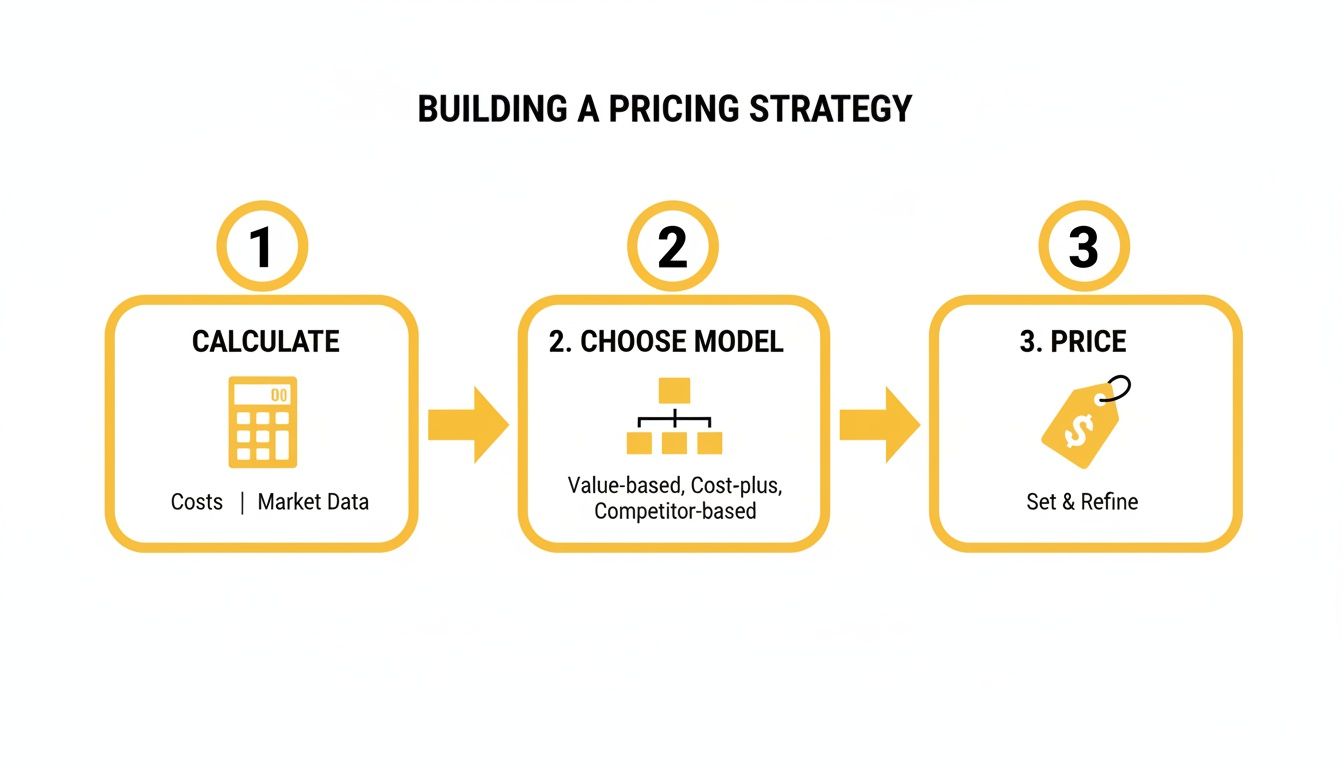
As you can see, it all flows logically. You figure out what it costs you to do the work, decide how you'll bill for it, and then set the final price to ensure you're actually making money.
At its core, your price tag is a message to your customer about the value you deliver. A clear, well-reasoned estimate builds instant trust. When clients see you've done your homework, they see a professional, not just someone with a mop and a bucket.
Your goal is to get away from "gut feelings" and create a system that works every time. To do that, you just need to get a handle on a few key things:
Remember, the best pricing strategy isn’t about being the cheapest. It's about delivering the most value. Your price should reflect the quality of your work, the reliability of your service, and the peace of mind you give your clients.
Trying to juggle all these factors on a napkin can feel overwhelming, but modern tools make it so much easier to get it right every time. For a deeper look at all the variables that go into a final estimate, our guide on house cleaning costs is a great next step.
By taking a structured approach, you can be confident that every estimate you send is both competitive in your market and profitable for your business. That’s how you build a company that lasts.
Deciding how to charge for your cleaning services is one of the first, and most important, decisions you'll make for your business. It's a classic debate in the industry: do you go with hourly rates or flat-rate pricing? The truth is, there's no single right answer. The best model really comes down to your business goals, the kinds of jobs you're targeting, and what makes your clients feel most comfortable.
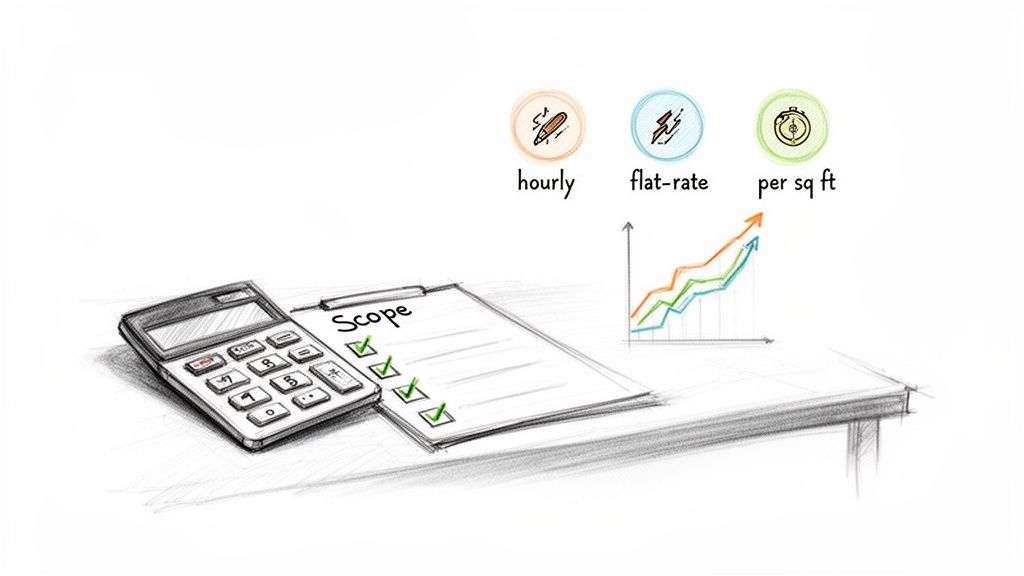
This isn't just a numbers game; it's about strategy. Your pricing structure immediately tells clients a story about your value and your transparency. Let’s walk through the models I’ve seen work—and where they can fall short.
Charging by the hour is often the simplest and safest way to start. It acts as a safety net, protecting you from drastically underbidding on a job that turns out to be far dirtier or more cluttered than expected. If a "standard clean" suddenly requires a deep-scrub intervention, you’re covered because your compensation scales with the effort.
The downside? Some clients get nervous about an open-ended bill. They can start to worry about cleaners "milking the clock," which can create an awkward dynamic and erode trust before you've even had a chance to prove your team's integrity.
Best for:
Flat-rate pricing is, without a doubt, a client favorite. It gives them complete peace of mind, knowing the exact cost before you even walk through their door. There's no clock-watching, no anxiety—just a clear price for a clear result. This model also positions your company as a results-oriented service, not just a pair of hands for hire.
Of course, with this model, all the risk shifts to you. A bad estimate can completely wipe out your profit margin on a job. To make flat-rate pricing work, you have to become a master estimator. If you want to sharpen that skill, we've put together a comprehensive guide on how to estimate cleaning jobs with confidence.
Key Insight: Flat-rate pricing directly rewards efficiency. As your team gets faster and develops better systems, you complete jobs in less time. That extra time doesn't change the price for the client, but it directly boosts your profit on every single project.
To help you weigh the options, here's a direct comparison of the two main pricing models. Think about which columns align best with the kind of business you want to build.
Ultimately, choosing flat-rate or hourly isn't an either/or decision for your entire business. The smartest companies use both, applying the right model to the right situation.
You absolutely don't have to lock yourself into just one pricing structure. In fact, many of the most successful cleaning businesses I know use a hybrid approach to stay flexible and competitive.
Here are a few other effective models to consider:
The cleaning industry is vast, and pricing reflects that diversity. The European cleaning services market, for instance, grew from $80.489 billion in 2021 to an estimated $103.006 billion in 2025. This growth highlights how different markets and specialized services, like premium floor care, demand tailored pricing strategies.
In my experience, the best strategy is often a blended one. You might use an hourly rate for the initial deep clean to get a feel for the home and then switch the client to a predictable, flat-rate plan for ongoing maintenance. This flexibility allows you to win more business and ensure every single job is priced for maximum profitability.
If you want to stay in business, you have to stop guessing what to charge. Profit isn't just what's left over at the end of the month if you're lucky; it's a specific line item you must build into every single estimate you send. To do that, you need to go way beyond what you pay your cleaners and buy in supplies. You need to know the true, total cost of doing business.
I’ve seen it a hundred times: a new cleaning business owner undercharges because they only see the obvious costs. They look at what they pay a cleaner for a few hours and tack on a little extra. But what about the gas to get to three different jobs in one day? The Facebook ad that brought in the lead? The slow, creeping wear-and-tear on your best vacuum? These are the “hidden” costs that can quietly drain your bank account, turning what looked like a great day's work into a net loss.
Let's start with the costs directly tied to performing a cleaning job. We call these direct costs, and they fluctuate with every appointment you book.
Your main direct costs will be:
Key Takeaway: Every job has its own mini P&L. If the direct costs for a clean add up to $60 and you charge the client $120, you haven't made $60 in profit. You've made a $60 gross profit, which now has to help pay for everything else.
Now for the costs that really sneak up on you: overhead, or indirect costs. These are the fixed expenses you’re on the hook for every single month, whether you clean one home or a hundred. To set your cleaning service rates properly, you have to know how to categorize business expenses like a pro.
These are the bills that keep the lights on:
Getting a firm grip on these numbers is the only way to build a price that actually sustains your business. Our house cleaning cost calculator guide dives even deeper into how these different factors should influence your final estimate.
Okay, you've got your overhead numbers. Now you can figure out your break-even hourly rate. This is the rock-bottom amount you must earn per billable hour just to cover all your expenses, without making a single penny of profit.
Here’s the back-of-the-napkin formula:
Total Monthly Overhead / Total Billable Hours Per Month = Your Overhead Cost Per Hour
Then, you just add your labor cost:
Break-Even Rate = (Overhead Cost Per Hour) + (Direct Labor Cost Per Hour)
Let's run a quick scenario. Say your monthly overhead is $1,500 and your team works a total of 150 billable hours. That makes your overhead cost $10 per hour. If your all-in labor cost is $25 per hour, your break-even rate is $35 per hour. If you charge anything less than that, you are literally paying to clean someone's house.
The last step is the best one: adding your profit margin. For a service business like ours, a healthy target is typically between 15% and 30%. So, if your break-even is $35, a 25% profit margin ($8.75) means your target hourly rate should be $43.75.
This isn't guesswork; it's business. This data-driven approach means every estimate you generate with a tool like Estimatty is built on a solid financial foundation. It's how you guarantee profitability and build a cleaning business that lasts.
You’ve done the math and figured out your pricing. Now comes the moment of truth: sending that number to a potential client. This is where so many cleaning businesses get it wrong. They just send a price, but an estimate should be your hardest-working sales tool.
Think of it this way: your estimate isn't just a price tag. It's your chance to prove your value, build trust, and show a customer exactly why you're worth what you charge. It’s the difference between getting ghosted and getting the job.
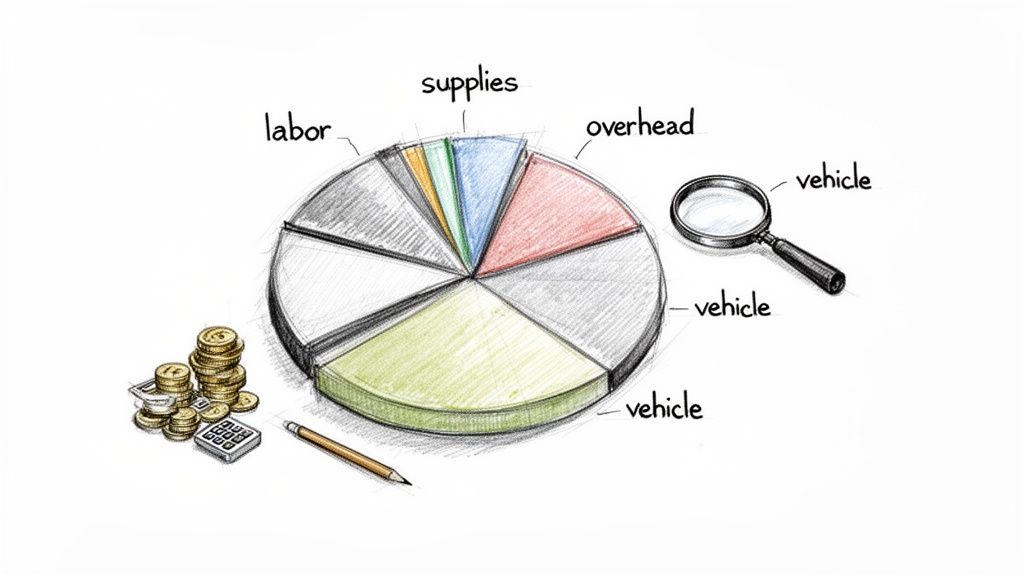
The biggest mistake I see new owners make is firing off a quick email with a single number. A professional estimate is a real document that sets clear expectations and prevents those painful misunderstandings later on.
A great estimate leaves no questions unanswered. It acts as a mini-proposal, showing off your professionalism and making the client feel confident in their decision to hire you.
Every single estimate you send out needs to include these core components:
The goal is to answer a client's questions before they even think to ask them. A detailed estimate shows you're organized and thorough—exactly the qualities someone wants in a cleaning service.
This level of detail isn't just for show. It’s how you protect yourself from scope creep, disputes, and clients who claim they "thought" something was included.
Here’s a pro tip that can save you a world of headaches. At Estimatty, we always use the word "estimate" instead of "quote," and it’s a deliberate, strategic choice.
Legally, a "quote" can be seen as a fixed, binding price. If you get to a job and discover it’s three times dirtier than you expected, that quote can lock you into a price that loses you money.
An "estimate," however, is understood to be a professional approximation based on the information you have. It gives you the wiggle room to adjust the final price if the job is far more complex, protecting your profit margin. It’s a small change in wording that makes a huge difference in managing expectations right from the start.
You don’t need to be a graphic designer to create a document that looks sharp and professional. A clean, well-organized template is all you need. If you're looking for a great starting point, our guide includes a free cleaning estimate template you can easily adapt for your own business.
To really make your estimate shine, make sure it has clear sections for:
When you present your pricing this way, you shift the conversation from "cost" to "investment." You aren't just cleaning a house; you're giving your client their time back, creating a healthier space, and providing peace of mind. A killer estimate communicates that value instantly and makes saying "yes" to your price an easy decision.
Let's be honest. If you're still creating cleaning job estimates based on a "gut feeling" or a tangled spreadsheet, you're not just being inefficient—you're actively leaving money on the table. Inconsistent pricing is one of the quickest ways to erode customer trust and kill your profitability.
Think about it. Every time you hesitate to give a price, or give two similar jobs different estimates, you look unprofessional. You risk losing that lead to a competitor who was faster and more decisive. The real key to scaling your cleaning business isn't just working harder; it's working smarter by building a rock-solid, automated pricing system.
Manual estimating is the ultimate growth killer. It’s slow, riddled with human error, and tethered completely to your personal availability. When a hot lead comes in at 9 PM on a Friday, they're not going to wait until you’re back in the office on Monday. They'll have already booked with the company that gave them an instant answer.
How much of your day is spent on the phone asking the same repetitive questions? "How many bedrooms? What's the square footage? Any pets?" This is the kind of low-value grind that automation was built to handle, freeing you to focus on what actually grows your business—like managing your team or landing big commercial contracts.
When you systematize your pricing, every potential customer gets a consistent, accurate, and—most importantly—profitable estimate based on the rules you’ve already set. No more accidental low-ball prices that cost you money, and no more inflated estimates that scare away perfectly good clients.
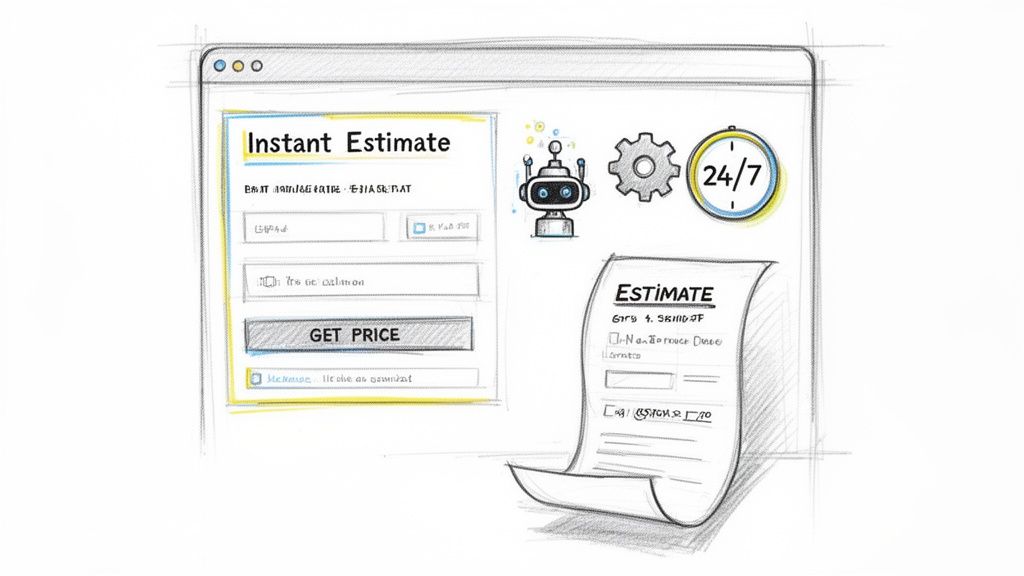
This is where a tool like Estimatty completely changes the game. Imagine having an AI-powered estimator on your website, working around the clock to engage every visitor the second they land on your page.
It completely transforms your lead-capture and sales process:
This kind of instant gratification is exactly what modern customers expect. They don’t want to fill out a contact form and wait. They want answers now. Delivering an immediate, professional estimate instantly sets you apart and will dramatically boost your conversion rates.
By standardizing with an automated tool, you’re not just sending a price—you’re delivering a superior customer experience from the very first interaction. It shows you're a professional, tech-savvy business that values your client's time.
A clean, simple button on your website is all it takes to kick off this automated process.
This button becomes the gateway to a sales funnel that captures lead info and delivers your perfectly calculated price, all without you lifting a finger.
One of the biggest silent killers of profit is simple inconsistency. One day you forget to add the surcharge for a home with three shedding dogs; the next, you accidentally under-price a move-out deep clean. These small mistakes add up fast, eating away at your bottom line.
Automation acts as your pricing bodyguard, enforcing your rules without fail.
This level of precision is almost impossible to maintain manually, especially as your team grows. As we've detailed on the estimatty.com/blog, this kind of standardization is the foundation of any scalable and highly profitable cleaning business. If you’re serious about building a pricing strategy that actually works, exploring a cleaning estimate calculator is the logical next step. It’s the engine that turns your pricing theory into automated, real-world profit.
Even after you've built the perfect pricing model, real-world questions always come up. Let's tackle some of the most common pricing curveballs I see owners face when they're figuring out how to charge for cleaning services.
Let's be real: you can't charge the same price in a starter-home subdivision as you can in a luxury gated community. Smart pricing is all about location, location, location.
Start by doing some simple recon. See what competitors are charging in the specific zip codes you want to work in. You'll quickly find that more affluent areas can easily support higher rates, not just because of income levels, but because the demand for premium, reliable service is higher.
A simple way to handle this is to create a location-based multiplier. For example, you might decide a particularly high-end suburb justifies a 1.15x multiplier on your base rate.
Of course, doing this manually for every estimate is a pain. This is where a tool like Estimatty really shines. You can set up pricing rules for different zip codes, so your instant estimates automatically reflect what the local market will bear.
It’s tempting to just slap a price list on your website, but trust me—it’s a trap. Posting a single price like "$150 for a 3-bedroom home" is a recipe for unprofitable jobs. It can’t possibly account for the reality of the home's condition, the level of clutter, or any unique client requests.
If you want to give visitors an idea, a much safer bet is to provide a price range. Something like, "A typical 2,000 sq ft home starts at around $180." This sets a general expectation without locking you into a price that could cause you to lose money.
The best solution, by far, is an instant estimation tool. It gives potential customers the immediate, personalized estimate they crave while turning that anonymous visitor into a qualified lead for your business. That’s infinitely more powerful than a static price list that tells you nothing.
This one is huge. When a client wants the inside of the oven, fridge, or windows cleaned, never just absorb it into your hourly rate. Doing that completely hides the value of the extra work and can make your base hourly rate look unfairly expensive.
Treat add-ons like an à la carte menu. Price them as separate, flat-rate items on every estimate.
This approach makes the value crystal clear to the customer and ensures you’re paid properly for the extra time and supplies. It also doubles as a simple, no-pressure upselling tool that can seriously increase your revenue on every single job.
You need to get comfortable with raising your prices. Plan to review your entire pricing structure at least once a year to keep pace with inflation and shifts in your market. You should also be ready to adjust rates anytime your major costs—like fuel, supplies, or payroll—go up.
When it comes to your loyal, recurring clients, communication is key. Always give them a heads-up of 30-60 days. Be transparent and confident about the change.
A simple script works wonders: "To continue providing the high level of service you expect and to support our amazing team, we are making a small price adjustment of 3% effective [Date]." A modest annual increase of 3-5% is standard practice and most clients will understand. For more great insights on hiring and keeping staff, the team at get.pipehirehrm.com/blog has some fantastic articles.
Ready to stop guessing and start growing? Estimatty gives you an AI-powered sales agent that delivers perfect, profitable estimates to every website visitor in under a minute. Automate your sales, capture more leads, and scale your business without the manual work.