September 8, 2026
How Much Should a House Cleaning Cost in 2026
How Much Should a House Cleaning Cost. Learn how much a house cleaning should cost in 2026, with real pricing ranges by home size, service type, and tips
Wednesday, April 29, 2026
Launch a winning google ads cleaning business campaign. Our 2026 guide covers keywords, bidding, landing pages, and instant estimates to book more jobs.
.png)
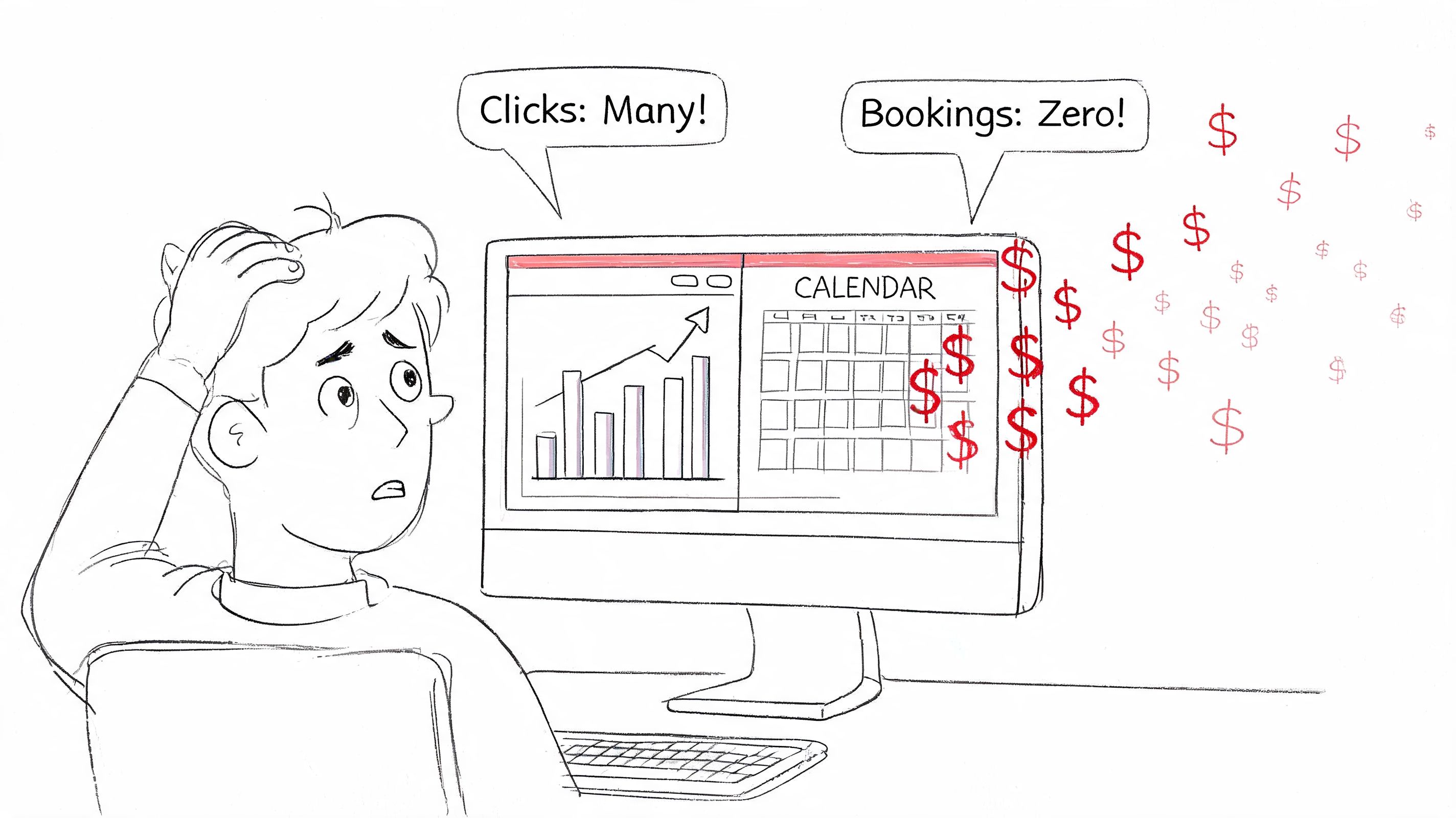
You’re probably seeing the same pattern most cleaning owners see when they try Google Ads for the first time. Clicks show up. Spend goes out. A few calls come in, some form fills trickle through, and then the calendar still looks too empty.
That usually doesn’t mean Google Ads can’t work for a cleaning business. It means the account was built to collect traffic, not to produce booked jobs.
The difference matters. In a real google ads cleaning business setup, the ad account, the search terms, the ad copy, the page, and the estimate process all have to work together. If one part breaks, the whole funnel leaks. A lot of owners fixate on cost per click when they should be asking a harder question: did this search turn into a profitable cleaning job?
Most cleaning companies don’t have a click problem. They have a conversion path problem.
A prospect searches for “move out cleaning near me,” clicks your ad, lands on a generic homepage, pokes around, sees a contact form, and leaves because they wanted a fast answer. That click wasn’t wasted because Google failed. It was wasted because the buying journey stalled.
A lot of owners also target terms that sound relevant but don’t reflect purchase intent. Broad searches can make a dashboard look active while producing weak leads. If you want a bigger picture of channel mix and what works beyond PPC, this guide on cleaning service advertising is a useful complement.
Google Ads only creates the opportunity. Your business still has to close it.
For cleaning businesses, the funnel looks like this:
If any step is weak, booked jobs drop fast.
Practical rule: Judge your campaign by booked jobs and customer quality, not by how busy the Google Ads dashboard looks.
Here’s where I see most ad accounts break:
That’s why some cleaning businesses feel like Google Ads is expensive. The platform isn’t the issue. The missing system after the click is.
A strong account starts with structure. Not creativity. Not clever headlines. Structure.
For cleaning companies, that means separating campaigns by service line and geography, because high-performing campaigns rely on granular keyword clustering paired with neighborhood and zip-code targeting, which improves ad relevance and supports Quality Score, as outlined in this cleaning services Google Ads setup guide.
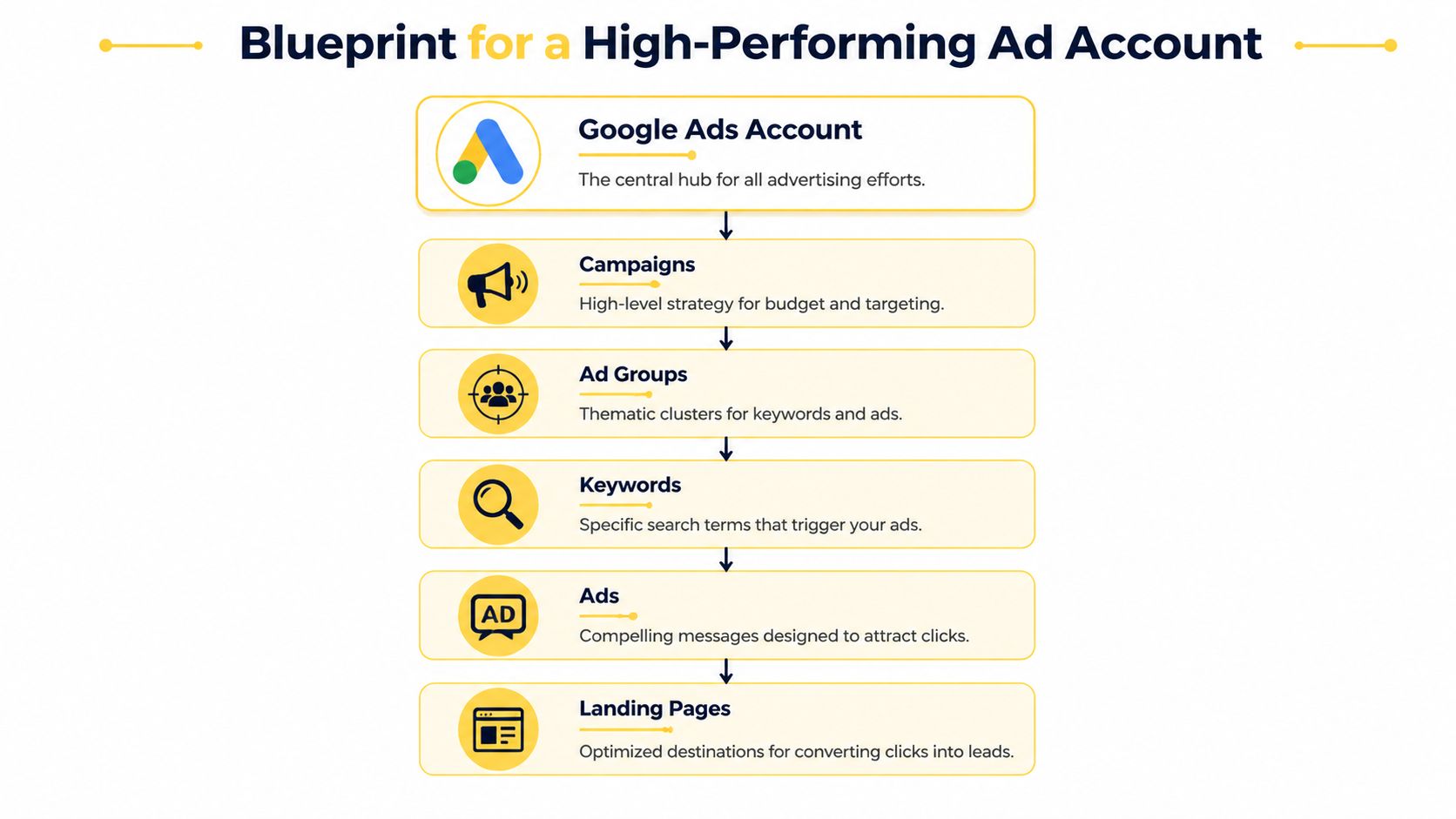
Don’t lump everything into one campaign called “cleaning services.”
That setup makes it harder to control spend, write relevant ads, and send people to the right page. A better structure looks like this:
| Campaign type | Example ad group |
|---|---|
| Residential cleaning | house cleaning in [city] |
| Deep cleaning | deep house cleaning [zip code] |
| Move-out cleaning | move out cleaning [neighborhood] |
| Commercial cleaning | office cleaning [city] |
| Carpet cleaning | carpet cleaning [neighborhood] |
A person searching for office cleaning isn’t the same buyer as someone needing recurring home cleaning, so different intent should trigger different messaging.
A lot of waste comes from loose local targeting.
If you serve selected neighborhoods, target those neighborhoods. If certain zip codes produce better customers, build around them. Hyper-local structure usually improves lead quality because the search, ad, and landing page all feel more relevant to the person clicking.
Use local modifiers in the account, not just on the landing page.
Cleaning owners get burned here all the time.
Broad matching can uncover demand, but it can also drag in searches you never wanted. Phrase and exact tend to give you more control when you’re trying to protect budget and tighten lead quality.
From a practical perspective:
If your budget is limited, start tighter. Expansion is easier than cleanup.
Separate premium services into their own ad groups or campaigns. If hardwood floor restoration or post-construction cleanup matters to margin, it deserves its own keywords, ads, and page.
Negative keywords keep your ad from showing on searches that look related but won’t become jobs.
For a cleaning business, you often need to block terms tied to job seekers, DIY intent, education, or unrelated services. Every week, review the search terms report and cut waste aggressively. That habit alone can change account economics.
Use this starting framework:
A messy account makes optimization hard. A clean account makes your decisions obvious.
Ad copy works when it sounds like the exact answer to the search that triggered it.
That sounds simple, but most cleaning ads still read like this: “Professional Cleaning Services. Call Today.” That copy says almost nothing. It doesn’t tell the searcher whether you handle their service type, their area, or their specific need.
One real example shows how much alignment matters. A residential cleaning company achieved a 23% conversion rate from 139 clicks to 32 conversions by combining strategic keyword selection with proper ad structure, as shared in this Google Ads cleaning case study. Strong ad copy sits inside that alignment. It doesn’t work alone, but weak copy will weaken everything around it.
Here’s the kind of ad I’d consider too generic:
Before
It’s broad, forgettable, and invites mixed-intent clicks.
A tighter version looks like this:
After
That second ad filters better. It attracts the right click and repels the wrong one.
A good ad should do at least three things fast:
If you’re also sharpening your positioning outside of paid search, this article on branding for cleaning services will help you define the language your ads should reinforce.
Here’s a useful walkthrough on ad messaging and setup:
Extensions help your ad do more work before the click.
I like these most for cleaning companies:
| Extension | Best use |
|---|---|
| Sitelinks | Send people to residential, deep cleaning, move-out, or commercial pages |
| Call extension | Capture buyers who want to talk now |
| Location extension | Reinforce local presence |
| Callout assets | Highlight insured, recurring service, pet-friendly products, or satisfaction promise |
If your ad promises one thing and your page opens with something else, the click gets colder immediately.
Specificity wins. Generic copy gets curiosity clicks. Specific copy gets buying clicks.
A lot of cleaning businesses lose the sale after doing the expensive part right.
They buy the click, then dump the visitor onto a homepage built for everyone. That page usually has too many links, too little clarity, and one weak contact form that asks the buyer to wait. Many guides admit that a poor landing page can effectively block conversions, but stop short of showing what to do next. That gap is described clearly in this discussion of Google Ads landing page issues for house cleaning businesses.
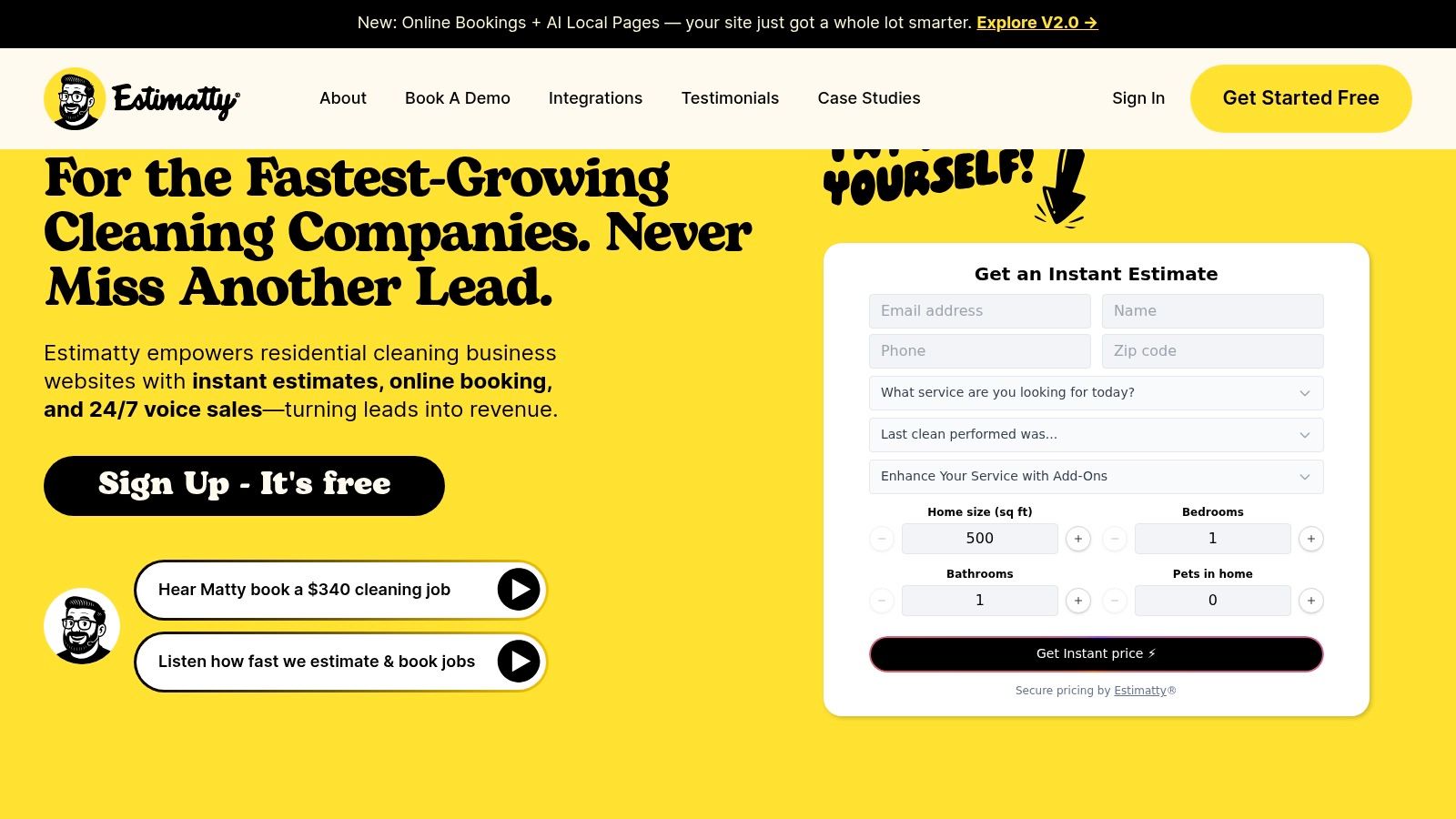
If someone searched for “apartment move out cleaning downtown,” they should land on a page about apartment move-out cleaning in that service area. Not your homepage. Not a general services page. Not a contact page.
The landing page should continue the ad conversation without making the prospect think.
A solid page usually includes:
Cleaning has price variability. Home size, condition, frequency, add-ons, urgency, and property type all affect the estimate. That’s why static forms perform poorly in so many campaigns. They ask for details, then force the buyer to wait.
Waiting creates drop-off.
If someone is searching for cleaning right now, they usually want one of two things immediately: availability or an estimate. If your page offers neither, you’re asking them to do administrative work while a competitor gives them a faster answer.
The best pages don’t just “collect leads.” They help the buyer make a decision.
Use this checklist:
Match the headline to the keyword theme
If the keyword is about deep cleaning, don’t lead with recurring maid service.
Ask only for decision-driving inputs
Property type, size, timing, service scope. Skip fields your team can collect later.
Show the process clearly
Tell prospects what happens after they submit. Uncertainty lowers completion.
Keep the page narrow
Remove top navigation if the goal is lead conversion, not browsing.
Offer estimate speed as a competitive advantage
Cleaning is often a convenience purchase. Speed matters.
For more on turning your site into a booking asset, this guide to a website for cleaning business is worth reading.
Buyers don't want homework. They want enough clarity to decide whether to book.
I’d avoid these patterns unless you enjoy paying for dead-end traffic:
Your landing page has one job. Turn search intent into action while the prospect still cares.
Budget and bidding get overcomplicated fast. For most cleaning companies, the first objective is simpler: give Google enough clean conversion data to find more buyers like the ones you want.
That’s why the practical starting point is usually automated bidding. Industry benchmarks for cleaning service leads treat a 20% to 30% lead close rate as the gold standard, and one recommended approach is to start with Maximize Conversions, then make device-level bid adjustments after you have enough data, typically 50 to 100 conversions, as explained in Estimatty’s guide to Google Ads for cleaning businesses.
If your tracking is weak, your bidding strategy will be weak too.
Before changing bids, define what counts as a conversion. For a cleaning company, that might include:
Not every lead action deserves the same weight. A generic contact form submit may be less valuable than a completed estimate flow. If you feed Google mixed or low-quality conversion signals, it will optimize for volume, not quality.
Cleaning businesses often start without enough history for manual bidding to be efficient.
Maximize Conversions gives Google room to learn from real actions. That works best when the account structure is clean, the targeting is tight, and the conversion tracking reflects actual business value.
Use it when:
| Situation | Better move |
|---|---|
| Newer account with little data | Maximize Conversions |
| Rebuilt account after poor prior setup | Maximize Conversions |
| Strong tracking but limited time for daily bid management | Maximize Conversions |
| Mature account with enough clean data by device | Add device-level adjustments |
Once you’ve built enough conversion history, you can start making controlled adjustments.
Mobile often behaves differently from desktop in cleaning campaigns because a lot of buyers search when they need help fast. But don’t assume. Verify. If your device data shows one segment consistently producing stronger lead quality, that’s when bid adjustments make sense.
Key takeaway: Automation works well when you train it with accurate conversion events. It fails when you count every weak inquiry as a win.
A lot of owners ask, “How much should I spend?” The better question is, “What kind of lead am I buying?”
If your campaign is generating qualified demand and your team can close it profitably, scale becomes easier. If your lead quality is poor, adding budget usually just buys more poor leads.
You should increase spend only when three things are true:
If your office can’t respond fast, ad spend can outrun operations and hurt ROI.
For a deeper look at efficiency on the acquisition side, this piece on how to reduce customer acquisition cost is a strong next read.
Launching a campaign is the easy part. Profit comes from what you do after launch.
For cleaning businesses, the lead-to-client pipeline can be very efficient. Closing rates often range from 20% to 40%, high-performing owners can close near 50% of Google Ads leads, and one example shows that $2,000 in ad spend generating 32 leads can produce 6 to 12 new clients depending on follow-up quality, according to this Google Ads lead-to-client breakdown. Those numbers don’t happen by luck. They happen when owners track the right bottlenecks.
You do not need to stare at every metric in Google Ads.
Watch these:
Search terms quality
Are your ads showing for buyer searches or junk queries?
Landing page conversion behavior
Are visitors completing the intended action?
Lead-to-client close rate
This is where ad performance meets sales execution.
Cost per booked job
A lead is not the finish line. A booked, profitable job is.
If you want cleaner attribution across channels, campaign types, and sales outcomes, set up a process for lead source tracking.
I like a simple operating rhythm.
| Task | Why it matters |
|---|---|
| Review search terms | Find waste and discover new buyer intent |
| Add negative keywords | Stop paying for irrelevant traffic |
| Test one ad variable at a time | Learn what messaging improves qualified clicks |
| Check close rate by campaign | Find which campaigns produce real customers |
| Compare device and location performance | Shift effort toward stronger segments |
This is also where technical cleanup matters. If your numbers feel inconsistent, it’s smart to optimize Google Ads conversions before making major budget decisions. Bad tracking creates fake confidence.
More leads create a second problem. Delivery.
If Google Ads starts producing steady demand, you need enough staff to fulfill the work without lowering service quality. That’s where hiring systems matter. For cleaning teams trying to scale responsibly, tools like pipehirehrm.com can help organize recruiting and reduce the chaos that often follows strong demand generation.
More leads don't fix operational bottlenecks. They expose them.
Use this before raising spend:
The owners who scale best treat Google Ads like a managed sales system, not a slot machine.
A few questions come up constantly when owners are evaluating a google ads cleaning business strategy. The answers below keep it practical.
| Question | Answer |
|---|---|
| Should a cleaning business send Google Ads traffic to its homepage? | Usually no. A homepage is too broad for paid search traffic. Service-specific landing pages work better because they continue the exact intent of the search and make the next step obvious. |
| What matters more, more clicks or better leads? | Better leads. A busy dashboard can hide weak search intent, vague ad copy, or poor post-click experience. The real test is whether your campaign produces booked jobs at a profitable acquisition cost. |
| How long should I wait before making big changes in Google Ads? | Give the account enough time to gather meaningful conversion data. If you change targeting, ads, landing pages, and bidding all at once, you won’t know what helped or hurt performance. Make controlled changes and judge them against lead quality and booking outcomes. |
The cleaning companies that win with Google Ads usually do ordinary things well. They structure tightly, write specific ads, remove friction from the estimate process, track the full funnel, and follow up fast. That’s less exciting than marketing hype, but it’s what books jobs.
If your Google Ads are generating clicks but not enough booked cleaning jobs, Estimatty helps close the gap after the click. It gives cleaning businesses a faster way to deliver estimates, capture lead details, and respond around the clock without relying on slow forms or missed calls.