October 16, 2026
Journeyman Electrician License Requirements Explained
Understand journeyman electrician license requirements, training hours, and reciprocity rules. Learn how jurisdiction impacts scope and hiring decisions.

Wednesday, March 4, 2026
Discover how much should i charge for house cleaning with practical pricing models, market rates, and instant estimates to win more jobs.
.png)
Want to know how much to charge for house cleaning? It all boils down to one simple truth: you can't pick a profitable price until you know exactly what it costs to run your business. So many new owners just guess or copy what the competition is doing, but that's a quick way to work yourself to the bone for practically nothing.
Real, sustainable profit comes from data, not guesswork.
Before you can confidently provide an estimate to a single client, you need a rock-solid grasp of your expenses. This number, your Cost of Doing Business (CODB), is the absolute foundation of your company. It’s what separates the pros who build lasting businesses from the hobbyists who eventually burn out.
Let's dig into the numbers that really matter and get this calculated.
Your expenses really come in two flavors: direct costs and indirect costs (or overhead). Direct costs are tied to a specific cleaning job, while overhead is what you pay just to keep the lights on, whether you have a full schedule or not.
The first step is to just list everything. I mean everything.
You have to account for every single dollar leaving your business account. That forgotten $15 monthly software subscription or the cost of replacing your vacuum every two years? It all adds up and will silently eat away at your profit if you don't build it into your prices.
I see this all the time. New business owners get so focused on covering supplies and insurance that they completely forget to include their own salary in the calculation. You are not a volunteer. Your time and expertise are valuable, and you need to build a consistent salary for yourself right into your pricing from day one.
This isn't just a job you've created for yourself; it's a business. Treat yourself like your most important employee.
This logic extends to your team, too. If you’re hiring cleaners, their wages, payroll taxes, and any benefits are a significant and recurring business cost. Getting this right is crucial, and it’s a job in itself. When you're ready to hire cleaning employees, resources like pipehirehrm.com can be invaluable. For a closer look at industry benchmarks, you can see our complete breakdown of the average house cleaning cost.
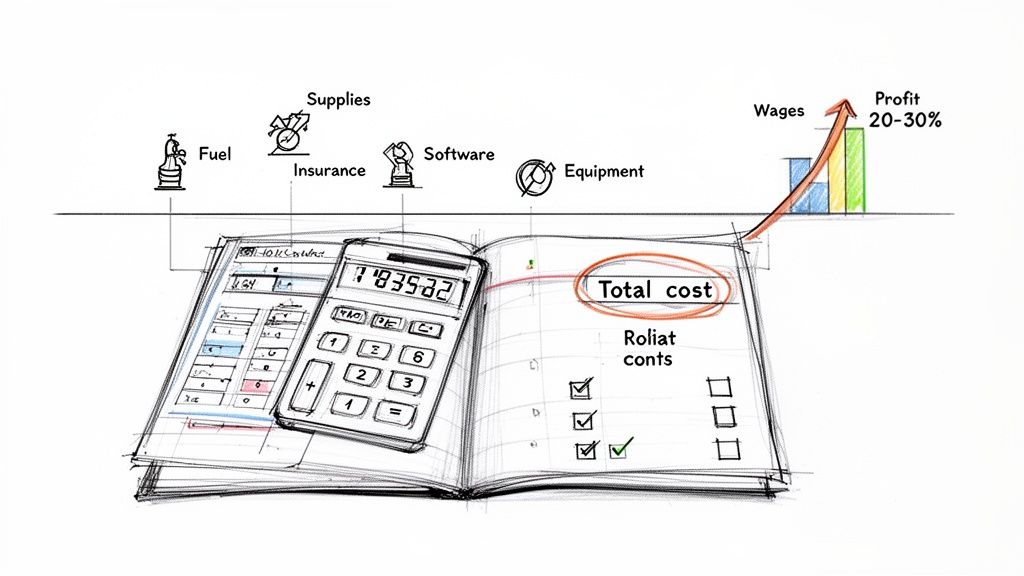
This simple diagram shows exactly how your costs, your salary, and your profit all fit together to create your final price.

It’s a clear reminder that your price isn't just a number you pull out of thin air. It’s a formula designed to cover every expense and, most importantly, secure your profit.
Once you've tallied all your costs and factored in salaries for you and your team, the final piece of the puzzle is profit. Profit is what lets you grow, invest in better equipment, handle a slow month without panicking, and build a truly valuable asset.
For a residential cleaning business, a healthy profit margin is typically between 20% and 30%.
Let's put it all together into a simple formula:
(Total Business Costs + Salaries) + Desired Profit Margin = Total Revenue Goal
This revenue goal is the magic number you need to hit to run a healthy, growing company. Once you know it, you can work backward to set your pricing, ensuring every estimate you send is a step toward that goal. This same thinking is vital whether you're cleaning homes or expanding your services; understanding how to price commercial cleaning services uses these same core principles.
So, the age-old question for every cleaning business owner: do you charge by the hour, or do you offer a single flat rate? This is one of the most critical decisions you'll make, and it shapes everything from your profitability to your client relationships. There’s no single correct answer, but after years in this business, I can tell you there’s definitely a smarter way to approach it.
Let's break down when to use each model and how to combine them for the best results.
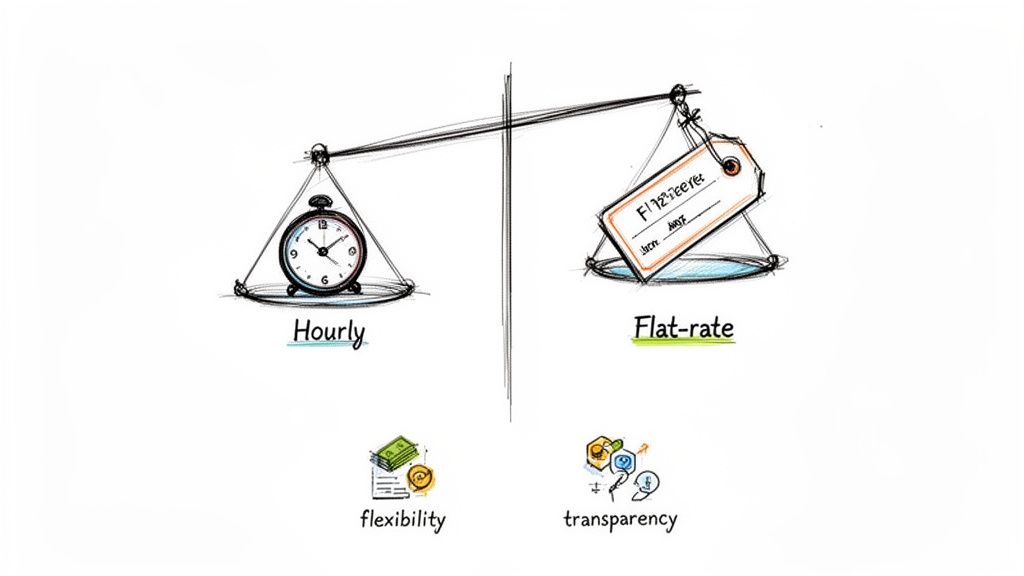
Billing by the hour is your safety net. It’s the most straightforward way to get paid for your time, and it’s perfect for jobs where you just can’t predict the effort involved. Think of it as your go-to for situations with a lot of unknowns.
An hourly rate completely protects you from "scope creep"—that dreaded moment when a "quick tidy-up" turns into an all-day project. If you walk into a home that's way messier than the client let on, you're covered for every extra minute you spend making it right.
I always recommend using an hourly rate for:
The downside? Some customers get anxious about an open-ended bill. More importantly, hourly rates don't reward you for being great at your job. The faster and more efficient you become, the less you earn per project.
This is where the real pros play. Flat-rate pricing immediately shifts the focus from your time to the result you deliver: a sparkling clean home. Clients love it. They get a clear, upfront cost with no surprises, which builds instant trust.
But the biggest win is for you. Flat-rate pricing rewards efficiency. The moment your team gets faster and your process gets smoother, your profit margin on every single job goes up. You're completing the work in less time for the same price. This creates a powerful incentive to constantly improve your skills and systems.
A flat rate transforms your service from a commodity (trading hours for money) into a premium product (selling a result). It’s a powerful positioning tool.
Of course, the whole thing falls apart if your estimates are just guesswork. If you under-estimate a job, you're working for free or even losing money. This is where you have to be disciplined. Using a smart tool like Estimatty to generate your estimates is a game-changer. It ensures your flat rates are based on hard data—like the home's square footage and the exact services requested—so you can protect your profits every time.
Here’s the thing: you don’t have to pick a side. The most successful and profitable cleaning companies I know use a hybrid strategy. It's about using the right tool for the right job.
Here’s the winning formula:
This gives you the best of both worlds. You're completely covered on that first, risky job, and then you lock in a happy, long-term client with the budget-friendly consistency they crave. For more advanced techniques, our guide on how to price cleaning jobs dives even deeper.
The timing couldn’t be better. The global house cleaning market is set to explode, projected to hit an incredible $563.99 billion by 2035. This massive growth, detailed in the full house cleaning and maid service market report, means a flood of new customers are looking for pros like you. By pricing your services intelligently, you can claim your piece of that profitable pie.
You've crunched your numbers and have a target profit in mind. That's a huge first step. But even the most carefully calculated price list won't work if it’s completely out of sync with what’s happening in your own backyard.
Before you finalize anything, you need to become a student of your local market. This isn't about copying what the next company is doing; it’s about gathering the intel you need to price your services smartly, making you an attractive choice for clients without undercutting your own value.
Finding out what other cleaning services charge is easier than you think. You don't need a trench coat and a fake mustache—you just need to put on your "potential customer" hat.
Here’s how you can get a feel for the local pricing landscape:
Don’t just fixate on the final price. The real gold is in the details. Are they charging by the hour or a flat rate? What do they consider a "standard" clean, and what costs extra? This tells you everything about their business model.
It’s obvious that prices vary by location, but understanding why is key to setting your own. The "going rate" in your city is a direct result of some powerful economic forces.
Here’s what shapes the pricing in your specific area:
The market for cleaning services is hot. North America holds a 31.85% share of the global market, and a big part of that is driven by hybrid work schedules and rising incomes. For a residential cleaner in the U.S., this often shakes out to charging between $0.15–$0.30 per square foot for a standard cleaning.
Better yet, data shows that 40% of demand comes from dual-income households and an aging population—groups who are actively looking for and willing to pay for high-quality, reliable service. This insight, highlighted in market analysis from sources like Grandview Research, shows there’s a real opportunity for businesses that position themselves correctly.
Armed with all this research, you can now make a strategic decision: where do you want your business to fit in? Are you the top-shelf, white-glove service, or are you the smart, affordable choice for busy families?
There are generally three paths you can take:
Your research should make this choice much clearer. If you find every competitor is in a race to the bottom on price, it might be the perfect time to launch a premium brand that stands out. On the flip side, if the market is full of expensive services, a high-quality, value-focused company could absolutely dominate.
If you’d like to dive even deeper into pricing strategies and see more examples, our complete guide to house cleaning prices has you covered.
Your standard cleaning package pays the bills, but it’s the extras that will truly grow your business. If you want to move beyond just surviving and start building real wealth, you have to think about maximizing the value of every single visit. This is where a smart menu of add-on services and a firm minimum fee come into play. They are, without a doubt, two of the most powerful tools for boosting your bottom line.
Think of your basic clean as the foundation. The real money, the high-margin work, is in all the little details that clients are more than happy to pay extra for.
I like to think of the standard service as the main course. The add-ons are the delicious, profitable side dishes and desserts that let a customer build their perfect experience. These aren't just random chores; they are targeted solutions to the specific, nagging tasks that homeowners hate doing themselves.
The trick is to offer services that make a huge, visible impact without tacking on a ton of extra time for your team. Here are a few of the most popular and profitable add-ons I've seen work time and time again:
Here’s a pro tip: when pricing your add-ons, stop thinking strictly in terms of hours. Start thinking in terms of value. A client will happily pay $40 for a sparkling-clean oven, a job that might only take you an extra 30 minutes. That simple add-on just skyrocketed your effective hourly rate for that appointment.
Making these options visible during the estimation process is absolutely critical. This is where an online booking system like Estimatty really shines. It can automatically show your add-on menu to every single person getting an online estimate. It basically acts as your 24/7 salesperson, upselling for you by showing customers all the ways you can make their home even cleaner. Many will add these services on their own, no phone call needed. If you're looking for inspiration on how to structure all this, grabbing a free cleaning estimate template is a great place to start.
Now, let’s talk about the most important rule for protecting your profit margin: You must have a minimum service fee. This is the absolute lowest price you'll charge for any job, no matter how small it seems. This single rule ensures that every time your team rolls out, the job is actually profitable.
Think about what goes into even a "tiny" job, like cleaning a single, small bathroom. You still have to cover:
Without a minimum fee, you could easily end up losing money on these small, one-off jobs. A common and very reasonable minimum fee for a professional cleaning service is usually somewhere between $90 and $120. This fee is your safety net, guaranteeing your core costs are covered and that every appointment makes a positive contribution to your bank account.
This isn't about being greedy; it's about being smart. A minimum fee protects your business from being stretched thin by unprofitable jobs. It also sends a clear message that you are a serious, professional company whose time—and expertise—is valuable.
You've done the hard work. You’ve crunched the numbers, decided on your pricing model, and even checked out what the competition is charging. You know exactly what your services are worth.
But here’s the harsh reality: having the right price doesn’t matter if you’re too slow to deliver it. If a potential client has to wait hours—or worse, a whole day—for a callback, they’ve already moved on. You’ve lost that job before you even had a chance to win it.
In this business, the first to respond is almost always the one who gets hired. This is where automating your estimates becomes your secret weapon for growth.
Think about the traditional way you give an estimate. A customer finds your website and fills out a "request an estimate" form. And then they wait. Meanwhile, you're out on a job, stuck in traffic, or just trying to have dinner with your family.
Every minute they spend waiting is an opportunity for them to google another cleaning service. That manual process is a huge bottleneck. It tethers you to your phone and creates a system that can never truly scale because you are the single point of failure. If you're busy, your entire sales pipeline comes to a screeching halt.
Now, imagine a different scenario. A potential client is scrolling on their phone at 10 PM and lands on your website. Instead of a clunky form, they find an interactive assistant. In under 60 seconds, they answer a few quick questions about their home—size, number of bedrooms, and the services they want.
Instantly, a professional, accurate estimate appears on their screen and is sent to their phone and email. That’s the magic of an automated estimation tool like Estimatty. It’s not about removing the personal touch; it’s about handling the repetitive first step so you can focus on running your business and keeping clients happy.
Speed to lead is everything. When a potential client has to wait for an estimate, their buying temperature drops with every passing minute. An instant, automated estimate captures their interest at its peak, dramatically increasing the chances they book with you on the spot.
By automating this one crucial step, you're essentially building a sales machine that works for you 24/7. It's booking jobs on holidays, weekends, and in the middle of the night, making sure you never miss another lead.
This is a perfect example of how you can present your services, including those profitable add-ons, in a way that's impossible to ignore.
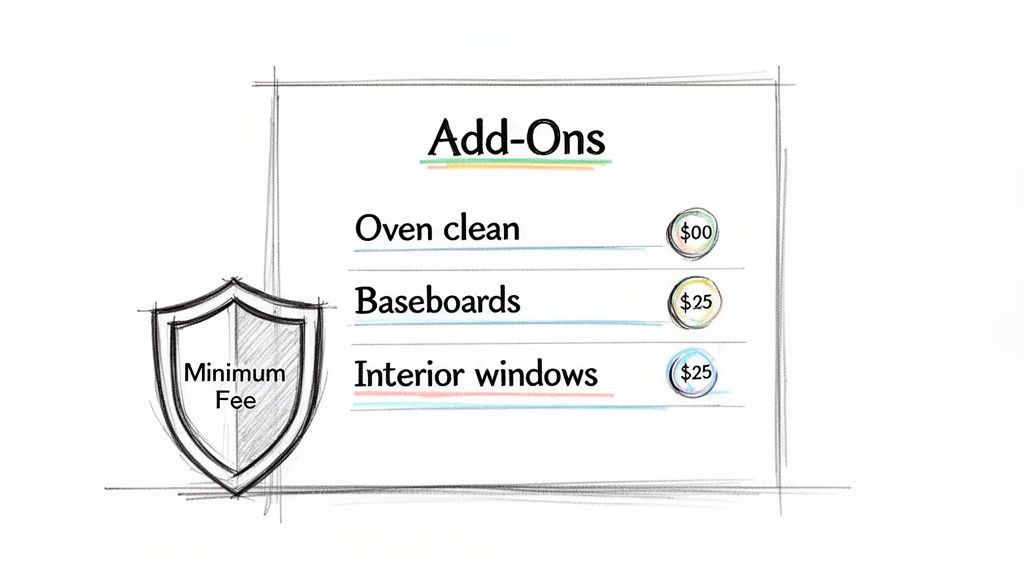
This simple visual menu makes it easy for customers to see the value in upgrading, often turning a basic cleaning inquiry into a higher-ticket job without you lifting a finger.
Setting up modern estimation software is surprisingly straightforward, but the impact is massive. It essentially takes all the pricing logic you have in your head and turns it into a smooth, interactive experience for your customers.
First, you plug in your unique pricing rules. This is where you enter your base rates (whether hourly or flat), your charges per bedroom or square foot, and the cost for all your money-making add-ons like oven cleaning or interior windows.
Then, when a customer visits your site, the AI assistant asks the same qualifying questions you would. It finds out the home size, what kind of cleaning they need, and any extras they're interested in.
The system instantly does the math, applying your rules to the customer’s answers. This means every estimate is perfect and consistent—no more gut-feel pricing or costly miscalculations. Finally, the estimate is sent directly to the customer via SMS and email, while you get a notification with the new lead's details.
This isn't just about saving time. It's about building a professional and scalable system. For anyone struggling with how to set pricing, a smart tool is the final piece of the puzzle. Our deep dive on using a cleaning estimate calculator breaks down just how seamless this can be.
The results speak for themselves:
And if you have a team, this ensures everyone is providing estimates from the same playbook. It creates a consistent brand experience and makes training new hires a breeze. Ultimately, knowing how much you should charge for house cleaning is only half the battle. You have to deliver that price quickly and accurately, and automation is what makes it happen.
Setting your prices feels like walking a tightrope. Price too high, and you scare away customers. Price too low, and you're working for free. It’s a mix of art and science, and it’s completely normal to have questions. Let's tackle some of the most common ones I hear from cleaning business owners just like you.
This is a big one. It's tempting to just slap a price list on your site—say, $150 for a 3-bedroom house—but this is a classic rookie mistake.
Think about it: no two homes are the same. A spotless, minimalist 3-bedroom is a world away from a home with the same layout but filled with clutter, two dogs, and three kids. A static price means you're either overcharging the easy client or, far worse, drastically undercharging and losing money on the tougher job.
The smarter move? Use an interactive booking form. This gives potential clients the instant estimate they're looking for, but the price is based on their specific details—square footage, number of bathrooms, pets, and any extra services they need.
A tool like Estimatty gives you the best of both worlds. The client gets a transparent, instant estimate, and you get the profit protection your business needs by basing every estimate on real data.
Hearing "your price is too high" can sting, and the knee-jerk reaction is to offer a discount. Don't do it. Slashing your price immediately signals that your initial estimate was inflated.
Instead, take a breath and confidently explain the value you deliver.
Try a script like this: "I completely understand it's an investment. Our estimate covers a professional, detailed clean from an insured and reliable team. We also guarantee our work to ensure you're always 100% satisfied with the result."
This simple response shifts the conversation from price to professionalism, quality, and peace of mind. If their budget is a genuine concern, you can then explore other options. Suggest removing an add-on service for now, or talk about the lower per-visit cost of a recurring cleaning plan.
You should be reviewing your entire pricing model at least once a year. This keeps you in line with your local market and, most importantly, protects your profit margins.
However, you can't always wait for an annual review. You need to be ready to adjust your rates any time your core business costs jump.
For example, it's time for a price check if you see:
Waiting too long to account for rising expenses is a fast track to an unprofitable business. And when it comes to raises, keeping your team happy is key. If you need fresh ideas on hiring and retaining great cleaners, resources like the Pipehire blog and articles on estimatty.com/blog offer fantastic advice. Staying on top of your numbers keeps your company healthy and ready for growth.
Ready to stop losing leads and start winning jobs on autopilot? Estimatty gives you an AI-powered sales estimator that delivers instant, accurate estimates to clients 24/7. Turn more website visitors into booked jobs and get your time back. See it in action at https://www.estimatty.com.