
September 29, 2026
Commercial and Residential Cleaning in 2026
Compare commercial and residential cleaning markets in 2026. Explore pricing, staffing, compliance, and how AI estimators streamline operations.

Sunday, May 17, 2026
Learn how to write and send a professional price increase notice for your cleaning business. Get templates, tips, and strategies to retain clients.
.png)
You're probably reading this because the numbers stopped working.
The route is familiar. Payroll is up. Supplies cost more. Fuel doesn't behave. Clients still expect spotless work, reliable arrival times, and fast communication. Meanwhile, you're trying to protect recurring accounts without training customers to think your pricing is negotiable every time your costs move.
That's where a price increase notice stops being an awkward admin task and starts becoming a leadership task. Handled well, it protects margins, keeps service quality stable, and shows clients that your company is run with discipline. Handled poorly, it creates confusion, invites objections, and makes loyal customers wonder what else feels improvised behind the scenes.
Cleaning businesses don't need a dramatic speech when prices change. They need a clear reason, a predictable process, and a communication plan that respects the relationship.
A cleaning owner reviews the month, sees crews working hard, sees clients staying on, and still ends up with less room in the bank than expected. That is usually the moment the pricing problem becomes impossible to ignore.
Many owners treat a price increase like an apology in advance. That mindset weakens the notice before a client ever reads it. Healthy companies adjust pricing because the alternative is predictable. Service standards slip, response times slow down, hiring gets harder, and the owner starts covering gaps personally just to keep accounts stable.

I have seen the same pattern across residential and commercial cleaning companies. Rates stay flat to avoid friction with long-term clients. Then labor costs rise, supply orders come in higher than expected, and small operational leaks start piling up.
Sometimes the leak is obvious, like overtime on a route that no longer fits the original quote. Sometimes it is quieter, like a team spending an extra 15 minutes at a site because the scope expanded months ago and nobody updated the price. I also see owners absorb unpaid text support, key coordination, lockout delays, and after-hours client communication that were never built into the original account margin.
That pattern usually gets mislabeled as customer care. In practice, it is delayed decision-making that pushes the cost back onto the business.
If you have not reviewed your numbers recently, start with the actual cost to deliver the work. A clear review of fixed and variable expenses often shows where margin has been draining out of otherwise good accounts. This guide on how to calculate overhead costs is a good place to tighten that analysis.
Practical rule: A business that never raises prices eventually raises stress instead.
A professional price increase notice signals stability. It tells clients you monitor costs, make decisions early, and intend to keep service quality consistent.
That matters in cleaning because clients are not only buying a clean space. They are buying reliability, trust, follow-through, and fewer surprises. Pricing has to support those outcomes.
It also helps to remember what happens after the notice goes out. Clients reply at night. They ask whether their rate is changing, whether their scope changed, or whether they have options. Owners who answer those questions slowly create uncertainty they did not need. Owners who use automation to send consistent explanations, log responses, and handle routine inquiries 24/7 reduce that risk fast. Tools like Estimatty help turn a price increase from a one-time announcement into a controlled process, which is one reason well-run companies get through pricing changes with less churn and less admin drag.
Before you draft the notice, do the operational work. Owners who skip this step tend to send vague messages, choose the wrong timing, and then get dragged into avoidable negotiations.
A strong price adjustment starts with internal clarity. You should know what changed, why it changed, which accounts are affected, and what client questions are likely to come back to your office.
Start with your profit and loss statement and your service mix. Don't ask, “How much can I get away with?” Ask, “What pricing keeps this account healthy without eroding delivery?”
Look at the cost lines that touch active jobs most directly:
For many owners, this is also the point where inconsistent estimating gets exposed. If similar jobs were priced differently over time, you'll have a harder time explaining changes now. Standardizing estimate logic before a price update makes the conversation cleaner. A cleaning estimate calculator can help you pressure-test whether your current rates still match labor and overhead realities.
The strongest benchmark is to use a contract-driven, predictable adjustment process instead of random one-off changes. Common practice includes annual CPI-based adjustments or a fixed 3–5% yearly update, and the biggest mistakes are vague messaging, too little notice, and failing to connect the increase to service scope or operating costs, as explained in this guidance on telling customers about price increases for cleaning services.
That one point changes the entire tone of the notice. Predictable pricing feels like policy. Ad hoc pricing feels personal.
Pull your active service agreements and check for:
If your current contract says one thing and your email says another, clients will focus on the mismatch instead of the reason for the increase.
The easiest price increase notice to defend is the one that follows terms the client already agreed to.
Timing does a lot of the work. If you announce a rate change during a holiday period, a client's budget review, or the busiest stretch of their operation, your message lands as a disruption.
Better timing usually includes:
Don't rush this part. Owners often lose confidence because they haven't done enough preparation, not because the increase itself is unreasonable.
A client opens your email at 9:30 p.m., sees a new rate, and immediately asks two questions: “What changed?” and “Why now?” If your notice forces them to hunt for the answer, you create avoidable pushback. If it answers both in the first few lines, the conversation usually stays calm.
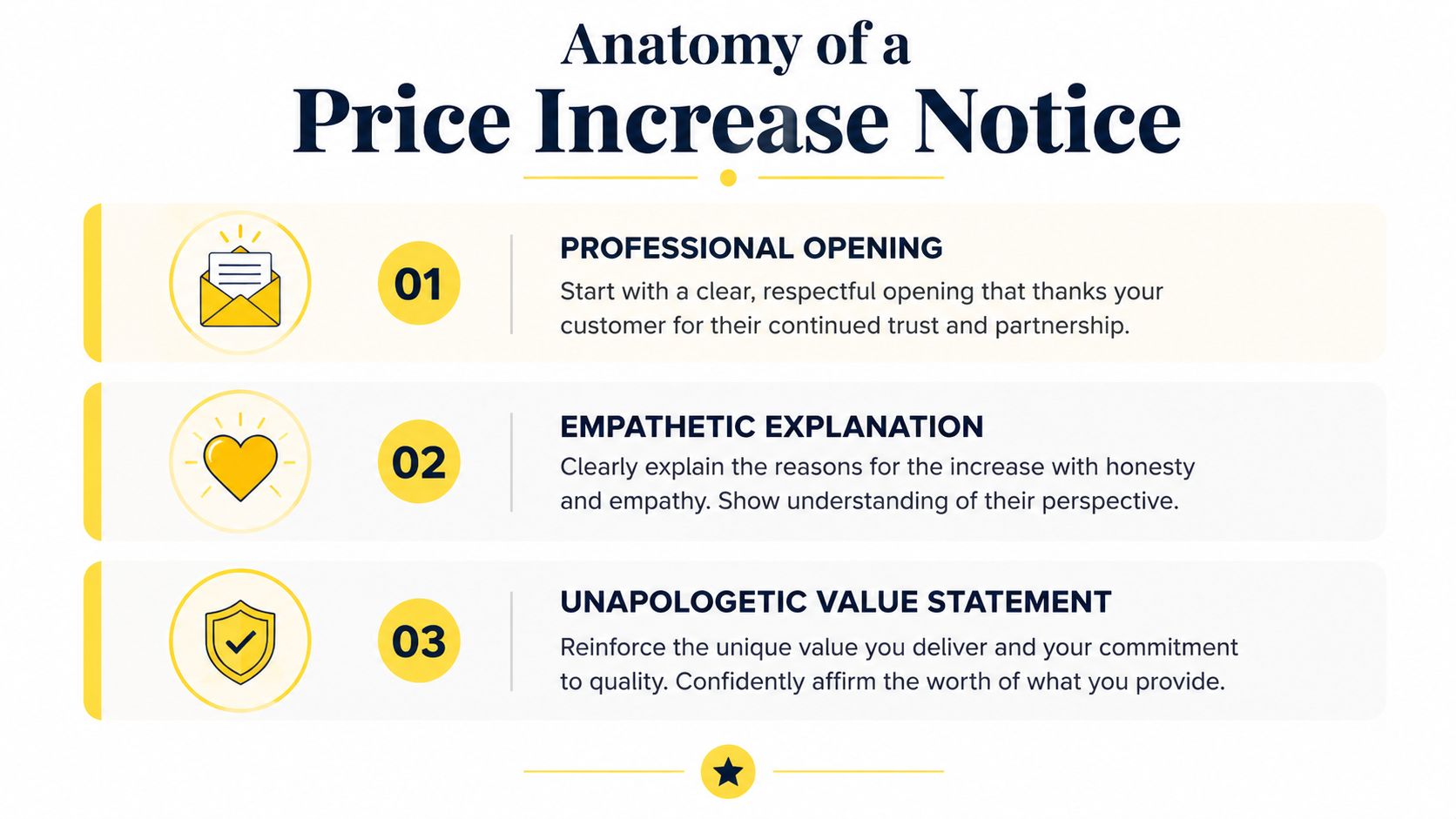
The strongest notices I see are easy to scan and hard to misread.
Start with appreciation. Keep it brief and sincere.
Then state the change with precision. Include the current rate, the new rate, and the effective date in plain language. Clients should not have to infer the number or guess when it starts.
Close by reinforcing what stays consistent: dependable scheduling, trained cleaners, clear communication, and quality control. That gives the client context without turning the message into a long defense of your business.
This section is the part owners often overdo. A client does not need your full cost breakdown. They need a believable business reason stated in one or two sentences.
As noted earlier, broad cost pressure has been real across the economy. For a cleaning company, that usually shows up in wages, supplies, fuel, insurance, and admin time. Tie your explanation to those realities and stop there.
A short reason reads better and creates fewer follow-up questions.
Use language in this range:
Hi [Client Name],
Thank you for trusting us with your cleaning service. Effective [date], your current rate of [current rate] will change to [new rate]. This update reflects higher operating costs and the work required to maintain consistent scheduling, communication, and service quality. We appreciate your business and look forward to continuing to serve you.
This format works for four practical reasons:
Certain phrases create friction fast:
Clarity also reduces admin load. If your message is specific, clients ask fewer repetitive questions. That matters even more when you use automation to support the rollout. A tool like Estimatty can help catch after-hours replies, answer common pricing questions, and keep communication consistent while your team is cleaning, quoting, or off the clock.
If you want a cleaner writing model, study strong service communications like this confirm appointment email example. The same traits apply here: clear subject line, direct wording, and the key details near the top.
A strong notice answers the client's first three questions immediately. What is changing, when does it start, and why is it happening?
The same message lands differently depending on how you send it. In this aspect, many cleaning companies create unnecessary friction. They send a mass email to everyone, including their biggest commercial account and their longest residential client, then wonder why the reaction feels colder than expected.
The better approach is segmented delivery.
A practical workflow is to match the channel to the account size, use phone or in-person communication for larger or long-term clients, use email or letter for smaller accounts, provide 4–6 weeks of advance notice, and avoid sending the message during peak seasons or holidays, according to this operational advice on how to raise cleaning prices. That approach reduces surprise and gives clients time to process the change.
If a client generates substantial revenue or has been with you for years, don't let them discover the increase the same way a low-touch account does. Personal outreach signals respect.
Smaller recurring accounts usually don't need a call unless the relationship is unusually sensitive. A clean written notice is often enough, provided it's specific and sent early enough.
Here's a practical comparison.
| Channel | Best For | Pros | Cons |
|---|---|---|---|
| Most recurring residential clients and routine commercial accounts | Fast, documented, easy to personalize at scale | Can feel impersonal if the account is high-value | |
| Printed letter | Traditional clients, formal commercial accounts | Feels official, useful for contract files | Slower, less interactive |
| Phone call | Large accounts, long-term clients, sensitive relationships | Personal, allows real-time questions | Time-intensive, requires script discipline |
| SMS | Short heads-up after formal notice is sent | High visibility, quick reminder | Too brief for the full message, can feel abrupt if used alone |
Email is the default for a reason. It gives you room to present the new rate, effective date, and rationale in one place. It also creates a searchable record for both sides.
Useful subject lines include:
For certain commercial clients, a printed letter still carries weight. Property managers, facilities teams, and procurement-minded contacts often appreciate something they can file or circulate internally.
Keep the letter short. Formal doesn't mean wordy.
A call is the right move when the client relationship has history, complexity, or high revenue attached to it.
A simple phone script works well:
“I wanted to let you know personally before the written notice goes out. We're updating our service pricing effective [date]. We've worked hard to keep the service consistent, and this adjustment reflects what it takes to maintain that standard. I'm sending the details in writing as well, but I wanted to answer any questions directly.”
That script is firm without sounding rehearsed.
Texting can be useful after the email or letter is sent:
“Hi [Name], we sent an update regarding your cleaning service pricing effective [date]. If you have any questions, reply here and we'll help.”
Short. Respectful. No surprises.
If you want one process that fits most cleaning businesses, use this:
For businesses that struggle with missed calls and uneven follow-up, systems matter here. A virtual receptionist for small business setup can help keep client communication consistent when reactions start coming in all at once.
Even a well-written notice won't prevent every objection. Some clients will push back because they're under budget pressure. Some will test whether your price is flexible. Others just want to be heard before they decide what to do.
That doesn't mean the notice failed.

A useful reality check comes from consumer behavior. In a 2025 PwC survey, 60% of consumers said rising prices were their top concern, 50% said they were trading down to cheaper alternatives, and 46% said they had reduced spending on non-essential items, as summarized in this price increase notice guide discussing the survey. Clients are often reading your notice while already feeling financial pressure.
Don't argue. Don't over-explain. Don't immediately offer a discount.
Use a response pattern like this:
That keeps the conversation professional and controlled.
If a client says your price is too high, they're not always rejecting your service. Often they're asking you to help them fit it into their budget.
Many owners give up margin here that they didn't need to lose. Instead of cutting the rate, adjust the package.
Examples include:
Those changes preserve your pricing integrity while still helping the client stay with you.
A short explainer can also help your team keep a steady tone during objection calls:
A brief FAQ attached to your email or available to office staff can prevent the same conversation from repeating all week.
Include questions like:
That last point matters more than most owners expect. Clients don't judge pricing changes only by the number. They judge them by how easy it is to get a straight answer.
The notice isn't the end of the process. It's the start of a response cycle.
Clients open the email at night. They reply on weekends. They call while your team is in the field. If nobody answers clearly and consistently, a reasonable price adjustment starts to feel disorganized. That's why the final stage isn't more wording. It's operational follow-through.
Automation closes the gap that older advice ignores. Most guides tell you to send the notice and be available for questions. That sounds simple until ten clients ask the same question across web chat, voicemail, email, and text.
There's a strong case for using an always-on assistant here. HubSpot's 2025 State of Marketing report found that 75% of marketers already use AI, a sign that instant automated communication has become normal, as noted in this article on telling clients about a price increase. For cleaning companies, that means an AI assistant handling pricing FAQs outside business hours isn't a novelty. It's a practical service layer.
A useful system can:
That last point is the key advantage. Automation shouldn't replace judgment. It should absorb repetition so your team can focus on high-value conversations.
If you're evaluating tools that support cleaner, faster estimating and more consistent customer communication, this overview of AI estimates software for cleaning is a practical place to start. For broader operations and hiring workflow ideas, many cleaning teams also explore articles on get.pipehirehrm.com/blog.
A disciplined price increase notice protects revenue. A disciplined response system protects trust.
If you want a cleaner way to standardize estimates, handle pricing questions around the clock, and give prospects and clients fast answers without adding headcount, take a look at Estimatty. It helps cleaning businesses deliver consistent estimates, reduce missed opportunities, and support a more professional pricing process from first inquiry to follow-up.