March 30, 2026
Game-Changing Content Ideas Social Media Will Love for Your Cleaning Biz in 2026
Boost your cleaning business with 10 game-changing content ideas social media platforms will love. Attract more clients in 2026!

Tuesday, March 31, 2026
Learn how to start a commercial cleaning business with this expert guide. Get actionable strategies for planning, pricing, hiring, and landing clients in 2026.

So you want to start a commercial cleaning business? Smart move. But before you stock up on supplies, let's talk strategy. Success in this game comes down to a few key moves: having a rock-solid business plan, getting your legal and insurance ducks in a row, mastering your pricing, building a great team, and knowing how to market and sell your services.
It all starts with the plan.
Don't even think about winging it. Launching a cleaning business without a plan is like trying to clean a high-rise with a single feather duster—a complete waste of time and energy. Your business plan is more than just a document for a loan officer; it's your personal roadmap. It’s what separates the pros who build lasting empires from the startups that fizzle out in a year.
First things first, you need to decide who you want to serve. "Cleaning buildings" isn't a niche. Getting specific right from the jump is a power move. While cleaning general office space is a fine place to start, specializing is where the real money and reputation are made.
Think about carving out a niche for yourself. Here are a few ideas that are always in demand:
Once you've picked a potential niche, it's time to see if it has legs. Market research isn't about creating stuffy reports; it's about getting answers. Who's already cleaning the medical offices in your town? What are their weaknesses? A quick search might reveal a string of bad reviews or an outdated website. Those are your openings.
Get in your car and drive around your target service area. Look for what's being built. A brand-new industrial park or a cluster of medical buildings going up is a gold mine waiting to happen. As you start, a resource like this guide to starting a business in Connecticut can be incredibly helpful for understanding the legal side of things, no matter where you're located.
A business plan isn't a "set it and forget it" document. It's a living, breathing guide that you should revisit every quarter. It will help you make smarter decisions on everything from who to hire to where to spend your marketing budget.
You're tapping into a massive opportunity. The global cleaning services market is set to hit an incredible $633 billion in 2026. The U.S. market alone makes up a huge $90 billion of that pie. There's more than enough work to go around.

Look at the sheer scale of this industry. Even carving out a small piece of your local market can build a seriously successful company.
Finally, your plan needs to get down to the brass tacks: the money. You need to map out your startup costs, set ambitious but achievable revenue goals, and project your cash flow for at least the first year.
Before you can determine your profitability, you have to understand your initial investment. The table below gives you a general idea of what to expect and how your chosen niche might affect these costs.
Startup Costs and Potential Service Niches
| Expense Category | Estimated Cost Range | Impact of Niche (e.g., Office vs. Medical) |
|---|---|---|
| Legal & Registration | $300 - $1,500 | Generally consistent across niches; some specialized permits may add minor costs. |
| Insurance (Liability/Bond) | $500 - $2,500 (annual) | Higher for high-risk environments like medical facilities or industrial sites. |
| Equipment & Supplies | $2,000 - $10,000+ | Medical or food-grade cleaning requires specialized (and pricier) equipment and chemicals. |
| Marketing & Branding | $500 - $5,000 | A professional website and initial ad spend are crucial for attracting high-value clients. |
| Initial Operating Capital | $3,000 - $15,000+ | Essential to cover expenses for the first 3-6 months before cash flow is steady. |
These figures are a starting point. A medical cleaning niche will demand a higher upfront investment in specialized gear and insurance compared to general office cleaning, but it also comes with much higher profit margins.
Be brutally honest when you map this out. Don't forget anything:
Your business plan is also the perfect place to define your brand. It’s never too early to think about your company's name, logo, and message. For a masterclass in standing out, check out our guide on branding for cleaning services.
Putting in this work now ensures you hit the ground running not as just another startup, but as a serious contender ready to build a business that lasts.

It’s easy to think that starting a cleaning business is just about buying some supplies and landing your first client. But before you even think about mopping a floor, you need to build a fortress around your company. This isn't about boring paperwork—it's about protecting yourself and everything you own from the risks that come with running a business.
The first big decision on your plate is how to legally structure your company. This one choice impacts everything from your personal liability and taxes to the day-to-day admin work you'll be handling.
This is the legal DNA of your company. For most new cleaning business owners, it boils down to two main options: a Sole Proprietorship or a Limited Liability Company (LLC).
Sole Proprietorship: This is the quickest and cheapest route. The law sees you and your business as the same entity. While that sounds simple, it comes with a massive catch: zero personal liability protection. If your business gets sued, your personal assets—your home, your car, your savings—are all on the line.
Limited Liability Company (LLC): An LLC is a game-changer. It creates a legal wall between you and your business, meaning your personal assets are generally safe from business debts and lawsuits. It costs a bit more to set up and involves some extra paperwork, but that protection is priceless for any serious entrepreneur.
Honestly, forming an LLC is one of the smartest first moves you can make. It tells potential clients you're a professional, makes getting loans easier, and most importantly, lets you sleep at night knowing your personal finances are secure.
Most states, like Georgia and Texas, let you register your LLC online with the Secretary of State. And if you plan to operate under a catchy trade name, you'll likely need to file a "Doing Business As" (DBA) certificate with your local county clerk's office.
Do not—I repeat, do not—try to save money by skimping on insurance. One bad accident without the right coverage can sink your entire business before you’ve even started. When sorting out your legal setup, getting comprehensive contractor insurance is an absolute must.
Here's the bare minimum coverage you need to have in place:
General Liability Insurance: This is your shield. It covers you if an employee breaks a client's window or spills a chemical that ruins an expensive carpet. It also protects you if a visitor slips and falls on a floor you just mopped. In fact, most commercial clients won't even consider hiring you without proof of this policy.
Workers' Compensation: As soon as you hire your first employee, you'll almost certainly need this. State laws typically require it. This insurance covers medical bills and lost wages for any employee injured on the job. Don't wait until you have a full crew; get this sorted out early.
Janitorial Bond (Surety Bond): While not technically "insurance," clients see it as just as vital. A janitorial bond protects your clients from theft by one of your employees. It's a huge trust signal and a powerful selling point that can help you win bids against less-prepared competitors.
We dive deeper into the nuts and bolts of coverage in our detailed guide on liability insurance for cleaning companies.
Finally, you need to make sure you're playing by the local rules. While most states don't require a special "cleaning license," nearly every city and county does.
Your first stop should be your local city hall or chamber of commerce. Ask about a general business license or what's sometimes called an occupational tax certificate. These rules can change from one town to the next, so you have to do your local homework.
Depending on the services you offer, you might even need special permits for things like disposing of certain cleaning chemicals. Getting all your licenses in order from day one builds a solid foundation, giving you the peace of mind to go out and grow your business with confidence.
Let's be honest: getting your pricing right is where you either build a thriving business or run yourself into the ground. It’s the single most critical piece of the puzzle. If you price too high, you’ll constantly get underbid. But price too low, and you'll find yourself working for peanuts, wondering why you ever started. This is where we move past guesswork and build a pricing strategy that actually makes you money.
You first need to get a handle on the three fundamental ways commercial cleaning jobs are priced. Each has its place, and a seasoned pro knows exactly when to use which one.
There's no magic bullet for pricing every job. The best method really depends on the client's needs, the type of facility, and what you’re trying to achieve with your business.
By the Hour: This is as straightforward as it gets. It’s perfect for one-off projects or clients who have a scope that might change. The big catch? You get punished for being good. The more efficient your team becomes, the less money you make on the job. It's a tough model to scale.
By the Square Foot: This is the industry-standard for a reason, especially for ongoing contracts in offices, retail stores, or any large building. It creates a predictable, consistent pricing structure that makes bidding on jobs much, much easier.
Flat-Rate Pricing: Here, you charge a single, fixed fee each month for a clearly defined set of services. Clients absolutely love this because it gives them budget certainty, and it's fantastic for building reliable, recurring revenue. The key is that you have to be a master at estimating your true costs to offer a flat rate without losing your shirt.
For anyone just starting out, I almost always recommend beginning with a square footage model. It forces you to standardize your rates and ensures you're paid fairly for the actual size of the space you’re responsible for.
The most profitable cleaning companies I've seen blend these models. They'll often use a square-foot rate to figure out their internal costs and then present the client with a simple, clean flat-rate monthly price. The client gets the simplicity they want, and you know your numbers are solid.
Theory is great, but let's put this into practice. We'll walk through a bid for a typical 5,000-square-foot office that needs cleaning three times per week.
First, figure out your Production Rate. This is just a fancy term for how many square feet one person can realistically clean in an hour. For a standard office, a good benchmark is between 2,500 to 3,500 square feet per hour. We’ll use 3,000 for our math.
Next, calculate the time on-site.
Then, get your total monthly hours.
Now, let's talk about the money. This is where you cover your costs and build in your profit.
Putting it all together for your monthly price:
You can't just add percentages to your labor cost—that's a classic mistake. You need to "back-in" your margins to find the correct final price.
That $651.00 is your target. You can confidently go to the client with a flat-rate proposal of $650 per month, knowing every single cost is covered and your profit is already baked in.
As you can see, there’s a real method to the madness. For a deeper look at the strategy behind this, our guide on crafting winning cleaning service estimates provides even more templates and examples.
Now, imagine going through that calculation for every single lead who calls or emails. It's a huge time-suck and easy to mess up when you're in a hurry. This is exactly why savvy cleaning businesses in 2026 are automating this process.
Tools like Estimatty put an AI-powered estimator right on your company's website. A potential customer doesn't have to fill out a boring "contact us" form and wait for you to call back. Instead, they can get a precise, professional estimate sent to their phone and email in less than a minute, any time of day or night.
This completely automates the top of your sales funnel. The AI asks all the right qualifying questions—square footage, type of facility, how often they need service—and runs the numbers instantly based on the pricing rules you've already set. You get a hot, qualified lead who already knows the price, and the customer gets the immediate answer they're looking for. It’s a powerful way to capture leads and close deals while you’re out running the rest of your business.

Let’s be honest. Killer marketing and a sharp pricing model will get you in the door, but it’s your people and your process that will keep you there. These are the twin engines that drive your company's reputation and growth. If your team is unreliable or the cleaning quality dips, you’ll be out of a contract faster than you can say “cancellation clause.”
Building an A-team and bulletproof systems isn’t just good business; it’s the only way to deliver the kind of five-star results that make clients happy to renew, year after year.
When you're starting out, the urge to hire the first warm body who walks through the door is immense. Don't do it. A single bad hire can poison your team's morale and, worse, jeopardize a lucrative contract you worked hard to win.
As you gear up to take on more work, finding reliable staff quickly becomes your number one job. While you can toss a job ad onto a generic board, be prepared for an avalanche of résumés from people who aren't a good fit. It’s a huge time-sink.
A much savvier move is to use platforms that are actually built for our industry. A service like pipehirehrm.com, for instance, is designed to connect cleaning business owners directly with experienced, pre-vetted cleaning pros. It helps you cut through the noise and find people who already get what commercial cleaning is all about.
During interviews, I focus on a few key things:
Hiring the right people is just step one. You've also got to manage the process without losing your mind. You might be interested in how an applicant tracking system can help you organize candidates and simplify your workflow from day one. You can also find great hiring resources at get.pipehirehrm.com/blog.
Hire for attitude and train for skill. You can teach someone the right way to mop a floor, but you can't teach them to take pride in their work. That's something you have to find.
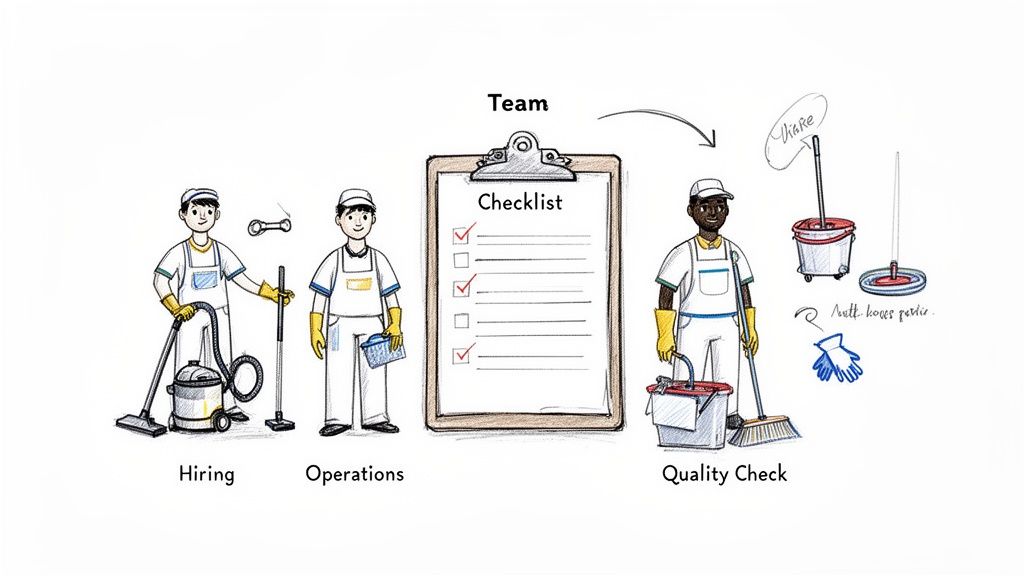
Once you've got your crew, you need a system. A system ensures that every clean is a great clean, whether it's your most seasoned veteran or a new hire on the job. This is where your Standard Operating Procedures (SOPs) come into play.
Forget the stuffy corporate jargon. An SOP is just a detailed checklist for every type of space you service. It’s your playbook for quality. For an office building, for example, your checklist should break down every task.
Sample Office Cleaning Checklist
| Area | Task | Frequency |
|---|---|---|
| Main Office | Empty all trash & recycling bins | Daily |
| Vacuum all carpeted areas | Daily | |
| Dust all horizontal surfaces | Daily | |
| Sanitize high-touch points (light switches, door handles) | Daily | |
| Restrooms | Clean and sanitize toilets & urinals | Daily |
| Restock paper towels, toilet paper, and soap | Daily | |
| Mop and disinfect floors | Daily | |
| Kitchen/Breakroom | Wipe down countertops and tables | Daily |
| Clean microwave interior and exterior | Daily | |
| Mop floor | Daily |
Checklists like these take the guesswork out of the equation and establish a clear standard for your service. This is your quality control, your guarantee that every client gets the same impeccable result, every single time. Systemizing your work is absolutely critical if you're serious about scaling your commercial cleaning business.
Your cleaners are only as effective as the tools you provide. This is not the place to cut corners. Investing in proper commercial-grade equipment is non-negotiable—that cheap vacuum from a big-box store simply won't hold up to the rigors of nightly use.
You’re entering a massive field; the cleaning industry employs over 3 million people in the U.S. alone. And if you’re thinking about a specialty, commercial floor and carpet care is a smart bet. It’s a niche projected to swell into a $20.46 billion market between 2020 and 2030. You can dig into more industry stats and read about this powerful growth in cleaning services to see the opportunity for yourself.
Here's my advice on where to spend your money upfront and where you can afford to wait:
Building a stellar team and efficient operations isn't a one-and-done project. It’s a constant process of refining and improving. But by focusing on quality people, standardized processes, and the right tools from the start, you're building a powerful engine for a profitable and respected commercial cleaning business.
You’ve done the heavy lifting—your business is legal, your pricing is sharp, and you have a solid plan for your operations. Now for the fun part: getting paid. Winning those first few commercial accounts is what turns your business from an idea into a real, cash-flowing company. This is where you start building momentum.
Landing these initial clients requires a smart blend of modern digital marketing and good old-fashioned sales hustle. It’s all about being visible where potential clients are actually looking and being ready to make a killer impression when they find you.
Let’s be honest: in 2026, your website is your most valuable sales tool. It’s your digital storefront, your marketing brochure, and your best salesperson, working 24/7. A cheap-looking, unprofessional website will actively scare away the exact high-value commercial clients you’re trying to land. For more tips, visit the estimatty.com/blog.
Your site needs to be clean, professional, and dead simple to navigate. It should immediately tell visitors what you do and who you serve. Use professional photos of your team or work (please, avoid generic stock photos), clearly list your services, and make it incredibly easy for a facility manager to request an estimate.
This is your chance to turn your website from a static pamphlet into a lead-generating machine. By putting an AI-powered tool like Estimatty on your site, you’ve essentially hired a tireless sales agent. Instead of making a busy property manager fill out a clunky form and wait for you to call back, you can give them an instant, professional estimate on the spot.
The company that responds fastest often wins the job. An instant estimator engages prospects the moment they're interested, capturing their details and delivering a customized estimate before your competitors have even checked their email.
This instant response gives you a massive advantage. It qualifies your leads automatically, freeing you up to focus your energy on drafting proposals and closing deals with people who are already warmed up and have a clear idea of your pricing.
Once you have a hot lead, the proposal is your moment to shine. A winning proposal doesn't just state a price; it sells a complete solution to the client's problems. It should be a tangible reflection of the value you deliver, reassuring them that you are the most professional and reliable choice.
Never, ever just email a number. You need a polished, branded document that lays it all out.
Think of this document as a direct reflection of your company's professionalism. Take the time to make it look sharp.
While a strong online presence is non-negotiable, don't ever underestimate the raw power of face-to-face connection. In the B2B world, relationships are everything.
Your ideal first clients are probably right in your own backyard. Start by strategically building connections with people who manage properties or hold the purse strings.
Building a sales pipeline takes consistent effort, but a multi-channel approach is the fastest way to get your business off the ground. For a deeper playbook of ideas, our guide on how to effectively advertise cleaning services is packed with actionable strategies. By combining a powerful website with proactive, real-world networking, you’ll build the client roster that launches your business toward long-term success.
Even the best business plan can't prepare you for every question that pops into your head at 2 AM. Let's tackle some of the biggest hurdles I see new owners wrestle with, clearing the air so you can move forward with confidence.
This is the big one, and the real answer is that your startup cost is tied directly to your ambition. You can absolutely get a lean, home-based operation off the ground for $3,000 to $5,000. That'll cover the essentials—your LLC formation, initial insurance policies, a solid set of commercial-grade supplies, and a basic marketing kit with a simple website and business cards.
But if you’re looking to make a bigger splash from day one, that number will climb. Thinking about a branded vehicle, hiring a crew immediately, and investing in heavy-duty equipment like floor scrubbers or carpet extractors? You could easily be looking at costs north of $20,000.
A piece of advice I give everyone, regardless of budget: Have at least six months of operating expenses tucked away in a business bank account. This is your lifeline. It lets you cover costs and even pay yourself before your client revenue smooths out into a predictable stream.
General office cleaning is your bread and butter—it’s consistent, and the work is everywhere. But if you're chasing higher profit margins, specialization is the name of the game. Just know that more profit usually means more training, bigger investments, and stricter rules.
Some of the most lucrative fields to get into are:
My advice for new owners? Start by mastering a specific type of local business—like all the fitness centers or private schools in your area. You’ll build a powerful reputation and a solid portfolio before branching out into more complex services.
Moving from cleaning homes to servicing businesses isn't just a step up; it's a completely different ballgame. You're shifting from a B2C model to a B2B world of contracts, after-hours work, and longer sales cycles.
To make that leap successfully, you have to get serious about your entire operation.
Start by targeting smaller local businesses, like retail shops or independent offices. Use those first few contracts to build your commercial portfolio and collect powerful testimonials before you start chasing the bigger fish.
Absolutely. In fact, most of the biggest names in this industry started out as a one-person show. As a solo owner-operator, you can comfortably handle a roster of several small to medium-sized accounts—think local law firms, insurance agencies, or small retail stores.
Starting this way has huge advantages. Your overhead will be almost zero, and you'll be forced to master every single aspect of the business, from closing deals to perfecting the cleaning routine. You become your own best form of quality control.
But you will hit a growth ceiling. You can't expand your business without eventually building a team. The trick is to plan for that from day one. Systematize everything. Create meticulous cleaning checklists and a streamlined client onboarding process. That way, when you're finally ready to hire, you have a proven system to hand off. When that time comes, check out resources like the pipehirehrm.com blog for tips on finding reliable people in the cleaning industry.
Ready to turn leads into signed contracts without spending all your time creating estimates? Estimatty acts as an AI-powered sales agent for your business, living on your website and phone line to give potential clients instant, accurate estimates 24/7. It qualifies your leads, answers their questions, and tees up hot, ready-to-close deals directly to you, freeing you up to build your empire. See how Estimatty works.