September 21, 2026
Inside and Out Cleaning: A Practical Pricing Guide
Learn what inside and out cleaning really includes, how pricing works, and which add-ons actually pay off for residential and commercial estimates.

Wednesday, March 25, 2026
Stop losing leads. This guide shows you how to build a home cleaning cost calculator that turns website visitors into booked jobs, instantly.
.png)
Let’s be honest for a second. Is your website still telling potential customers to "call for an estimate"? If it is, you're not just being old-fashioned—you're actively losing money every single day. A home cleaning cost calculator isn't a luxury; it gives people the instant, straightforward pricing they expect and turns those casual website visitors into confirmed jobs, 24/7.
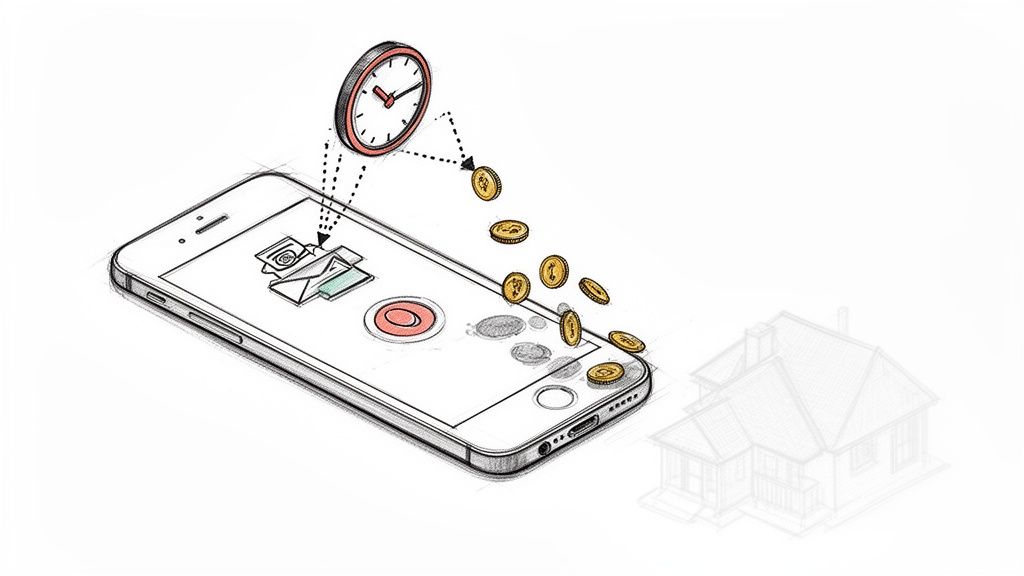
Think about your own buying habits. When you want something, you want a price now. Your customers are no different. Every hour you make someone wait for an estimate is an hour they can—and will—spend finding a competitor who gives them an immediate answer.
This delay is a silent killer for cleaning businesses. Your ideal customer isn't just browsing from 9 to 5. They're looking for help after putting the kids to bed or during a late-night work break. If they land on your site at 10 PM, they won't leave a voicemail and wait. They'll just click over to the next company on the list.
Beyond being slow, manual estimates are a recipe for inconsistency. When you or your staff are just "guesstimating" based on a phone call or a vague email, you open the door to all sorts of problems.
It’s a tightrope walk you can’t win:
A home cleaning cost calculator takes the guesswork out of the equation. It runs every inquiry through the same proven formula, ensuring every lead gets a fair, consistent price based on their specific details. This isn't just about looking professional; it’s about protecting your bottom line. Just look at how one company saw their sales double after they made the switch.
To see this in action, let’s break down the real-world differences between sticking with the old way and embracing automation.
The table below reveals the stark difference in business outcomes between traditional manual estimating and using an automated home cleaning cost calculator. The numbers don't lie.
| Metric | Manual Estimating (Forms/Phone) | Automated Calculator (Estimatty) | Impact on Business |
|---|---|---|---|
| Lead Capture Window | 8-10 hours/day (business hours) | 24/7/365 | Capture 60-70% more leads from after-hours browsers |
| Response Time | 2-24 hours | Instant (under 60 seconds) | Eliminates lead drop-off and competitor shopping |
| Pricing Consistency | Varies by employee/mood | 100% consistent, formula-based | Prevents underbidding (lost profit) and overbidding (lost jobs) |
| Admin Time per Lead | 10-15 minutes | 0 minutes | Frees up hours of your day for growth-focused activities |
| Conversion Rate | Low (around 5-10%) | High (often 25-40%+) | Drastically increases booked jobs and revenue from the same web traffic |
As you can see, the "cost" of manual estimating isn't just about the time you spend on the phone. It's about the tangible revenue and market share you lose by not meeting modern customer expectations.
A major blind spot for cleaning businesses is the sheer volume of after-hours leads. As many as 60-70% of potential customers browse and inquire outside of typical 9-to-5 business hours, a window where manual estimating processes completely fail.
The demand for professional cleaning services isn't just growing; it's exploding. The market was valued at an incredible $451.63 billion in 2025, and it's only climbing from there. North America represents a massive slice of that pie, meaning the opportunity for your business is right there for the taking.
But you can't capture that growth by playing phone tag. While you're stuck in an endless back-and-forth of emails and voicemails, your competitors with automated systems are booking the jobs you're missing.
Putting an estimator on your site isn’t a small tweak. It's the single most powerful move you can make to plug the leaks in your sales process and finally start scaling your business effectively.
A profitable estimate starts with asking the right questions. Your home cleaning cost calculator is only as smart as the information you feed it, and frankly, relying on just square footage is a rookie mistake that will absolutely torch your profit margins. To give customers an estimate you can actually stand by, your calculator needs to dig deeper.
This isn't about guesswork; it's about building a data-driven pricing machine. When you get this right, the price you provide is fair for the client and consistently profitable for your business.
Square footage gives you a starting point, but it barely scratches the surface. Think about it: a 1,500 sq. ft. condo with one bathroom is a totally different job than a 1,500 sq. ft. townhome with three bathrooms and a playful golden retriever. The real work is always in the details.
At a minimum, your calculator needs to gather these core inputs:
These three inputs are the foundation of a reliable estimate. They immediately give your calculator a much clearer picture of the job than square footage alone ever could.
Once you have the basics, you need to understand how the client lives in their home. This is where you can separate a straightforward clean from a serious challenge. Two homes with the exact same layout can require wildly different amounts of work.
The biggest mistake I see new cleaning services make is assuming all homes are maintained equally. A home with two large dogs and three young children will always be a bigger job than a single professional's apartment, even if they have the same number of rooms.
To price for reality, your calculator should gently ask about:
Gathering this info is how you prevent your team from walking into a job that was drastically underestimated. It protects their morale and your bottom line. For more on this, check out blogs like estimatty.com/blog or get.pipehirehrm.com/blog for articles like how to transition from in-home estimates to online estimates.
Finally, a "clean" isn't just a "clean." Your calculator must let customers choose exactly what they're looking for. This is where you define your services, tie them directly to your pricing, and create clear opportunities to upsell.
Your service levels should be crystal clear:
By building these specific inputs into your calculator, it becomes more than a simple price tool. It’s a powerful machine for qualifying leads and scoping jobs accurately—so you can win the work and get paid what you’re worth.
Okay, you've figured out what information to collect from your customers. Now for the important part: turning those details into an instant, accurate price. This is where the engine of your home cleaning cost calculator comes to life. Forget scribbling on notepads or pricing based on a "gut feeling." A solid set of formulas gives you predictable revenue and shows your customers you're a professional who values transparency.
Let's walk through the classic pricing models you've probably heard of, and I'll show you why a hybrid approach is what the most successful cleaning businesses actually use.
Every owner has their preferred method, but each one has some serious blind spots if you rely on it alone. Understanding these is the key to building a calculator that doesn't leave money on the table.
While each of these has a time and place, none of them are a complete solution. The real magic happens when you blend them together.
This is the kind of flow you're aiming for—from gathering the basic home details to layering in the specific rooms and high-value add-ons that drive your revenue.
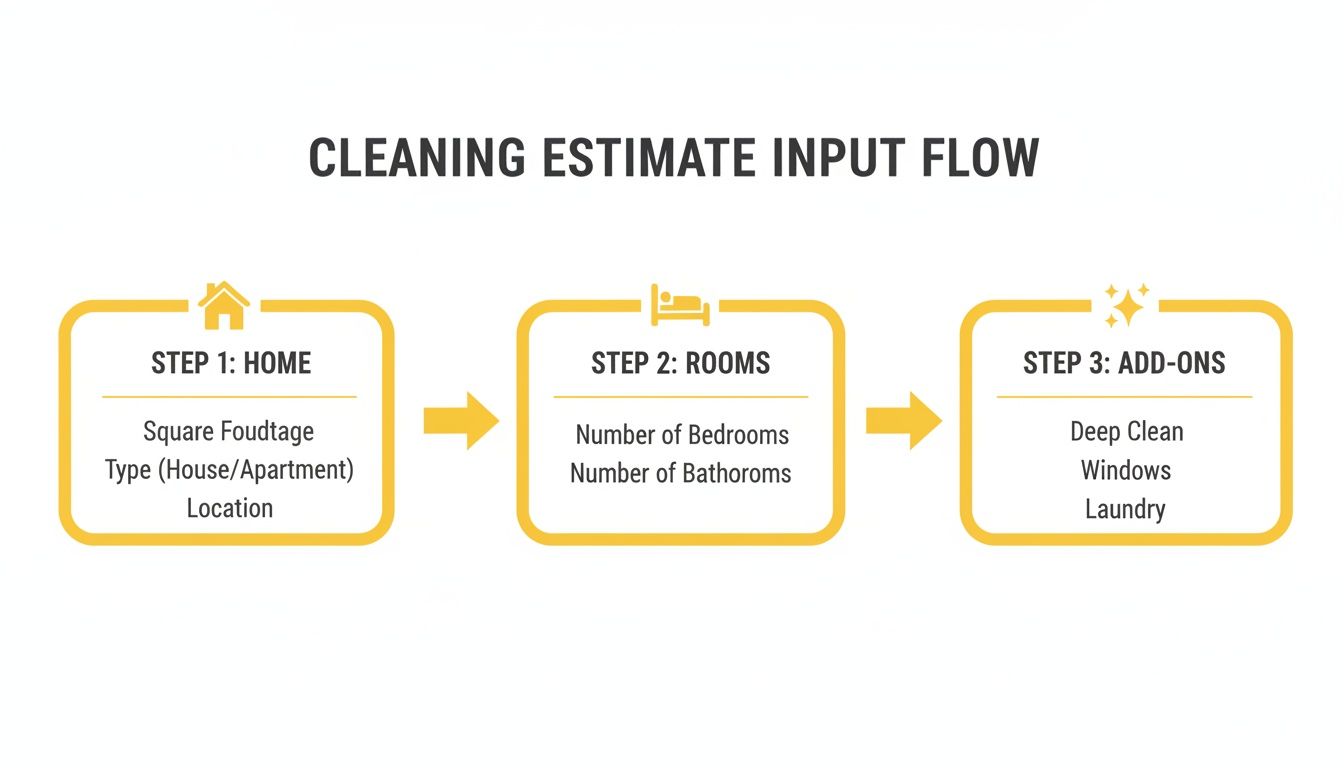
This simple, three-part process is what allows your calculator to gather all the variables it needs to generate a truly reliable automated estimate.
Here’s the secret sauce for a killer online estimator: a hybrid formula. It gives you the consistency of a flat rate but adds in the smart, detail-oriented adjustments that protect your profits. It's truly the best of all worlds.
Let’s look at a practical formula you can tweak for your own business:
Base Rate + (Variable A) + (Variable B) + (Add-on C) = Final Estimate
This might look simple, but it's incredibly powerful. Let’s put some real numbers to it. Say your Base Rate is $150 for a standard clean in any home up to 1,500 sq. ft., which includes two bedrooms and one bathroom.
Your calculator's logic would then instantly build on that foundation:
So, when a potential customer with a 3-bedroom, 2-bathroom home requests a deep kitchen cleaning, their instant estimate would be: $150 (Base) + $25 (1 extra bed) + $40 (1 extra bath) + $50 (kitchen add-on) = $265.
This hybrid model gives the client a specific, justifiable number right away. They can see exactly how the total was built, which establishes trust from the very first click.
The most profitable cleaning companies don't just guess their prices; they engineer them. A hybrid formula ensures you're compensated for every variable—from extra bathrooms to that last-minute oven cleaning request—without having to haggle or absorb costs.
Of course, a formula is useless without the right numbers behind it. To set your rates, you have to know your costs cold and build in a profit margin that actually lets your business grow. It all starts with labor, which will always be your biggest expense.
When you're figuring out your hourly labor rate, you can't just pick a number out of thin air. You've got to factor in wages, payroll taxes, insurance, and any benefits you offer. Getting this right is crucial for hiring and keeping good people. Platforms like pipehirehrm.com can be a great resource for finding cleaning employees and understanding local wage trends.
Once you know your true cost per hour, you can build your pricing. A good rule of thumb in this industry is to aim for a 20-30% net profit margin. So, if your total cost for a job—including labor, supplies, and overhead—is $100, you need to be charging somewhere between $125 and $145 to keep the business healthy.
Finally, once you have your calculator's logic built, do a little opposition research. See what your top local competitors are charging. You don't have to be the cheapest—in fact, you probably shouldn't be—but you need to know where you fit in the market. This allows you to confidently justify your price with the superior quality and convenience you're offering. For a much deeper look at the numbers, our guide on how to price cleaning jobs effectively will help you dial everything in perfectly.
Let's be honest: standard cleanings pay the bills. They keep your schedule full and your team busy. But the real money? That comes from the high-margin add-ons that solve bigger problems for your clients.
When you build these upsells right into your online cost calculator, you're doing more than just giving an estimate. You’re turning a simple form into your best salesperson. A customer building their own estimate is already telling you they want to buy. This is the perfect time to show them everything you can do for them.
Stop thinking about basic dusting and vacuuming. The services that take a little more elbow grease, specialized supplies, or a specific skill set are where your highest profit margins are hiding. Your calculator should make adding these services an absolute no-brainer for the customer.
Think about the tasks homeowners hate doing themselves:
Here’s a pro tip: when a customer selects a "Deep Clean" for their kitchen, have your calculator automatically suggest adding an oven or refrigerator cleaning. You're not being pushy; you're anticipating their needs and offering a simple, pre-priced solution.
Deep cleaning isn't just another add-on; it's a premium service that can become one of your biggest money-makers. These jobs are tougher, sure, but they also command a much higher price tag.
The market for deep house cleaning is exploding, with projections set to hit $11,980 million by 2025. You can often price these jobs 50-100% higher than a standard clean. The problem is, without a solid system, many owners guess at the price and end up underbidding by 15-25%. A good calculator eliminates the guesswork and stops that profit from leaking out of your business.
When you sell a deep clean, you're selling a total transformation. A well-built calculator ensures you price that transformation correctly every single time, turning a risky gamble into a reliable source of income.
To make sure your deep cleans are truly top-tier, you need a solid game plan. Our professional deep cleaning checklist is a great resource to make sure you're covering all the bases and blowing your clients away.
Of course, not every job is straightforward. Your calculator has to be smart enough to handle the curveballs, protecting your time and your bottom line.
Two of the most common exceptions are out-of-area travel and post-construction cleanups.
Travel Fees for Far-Flung Jobs: If a client is outside your normal service area, your calculator should automatically add a travel surcharge based on their zip code. This covers the extra gas and drive time that isn't billable. Just make sure it’s listed clearly on the estimate so there are no surprises.
Post-Construction Messes: This is a beast of a job. It's not a deep clean; it's a specialized project that involves getting fine dust out of every nook and cranny. Instead of trying to provide an estimate automatically, your calculator should flag it and prompt the user to "Request a Custom Estimate." This gives you a chance to see the site and price the massive scope of work properly.
By building these rules into your system, your calculator works around the clock to filter and price jobs the right way. That means when your crew—sourced from a great platform like Pipehire—shows up, the job is exactly what they expected and priced for profit from the start.
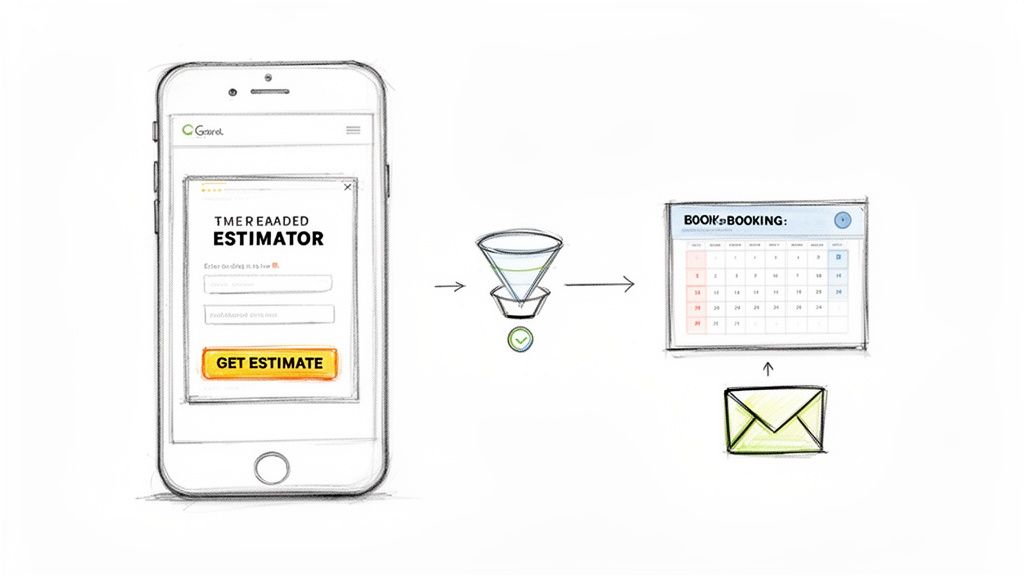
So you've built a smart, accurate calculator that spits out perfect estimates. That’s the hard part done, right? Not quite. A brilliant pricing engine is useless if it's hidden away. How and where you place your home cleaning cost calculator is the real secret to turning website visitors into paying customers.
Think of your calculator as your best employee. It’s ready to work around the clock to close deals for you, but you have to put it in front of the right people. Let's make sure it's not stuck in the back office.
Your estimator needs prime real estate. I’m talking front-and-center, "above the fold" on your homepage—the very first thing people see without scrolling.
I’ve seen too many cleaning businesses bury their estimate tool under a generic menu item or at the very bottom of a long services page. That’s a huge mistake. When someone lands on your site, their first question is almost always, "What's this going to cost me?" Answer it immediately.
A simple embeddable widget, like the kind Estimatty offers, makes this dead simple. The goal is to give a potential customer a real price in under 60 seconds. Every extra click or confusing question is an open door for them to leave your site and find a competitor.
Let's be real: most of your customers are finding you on their phones, probably while multitasking. If your calculator is a nightmare to use on a small screen—if it's slow, buggy, or requires pinching and zooming—you're throwing away the majority of your leads.
Your mobile experience has to be flawless. This isn't negotiable.
Test it. Then test it again. Borrow your friends' phones and test it on every device you can get your hands on. The experience on an iPhone has to be just as smooth as it is on a desktop. This is a basic requirement for winning business today.
Getting a price on the screen is only half the job. What happens next is what separates the pros from the amateurs. You have to guide the user from seeing the number to taking action. This is where your call-to-action (CTA) becomes your money-maker.
Don't just flash a price and hope they decide to call. Give them a clear, compelling next step.
Your calculator’s final screen is the most valuable real estate in your sales process. A weak call-to-action here is like a salesperson walking away right before the customer is ready to buy. Make it count.
Try experimenting with a couple of different CTAs to see what resonates with your audience:
For the best results, hook this into an automated SMS and email system. A tool like Estimatty can instantly fire off a professional-looking estimate to their inbox and phone. Not only does this look great, but it also captures their contact info so your CRM can kick off automated follow-ups.
The demand is definitely there. The household cleaning market is projected to skyrocket to $147.44 billion by 2026, which means countless homeowners are actively searching for services like yours. To get a piece of that pie, you need to be ready to capture leads the second they show interest.
Finally, remember that your calculator is part of a larger system. To truly maximize its power, make sure it’s embedded in a website that’s designed from the ground up to be a salesperson who works for you 24/7. A great site and a great calculator are an unstoppable combo. If your online presence could use an upgrade, our guide to building a top-notch website for your cleaning business is the perfect place to start.
Thinking about adding an automated estimator to your site? It's a game-changer, but it's natural to have a few questions before you dive in. We've been through this process with countless cleaning businesses, and a few key questions always come up. Let's tackle them head-on.
Getting your hourly rate right is the absolute bedrock of a profitable calculator. Don't just guess. You need to build it from the ground up, starting with your real business costs.
First, add up all your monthly business expenses—think insurance, gas, marketing, software like Estimatty, and your cleaning supplies. Then, tack on your desired profit margin. A healthy target to aim for is around 20%; this is what fuels your growth.
Next, you have to account for labor. To get a realistic idea of what you should be paying your cleaning employees, check out hiring resources like what you'll find on pipehirehrm.com for solid local wage data. Add those labor costs to your expenses and profit. Now, take that grand total and divide it by the actual number of billable hours your crew can work in a month. That final number? That's your profitable hourly rate, the engine for your entire calculator.
This is a classic debate, and the answer is... both. Relying only on square footage is one of the biggest mistakes you can make. A 2,000 sq. ft. house with four bathrooms and a messy kitchen is a completely different job than a minimalist 2,000 sq. ft. home with only two bathrooms. They just don't compare.
The smartest and most accurate approach is a hybrid model. Use the square footage to establish a baseline cost. Then, your calculator should add costs based on the number of labor-heavy rooms—your kitchens and bathrooms. This is where the real work happens. This blended method gives you an estimate that's far closer to reality.
While square footage provides a starting point, the real cleaning time is driven by the number of bathrooms and the service level chosen. A hybrid pricing model that accounts for both is the only way to generate consistently profitable online estimates.
Ah, the big fear: what if they lie about the size of their home or the number of rooms? It happens, but it's totally manageable. The key is to be upfront and set clear expectations from the very first interaction.
Your online estimator should have a clear disclaimer, and you should link to your terms of service. It simply needs to state that the instant estimate is based on the information provided and is subject to a quick confirmation by your team on arrival.
A tool like Estimatty can automatically bake this disclaimer right into the estimate it sends to the customer. You can frame it positively, too. Something like, "This helps us ensure our team arrives fully prepared to make your home shine!" It's not about mistrust; it's about delivering great service.
Always give a single, firm price. A price range like "$200-$250" just creates uncertainty. It signals a lack of confidence and practically invites customers to start haggling for the lower number.
A confident, precise estimate like $235 does the opposite. It shows you know your stuff and gives the customer a solid number they can plan around. A well-built calculator that asks for the right inputs—square footage, room counts, service type, and any add-ons—has everything it needs to land on a specific number. This clarity removes friction and gets you more conversions.
Of course, you still need that little disclaimer we just talked about, confirming the price upon an on-site walkthrough. This protects you from any major surprises without watering down the confidence of your initial estimate.
Ready to stop losing leads and start converting visitors 24/7? Estimatty provides an AI-powered sales estimator that delivers instant, accurate estimates to your customers, helping you book more jobs without lifting a finger. See how it works and transform your sales process today.