
October 12, 2026
Cleaning Office Prices: A Practical Pricing Guide for 2026
Learn how cleaning office prices really work in 2026. Compare per square foot, hourly, and monthly models, plus tips to estimate and present winning quotes.

Saturday, April 11, 2026
Discover how HVAC estimating software drives profitability and efficiency. This guide explains features, workflows, and ROI for any service business owner.
.png)
Most service owners don’t realize their estimating process is deciding their margins long before the work starts.
A cleaning company owner feels it when one office job is priced profitably by one team member and underpriced by another. An HVAC contractor feels it when a rushed spreadsheet misses material details. A plumbing company feels it when labor assumptions live inside one veteran estimator’s head instead of inside a repeatable system.
That’s why HVAC is such a useful case study. It’s a mature, technically demanding trade, and it has pushed estimating software much further than many other service categories. If you want to understand what accurate, automated estimating should look like in any service business, hvac estimating software is one of the best places to study.
A lot of owners start the same way. They use a spreadsheet, a calculator, old notes from past jobs, and instinct.
That works for a while. Then growth turns those habits into risk.

One estimator rounds up. Another rounds down. One remembers to include setup time, travel, and disposal. Another forgets. The customer receives two very different estimates for jobs that should have been priced almost the same.
That inconsistency hurts in three places at once:
Manual estimating usually fails unnoticed.
At first, nobody notices. A few underpriced jobs get blamed on tough customers. A few overpriced jobs get blamed on competition. But the deeper issue is that the business has no single pricing logic.
That’s why many owners start searching for tools that can tame spreadsheet complexity. Even a productivity aid like What is an Excel Formula Bot can help teams understand how fragile formula-heavy workflows become when too much business logic lives inside cells and tabs.
Spreadsheets are flexible. They’re also easy to break, hard to standardize, and terrible at preserving pricing discipline across a growing team.
Service businesses that move from in-person, owner-led pricing to a more scalable model often run into this exact wall. If that’s where you are, this guide on shifting to online estimating is useful: https://www.estimatty.com/blog/how-to-transition-from-in-home-estimates-to-online-estimates
HVAC contractors deal with complexity that most service businesses would rather avoid. Equipment, load calculations, duct sizing, code requirements, material takeoffs, labor assumptions, and project-specific variations all affect the final estimate.
That pressure forced the HVAC industry to get serious about software.
Instead of treating estimating like admin work, mature HVAC companies treat it like a core operating system. Their software doesn’t just total numbers. It standardizes how the business thinks about labor, materials, scope, and profitability.
Owners outside HVAC should pay attention to that lesson.
A cleaning company may not need duct design. It still needs consistent labor logic, scope capture, and pricing rules. A plumbing company may not need load calculations. It still needs material databases and repeatable production assumptions.
The universal principle is simple. The estimate isn’t just a sales document. It’s the first financial decision on the job.
Think of hvac estimating software as a GPS for project profitability.
You tell it where the job needs to go. The software helps map the route using materials, labor, specifications, and pricing rules. Without it, crews and sales teams take wrong turns. They miss costs, duplicate work, or rely on memory.
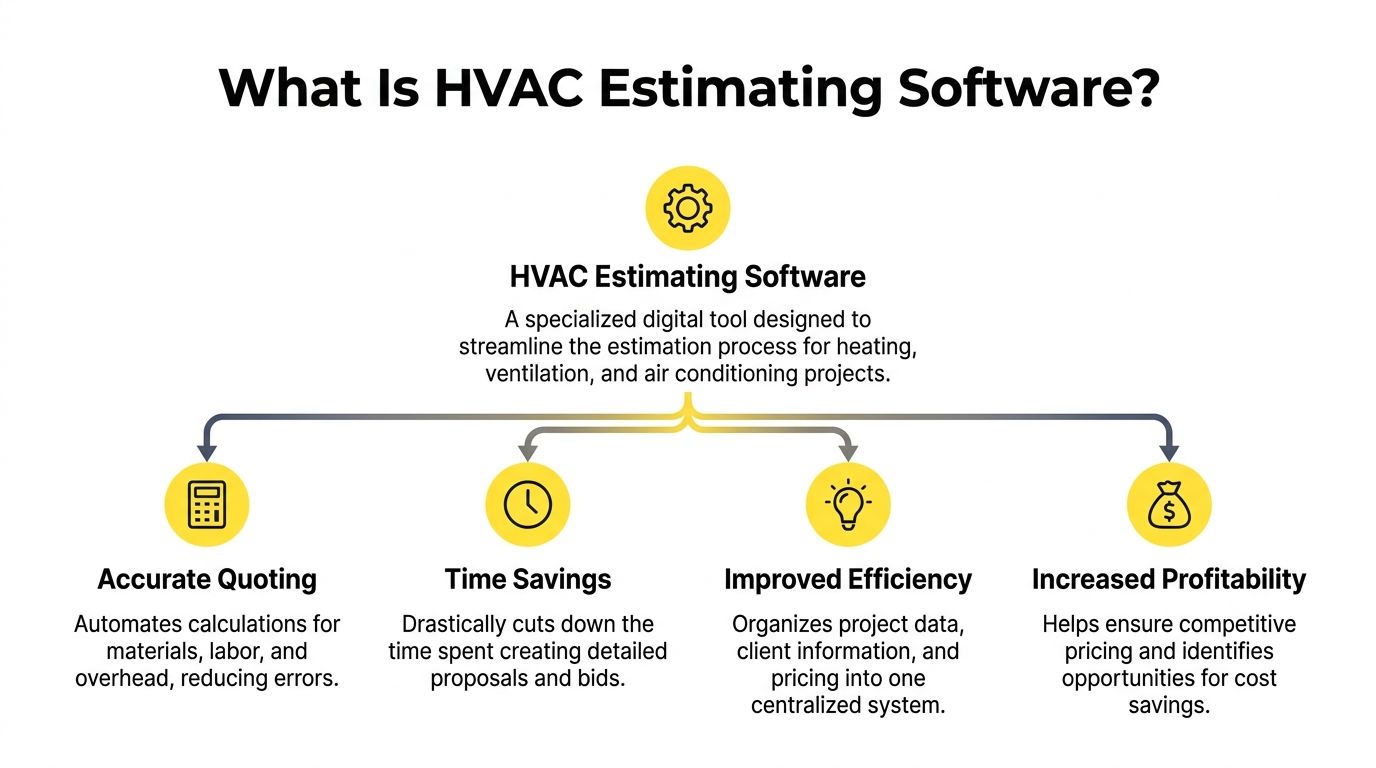
A calculator can total inputs.
HVAC estimating software decides which inputs matter, where they come from, and how they connect. It pulls together cost items that would otherwise sit in different places, such as price books, supplier lists, labor assumptions, job specifications, and scope details.
For an HVAC contractor, that can include things like ductwork, piping, equipment, fittings, and labor by task type. For another service business, the same logic might apply to room counts, square footage, surface types, travel time, urgency, or frequency.
At a practical level, the system usually handles several jobs at once:
That consistency matters because estimating is where many businesses accidentally create chaos. If sales, operations, and billing all use different assumptions, the customer experience gets messy fast.
This category didn’t become large by accident. The global HVAC estimating software market was valued at $1.15 billion in 2024 and is projected to reach $3.27 billion by 2033, with a 12.2% CAGR, according to Market Intelo’s HVAC estimating software market analysis.
That tells you something important. Contractors aren’t buying these tools because they’re trendy. They’re buying them because estimating has become too important, too frequent, and too complex to manage casually.
If you run a cleaning business, replace “duct layout” with “surface and scope logic.”
If you run landscaping, replace “equipment sizing” with “property conditions and service frequency.”
If you run plumbing, replace “load requirements” with “fixture counts, pipe runs, and labor conditions.”
Practical rule: The best estimating software doesn’t just make estimates faster. It makes them repeatable.
That’s the key idea owners from other industries can borrow from HVAC. Mature businesses don’t ask one employee to “just figure it out.” They build systems that turn business judgment into process.
The value of hvac estimating software becomes clear when you look under the hood.
These tools aren’t magic. They work because several specialized components feed the same estimating workflow.
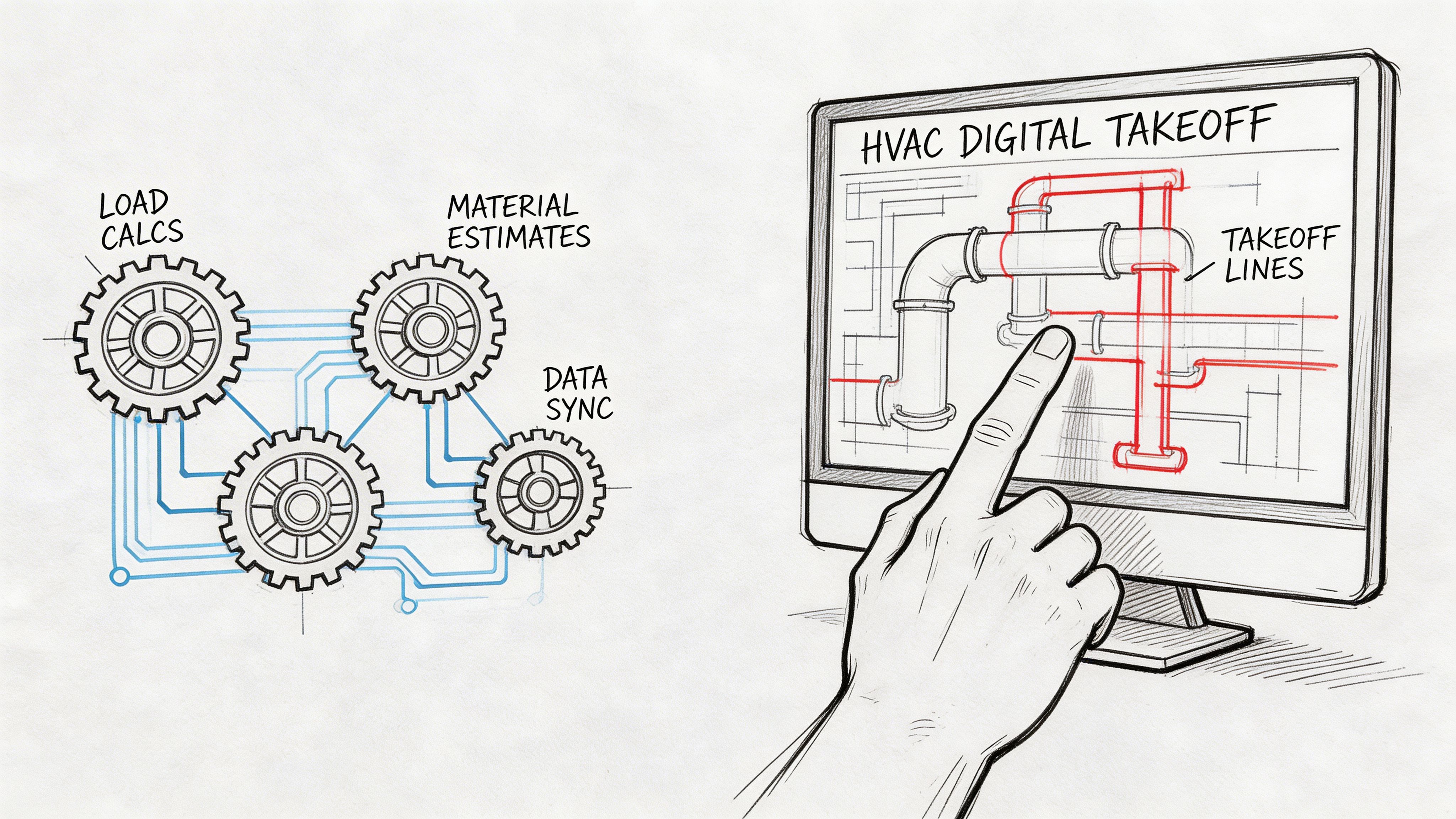
A digital takeoff is the step where software reads project plans and helps convert them into quantities.
In HVAC, that may mean tracing layouts from PDFs, CAD drawings, or BMP files to identify duct runs, piping, and related components. Instead of measuring everything by hand and re-entering it into another document, the estimator works from a single digital workflow.
That matters because small measuring mistakes don’t stay small. They ripple through labor, materials, and system design.
A cleaning company can learn from the same principle. You may not trace duct routes, but you still need a clean way to convert job scope into billable units. That could mean square footage, room types, floor surfaces, add-ons, or urgency. Different trade, same estimating discipline.
In HVAC, one of the most important technical layers is load calculation.
Professional HVAC estimating software combines automated load calculations with digital takeoff accuracy, allowing contractors to complete complex system designs in 15 minutes or less, using built-in ASHRAE and NEC procedure algorithms for compliance and precision, as described in this HVAC load calculation software comparison.
That’s a major leap from “best guess” estimating.
It also explains why HVAC software is such a strong model for other service industries. The mature version of estimating software doesn’t just list prices. It links operational reality to financial output.
For cleaning businesses, the equivalent isn’t load sizing. It’s service logic. How long does a first-time deep clean take versus a recurring maintenance clean? How does pet hair affect labor? What does a post-construction scope require that a routine home doesn’t?
If you want to see how that logic can be translated into a service-specific workflow, this resource on a cleaning estimate calculator is a helpful example: https://www.estimatty.com/blog/cleaning-estimate-calculator
The next engine component is the pricing database.
Advanced HVAC platforms maintain dynamic parts libraries, manufacturer pricing, labor standards, and custom specifications. The software can calculate bills of materials and labor cost breakdowns using those inputs instead of forcing estimators to rebuild pricing logic every time.
That fixes one of the oldest service-business problems. Two employees can look at the same job and price it differently because they’re pulling assumptions from memory, not from a shared system.
Here’s what a mature database usually controls:
A labor database is only useful if it reflects the team you can hire, train, and schedule.
That’s true in HVAC, and it’s just as true in cleaning. If your estimate assumes one level of speed and skill but your hiring pipeline produces another, your margins won’t hold. That’s one reason operational systems matter as much as sales systems. For cleaning companies thinking about that side of the equation, pipehirehrm.com is relevant because estimating assumptions and staffing reality have to stay aligned.
A quick visual may help tie these moving parts together:
The specific variables change by industry. The architecture doesn’t.
A mature estimating system in any service business should answer four questions reliably:
| Question | HVAC example | Service business equivalent |
|---|---|---|
| What is the job scope? | Ductwork, piping, equipment | Rooms, surfaces, service level |
| What resources are needed? | Materials and labor hours | Labor time, supplies, add-ons |
| What rules affect the work? | Design standards and specs | Service SOPs and pricing rules |
| What should the customer receive? | Accurate estimate with defined scope | Clear estimate with consistent pricing |
That’s the engine room. Accurate estimates come from structured inputs, not from faster typing.
An estimate has the most value when it doesn’t live alone.
In strong HVAC operations, the estimate becomes the first record in a connected workflow. The same job data moves through sales, scheduling, operations, and billing without being rebuilt from scratch each time.
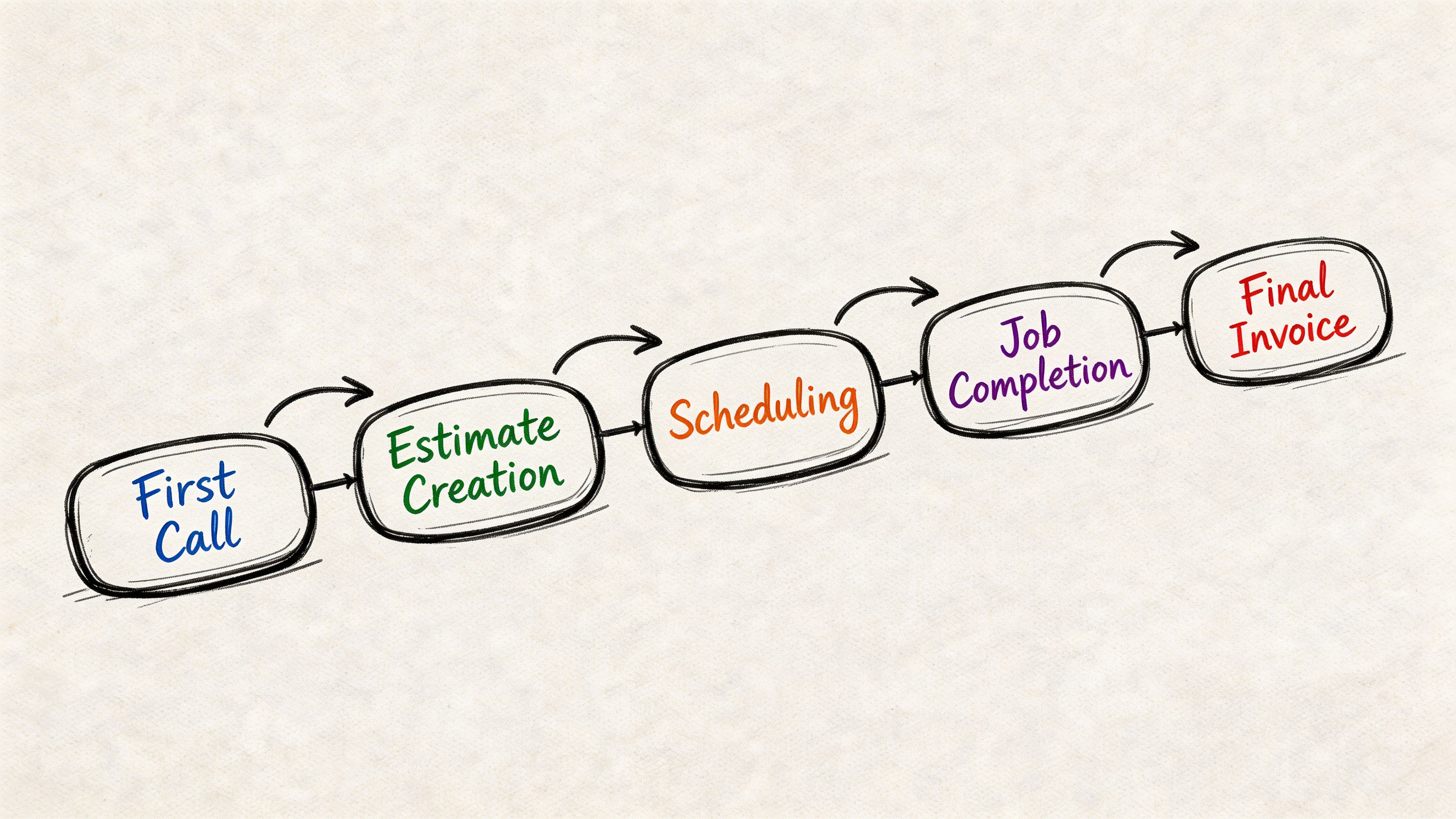
Start with a lead.
A customer calls an HVAC company about a replacement or installation. The office gathers project details. An estimator or sales rep builds the estimate inside the platform. The customer receives a professional document quickly. If approved, the same scope and pricing information flows into the next systems.
That handoff matters more than most owners think.
When teams manually re-enter estimate details into a CRM, dispatch system, or accounting tool, they introduce friction and mistakes. A line item gets skipped. A task gets scheduled without the right scope. The invoice no longer matches what was sold.
A mature business usually connects estimating with at least three other functions:
That’s why owners researching this space often end up looking beyond a narrow estimating tool and into broader systems. If you want a useful overview of that larger ecosystem, this guide to HVAC business management software adds context around how estimating fits into the full operating stack.
Here’s the process in plain language.
Inquiry comes in
The business captures customer details, service type, location, and scope signals.
Estimate gets built
Pricing logic, labor assumptions, and scope templates generate a consistent estimate.
Customer approves
The estimate becomes the basis for the job record, not a separate document nobody references later.
Work gets scheduled
Operations receives the same details sales used. Fewer surprises reach the field.
Invoice follows completed work
Billing starts from approved scope instead of from memory or handwritten notes.
A disconnected estimate creates admin work. A connected estimate creates operational control.
Owners in cleaning, plumbing, electrical, and landscaping should pay close attention here.
The best lesson from HVAC isn’t just fast estimating. It’s data continuity. The software should pass information forward so your team doesn’t duplicate effort.
That’s why integration choices matter early. A flashy estimate screen won’t solve much if your office still has to copy details into three other systems. Businesses evaluating how tools should connect can review common options here: https://www.estimatty.com/integrations
HVAC has clearer technical requirements than many service businesses, but the workflow pattern is universal.
A cleaning company can apply the same chain:
| Stage | HVAC workflow | Cleaning workflow equivalent |
|---|---|---|
| Lead intake | Project details captured | Customer scope captured |
| Estimate creation | Materials and labor calculated | Labor and service scope calculated |
| Approval | Proposal accepted | Estimate accepted |
| Scheduling | Crew and materials assigned | Team and visit assigned |
| Billing | Invoice generated from approved scope | Invoice generated from booked service |
Many owners stop thinking of estimating as a front-end task at this point. It becomes a system for reducing rework across the whole business.
The software can be excellent and still be the wrong fit if you choose the wrong delivery model.
For most businesses, the first decision is whether they want cloud-based software or on-premise software. That choice affects accessibility, upkeep, and how much technical burden the company carries internally.
In 2025, cloud-based solutions are increasingly favored for collaboration and accessibility, especially for businesses that need accurate labor and material costing without the burden of heavy internal IT support, according to Report Prime’s HVAC estimating software market overview.
That preference makes sense.
Service businesses don’t just estimate from one desk anymore. Owners review jobs from home. sales reps need mobile access. Managers need visibility without logging into a computer in the back office.
| Factor | Cloud-Based (SaaS) | On-Premise |
|---|---|---|
| Access | Available anywhere with login access | Usually tied more closely to company-managed environments |
| Setup | Faster to launch for many teams | Often requires more internal setup and support |
| Maintenance | Vendor usually handles updates | Business usually handles updates and upkeep |
| Collaboration | Better suited to distributed teams | Can be less flexible for remote collaboration |
| Control | Vendor-managed environment | More direct internal control over deployment |
| Scalability | Easier to expand as team needs change | Expansion may require more internal planning |
Software pricing can look confusing because vendors package similar products in different ways.
Here are the common models:
Some owners prefer a subscription because it lowers the barrier to getting started. Others prefer ownership-style models because they want predictability over the long term. The right answer depends on how your team works and how fast you expect your process to evolve.
Don’t start with features alone. Start with operating reality.
Ask:
If you’re comparing options across trades and not just HVAC, this buyer-oriented roundup can help frame the evaluation: https://www.estimatty.com/blog/best-estimating-software-for-contractors
Pick the software model that matches your operating style, not the one with the longest feature list.
Most owners don’t need to be convinced that better estimates would help.
They need a practical way to decide whether new software is worth the cost and disruption.
You can build the business case with a few basic questions.
You don’t need industry-wide averages to run this analysis. You need your own baseline.
A useful internal framework looks like this:
| ROI driver | What to examine |
|---|---|
| Time savings | Hours spent building and revising estimates |
| Margin protection | Missed line items, bad assumptions, inconsistent markups |
| Sales responsiveness | Delays between inquiry and delivered estimate |
| Admin reduction | Duplicate entry between estimating, scheduling, and billing |
The obvious return is speed. Faster estimates free up labor.
The less obvious return is consistency. A standardized system protects margins by preventing “close enough” pricing decisions from slipping into the sales process. It also makes training easier because new staff follow a framework instead of inheriting unwritten habits.
Some companies also see gains from customer experience. A clearer estimate reduces back-and-forth because the scope is easier to understand.
If you want to see how speed and consistency can affect revenue outcomes in a service business setting, this example is worth reviewing: https://www.estimatty.com/case-studies/company-sales-doubled-after-instant-estimates
Good software can still fail if the rollout is sloppy.
The biggest mistakes tend to be operational, not technical:
Most businesses do better with a staged launch.
Start with one service line, one office, or one estimator group. Test common job types. Refine pricing logic. Then expand. That approach creates cleaner feedback and fewer internal arguments.
The software doesn’t create ROI by existing. Your team creates ROI by using one pricing system consistently.
Owners who want more practical thinking on efficiency, sales process, and staffing can learn a lot by regularly reading both estimatty.com/blog and get.pipehirehrm.com/blog. The lesson applies across trades. Better estimates work best when the business around them is also structured.
Yes.
HVAC is useful because it’s demanding. If a software approach can handle technical design inputs, material complexity, and labor logic in HVAC, the underlying principles can usually be adapted to less technical service models.
What transfers best is the framework. Standardized inputs. Consistent pricing rules. Reusable scope templates. Connected workflows.
Usually, no.
Most HVAC platforms are built around trade-specific requirements like load calculations, ductwork, equipment specs, or piping detail. A cleaning business doesn’t need that overhead.
The better lesson is architectural, not literal. You want software built for your own estimating variables, using the same discipline HVAC companies apply in theirs.
They assume automation means generic speed.
Good automation is structured judgment. The tool should use your business rules, not replace them with random defaults. If your pricing logic is messy before implementation, the software will reproduce that mess faster.
Yes, but the main question isn’t whether AI is present.
More important is whether the software captures scope accurately, responds quickly, and keeps estimates consistent across channels. In some businesses, that may include conversational intake through web or voice. In others, it may mean smarter templates or cleaner data capture.
The technology matters less than the workflow outcome.
Start with these:
Standard pricing logic
Get labor assumptions, scope rules, and markups documented.
Consistent estimate format
Customers and staff should see the same structure every time.
Workflow connection
Make sure estimate data can move into scheduling or billing.
Ease of use
If the team avoids the tool, the project fails.
You’re ready when estimates depend too much on memory, when team members price similar jobs differently, or when turnaround time starts costing you opportunities.
That point often arrives earlier than owners expect.
Mature companies don’t leave estimating to improvisation.
They treat it as a system that protects margin, improves response time, and creates cleaner operations from the first customer inquiry through final billing.
If you run a cleaning business and want that kind of estimating discipline without forcing HVAC-style complexity into your workflow, Estimatty is built for that purpose. It helps cleaning companies deliver fast, consistent estimates through web and voice, capture scope details automatically, and keep pricing standardized around the clock.