September 29, 2026
Commercial and Residential Cleaning in 2026
Compare commercial and residential cleaning markets in 2026. Explore pricing, staffing, compliance, and how AI estimators streamline operations.

Saturday, February 14, 2026
Learn how to quote cleaning jobs with our expert guide. Discover pricing models and calculation methods to create accurate estimates that win clients.
.jpg)
Figuring out your pricing for a cleaning job boils down to a pretty straightforward idea: figure out your costs, add what you need to make, and give the client a clear number. But getting that process right is what separates the businesses that just get by from the ones that actually grow and make real money.
If you're still pricing jobs based on a "gut feeling," you're actively hurting your business. I've seen it happen time and time again. Without a solid system for your estimates, you're essentially gambling on every single job.
This isn't just about crunching numbers on a calculator; it's about the real-world impact of getting it wrong. Bid too low, and you're working for peanuts, burning out your team and wondering why you're not making any profit. Bid too high, and you're losing perfectly good jobs to the competition down the street. Neither path leads to a sustainable business.
Your goal should be to build a reliable, repeatable system that spits out a professional and competitive estimate every single time. It doesn't matter if you're a one-person show trying to make the most of your day or a growing company with multiple crews on the road.
A rock-solid estimating process builds trust from the moment a potential client gets in touch. It shows you're a professional who knows their stuff, not just another name they found online. To get a feel for how these numbers come together, you can play around with our house cleaning cost calculator and see these principles in action.
The global cleaning services market was valued at USD 415.93 billion and is expected to hit USD 616.98 billion by 2030. That’s a staggering amount of growth, which makes accurate pricing more critical than ever. You can dig into these industry trends on Grandviewresearch.com.
With the market booming like this, clients are getting smarter. They expect fast, clear, and fair pricing. The cleaning companies that can deliver a professional estimate quickly are the ones who are going to win the business, plain and simple.
Your system needs to account for everything—from your biggest expense, which is almost always labor (something platforms like Pipehire can help you manage), to cleaning supplies, insurance, and gas. This isn't just about winning the next job; it's about building a business model that can actually scale. For more tips on managing cleaning employees, you can check out resources on get.pipehirehrm.com/blog.
Your entire estimating process hinges on one crucial decision: choosing the right pricing model. This isn’t just about numbers; it’s about how clients see your value and how accurately you can forecast your own revenue. Get this right, and you're building a profitable business. Get it wrong, and you're just guessing.
The three heavy hitters in the cleaning industry are hourly, flat-rate, and per-square-foot pricing. Each has its time and place, and an experienced pro knows when to use which. Trying to force a one-size-fits-all model onto every job is a surefire way to either underbid and lose money or overbid and lose the client. This is your first real step away from random guesswork and toward a system built for growth.
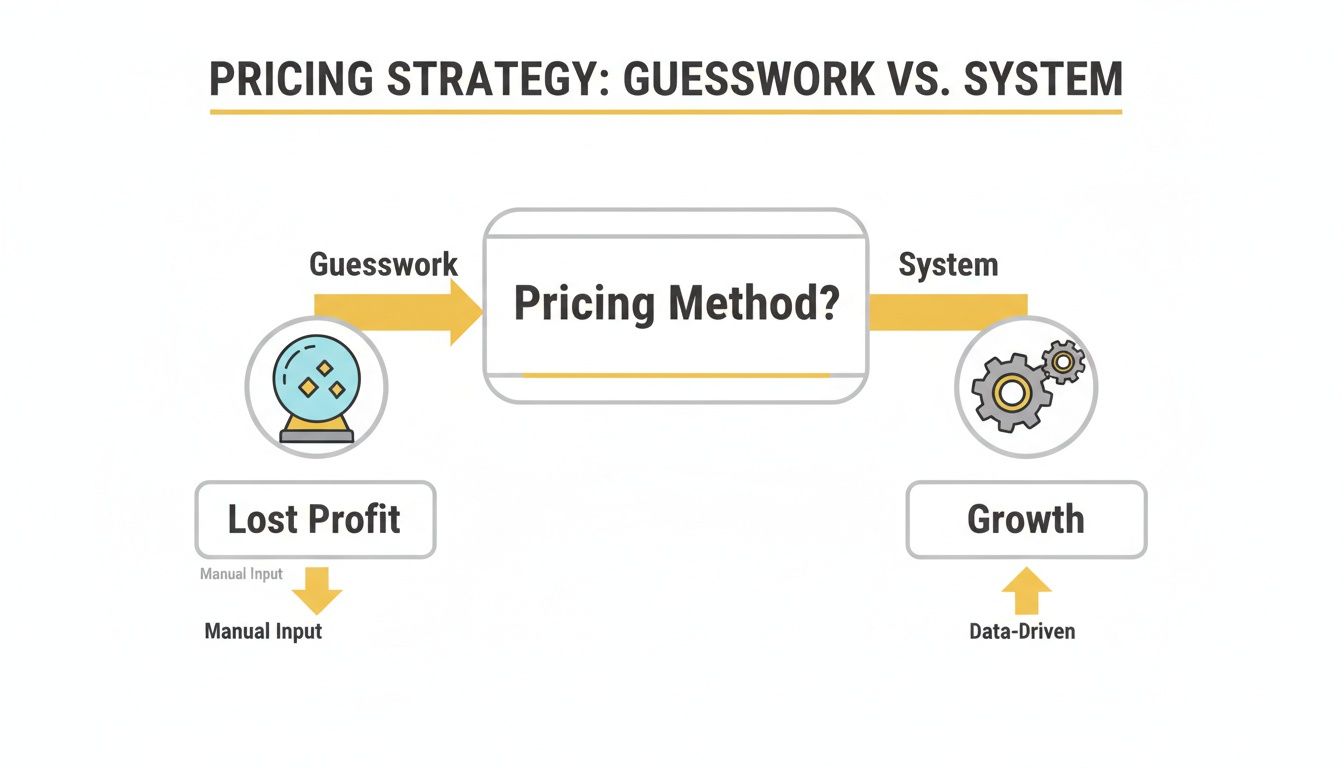
As you can see, a structured system is your direct path to predictable profits. Sticking with guesswork is like punching holes in your own bucket—you'll lose money every time.
To make this choice easier, here's a side-by-side look at the most common pricing models to help you pick the best fit for different cleaning jobs.
Each model has its place in a successful cleaning business. The real skill is knowing which tool to pull out of your toolbox for the job at hand. Let's dig into where each one shines.
Charging by the hour is your safety net for jobs full of unknowns. I'm talking about the post-construction cleanups where you have no idea how much drywall dust you'll be fighting, or the hoarder situations where the scope can explode once you start digging in.
This model guarantees you’re paid for every minute your crew is on-site. For a more detailed breakdown, you can check out our complete guide on how to price cleaning services, which explores these models even further.
For your bread-and-butter residential cleans, the flat-rate model is tough to beat. Once you’ve done enough jobs to know that a standard 3-bedroom, 2-bathroom house takes your crew about four hours, you can confidently package that service for a fixed price.
This approach is a client favorite because it’s transparent. They know the exact cost before you ever show up, which completely removes the budget anxiety that makes people hesitate. It makes saying "yes" a whole lot easier.
Flat-rate pricing also makes your sales process incredibly efficient. You can build out service packages—like "Standard Weekly Clean" or "Premium Deep Clean"—with set prices, allowing you to give potential customers an instant estimate and get ahead of the competition.
Walk into any conversation about preparing an estimate for a commercial space, and you'll be talking square footage. It’s the industry standard for a reason—it's the most logical and scalable way to price large, open areas like offices, warehouses, or retail storefronts.
Rates will naturally vary. A medical facility, with its stringent sanitation protocols, will always command a higher rate per square foot than a basic office building. This method gives your B2B clients a clear, justifiable pricing structure they understand and respect.
Profitability in this business isn't about landing the biggest contracts; it's about knowing your numbers on every single job. If you want to write an estimate that actually makes you money, you have to look past the final price and get real about your costs. That means accounting for every dollar spent on labor, supplies, and the one that gets forgotten most often: overhead.

So many new cleaning business owners fall into the trap of only pricing for their time on-site. They completely forget the hidden expenses that slowly but surely eat away at their profits. Breaking your costs down into these three buckets is the best way to make sure nothing slips through the cracks.
Let's be clear: labor is almost always your single biggest expense. Getting this number right is non-negotiable. It’s not just the hourly wage you pay your team; it’s the fully burdened labor cost.
That bigger, more accurate number includes things like:
A simple mistake here can flip a profitable job into a loss. To keep your numbers tight, integrating with accounting software like QuickBooks Online can be a game-changer for tracking and invoicing. There are also industry-specific platforms like pipehirehrm.com that are fantastic for managing payroll and HR, helping you keep these figures precise when you're hiring cleaning employees.
Next up are your supplies and equipment. While a single microfiber cloth or a splash of all-purpose cleaner might seem trivial, those costs add up fast across hundreds of jobs. You have to account for them.
The trick is to figure out a "cost per job" or "cost per hour" for your supplies. Start tracking how long a bottle of your primary disinfectant lasts or how many jobs you get out of a pack of sponges. This gives you a working average. And don't forget to factor in the wear and tear on your big-ticket items like commercial vacuums, carpet extractors, and floor buffers.
Pro Tip: I've found it's easiest to add a small percentage—say, 3-5% of the job's total labor cost—to every estimate just to cover supplies. It’s a consistent and scalable way to make sure these costs are covered without having to do complex math on every single estimate.
Overhead is all the stuff you have to pay for just to keep the lights on, even when your team isn't actively cleaning. These are the "hidden" costs that are so easy to forget but can absolutely sink your business if you ignore them. If you're just getting your feet wet, a good cleaning estimate template can be a lifesaver to ensure you've covered all your bases.
What falls under overhead?
The simplest way to build this into your pricing is to calculate your total monthly overhead and divide it by the total number of billable hours your team works in a month. This gives you an hourly overhead rate that you must add to every single hour you bill just to break even. This is the final piece of the puzzle, giving you a true financial baseline to price your services for actual, sustainable growth.
Alright, you've crunched the numbers and know exactly what it costs to do the job. Now for the most important part—the part that actually grows your business: adding your profit margin.
This isn't about being greedy. It’s the lifeblood of your company. Profit is what pays for that new commercial-grade vacuum, funds your next marketing push, and ultimately, builds a business that can sustain you and your team.
So, what's the magic number? Well, it really depends on your market, the services you offer, and how you've positioned your brand.
For residential cleaning, a healthy profit margin usually lands somewhere between 20% and 35%. Commercial jobs, with their larger scale and longer contracts, often work well in the 15% to 30% range.
But don't just pull a number out of a hat. Think about the value you bring to the table. If you've invested in top-tier training for your crew and specialized eco-friendly supplies, you've earned the right to charge a higher margin than the new guy on the block. Your expertise has real value.
Once you have your final price, how you present it can make or break the deal. A quick text with a number is easy for a potential client to ignore or haggle over. A professionally drafted estimate, on the other hand, immediately builds trust and starts selling your service for you.
Think of your estimate as a critical marketing tool. It’s your first real chance to show them you’re a serious, reliable professional. Investing time in properly branding your service is a huge piece of this puzzle, as it shapes how clients perceive your value before they even see the price.
A truly compelling estimate needs to have a few key things:
Your estimate shouldn't just be a bill sent in advance. It should be a document that screams value, anticipates their questions, and gives them the confidence to hire you on the spot.
This level of detail is non-negotiable when you're bidding on commercial jobs. The contract cleaning services market is a behemoth, valued at a staggering USD 417.71 billion, and it's still growing.
These clients aren't just looking for the cheapest price; they're looking for a reliable partner. A detailed, professional proposal shows them you understand the scope and have a solid plan to deliver.
Ultimately, a great estimate does more than just win a single job. It sets the tone for a fantastic client relationship built on clarity and trust. This is exactly how one cleaning business discovered their sales doubled after implementing instant estimates—they made it professional and easy to say yes.
Let’s be honest. Creating estimates by hand is slow, full of potential errors, and it's actively costing you business. For every hour you spend on-site measuring a property or plugging numbers into a spreadsheet, a competitor with a slicker system is snagging that same lead in real-time.
Today's customers want one thing: speed. If they have to wait for you to call them back, they’ve already found someone else. It's that simple.
This is where you need to let technology become your best salesperson. Imagine a system that’s on the clock 24/7, engaging potential clients the second they land on your website. This isn’t some pie-in-the-sky idea; it’s a practical growth strategy that the sharpest cleaning companies are already putting to work.

Manual estimates create a massive clog in your workflow. You're either out on a job and can't pick up the phone, or you're burning the midnight oil just to catch up on paperwork. This isn't just inefficient; it's inconsistent. Prices start to vary depending on who's writing the estimate and how swamped they are at that moment.
That inconsistency doesn't just cost you money—it chips away at your professional reputation. You're stuck reacting to new business instead of proactively chasing it.
This is exactly the problem tools like Estimatty's AI-powered estimator were built to solve. It gives potential clients an instant, accurate estimate, no matter the time of day. Think about it: a hot lead lands on your website at 10 PM on a Saturday. Instead of getting a "we'll call you back" message, they receive a precise, professional estimate on their phone in under a minute.
This kind of tech completely flips the script. Here’s how:
This move toward automation is essential for grabbing your piece of a massive pie. The U.S. janitorial services industry is on track to hit USD 112.0 billion in revenue, and niche cleaning services are growing even faster. To compete in this market, you need the speed and precision that only automation delivers. You can dive deeper into these janitorial industry projections on IBISWorld.com.
Automating your estimating process isn't just about being faster. It’s about building a modern, frictionless customer experience from that very first interaction. It means you never miss another lead because you were busy, asleep, or finally taking a well-deserved vacation. This is how you build a business that scales—one that wins the job before your competitors even know there’s a job to win.
Even with a rock-solid system, questions are going to pop up. Think of refining your estimates as an ongoing project, not a one-and-done task. Learning to handle these common situations is how you build a more profitable, efficient, and stress-free business.
Let’s dive into the real-world questions I hear from cleaning business owners all the time. Getting comfortable with these scenarios will not only make your sales process smoother but will also give you the confidence to lead any client conversation.
It's inevitable. A potential client will ask, "Can you do it for less?" The absolute key here is to never, ever devalue your service by just dropping the price. That's a race to the bottom.
Instead of caving and saying, "Sure, I can knock $20 off," you need to reframe the conversation. Try this: "I can definitely work within that budget. To get the price down to that number, we could, for example, skip the guest bedroom and focus on the main living areas this time around. How does that sound?"
See what happened there? You shifted the discussion from being about your price to being about their priorities. You hold firm on your value while still offering a flexible solution that meets their needs. It’s a win-win.
We've all been there, especially when we were starting out. You're halfway through a job and that sinking feeling hits—you completely misjudged the time and effort this would take. It happens.
First thing's first: you have to honor the price you estimated for that initial cleaning. Chalk it up to a learning experience.
Treat it as a paid lesson. Once the job is done, take a hard look at your numbers and figure out exactly where you went wrong. Was the home far dirtier than you anticipated? Did you forget to factor in the three golden retrievers? Use that fresh data to make your next estimate sharper.
If you’ve landed a recurring client, you have a perfect opportunity to adjust. After that first clean, you can approach them and say, "Now that we've completed the initial deep clean and have a true sense of the home, the ongoing maintenance cleans will be 'X' price. This ensures we can deliver the high-quality results you expect every single time." Most reasonable clients will understand completely.
Yes. 100% yes. Any task that falls outside your standard cleaning checklist is a special request, and that means it's an upsell—not a freebie.
These requests need to be treated as distinct add-on services with their own clear, pre-determined pricing.
When you present your initial estimate, make these popular add-ons clearly visible. This makes it easy for the client to customize their service and, more importantly, it increases the total value of the job for you. For more complex staffing challenges that come with specialized jobs, you might find valuable insights on platforms like pipehirehrm.com.
Ready to stop losing leads to slow, manual estimates? Estimatty gives your cleaning business a 24/7 AI-powered sales agent that delivers instant, accurate estimates to customers the moment they reach out. See how you can win more jobs and automate your growth at https://www.estimatty.com.