September 29, 2026
Commercial and Residential Cleaning in 2026
Compare commercial and residential cleaning markets in 2026. Explore pricing, staffing, compliance, and how AI estimators streamline operations.
Sunday, February 22, 2026
Thinking about how can I start my own cleaning business? Follow our guide to build a million-dollar company with a growth mindset from day one.
.jpg)
So you want to start a cleaning business. Forget about buying mops and vacuums for a minute. The real first step—the one that separates a side hustle from a seven-figure enterprise—happens entirely in your head.
This guide isn't about how to find a few clients to replace your day job. It’s about building a genuine company with a growth mentality, one designed for serious scale from the very beginning with $1M+ in sales in mind.

If you're asking, "how can I start my own cleaning business?", let’s get one thing straight. You have to decide right now: are you a cleaner who owns a business, or a business owner who happens to be in the cleaning industry?
The difference is everything. One builds a job that never ends. The other builds an empire.
When you think like a business owner with a growth mentality, your entire perspective shifts. You stop seeing individual cleaning jobs and start seeing systems, scalability, and brand value. You're not just scrubbing floors; you're engineering a well-oiled machine built for predictable, repeatable growth.
Your long-term vision needs to be bigger than just filling up your personal calendar. Plan for the day your schedule is overflowing and you desperately need your first hire. Thinking about this now forces you to create simple, repeatable processes that someone else can actually follow.
This is all about strategic foresight. What does your business look like when it hits $1M+ in sales? It's definitely not just you with a bucket and a dream. It’s a full-fledged operation with:
The founders who truly make it don't just put out today's fires; they build the fire station to prevent tomorrow's emergencies. Your job is to work on the business, not just in it.
A business that can actually grow is built on repeatable systems, not your personal hustle. Every single thing you do, from how you answer the phone to the exact steps of a deep clean, should be documented in a Standard Operating Procedure (SOP).
Why is this so critical? Because when you bring on your first team member, you won't be teaching them "how you do it." You'll be training them on "how we do it." That tiny change in language signals a massive shift in mindset. For a real-world look at how one cleaning team built their own automated sales system, check out the story behind Estimatty on the estimatty.com/blog.
At the end of the day, you’re building a brand that high-value clients trust, backed by a team that delivers consistent quality, and powered by systems that make growth feel inevitable instead of overwhelming. This is the bedrock of a seven-figure cleaning business.
A million-dollar vision is one thing, but it needs a rock-solid foundation to actually support it. This is where you build the legal and financial framework that protects you, your assets, and your future. If you're serious about scaling beyond a few clients, getting this right from the very beginning isn't just important—it's everything.
Your first big decision is your business structure. I know it's tempting to just run as a Sole Proprietor because it's so simple. But that's a rookie mistake. It leaves your personal assets—your house, your car, your savings—completely exposed if something goes wrong. For anyone aiming to build a $1M+ company, that's a risk you just can't afford to take.
The real conversation starts with two options: the Limited Liability Company (LLC) and the S-Corporation (S-Corp). Both create that critical legal wall between your business and your personal life.
Honestly, starting as an LLC is the perfect move. It gives you the protection you need without the administrative headache. You can always elect to be taxed as an S-Corp later without having to tear down and rebuild your whole company structure.
Think of insurance as more than just a safety net; it's a powerful sales tool. High-end residential and big commercial clients won't even look at your estimate without seeing proof of insurance. It immediately tells them you're a serious, professional operation.
You’re not just buying a policy; you're buying credibility. Being fully insured and bonded is a key differentiator that lets you confidently chase those larger, more lucrative contracts.
Here’s the bare minimum you need to have in place:
Okay, with your legal and insurance shields up, it's time to get your money organized for growth. Mixing your personal and business funds is a classic recipe for chaos. Don't do it.
Go open a dedicated business bank account. Today. This single step will make bookkeeping a breeze, simplify your life immensely at tax time, and make you look professional to clients.
Next, you need to map out your startup budget. The great thing about the cleaning industry is that you don't need a fortune to get started. Many entrepreneurs get off the ground for $2,000–$6,000, which covers essentials like initial equipment, licenses, and insurance. From there, project your cash flow for the first six to twelve months. Plan for your expenses, of course, but also plan how you'll reinvest your profits back into the business to fuel growth.
We get into the nitty-gritty of pricing in our guide on how much to charge for cleaning services. This blueprint—legal, insurance, and financial—is the launchpad for your seven-figure journey.
If you want to know the fastest way to run your new cleaning business into the ground, I’ll tell you: compete on price. It’s a guaranteed race to the bottom, leaving you with burnout, nightmare clients, and absolutely no room to grow. The million-dollar cleaning companies out there aren't just mopping floors; they strategically picked a profitable niche and owned it.
Trying to be a generalist who cleans "anything for anyone" instantly makes you a commodity. You don't want that. Instead, you need to become a specialist—the undisputed expert for a specific type of client with a specific, high-value problem. That's how you find your unfair advantage.
Look, standard house cleaning is a perfectly fine place to start, but the real money is in specialization. You need to start thinking about markets that are either underserved or have messy, complex needs that most general cleaners won't touch.
These niches almost always command higher rates. Why? Because the client sees it as a bigger risk, and the job requires a more advanced skillset. This is your opening to build a reputation that justifies a premium price tag.
Here are a few high-margin specializations I've seen explode:
Let's look at how the numbers stack up when you choose a niche. This isn't guesswork; it's about making a smart financial decision from day one.
This table breaks down the real-world financial upside of specializing. Notice how both the potential profit and the hourly rates jump significantly compared to basic residential cleaning.
As you can see, focusing your efforts on a high-demand, high-skill niche directly translates into a much healthier bottom line. It's the difference between building a job for yourself and building a real, scalable business.
Once you’ve got a niche in mind, it's time to get hyper-specific about your Ideal Customer Profile (ICP). This isn't just some vague concept like "property manager" or "homeowner." You need a crystal-clear picture of the exact person or business you’re built to serve.
Get granular and ask yourself:
The answers to these questions become your value proposition. It’s the core promise you make to your clients. It’s not "we clean well." It’s "we guarantee your Airbnb is five-star guest-ready in three hours, every single time" or "we ensure your new construction passes the final walkthrough with zero cleaning items on the punch list." See the difference?
This chart offers a practical breakdown of where your initial investment should go for a business that's built for growth from the start.
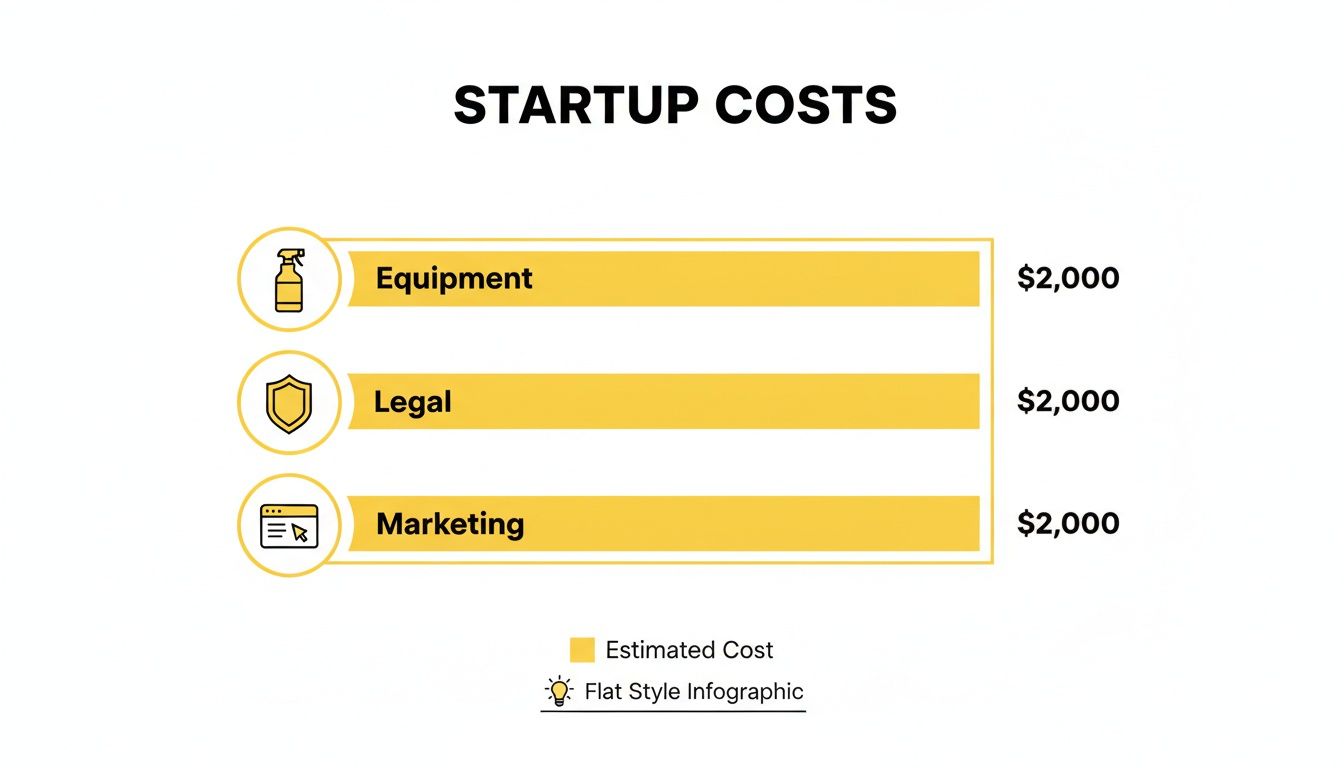
As the infographic shows, a smart budget doesn't just focus on mops and buckets. It allocates funds evenly between the tools you need to do the job, the legal framework to protect your business, and the marketing engine to bring you paying clients.
When you combine a profitable niche with a powerful value proposition, you stop being just another name on a long list of cleaning services. You become the only logical choice for your ideal customer. This focus is the true foundation for building a strong brand and, more importantly, a business that can scale well past that seven-figure mark. To get a head start on the sales process, check out this guide on how AI sales automation for cleaning services can help you win clients in your niche.
Look, you can be the best cleaner in the world, but if your phone isn't ringing, it doesn't matter. To build a $1M+ cleaning business, you need more than just great skills—you need a reliable, predictable system for bringing in a steady stream of high-value clients.
This isn't just about "getting your name out there." It's about engineering an automated engine that attracts leads and closes jobs, often while you're busy running the rest of the business.
Your professional website is the heart of this engine. Think of it as your digital storefront and your best salesperson, working tirelessly 24/7. A cheap-looking site screams cheap service. From day one, your website needs to be clean, easy to navigate, and instantly tell your ideal customer why you're the right choice.
But it has to do more than just look pretty. It needs to be a lead-generating machine. That means having clear calls-to-action, glowing testimonials, and a dead-simple way for potential clients to get a price and book your service. Fast.
For a local service business, being visible when people search nearby is everything. This is where Local Search Engine Optimization (SEO) becomes your most powerful free marketing tool. When someone in your town Googles "office cleaning services near me," you absolutely have to be on that first page.
The cornerstone of your local SEO is your Google Business Profile (GBP). It's a free listing that is critical for showing up in the local map results. Optimizing it is straightforward but absolutely essential:
Getting a handle on SEO is one of the fastest ways to attract your first clients and build momentum. To really get this right, check out this guide: Your Ultimate Guide to Small Business SEO.
Here's a hard truth every founder needs to hear: if you want to grow, you are the biggest bottleneck in your own sales process. Every minute you spend on the phone giving a ballpark estimate, typing a custom email, or playing phone tag is a minute you're not spending on tasks that actually scale the business.
The goal is to remove yourself from the day-to-day process of providing estimates.
This is where automation gives you a massive advantage. Modern tools can handle the entire journey from a curious visitor to a booked job, all without you lifting a finger.
The secret to scaling is to stop trading your time for leads. When you automate your estimates and bookings, you guarantee that every single lead gets an instant, professional response—even at 2 a.m.
Tools like Estimatty are built for exactly this. They turn your website from a passive brochure into an active sales agent. When a potential customer lands on your site, they aren't forced to fill out a clunky form and wait for you to call them back. Instead, an AI-powered agent engages them, asks the right questions, and gives them a precise, professional estimate in under 60 seconds.
This kind of system is a game-changer for a few key reasons:
By putting these systems in place, you finally shift from being an operator in the business to an owner who works on the business. You build a client acquisition engine that fuels your growth, freeing you up to focus on the million-dollar tasks: hiring great people, perfecting your services, and planning your next big move. To learn more, see our guide on using the right house cleaning booking software to put your growth on autopilot.

Here’s a hard truth: real growth kicks in the moment your business doesn't need you holding the mop, giving the estimates, or shuffling the schedule. This is the big leap from being a founder to becoming a CEO. It’s when you finally stop working in your business and start working on it.
Getting there isn't about working harder—it's about building systems. Without them, you haven't built a business; you've just bought yourself a much more stressful job.
The first, most critical step to getting out of the day-to-day grind is creating a playbook that anyone on your team can pick up and run with. These are your Standard Operating Procedures, or SOPs. Think of them as the DNA of your business—they’re what guarantee quality and consistency, no matter who's on the job.
Your goal is to get every core process out of your head and onto paper (or a screen). This isn't a vague to-do list; it's a detailed, step-by-step guide for everything.
Your business needs to run on systems, not your memory. An SOP isn’t just a boring document; it’s the tool that empowers your team to make the right call without having to text you first.
Hiring is the ultimate growth hack. The right people will free you up to focus on what really moves the needle—sales, strategy, and expansion. The wrong people? They'll drag the whole operation down with them.
That’s why you need a clear, repeatable hiring process, especially if you have a $1M+ growth mentality. Vetting, interviewing, and onboarding can't be improvised. Using a dedicated platform like pipehirehrm.com, which is built for the cleaning industry, can put this entire workflow on rails, helping you find and manage top-tier cleaning techs.
The cleaning market is massive and projected to hit $46 billion by 2026. Yet, a staggering 55% of commercial clients jump ship every year due to bad service. This is a golden opportunity for reliable, system-driven companies to clean up.
Once you have a team in the field, you need a simple way to make sure the work is still done your way. Quality control doesn't have to be complicated or time-consuming.
Try starting with these simple systems:
Beyond just quality, you have to know your numbers. I'm talking about the Key Performance Indicators (KPIs) that tell you the real story of your business's health.
Tracking these numbers gives you a clear dashboard for your business. Once you've got a solid foundation, you can really dig into how to scale a service business the right way.
Putting these pieces together—SOPs, a rock-solid hiring process, and a close eye on your KPIs—is how you build a business that can run without you. That's what frees you up to be the visionary CEO your company needs to hit that seven-figure mark. For a deeper look at the tools that can help, check out our guide to the best cleaning business software to manage these critical operations.
As you start laying the groundwork for your seven-figure cleaning empire, the questions that keep you up at night won't be about which microfiber cloth is best. They'll be about the make-or-break decisions that separate a side hustle from a scalable, professional enterprise.
Let's dive into the most common questions I hear from ambitious founders—the ones who are thinking about hitting $1M+ from day one. These are the straight answers you need to get it right from the start.
Sure, you can find articles telling you how to start with less than $2,000. But if you’re serious about building a real company, that's not the mindset you need. For a business with a seven-figure trajectory, you should be prepared to invest somewhere in the $5,000 to $10,000 range.
Why so much more? Because you're not just buying cleaning supplies. This is a strategic investment in a rock-solid foundation.
This budget allows you to cover the things that truly matter for scaling:
Think of it this way: you’re building a launchpad, not a dinghy. Investing upfront means you're ready for explosive growth, not stuck patching holes later.
This might surprise you, but the quickest path to a million-dollar business often starts in the residential space. It seems counterintuitive, but here’s why it works: residential cleaning lets you build a base of predictable, recurring revenue while you iron out your systems in a lower-stakes environment.
Consider it your real-world training ground. You’ll master scheduling, perfect your quality control checklists, and dial in your client communication on a manageable scale.
Once your residential division is running like a well-oiled machine, you can use that stable cash flow, proven expertise, and glowing reputation to aggressively pursue much larger and more profitable commercial contracts. It’s a phased approach that builds momentum and minimizes risk.
Here’s the golden rule: start the hiring process the moment you are consistently at 70-80% of your own cleaning capacity. Do not wait until you’re completely swamped and turning away work.
Waiting until you're drowning is a recipe for disaster. It forces you into rushed, desperate hires that almost never work out. When you start the search early, you give yourself the breathing room to properly screen candidates, check references, and train them to meet your high standards. Look into platforms designed for our industry, like pipehirehrm.com, which can help you find quality cleaning technicians.
Your first hire is the single most important step you'll take in shifting from being a cleaner to owning a cleaning business. It’s the move that finally frees you up to focus on sales, marketing, and strategy.
Without a doubt, the most damaging—and common—mistake is underpricing your services to land those first few clients. It’s a trap. Doing this sets a dangerous precedent for low-margin work that makes it practically impossible to scale, pay great employees a competitive wage, or invest back into your own growth.
From the very first estimate you send, you must price for profit. You have to know your numbers inside and out, building a formula that accounts for all your costs: labor, supplies, insurance, software, marketing, and a healthy profit margin on top.
This is where having a disciplined system becomes your superpower. An AI-powered tool like Estimatty acts as your gatekeeper, applying your profitable pricing rules to every single inquiry, 24/7. It ensures every estimate is consistent and protects your margins. It removes that all-too-human temptation to offer a "special deal" that ends up costing you in the long run.
Ready to build an automated sales engine that delivers profitable estimates around the clock? With Estimatty, you can stop being the bottleneck in your own growth and start converting leads into booked jobs while you sleep. Learn how Estimatty can transform your sales process today.